
How to Use Agentic AI for Business Process Automation

Your board has asked what AI has changed. The answer they need is a cost line that moved: service hours no longer spent on requests that repeat every week, or a software module that didn't renew.
AI is a board level mandate. It is not yet an operating model. Turning agentic AI for business process automation into that operating model takes a sequence your CIO can sign off on.
Start with one process. Choose it for its economics, then map, govern and measure it. Put it into production before the next one starts
See How Agents Differ From Rules-Based Automation
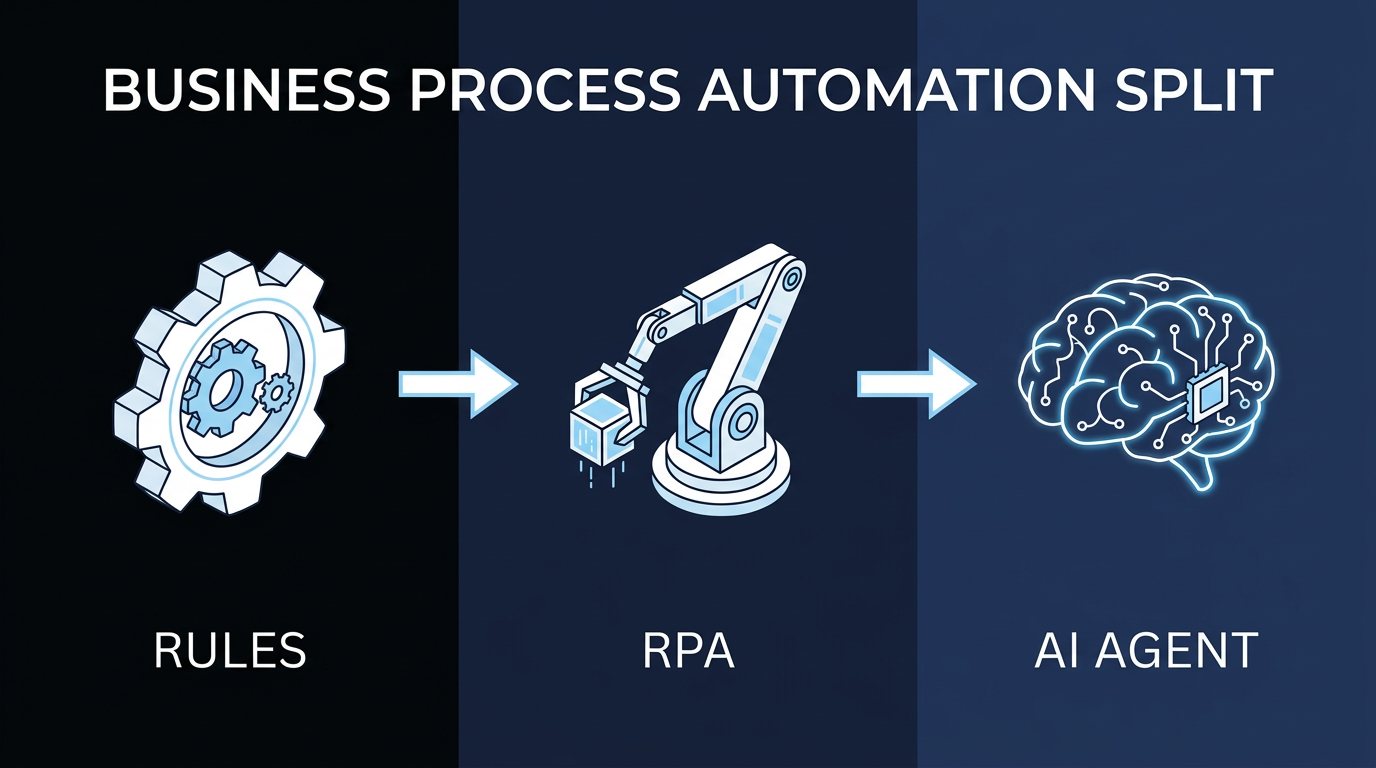
Rule-only automation and robotic process automation (RPA) execute explicit instructions, so they can break on inputs their designers never anticipated. An AI agent can interpret an unstructured request. Agentic AI for business process automation places AI agents at the specific steps where reading or reasoning adds value. Fixed business rules handle steps that need consistency, and people handle judgment.
The split between rules, RPA and AI agents has a fuller side-by-side comparison of its own.
Step 1: Choose the First Process by Its Economics
The first process decides whether the program earns a second one. Pick it on numbers you can already measure: high monthly volume and a cost per request you can baseline today. Look for an event that marks the work as done and one bounded step where someone reads and interprets before acting.
High volume makes the case for automating the process, and the reading step is what justifies putting an AI agent inside it.
Employee IT requests meet all four criteria, and they're the example carried through each step here. Password resets, software access and laptop issues arrive in large numbers. They follow policies that rarely change and close on a clear event.
The AI agent's job is to read the request. Policy stays with the rules. Because the requesters are employees, errors stay inside the company, where the team can spot and reverse them.
You choose the process and name one accountable owner, usually the CIO or the head of the service desk. That team pulls last quarter's ticket volume, cycle time and cost per case, so the first result has a baseline to beat.
Step 2: Map Every Step, System and Handoff
An undocumented handoff can stall an automated process. Map the work as it actually runs, not as the procedure manual describes it. Capture every step, the system it touches and who hands what to whom.
Include the exceptions. Record what pulls someone off the standard path.
For example, an access request might arrive by email, portal or chat. It then sits in a queue until a service desk analyst triages it. Someone checks it against the approved software list, and a manager approves it from an inbox.
The work finishes with provisioning in the identity directory and closure in the IT service management system. Each wait in that chain is a candidate for removal. Each system boundary marks where the automated version needs an integration.
Your decision here is whether to automate the current path or redesign it. Automating a weak process gets you a faster weak process. Your team should flag steps that exist only because two systems don't talk. Count the rework, including labor spent on exceptions, alongside the standard path.
Step 3: Assign Each Step a Rule, Agent or Person
Every step in the map gets one owner. Logic that must run the same way every time goes to a business rule, reading and classifying go to an AI agent, and a person keeps judgment and sign-off. The wrong owner costs either money or control.
For the IT example, the assignment might look like this:
| Step in the IT request | Owner | Why |
|---|---|---|
| Classify the incoming request | AI agent | Free-text input with variable wording |
| Check entitlement against the approved software list | Business rule | One correct answer every time |
| Provision standard software through the identity system | Automated logic | Fixed action through an API |
| Approve licensed software above a cost limit | Manager | Spend decision with clear accountability |
| Handle admin-rights or production-change requests | Engineer | High risk, hard to reverse |
The split has a cost consequence. Rules don't call models. Reserving the AI agent for classification ties model spend to the step where reasoning changes the outcome. That is the core of the deterministic versus probabilistic decision.
You approve which decisions stay human. Your CIO's team confirms that each automated step runs through a native integration rather than a bot clicking through screens.
Step 4: Set Thresholds and Escalation Before Go-Live
Set decision thresholds and escalation paths before anything runs. A threshold added after an incident comes too late for the cases it missed.
The workflow decides when a person steps in through human-in-the-loop checkpoints. An AI agent's output can't skip an approval or route around a reviewer.
In the IT example, a request outside the AI agent's classification threshold goes to a named analyst. The analyst receives the original message and the agent's reasoning. Any request touching administrator rights goes to an engineer regardless of the classification. An approval left untouched past its deadline escalates to a backup reviewer.
These design choices are governance controls. The National Institute of Standards and Technology (NIST) AI Risk Management Framework asks that "Processes for human oversight are defined, assessed, and documented" (MAP 3.5). It also calls for distinct roles for human-AI configurations (GOVERN 3.2) and mechanisms to supersede, disengage or deactivate an AI system (MANAGE 2.4).
In Elementum's Workflow Engine, the process definition includes approval checkpoints and exception routing to a named reviewer. A run doesn't advance until the approval lands. These controls stay in place as the AI agent takes on more requests, because higher volume raises the stakes of every ungoverned decision.
Step 5: Instrument the Process Before It Runs
Define the logs and the measures before go-live, because a result without a baseline won't survive the CFO's first question.
Log Every Run
Record which AI agent the workflow invoked, which workflow ran and what result it produced. Record who approved what, with reviewer identity and timestamps.
Processes should track, respond to and recover from incidents and errors, as NIST's MANAGE 4.3 guidance calls for. A run log supplies the evidence those processes depend on. Elementum logs every AI determination and makes each one citable, and every agent action can be revoked.
Turn Four Measures Into a Cost Line
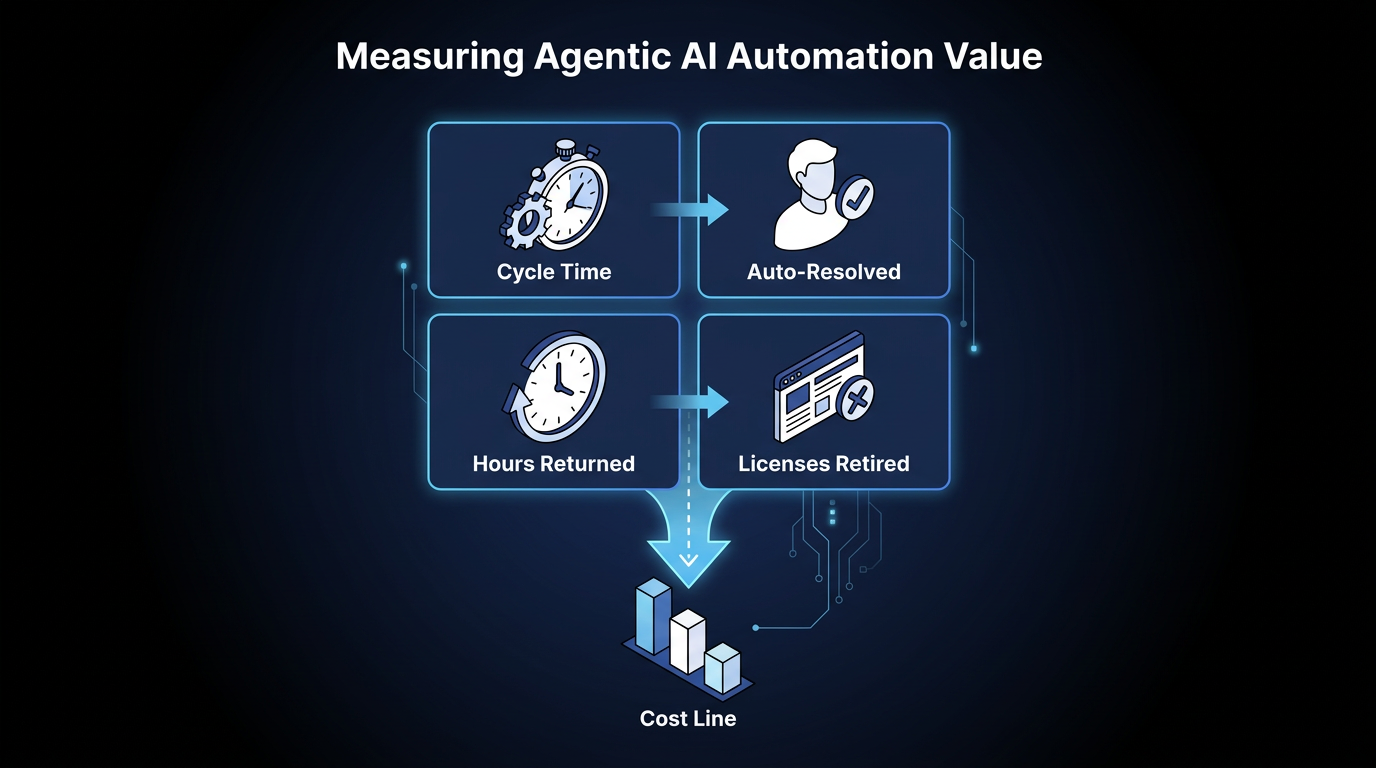
Four measures turn the IT example into numbers finance can use: cycle time per request, the share resolved without a person, service hours returned, and software licenses retired. For the second measure, track Tier-1 tickets resolved with no human touch.
Use your own baseline. That's the number your board will hold you to.
Hours returned reach the profit and loss (P&L) statement only when they remove a cost. That could mean contractor or outsourced service desk hours you stop buying, or a backlog you clear without adding staff.
Name the cost. Licenses retired work the same way. When employees stop using the ticket portal module that handled those requests, you can decline that module at renewal. Your IT service management system stays the source of record.
Define "the expected P&L impact, baseline, KPIs, owners, and value logic before a project goes live," as BCG recommends in its guidance for CEOs on scaling AI value. Write the target line down before launch. That moves the board conversation from adoption counts to a named line that changed.
Step 6: Prove One Process, Then Fund the Next
Run one process in production before starting a second. Real requests and approvals must run through it. A pilot in a test environment tests whether the AI agent can classify a request.
Production lets you measure whether the cost line moves. Elementum builds the first application with your team and puts it into production.
Verified savings from that first process can help fund the next. Audit the actual return from that first process before committing its savings to new agentic AI investment. That keeps the next budget tied to costs you've removed.
Once the IT process has a verified number, reuse the same rules-agent-person split, threshold design and logs. Apply them to HR service requests or finance queries.
Sanofi is taking that path with employee IT support. Its chief digital officer plans to run those workflows directly on the company's own data lake with Snowflake and Elementum, rather than adopt the agents SaaS vendors pitch, Fortune reported.
Extend once results repeat under those controls and your CFO can reproduce the value calculation.
Take Agentic AI for Business Process Automation to Your Planning Meeting
One governed process can return service hours and let you decline a module at renewal. Everybody is adding. Nobody is retiring. If pilots never replace the module's work, its renewal cost remains.
Elementum, the Enterprise AI Apps Platform, replaces legacy SaaS back-office modules one at a time rather than automating steps inside them. Your IT service management system and the rest of your current systems stay sources of record. What changes is how the work gets done. A deterministic engine builds, runs and governs complete business processes across AI agents, automated logic and people.
Each use case runs as one application, and the engine calls AI agents only on steps that need reasoning. Pricing is one annual price per application, with no separate fee per seat, conversation or AI action.
The zero persistence architecture retains nothing at the execution layer once a run completes. You can change the AI model, the data, the data platform and the interface without rebuilding the process.
Global enterprises including Sanofi, Under Armour, and Elevance Health run on Elementum. Contact us to map an enterprise AI app into your enterprise application estate and the rest of your AI roadmap.
Frequently Asked Questions About Agentic AI for Business Process Automation
How Can You Use Agentic AI in Your Business?
We recommend starting with one high-volume internal process with a bounded reading or classification step, such as employee IT requests. Map it, assign each step to a rule, an AI agent or a person, and set escalation thresholds to keep errors visible and reversible. Measure cycle time and resolution share against a baseline so you can verify the change before extending.
Can You Run Agentic AI Alongside Existing RPA Bots?
Yes. RPA remains a good fit for fixed, repetitive steps on structured data, and an AI agent can handle the interpretation steps around those bots inside the same governed process. Review each bot when its process is mapped: some keep running, and others become candidates for retirement once a native integration does the same work.
How Do You Choose the First Business Process to Automate With Agentic AI?
We recommend choosing by volume, measurable cost per request, a clear completion event and a bounded, reversible judgment step. These criteria let you measure the return while limiting errors. IT service requests offer a starting point before HR and finance because they combine repeat demand, stable policies and clear closure.
What Is Agentic Process Automation?
Agentic process automation runs a business process with AI agents handling the steps that need reasoning, alongside deterministic logic and human approvals. The term separates it from RPA, which repeats scripted actions and needs rework when inputs or interfaces change.
How Soon Can You Get the First Process Live?
Elementum puts the first application into production in 90 days, built with your team. Choosing the process and agreeing the baseline before the build starts keeps that timeline intact.
Keep Reading
Agentic AI for ITSM: A Practical Architecture for Enterprise IT
AI Agent vs AI Workflow: Orchestration vs Automation
Business Process Automation Benefits: Cost, Speed & Quality Gains
How to Connect AI Tools to Your Business Workflows
How to Select Business Process Automation Software for Enterprises

A Guide to Business Process Automation for Enterprise Use Cases