
How to Select Business Process Automation Software for Enterprises
A purchase order can pass through a procurement system such as Coupa, a CRM such as Salesforce, and your ERP before landing in multiple spreadsheets. Multiply that through procurement-to-finance work and IT service processes. The cost of picking the wrong automation platform compounds every quarter. The stakes are higher now that AI agents are entering the mix. They raise basic questions about how many are running and what data they touch.
Selecting business process automation software for enterprise use is an architecture decision. It is also a workflow-tooling decision. It shapes where your data lives, how much AI costs, whether your automation survives an audit, and how workflow operations run.
Enterprise selection depends on integration depth, governance, deterministic control, data sovereignty, cost, and room to change later. The sections below walk through the selection criteria, the deterministic-versus-agentic decision, and the board-level business case, in that order.
Choose Selection Criteria That Predict Enterprise Success
Enterprise automation evaluations often over-weight feature counts and demo polish. Those factors matter. But production success depends more on integration depth, governance, and cost control. Production workflows must connect to systems of record and enforce controls. They also have to stay within budget at higher volume.
Get these wrong and agent pilots can fail to reach production. Evaluation weaknesses and governance friction around model reliability surface once pilots move into production, and neither shows up in the demo.
Six criteria expose the risks most demos hide when you evaluate platforms against real enterprise conditions.
- Integration Breadth and Depth: Enterprise connectivity via APIs and integrations to major systems is mandatory. A platform that connects to systems such as Salesforce, Coupa, ServiceNow, or Workday while reaching the data warehouse gets teams working faster.
- Governance Built into Execution: AI agent governance is still a work in progress in enterprise evaluations. If approval controls and access logs sit in a separate tool, teams may bypass them. Governance has to run inside the workflow.
- Deterministic Control: Some processes need the same result every time. Financial close and compliance reporting need repeatable execution; onboarding often does too. A platform that cannot guarantee that repeatable execution is the wrong tool for regulated processes.
- Data Sovereignty: Where your data lives during processing changes what auditors and security teams must review. Any platform that copies data into its own store expands your attack surface and your audit scope.
- Total Cost of Ownership: Enterprise SaaS spend now averages $55.7 million annually, driven by pricing inflation and consumption charges, according to Zylo's 2026 SaaS Management Index. Model projected usage against a vendor's pricing structure before you sign.
- Room to Change Later: As AI architectures move toward multi-model deployment, a platform that locks you to one model or one cloud limits your options as the market moves.
Assign Deterministic and Agentic Work Correctly
Decide which workflow steps need the same result every time and which steps benefit from adaptive intelligence. Skip this, and you can pay for AI reasoning on steps that never needed it. Or you can let a probabilistic model run a process that demands consistency. That’s the wrong trade-off.
Traditional automation follows fixed rules: if X happens, do Y, every time. An AI agent interprets a goal and decides how to reach it. The same input can produce different outputs depending on context. This is the core deterministic vs. agentic distinction: workflows orchestrate through predefined paths, while agents dynamically direct their own reasoning and tool use.
That flexibility is valuable for reading an unstructured contract or classifying an ambiguous support ticket. It is dangerous to approve a payment. Use it sparingly.
Agentic systems also fail differently. They produce semantic failures: wrong outputs that look like right outputs to the execution layer. The software may see a valid-looking answer and keep going. A bad extraction or reasoning error may raise no exception.
In a deterministic workflow, many failures show up as software errors or failed validations. Teams can catch and log rule exceptions before retry. Bad rules can still create bad outcomes, but the failure mode is easier to inspect.
Production architectures can use a mostly deterministic backbone. One example is a roughly 80% deterministic workflow architecture, with the remaining work reserved for genuine ambiguity that uses agentic reasoning. The pattern has to match the work: deterministic logic for repeatable steps, agentic reasoning for genuine ambiguity, not the reverse.
Cost follows. Agentic workflows can multiply model calls per task. Each task may send several requests to an AI model. Poorly tuned deployments can also materially increase inference cost. Right-sizing each step is where cost control lives.
As AI handles more workflow steps, the deterministic governance layer matters more, since higher volume raises the stakes of every ungoverned decision.
Evaluate Vendor Categories by Ownership and Lock-In
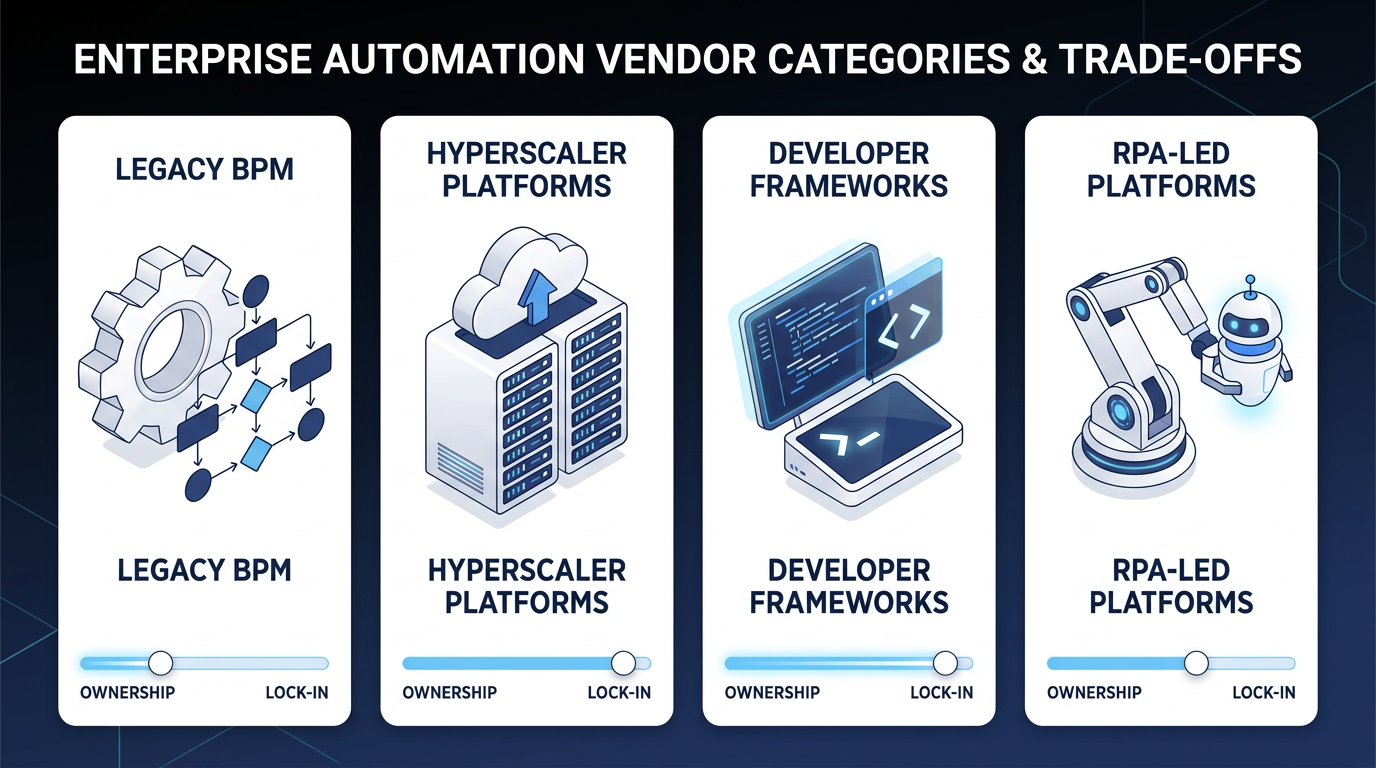
The platforms competing for your budget fall into four categories. Each has a distinct trade-off. Across all four, ownership competes with lock-in. Misread which category fits your environment and you can end up with a tool that demos well and stalls in production.
- Legacy BPM Platforms: These bring deep workflow maturity and strong audit trails. They can require high platform cost and specialist staffing after a steep learning curve. Rollout can be long, with an industry-average rollout timeline of 12 to 18 months.
- Hyperscaler Agent Platforms: These offer managed runtimes and native identity integration when your data already lives in that cloud. They often leave cross-cloud versioning and rollback controls for you to build, and they can tie you to a single cloud.
- Developer Frameworks: These give dedicated AI engineers full architectural control. They solve agent construction, but often leave teams to add governance and human oversight for production operations after the build step.
- Enterprise Workflow and Robotic Process Automation (RPA)-Led Platforms: These combine automation with AI models. Licensing complexity across layered SKUs can make cost modeling hard. Legacy architecture can require extra engineering for cloud-native environments.
Assess deterministic workflow orchestration and agent-to-agent coordination separately. Can the system coordinate agents? Can it run the workflow the same way every time? Vendor pitches often combine both under a single buying label, but agent-conversation governance and repeatable financial-close execution require separate assessments.
Suite-native platforms need a close look. Platforms embedded inside large enterprise application suites win on speed when your data already lives in their environment. But they can make it harder to change your architecture later. Room to change matters because the model market moves fast. Even as model unit prices fall, enterprise AI spend can rise as usage volume grows. A platform that lets you swap models and route each step to the most cost-effective option protects you from that curve.
Build a Business Case That Survives the Board
Boards now treat AI spend that doesn't produce dollar-denominated return as a credibility problem. Only 28% of AI use cases in infrastructure and operations fully succeed and meet ROI expectations, and 20% fail outright, according to a Gartner survey of 782 I&O leaders. A platform that cannot show savings in dollars is hard to defend in that conversation.
Use two concrete numbers. First, digital labor full-time equivalents (FTEs): the consultant and contractor headcount an automated workflow replaces. A single domain like purchase order compliance can absorb weeks of manual review work every month. Second, SaaS license displacement. Gartner estimates that up to $234 billion in enterprise application software spending is at risk from agentic AI bypassing traditional interfaces by 2030.
Sanofi shows what this looks like in a large enterprise deployment. The biopharmaceutical company worked with Elementum and Snowflake. It built AI workflows directly on its data lake. It targets autonomous resolution of up to 80% of employee IT support requests, projected to save 10 million euros (about $11.6 million) annually.
Frame the return as capacity reclaimed and licensing displaced. That framing ties directly to moving people back to work that grows the business. It survives board scrutiny.
Apply the Deterministic vs. Agentic Decision
Your platform must run the deterministic backbone your regulated processes require. It should apply AI reasoning only where ambiguity genuinely exists. Choose poorly and you inherit the failure modes the data keeps surfacing: ungoverned agents and runaway inference costs. Then pilots never reach production. Choose well and automation becomes a durable source of operating capacity.
Elementum's AI Workflow Orchestration Platform treats AI agents as equals with humans and business rules within a deterministic Workflow Engine. Configurable decision thresholds route judgment calls to people and repeatable logic to rules.
Elementum's AI Agent Orchestration governs agents across multiple AI providers. Teams can adopt new models as they ship. They do not have to rebuild workflow logic. Your data stays where it lives through CloudLinks real-time connectivity to Snowflake, Databricks, BigQuery, and Redshift. API integrations connect workflows to systems of record such as Salesforce, ServiceNow, Workday, and Coupa.
Many of our customers start with one workflow, prove the savings, and expand into adjacent processes. With Zero Persistence architecture, your data is always yours. We never train on, replicate, or warehouse your data.
Among orchestration platforms in this category, we have the production track record for replacing legacy SaaS at enterprise scale, with named customers including Sanofi, Snowflake, Under Armour, and Elevance Health.
Contact us to map workflow orchestration into your architecture and the rest of your AI roadmap.
Frequently Asked Questions About Enterprise Business Process Automation
Enterprise buyers most often ask these questions when they validate budget, rollout risk, governance, and proof-of-concept scope before committing to a platform.
What should you know about BPA, RPA, and workflow orchestration?
Business process automation (BPA), robotic process automation (RPA), and workflow orchestration solve different layers of the same problem. RPA mimics human actions on interfaces, often through screen scraping. BPA orchestrates complete workflows across systems and departments, with people in the loop via native integrations and APIs. Workflow orchestration coordinates AI agents with humans and rules within a governed process.
How long should you expect enterprise BPA rollout to take?
Enterprise BPA rollout can take many months under traditional platforms, and teams often wait before a single group can use the system on real work. Timelines depend on process complexity and on whether the platform requires a data migration project. Platforms that query data where it lives avoid that delay and can reach production far faster.
How do you justify BPA investment to the board?
Justify BPA investment to the board by anchoring the case in net cost reduction: total verified savings minus tool licenses, infrastructure, training, and rework. Express returns in digital labor FTEs replaced and legacy SaaS licenses displaced, both concrete dollar figures. Frame the outcome as capacity reclaimed and redeployed. Exclude headcount removal from the business case. That positions the investment as operating capacity.
Should your team run a proof of concept before committing?
Yes. A proof of concept tests specific integrations and expected workload against your real environment. It goes beyond a vendor demo. Prioritize a workflow that touches Salesforce, ServiceNow, Workday, Coupa, or another system of record and requires governance. Those are the conditions where platforms most often break when production volume rises.
How do you avoid vendor lock-in with AI automation?
Avoid vendor lock-in by building an abstraction layer between your workflow logic and the underlying models. That lets you swap models and update agents or tools without rebuilding processes. Confirm the platform is model-agnostic and cloud-agnostic, and that workflow formats are exportable. As enterprises adopt multi-model AI architectures, treat optionality as a procurement criterion.