
Agentic AI vs. RPA: Move UiPath Bots to Governed AI Workflows
Your UiPath renewal arrives priced for an estate that no longer matches its original business case. The center of excellence (CoE) spends more of its week repairing bots that broke when a screen changed than building new automations. Some bots on the license haven't run in months, and pricing now includes metered AI consumption.
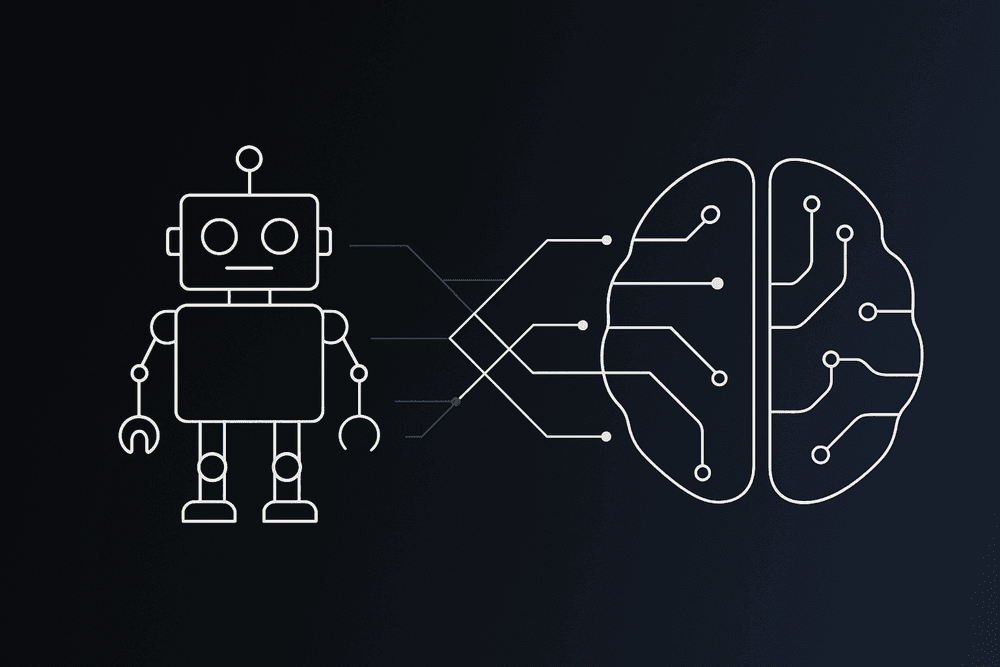
The renewal forces an agentic AI vs. RPA decision for every bot. You can renew a smaller estate or move the work to a platform that runs deterministic rules, AI agents, and human approvals inside one governed process. Choose badly, and you lock in another multi-year term of maintenance cost. Choose well, and retired license spend can fund the next phase of your AI roadmap.
Use the UiPath Renewal to Reassess the Bot Estate
Most robotic process automation (RPA) business cases omitted one cost: keeping bots running after their applications change. Most bots use screen scraping or visual recognition to find their targets, and new features, bug fixes, changing dependencies, and design updates in those applications break the bots.
A selector is the control ID, XPath, or image match a bot uses to locate a field, and it assumes the screen won't change. Enterprise software changes on a schedule, so quarterly enterprise resource planning (ERP) releases usually require regression testing across the estate. Nobody knows which bots the upgrade touched.
That repair load is one reason estates stall, and anyone who ran an RPA CoE recognizes the curve. The first wave automates clean, stable processes, the second hits exceptions and multi-system handoffs, and team capacity shifts from new automations to repairs. The bot count flattens while the license line keeps growing.
UiPath's model has moved toward consumption. Its Unified Pricing plan folds AI, app, robot, and application programming interface (API) consumption into a single consumption unit, and AI and agentic usage draw against assigned limits. Token rates don't represent the full cost of AI, according to Gartner. Because the consumption unit bundles AI usage, its cost moves with that usage, so it is harder to forecast than a per-robot fee.
A surge in automated volume or an agent that retries more than expected can use up those limits faster than finance planned. Forecasting gets harder even when the bots still work because the per-process economics you signed up for no longer describe the estate you're renewing.
Weigh Agentic AI vs. RPA Step by Step
Keep bots on stable, rule-based steps in systems that have no API, and move the steps that need interpretation, such as reading an unstructured contract, to AI agents. RPA is becoming one way to run a step inside a process another platform owns. "By 2030, 70% of enterprises will pivot to a consolidated automation platform that orchestrates business processes, AI agents, bots, APIs and human actions, up from 10% today," Gartner predicts.
In that model, a process calls a bot when a legacy system has no API, and the bot sits alongside direct integrations, AI agents, and human approvals.
RPA follows fixed rules, such as posting an invoice when its total matches the purchase order, so the same input produces the same output on every run. That consistency is why finance and audit accepted bots in the first place.
An AI agent interprets a goal and decides how to reach it, so the same input can produce different outputs depending on context. Models aren't fully deterministic even at settings meant to make them so.
That flexibility helps when a step involves reading an unstructured supplier contract or classifying an ambiguous ticket. It creates risk when the step approves a payment.
Avoid swapping one ungoverned tool for another. Replacing a bot estate with autonomous agents trades unmanaged bots for unmanaged agents, at higher stakes. Replacing bots with agents can produce "an unmanageable number of AI agents with overlapping functionalities, poor governance, and high run and maintenance costs." Agentic work also bills by usage, and retries and recursive tool loops, where an agent repeatedly calls the same tools, increase consumption in ways a per-robot license never did.
Keeping the deterministic and probabilistic parts of a process separate produces a clearer control model: a fixed workflow owns sequencing, approvals, and the record of what happened, and agents handle only the steps that need interpretation. Without that separation, agent sprawl follows.
Compare UiPath Alternatives by Type
UiPath alternatives fall into three types, and the type decides how much of the estate's maintenance load moves with you.
- RPA suites: Automation Anywhere, Microsoft Power Automate, and SS&C Blue Prism offer bot-based automation of application screens. A move between them keeps the estate on screen-level automation, so selector repairs continue.
- Integration platforms: Workato connects systems through APIs, which removes the screen dependence for any system that exposes one.
- Governed process platforms: A deterministic workflow runs rules, AI agents, and people in one process, calls a bot only where a system has no API, and keeps the audit trail. Elementum is this type.
Elementum's UiPath alternatives guide compares nine products in detail.
Require Governed Architecture From the Replacement Platform
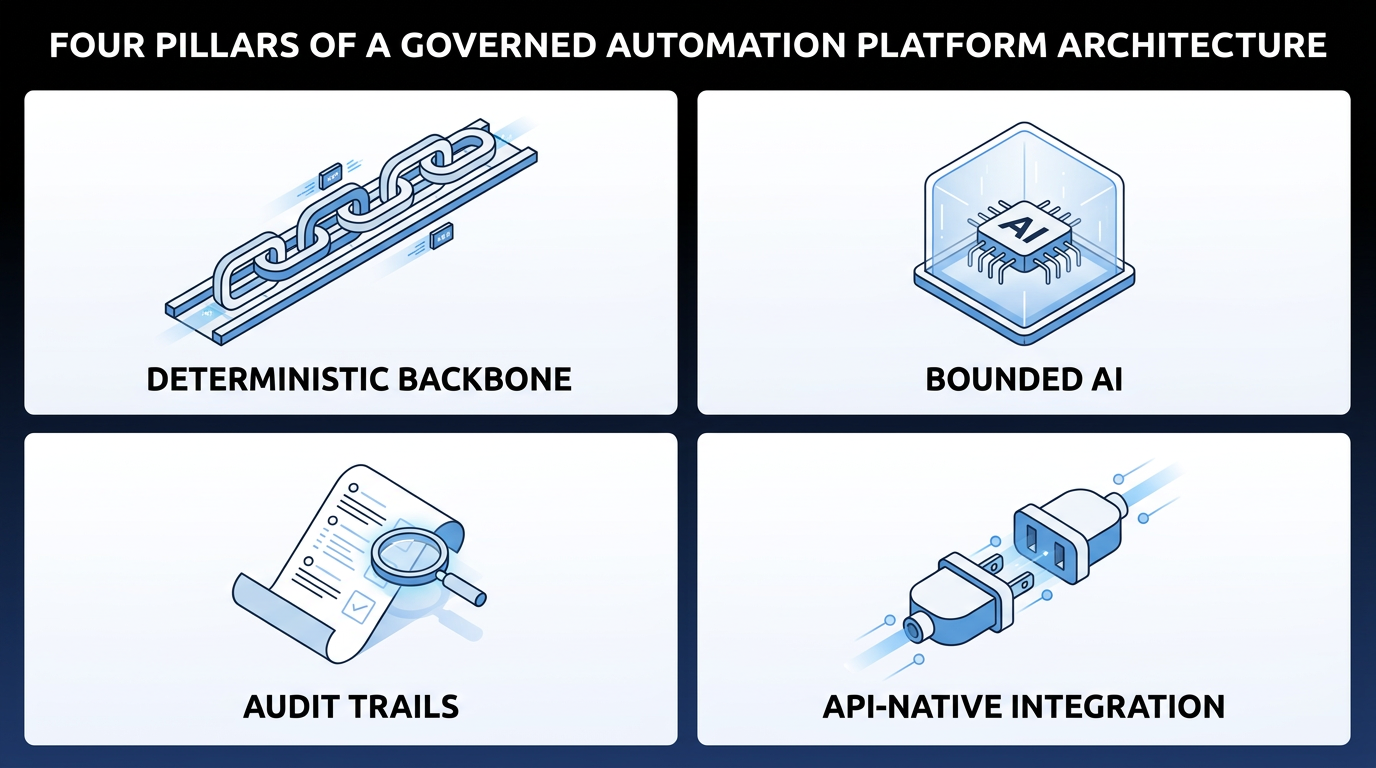
Judge each UiPath alternative on governance, because the platform that runs the migrated work decides whether risk and maintenance go down. A governed process platform meets four requirements:
- Deterministic backbone: The workflow engine sequences steps, enforces approval chains with separation of duties, and produces the same route for the same inputs. Require durable execution that retries and resumes, so a failed step never silently drops a transaction the way a broken selector does.
- AI bounded inside the workflow: The workflow calls agents one step at a time with defined inputs and outputs, and each agent uses its own credentials. Require configurable thresholds that send some outputs forward and route others to a named reviewer, and validate the input on every model call.
- Audit trails a regulator can read: Each entry should name who acted, whether a person, a rule, or a named agent. It should also record the trigger, the model and prompt version, the output, the approver, and any override. Deployers of high-risk systems under the EU AI Act must keep logs under their control for at least six months and assign oversight to people with the competence, training and authority to act on what they see.
- API-native integration: Reach systems of record through their supported APIs and events, leave them as the source of record, and run logic outside the ERP core through the interfaces the vendor publishes. Check the license terms before go-live, because writing through external APIs may require additional licenses.
Elementum's deterministic Workflow Engine sequences the steps and calls AI agents where reasoning is required, and it executes automated logic where reasoning isn't needed. It sends exceptions and approvals to the people who own them, and every AI determination is logged and citable.
Elementum replaces named process modules rather than automating steps inside SAP, Salesforce, or Oracle. Current systems remain sources of record, and Elementum updates them through API calls.
Migrate UiPath Bots in Four Phases
A big-bang platform swap fails when teams lack a complete view of the estate, and selector and exception handling differ enough between platforms that bots rarely transfer unchanged. Go process by process, with a gate before switching off each bot.
Phase 1: Inventory the Estate and Name Owners
A complete inventory shows which bots are worth moving and who owns each process. For every bot, record:
- The process it serves
- The systems it touches and how often it runs
- Its failure rate
- The person who answers when it fails
An RPA program can struggle to produce that list when teams fund bots as technology rather than assign business ownership. Record a status for each bot: live, phasing out, or retired. That review may reveal that fewer bots need licenses than the contract currently covers.
Before anything moves, assign each process to a named business owner. That owner decides what the workflow does without review, what needs sign-off, and what escalates.
The owner also has authority to pause or stop a bot or agent in production. Without that authority, failures continue while teams debate who can stop the run.
Support that owner with a cross-functional governance body that includes IT, legal, security, HR, and the business leaders who own the outcome.
Human approval establishes accountability, because a person remains responsible for the decision. An agent isn't a legal entity and can't answer for its actions.
Phase 2: Triage Each Bot to Migrate, Retire, or Rebuild
Each bot's path depends on two facts: whether anyone still needs the process, and whether the system the bot touches now has an API.
- Retire: Bots with no owner, no traffic in the last quarter, or a process that no longer exists belong on the retire path. Switch them off before migrating anything.
- Migrate: Stable, rule-based bots on systems that still have no API belong on the migrate path. These stay deterministic and keep running until the system exposes an interface.
- Rebuild: Bots that screen-scrape a system that now has an API, or that break on exceptions, belong on the rebuild path. Each step becomes a direct integration, with an AI agent assigned only to the part that needs interpretation. Start with the bots that need the most repair time, so the CoE capacity you free can fund the next batch.
High-stakes decisions with clear accountability, such as releasing payments or granting privileged access, stay with a person under every path. Phase 4 then proves each new path against the old bot.
Phase 3: Build Each Workflow on the Governed Platform
Build each migrated or rebuilt workflow on the target platform before any live transaction reaches it. Connect each system through its supported API, keep a called bot only where a system still has no API, and set the approval gates and decision thresholds the process owner defined in Phase 1.
Test against a sample of past transactions that includes the exceptions that broke the bot. The parallel run then starts from a workflow that already handles them.
Phase 4: Parallel Run, Then Decommission on Parity Sign-Off
During a parallel run, the legacy bot and new workflow process the same live transactions, and only the legacy output goes into use. Compare every transaction by output, exception rate, and processing time. That comparison defines parity.
For finance processes, run at least one full monthly cycle. That period exercises month-end paths, not only normal daily transactions. Small samples hide the exceptions that broke the bot in the first place.
Decommission only after the process owner and internal audit formally approve parity. Before shutdown, archive the bot's run logs and historical outputs under your retention policy. Ask finance and audit users to retrieve a sample from the archive, then remove the license from the renewal.
Settle Agentic AI vs. RPA Before the UiPath Renewal
Complete the inventory and retire unowned bots before moving the first process, and do it while the renewal deadline still leaves room to negotiate. Switch off each bot only after its replacement matches the bot's results and meets the four governance requirements.
On Elementum, The Enterprise AI Apps Platform, the deterministic Workflow Engine runs AI agents, automated logic, and people in a single flow, and human reviewers handle exceptions. Current systems remain sources of record. The flat annual application fee covers seats, conversations, and AI actions, so usage volume doesn't move the fee the way metered consumption does.
Sanofi, for one, expanded from software license management into procurement and CRM workflow replacement on Elementum, and we have the production track record for replacing legacy SaaS at enterprise scale. Waiting another term adds a cycle of selector repairs and hard-to-forecast consumption charges.
Contact us to map an enterprise AI app that replaces legacy SaaS into your enterprise application estate and the rest of your AI roadmap.
Frequently Asked Questions About Agentic AI vs. RPA
The right split between agentic AI and RPA depends on how you prove parity and govern the AI steps that require judgment.
How Can You Replace UiPath Without Losing Existing Automations?
Bots don't port between platforms. Retire each one, keep it running as a called step, or rebuild it as an API integration. A parallel run on live transactions proves parity before you switch off the old bot, so no process goes dark during migration.
When Should You Use an AI Agent Instead of an RPA Bot?
A bot is deterministic and suits stable, rule-based steps. An agent interprets inputs and suits steps that require judgment on unstructured material. A governed workflow uses each where it fits and keeps high-stakes decisions with people.
How Long Should a Parallel Run Last Before Decommissioning a Bot?
Run it long enough to exercise every path the bot handles, which for finance processes means at least one full monthly cycle. Compare the same parity measures on the same transactions, and require sign-off from the process owner and internal audit.
Keep Reading
How Companies Use Agentic AI Across the Enterprise
The Enterprise Guide to Agentic AI for ITSM
Agentic AI for ITSM: A Practical Architecture for Enterprise IT
What Is Agentic AI Orchestration? An Enterprise Guide

How to Measure ROI from Agentic AI Implementations
Agentic AI vs. Generative AI: Why Enterprise Workflows Need Both