
The Enterprise Guide to Agentic AI for ITSM
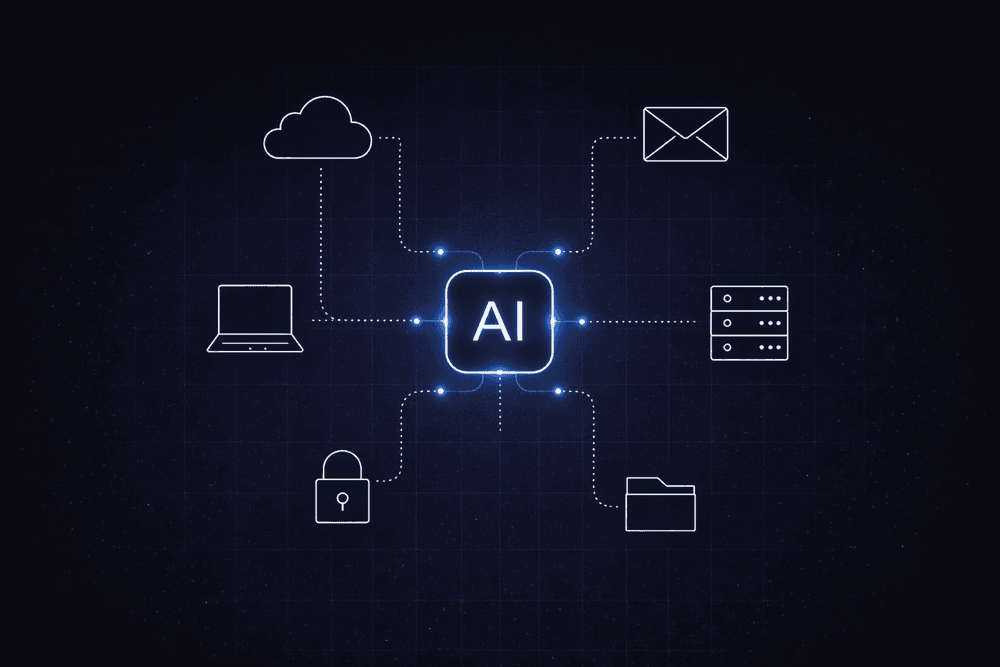
An IT service ticket bounces between three teams over two days. A password reset that should take minutes sits in a queue for hours. An incident that mirrors one resolved last month gets triaged from scratch because no one connected the dots. Manual handoffs, disconnected systems, and missing context slow down IT service management (ITSM) at scale.
Agentic AI can change how ITSM tickets move through the queue by interpreting requests, reasoning about context, and coordinating multi-step resolutions across systems without waiting for a human to push each step forward. But without the right architecture, agentic AI deployments often produce inconsistent execution, audit gaps, and ungoverned changes to production systems.
This article breaks down how agentic AI works for ITSM, where it delivers measurable results, and what to get right before deploying it.
How Agentic AI Differs From the Automation Already in Your ITSM Stack
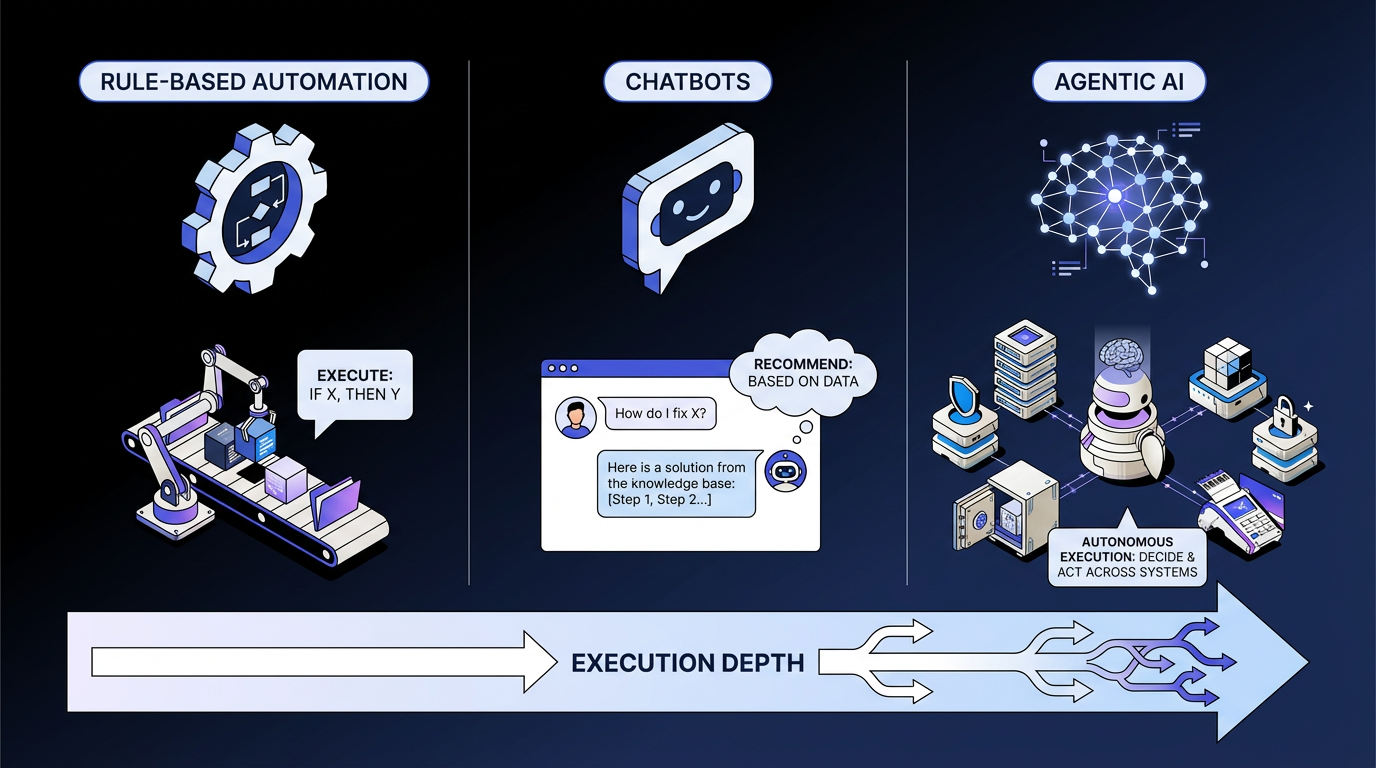
Agentic AI sits atop a capability ladder that most IT operations teams have already begun climbing. The differences between levels come down to how much the system can interpret, decide, and act on its own.
Rule-based automation and robotic process automation (RPA) follow explicit, predefined workflows. If X happens, do Y. Every time. RPA cannot interpret unstructured data, adapt to novel situations, or handle flexible tasks.
Chatbots and virtual agents converse with users and match intent to scripted responses. A chatbot can suggest a laptop replacement and walk someone through the steps of the request. But chatbots respond to users without acting on their behalf. AI agents automate tasks across systems.
Agentic AI interprets a goal, reasons about context, determines the appropriate action, and executes it across multiple systems. The same laptop replacement request can trigger agents that diagnose the issue, check procurement systems, place the order, coordinate delivery, and update the asset record, with human oversight reserved for exceptions or high-value approvals.
In practical ITSM terms, agentic AI carries out the full workflow across systems, from diagnosis through resolution.
How Does Agentic AI for ITSM Work?
Enterprise agentic AI deployments typically separate into two layers. A common mistake in vendor evaluation is treating the two as the same thing. Here's how they differ:
- The reasoning layer is where AI agents, powered by LLMs, interpret intent, analyze context, and determine what action to take. When a user submits an incident report in plain language, the reasoning layer classifies the issue, identifies related past incidents, and selects a remediation path from multiple options.
- The execution layer is where deterministic orchestration and API integrations carry out the planned action across enterprise systems within governed boundaries. The LLM does not execute the remediation directly. It generates the plan. The orchestration layer then carries it out in a governed way with an audit trail.
Separating reasoning from execution is a practical architectural requirement in enterprise ITSM. Orchestrated execution lets AI agents understand a request and fulfill it across multiple systems in the stack. Without the separation, an agent may reason well but execute inconsistently, or make autonomous changes to production systems with limited governance.
The agent plans a course of action, performs it, evaluates the outcome, and decides whether to continue, adjust, or escalate. Each cycle generates data that feeds the next, creating a feedback loop that static automation cannot replicate.
Common Use Cases for Agentic AI for ITSM
ITSM use cases for agentic AI fall into three broad categories. Each follows the same general pattern, with interpretation and reasoning handled by AI agents and governed execution handled by deterministic orchestration.
Incident Triage and Resolution
Agentic AI compresses the incident management cycle by front-loading diagnosis and context assembly before a human analyst ever sees the ticket.
Traditional incident management follows a familiar path. A user reports an issue, a ticket is created, level one triages, the issue escalates to level two, and level two diagnoses and resolves. Hours or days can elapse before resolution.
With agentic AI, the system pre-populates resolution guidance with reproduction steps, log snippets, impact analysis, and suggested response templates, using historical routing data and real-time performance metrics to route contextually. When confidence thresholds are met, agents can automatically execute approved remediation. When uncertainty remains, incidents escalate to human engineers with a full diagnostic context already assembled.
At enterprise scale, no production deployment eliminates human involvement entirely. Complex incidents, novel failure modes, and high-stakes changes will always surface edge cases that require human judgment. Most current deployments use agents for triage, classification, and context assembly, with deterministic orchestration governing the actual resolution steps.
Service Request Fulfillment
High-volume, low-complexity requests like password resets, access provisioning, hardware replacements, and software license allocation are a major source of service desk workload. These requests follow the same logic every time, require no interpretation, and touch well-defined systems with predictable outcomes.
That makes them ideal candidates for agentic workflows. An AI agent can match the request to a known resolution path, execute across systems, and close the ticket without human intervention. For requests that follow identical steps every time, such as a password reset, deterministic rules can execute them more reliably and at lower cost than routing through an LLM. The result is fewer tickets reaching the service desk and faster resolution times for the ones that do.
For example, consider new hire onboarding. An HR system event can trigger an agent that orchestrates Active Directory setup, Office 365 provisioning, application access, and credential delivery, without a manual ticket in sight. The value comes from speed and from removing repetitive work that follows the same logic every time, freeing teams to focus on incidents that require judgment.
Change Management Augmentation
In many organizations, Change Advisory Board (CAB) processes involve manual risk matrices, scheduled meetings, and committee-based approvals. Agentic AI introduces three capability layers:
- Classification and routing powered by natural language processing
- Impact analysis using historical success rates and real-time data from configuration management databases (CMDB), which store records about IT assets and dependencies
- Intelligent approval routing based on risk classification
Low-risk standard changes can proceed autonomously. Non-standard and high-risk changes still route to human approvers, but with a pre-analyzed risk brief rather than a blank form. The AI agent acts within pre-approved categories. It does not replace the CAB. It removes the manual work that slows down CAB processes.
Top Risks That Sink Agentic AI Projects in ITSM
Over 40% of agentic AI projects will be canceled by the end of 2027 due to escalating costs, unclear business value, or inadequate risk controls. In ITSM, where agents touch production infrastructure and sensitive user data, three failure modes account for much of the wreckage.
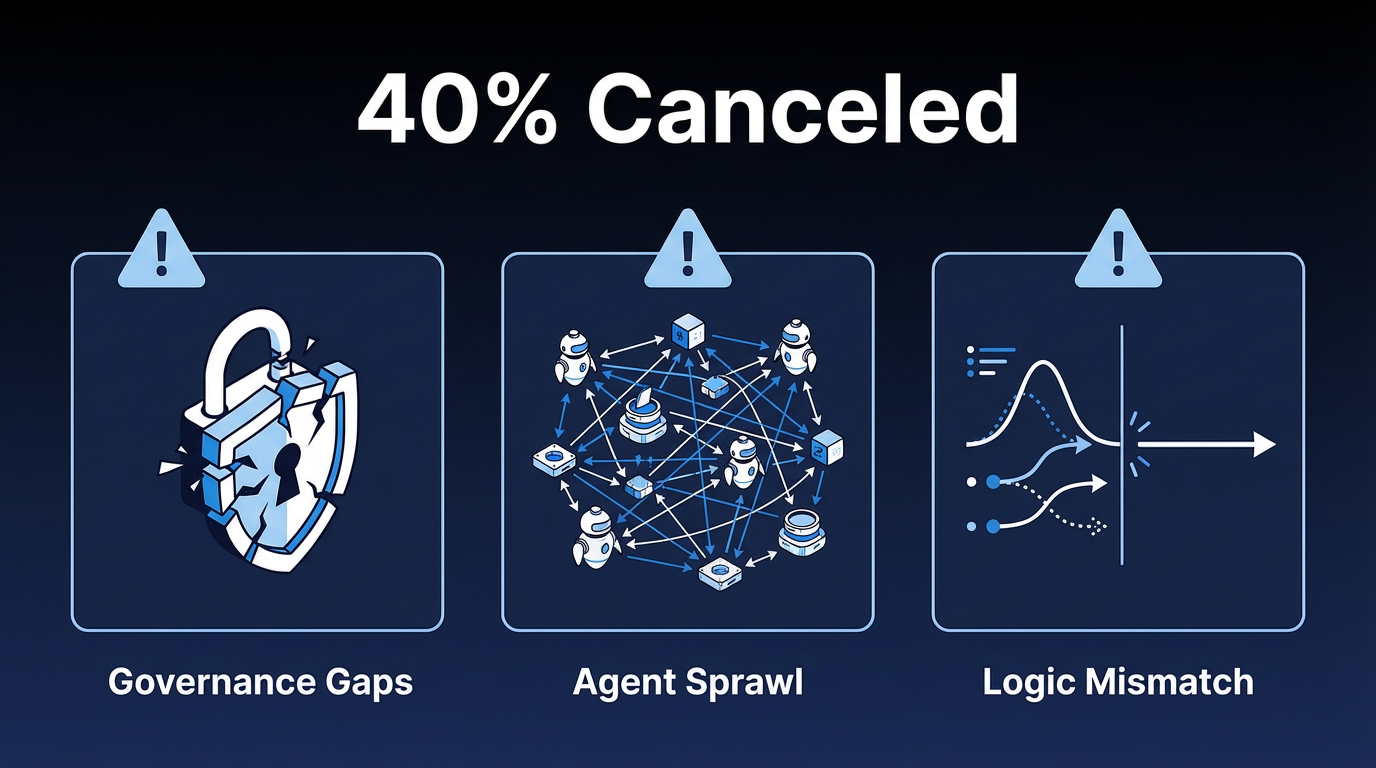
Governance Gaps That Compound at Scale
ITSM agents operate with privileged access to incident data, change records, configuration items, and user identity information. Without formal identity governance for machine identities, including least-privilege access, lifecycle management, and access revocation, every agent deployment expands your attack surface.
For instance, AI-specific threat surfaces such as prompt injection, privilege escalation, and data exfiltration via agent tool access compound the problem. Multi-agent workflows also introduce compounded hallucination risk.
Governance cannot be a one-time deployment checklist item. Sovereign agentic AI requires enforcement across the full stack, spanning data, models, orchestration layers, applications, and runtime operations.
Agent Sprawl Replicating the Shadow IT Problem
As organizations experiment with agents across teams, overlapping workflows emerge due to a lack of standardized processes or oversight. Multiple teams may build separate agents for similar ITSM tasks, such as ticket classification or password resets, each with different models, governance standards, and escalation paths.
In ITSM environments, agent sprawl poses additional risk because those agents interact with production systems, access sensitive incident data, and execute changes with real operational consequences. Without a centralized inventory of deployed agents and the workflows they support, IT leaders lose visibility into what is running, who authorized it, and whether overlapping agents are producing conflicting outcomes.
The Probabilistic-Deterministic Mismatch
Agentic AI introduces probabilistic reasoning, meaning the same inputs can produce different outputs depending on context. Probabilistic reasoning is appropriate for classifying an ambiguous ticket or reading an unstructured incident report. It is risky to approve a production change or execute a remediation script.
Without a deterministic execution layer, the same ITSM process can produce inconsistent outcomes and leave no reliable audit trail, directly undermining the governance frameworks ITSM exists to enforce.
What to Evaluate Before You Deploy Agentic AI for ITSM
An evaluation framework for agentic AI in ITSM should prioritize four tiers, ranked by importance:
- Governance and compliance: Complete audit trails with action-level attribution. Decision explainability means why the agent took a specific action. Agent identity governance equivalent to human identities. Data sovereignty enforcement across every layer of the stack.
- Architectural integrity: Deterministic execution for consequential actions such as approvals, changes, and system modifications. Rollback and reversibility for agent-initiated changes. A clear separation between AI reasoning and workflow execution that cannot be bypassed.
- Operational risk controls: Agent discovery and inventory across all deployment environments. Real-time behavioral monitoring. Shadow AI governance.
- Business value validation: ROI defined at the workflow level, not the individual task level. Realistic legacy integration cost assessment. Keep in mind that 57% of enterprise data is not AI-ready, which can affect agent performance when working with CMDBs, incident records, and service-level agreement (SLA) definitions.
Addressing all four requirements helps separate a controlled production architecture from an expensive pilot that never reaches scale.
How Elementum Enables Agentic AI for ITSM
Enterprise ITSM teams that capture efficiency gains from agentic AI tend to deploy it within a governed, deterministic architecture rather than chase agent autonomy without controls. Executive trust in AI agents dropped from 43% to 27% between 2024 and 2025, signaling a clear market preference for outcomes without uncontrolled risk. The practical question is whether your architecture can deliver that balance.
Elementum is the Open Orchestration Platform that treats humans, business rules, and AI agents as equal first-class actors in every ITSM process. The Workflow Engine routes each step to the appropriate actor based on its requirements. AI agents handle interpretation and reasoning, such as ticket classification, context assembly, and impact analysis. Deterministic rules handle steps that require consistency, such as SLA enforcement, approval routing, and escalation chains. Humans handle what requires judgment.
Our Intelligent Front Door provides a single chat-based entry point for IT service requests, routing each request to the right agent and workflow, with orchestration, governance, and audit trails behind the scenes. Our patented Zero Persistence architecture means your data is never replicated, stored, or warehoused. CloudLinks queries your data in real time, where it already lives.
Our platform is also pre-integrated with OpenAI, Gemini, Anthropic, Amazon Bedrock, and Snowflake Cortex. No LLM vendor lock-in means you can adopt new models as they are released.
If your ITSM operation processes thousands of tickets across multiple systems and you are evaluating how agentic AI can help, contact us to see how Elementum integrates with your existing stack.
FAQs About Agentic AI for ITSM
What's the Difference Between Agentic AI and the AI Already Built Into ITSM Platforms Like ServiceNow?
Most embedded ITSM AI features handle narrow tasks like ticket classification, suggested responses, and knowledge article summaries. Agentic AI goes further by reasoning about context and autonomously executing multi-step actions across systems. The platform vs. feature distinction is significant because buying an agentic AI feature from your ITSM vendor is not the same as having an agentic AI orchestration architecture with consistent governance, orchestration, and lifecycle management.
Is Agentic AI for ITSM Actually Production-Ready?
Yes. Agentic AI for ITSM is production-ready when it operates within a governed workflow with appropriate human checkpoints. Gartner found that 75% of organizations have deployed some form of AI agents, while only 15% are considering, piloting, or deploying fully autonomous agents. At enterprise scale, human judgment at key decision points must be a permanent architectural requirement.
Production-ready deployments today handle ticket categorization, resolution suggestions, and the execution of approved scripts within defined confidence thresholds. Human review is reserved for high-risk, ambiguous, or irreversible actions.
What ITSM Tasks Should Agentic AI Never Handle Autonomously?
Agentic AI should not autonomously execute irreversible, high-risk changes, such as direct production database edits, emergency change approvals, or actions that affect security or uptime, without human review.
Change management protocols exist to prevent concurrent or conflicting modifications from reaching production simultaneously. When multiple automated changes execute simultaneously, they can create race conditions that corrupt system dependencies and cause difficult-to-diagnose failures. Human oversight at defined approval points mitigates these risks.
How Should You Measure ROI for Agentic AI in ITSM?
Traditional metrics like ticket volume and average mean time to resolution (MTTR) can be misleading. As AI removes high-volume, low-value tickets, the remaining tickets are typically more complex, which distorts benchmarks.
Measure at the workflow level instead. Track resolution time across the full ticket lifecycle, automation rate by request type, and cost per resolution. Those operational metrics aggregate into a business outcome that the board recognizes: digital labor full-time employees (FTEs) displaced from repetitive, low-judgment work. This is how IT efficiency translates into dollar-denominated impact at the executive level.
Where Should You Start With Agentic AI in ITSM?
Start with high-volume, low-risk service requests like password resets, multi-factor authentication (MFA) lockouts, ticket status checks, and access provisioning. Requests like these represent the clearest ROI because they are repetitive, follow consistent logic, and consume disproportionate service desk capacity. As governance matures, you can expand into more complex tasks such as incident triage and change management.
Keep Reading
What Is Agentic AI Orchestration? An Enterprise Guide

Agentic AI vs. Generative AI: Why Enterprise Workflows Need Both
Beginner's Guide to Agentic Automation: What Is Agentic Automation?
RAG vs. Agentic AI: When to Use Each in Enterprise Workflows

Human-in-the-Loop Agentic AI: How Enterprise Teams Deploy Agents Without Losing Control
How To Set Up an AI-Powered IT Service Desk Workflow