
ITSM Workflow Automation: Combining Agents, Rules, and Human in the Loop
Your IT service desk handles thousands of tickets a month across multiple systems. Every manual handoff between triage, routing, approval, and resolution introduces delays, errors, and compliance risks. AI agents can take some of that load off. The harder question is how much of that automation holds up at real production volume. A single model running every step produces output that varies from one run to the next, and enterprise processes cannot absorb that inconsistency.
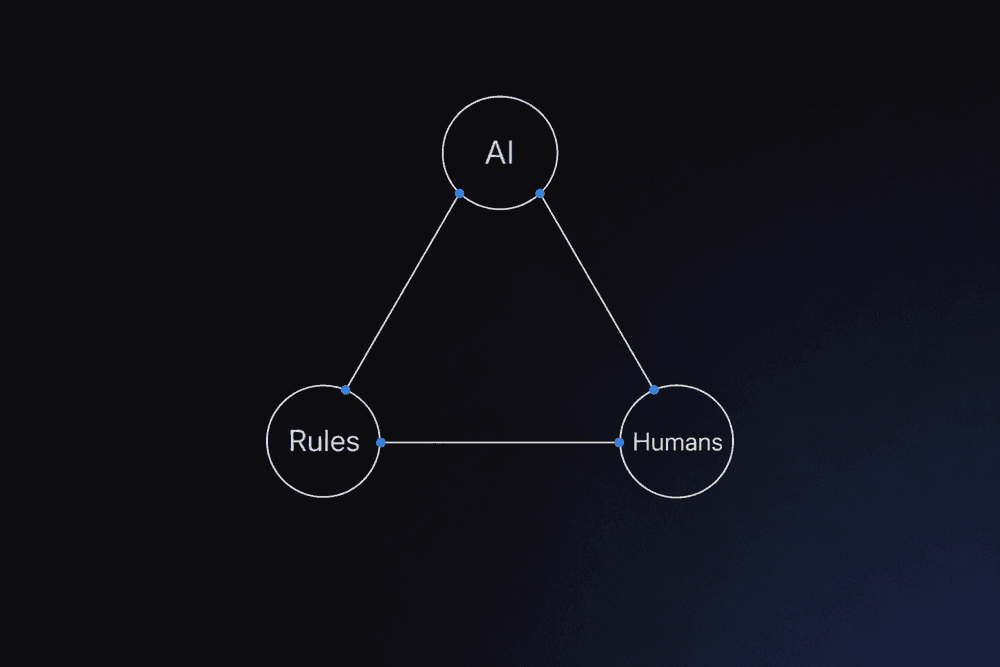
IT service management (ITSM) workflow automation holds up in production when the architecture separates roles by what each does best: AI agents for interpretation and reasoning, deterministic rules for consistency and compliance, and human judgment for high-stakes decisions. The rest of this article covers how to apply that role split across the ITSM workflows where volume and risk run highest.
Where ITSM AI Spending Outpaces Results
Enterprise IT is investing heavily in AI for service management, and results have not kept pace with the spending. Improvements in service quality arrive unevenly across organizations, and the barrier leaders name most often is cost justification.
That pressure falls on operations leaders responsible for both service quality and budge: 71% of CIOs expect their AI budget to be cut or frozen if AI does not prove its value this year. The problem ITSM workflow automation must solve is how to turn AI spend into defensible service outcomes.
Where Agent-Only Automation Breaks Down
Results often lag because teams ask AI agents to carry out the entire workflow. Agents are useful for specific ITSM tasks: they read unstructured ticket descriptions, classify intent in ambiguous language, and correlate alerts across systems. Problems start when agents become the entire automation layer. They work best as a single participant in a governed workflow, and better models do not eliminate the need for governance around them.
Non-Determinism Breaks Compliance
Large language model (LLM)-based agents can produce inconsistent outputs across similar runs, and their behavior shifts as inputs and context change. Deterministic systems follow set rules and return the same result every time. For change management, service-level agreement (SLA) enforcement, and incident escalation, that consistency is the compliance requirement. An agent that routes identical priority-one (P1) incidents differently on Tuesday and Thursday creates an audit failure.
Production Rollback Rates Run High
A survey of more than 2,500 enterprise decision-makers found high post-deployment rollback rates: 74% had rolled back or shut down a live AI agent, and the rate rose to 81% at organizations with the most mature guardrails. Governance added after deployment does not appear to fix the problem. In regulated and high-volume environments, governance has to be architectural, built into the workflow design from the start.
Costs Spike When You Need Them the Least
Rules-based automation carries predictable per-transaction costs. LLM-based agents carry variable token costs that scale with complexity and request frequency, so costs can spike during major outages, exactly when IT operations budgets are already under pressure. The economics get harder over time: GenAI cost per resolution is projected to exceed offshore human-agent costs by 2030, undercutting cost-reduction business cases built on the assumption that AI resolution is inherently cheaper.
Match Each ITSM Step to AI, Rules, or People
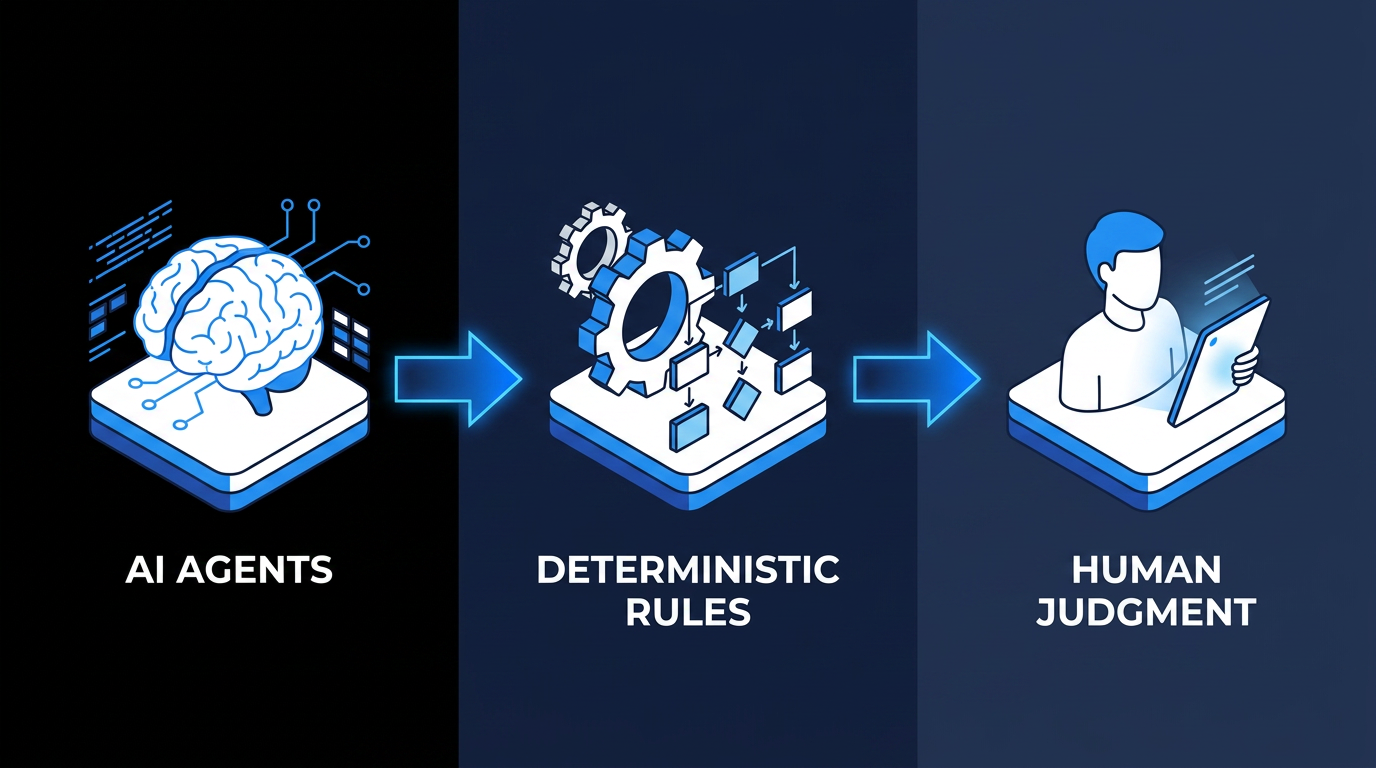
Effective ITSM workflow automation assigns every workflow step to the participant best suited for it. Some steps need interpretation, others need control logic, and a few need accountable human review. At enterprise scale, the architecture works better when each participant has a defined role.
Interpretation tasks route to AI agents: unstructured ticket text, ambiguous intent, alert correlation, and resolution recommendations drawn from historical patterns. These are the steps where language understanding and reasoning add value that rules cannot replicate.
Deterministic rules own consistency. SLA timers, escalation thresholds, approval routing by ticket category or dollar amount, notification dispatch, and change freeze windows require the same output every time, with no variation in phrasing or context.
High-risk decisions require a named human. Where accountability carries regulatory, financial, or irreversible consequences, a person has to be in the loop, and the workflow should enforce that gate rather than leave it optional.
The controlling layer for enterprise deployments is the deterministic process engine, with AI agents invoked selectively at the steps where ambiguity is highest. That split gets concrete in the workflows you run every day.
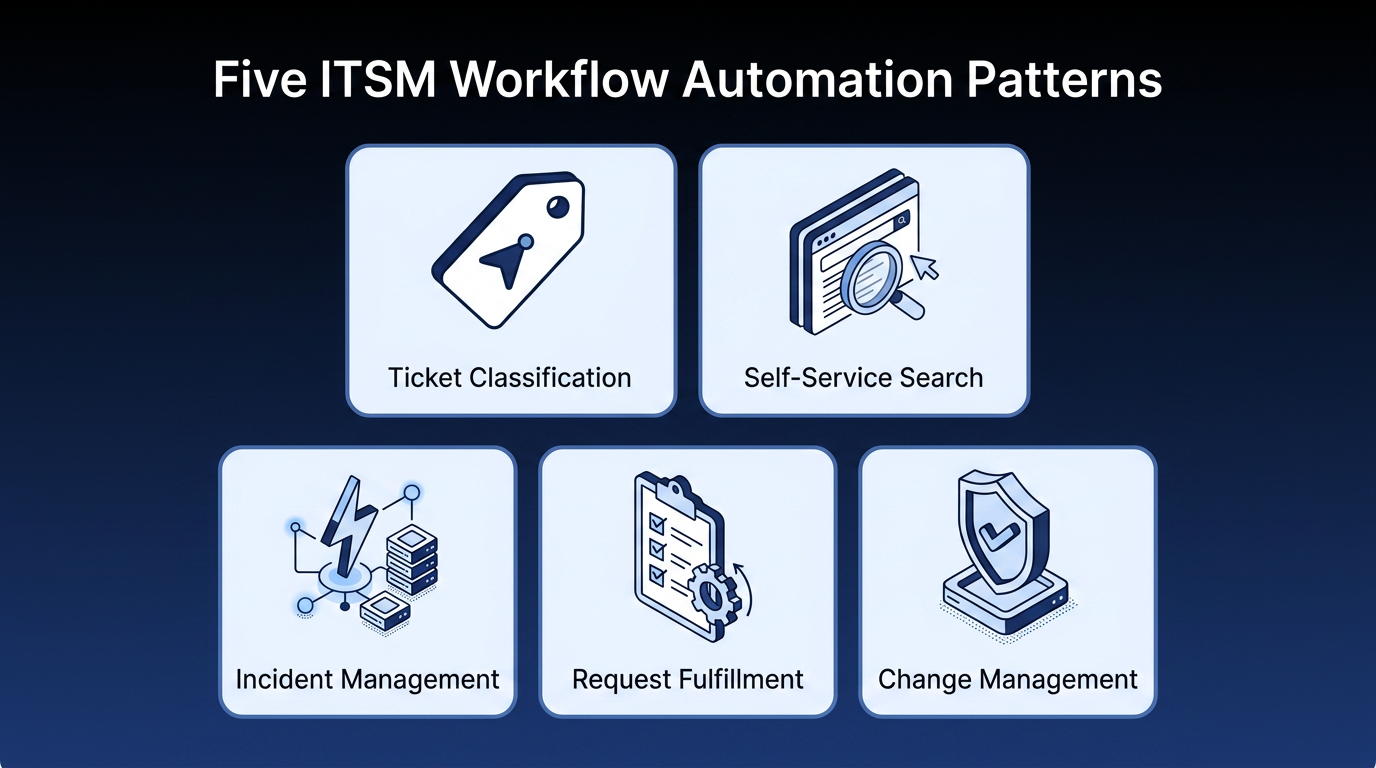
Ticket Classification and Routing
AI reads ticket text to identify intent and urgency. Deterministic rules handle escalation after classification: P1 and P2 incidents route to senior engineers, and SLA thresholds trigger automatic escalation. Security-related tickets require human approval regardless of the model's recommendations. Faster, more accurate routing at the classification step is where much of the early ITSM AI value shows up across high ticket volumes.
Knowledge-Driven Self-Service
AI powers semantic search across the knowledge base, matching natural language queries to resolution articles even when keyword matching fails. Deterministic workflows govern what happens after the match, from the resolution steps presented to the auto-close criteria. If self-service fails, escalation triggers. A well-maintained knowledge base paired with semantic search deflects routine tickets before they reach a human.
Incident Management
AI agents correlate alerts, pull configuration data, run diagnostic queries, and generate resolution guidance. Deterministic rules set the boundary between automated remediation for well-understood, known-error resolutions and human escalation for novel or P1 incidents, especially in regulated systems. Without a deterministic gate, a single error can propagate across multiple systems before any human notices.
Service Request Fulfillment
Standard service requests, such as password resets and software installations, follow clear policy boundaries. AI classifies the request and orchestrates fulfillment, while rules enforce approval chains and spending limits. Compliance checks sit upstream of AI execution, so agents cannot bypass governance controls. An access provisioning request that touches sensitive systems, for example, follows a higher-risk approval path with human review.
Change Management
AI assesses change risk using historical data, deployment patterns, and configuration item (CI) dependencies. Deterministic rules enforce mandatory change advisory board (CAB) review thresholds, change freeze windows, and rollback triggers. AI recommendations inform the decision but cannot override checkpoints where compliance requires human sign-off. The result is faster risk assessment without losing process consistency, and humans keep decision authority for changes with a major impact.
Keep Humans in the Loop at Enterprise Scale
Human oversight remains mandatory for some categories of ITSM work. Before automating an access decision, weigh whether it could materially affect an individual, and apply review controls that match that risk.
Two oversight models apply, depending on the decision's risk profile.
Human-in-the-loop (HITL) pauses the workflow until a human approves. Use it for financial approvals, security-sensitive access, major incident declaration, and any irreversible action. The system assembles context and presents a recommendation. The human decides.
Human-on-the-loop (HOTL) lets AI execute within defined boundaries while a human monitors and steps in on exceptions. Use it for repetitive, high-volume service requests with clear policy boundaries.
Design governance around three controls:
- Decision-threshold escalation as a structural control: When an AI decision does not meet the workflow's defined threshold, or the action falls outside defined patterns, the workflow routes it to human review regardless of stated risk level. The threshold is the point where the workflow stops trusting the model to act on its own. Operational teams can adjust these thresholds after deployment without engineering involvement.
- Immutable audit trails for every participant: The workflow logs AI recommendations, rule executions, and human decisions, along with the reasons behind each. The trail records why the system acted and who approved any exception.
- Governance built into the design: Governance added only after deployment often falls short. Human oversight works best when it is part of the core architecture from the first design, before agents start making decisions.
Use the three controls together to keep accountability where service risk and compliance exposure are highest, even as automation expands.
Take ITSM Workflow Automation to Production With Elementum
ITSM workflow automation holds up at enterprise scale when the architecture separates model interpretation from deterministic control and human review. Operations leaders accountable for ITSM outcomes cannot afford an architecture that works in a pilot and collapses at production volume, or one that takes a year to deploy.
Elementum's AI Workflow Orchestration Platform runs on this role-based model. Our Workflow Engine gives defined responsibilities to model outputs, business rules, and human approvals in every ITSM workflow. AI classification and reasoning run under deterministic SLA thresholds, compliance gates, and defined escalation paths. Human decision authority remains in place for high-stakes actions, and configurable decision thresholds determine when AI acts autonomously or escalates to humans. We log every agent action and can revoke it, with human-in-the-loop checkpoints at the highest stakes.
Our platform is model-agnostic, with pre-integrations across OpenAI, Gemini, Anthropic, Amazon Bedrock, and Snowflake Cortex, so teams avoid single-vendor AI lock-in and can swap or mix models within a workflow as needs change. Our Zero Persistence architecture means your data stays yours. We never train on, replicate, or warehouse your data; we query it in real time via CloudLinks.
Our architecture brings production workflows live in 30 to 60 days by connecting directly to data where it already lives, with no migration or warehousing. Teams build workflows agentically, describing the process in natural language and letting the platform construct the workflow logic. The visual builder is available for maintenance and updates once workflows are live. Many of our customers start with one workflow, prove the savings, and expand into adjacent processes, taking over the build themselves without needing specialized resources.
Among orchestration platforms in this category, we have the production track record for replacing legacy SaaS at enterprise scale, with named customers including Sanofi, Snowflake, Under Armour, and Elevance Health.
Contact us to map agentic AI orchestration into your ITSM architecture and the rest of your AI roadmap.
FAQs About ITSM Workflow Automation
These are the questions that IT and operations leaders most often raise when they move ITSM workflow automation from pilot to production.
How Do You Decide Which ITSM Steps Need AI Agents Versus Deterministic Rules?
Deciding which ITSM steps require AI agents versus deterministic rules depends on what the step demands. If it requires interpreting unstructured or ambiguous inputs or correlating data across systems, assign it to an AI agent. If it has to produce the same result every time, such as SLA enforcement, escalation thresholds, or policy-based approval routing, assign it to a deterministic rule. Steps with regulatory or financial consequences, or any irreversible action, need human decision authority.
What ROI Timeline Should You Expect for ITSM Workflow Automation?
The ROI timeline for ITSM workflow automation can be short. Teams that apply AI to the right steps in the service desk report faster ticket resolution and lower handling time, and platforms that reach production in 30 to 60 days can show results within a single budget cycle.
Why Do AI Agent Deployments in ITSM Get Rolled Back?
AI agent deployments are most often rolled back because governance is bolted on after the system is live, rather than designed into the workflow from the start. Rollback rates remain high even in organizations with the most mature guardrails, suggesting an architectural rather than a tuning problem. Building deterministic control and human checkpoints into the design from day one is what keeps deployments in production.
Can Your Existing ITSM Platform Work With AI Agents?
Yes, your existing ITSM platform can work with AI agents because the two solve different problems. Agents handle interpretation and reasoning, while the platform manages process structure and the compliance workflows tied to your system records. An orchestration layer can sit above your existing tools, governing AI agents inside deterministic workflows without a rip-and-replace migration.
Is CMDB Data Quality the Biggest Barrier to ITSM Automation?
Configuration management database (CMDB) data quality is one of the biggest barriers to ITSM automation, and often the first one teams hit. Poor CMDB data feeds ticket misclassification and improper escalations, so the AI inherits the errors already in the record. Without a data quality remediation plan, automation will not compensate for underlying data problems.
Keep Reading
Agentic AI for ITSM: A Practical Architecture for Enterprise IT
Human-in-the-Loop Agentic AI: How Enterprise Teams Deploy Agents Without Losing Control
Human-in-the-Loop vs. Human-on-the-Loop: When to Use Each for Enterprise Workflows
Are AI Agents Deterministic? Understanding Predictability in Agentic Systems
5 Top Solutions for Intelligent Ticket Routing in ITSM: Improve Resolution Speed & Accuracy
How to Control and Monitor the Output of AI Agents