
Business Process Automation Benefits: Cost, Speed & Quality Gains

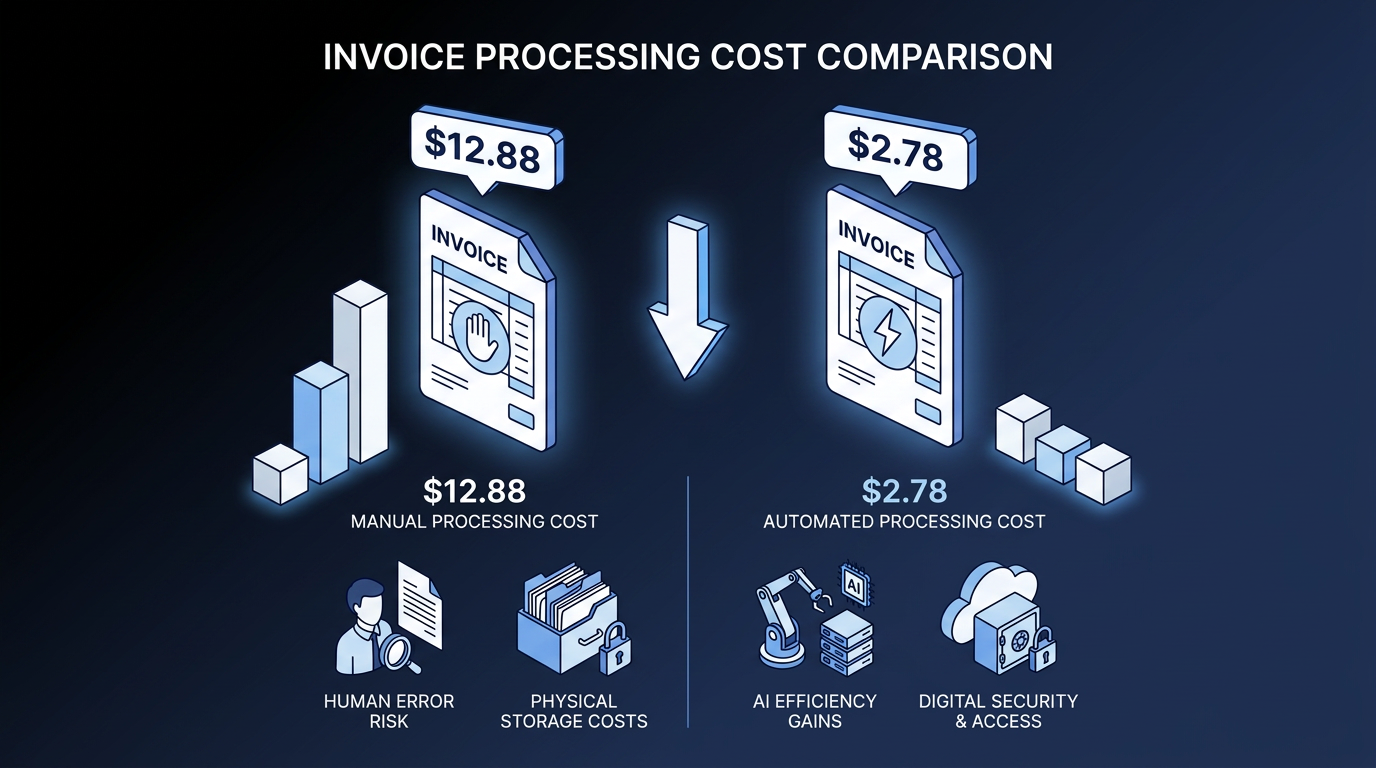
A single invoice costs about $12.88 to process by hand. Automate it, and that drops to roughly $2.78. That adds up. At high invoice volumes, that per-invoice difference compounds into a large savings case. Multiply that logic across procurement, IT service management, HR, and finance, and automation becomes a board-level cost question.
The benefits are real. So are the failure patterns: stalled pilots turn automation from a savings case into another stranded technology bet.
Distinguish Business Process Automation from BPM, RPA, and Workflow Automation
Business process automation (BPA), business process management (BPM), robotic process automation (RPA), and workflow automation solve different problems at different scales. Using the wrong one creates integration debt that compounds every quarter.
- Business Process Automation (BPA): Automates complex, multi-step business processes end to end, combining workflow orchestration, BPM, RPA, and AI as needed. BPA is the umbrella strategy that coordinates the other three.
- Business Process Management (BPM): A discipline that models, measures, and improves how a process runs. BPM produces the maps and metrics that automation projects execute against.
- Robotic Process Automation (RPA): Software bots that mimic human clicks, keystrokes, and copy-paste across existing application interfaces. RPA automates a single task and breaks when the underlying interface changes.
- Workflow Automation: Automates the sequence of steps inside one workflow, such as routing an approval or triggering a notification. BPA coordinates multiple workflows, systems, and actors into one governed process.
Elementum's Workflow Engine operates at the BPA layer, orchestrating the rules, agents, and people that BPM designs and that RPA or workflow automation execute at each step.
Trace Cost Reduction to Specific Workflows
The clearest business process automation benefits show up as real savings you can trace to a specific process. Vague enterprise-wide ROI claims can struggle under board questions because they are hard to trace. Process-level numbers are easier to defend.
Teams see cost reduction most clearly when they tie automation to a defined workflow with visible baselines. Hyperautomation, the practice of coordinating automation tools across many processes at once, has become common at large-enterprise scale.
In finance, the numbers get sharper. Invoice processing and accounts payable (AP) remain among the easiest places to defend automation ROI because the baseline cost, approval cycle, and exception volume are visible before the project starts. Routine general and administrative (G&A) tasks can also produce measurable savings as programs mature.
The AP case becomes concrete when teams measure the workflow directly. Track close activities, manual entries, invoice volume, and manual handoffs. Start there.
Board conversations land on capacity reclaimed and cost avoided. Teams can replace consultant and contractor hours, reclaim full-time equivalent (FTE) capacity, and remove legacy software licensing spend. Those are dollar figures a CFO can defend line by line, stronger than an aggregate efficiency percentage nobody can trace back to a specific workflow.
Reduce Cycle Times Across High-Volume Workflows
Faster cycle times are one of the clearest automation benefits. A purchase order stuck in an approval queue can cost early-payment discounts and strain supplier relationships.
When routing and approvals move out of manual queues and into the workflow itself, teams can resolve exceptions without idle handoff time. The same logic applies across any transaction-heavy process: governed handoffs that stay inside the workflow leave fewer steps sitting idle.
IT service management (ITSM), which manages service requests, incidents, and operational tickets, follows the same speed pattern. IT teams resolve tickets faster when they build agentic AI into a closed-loop workflow, where ticket creation, routing, resolution, and feedback stay inside the process instead of sitting in separate queues. Sanofi's IT automation goal is to have agentic AI autonomously resolve up to 80% of employee IT support requests, a target the company projects will save 10 million euros a year.
Speed also matters before production even starts. A workflow that goes live quickly preserves more value than one stuck in a long deployment cycle, and broad enterprise rollouts that need heavy coordination let value leak out while teams wait to go live.
Use Traceable Automation to Cut Error Volume
Manual errors compound across enterprise transaction volume. Even a low manual error rate can create large exception volumes that require rework or escalation, sometimes with a compliance write-up.
Automating standardized workflows with clear business rules reduces avoidable manual errors. The same validation logic runs the same way every time. In finance, AI-powered optical character recognition (OCR) and intelligent automation can improve invoice processing accuracy. Teams still need deterministic checks, fixed rules that return the same result every time, plus exception routing and human review for ambiguous cases.
The quality argument also depends on traceability. Quality scales, too: automation makes quality control easier to monitor while reducing rework. For regulated processes, traceability is the point, since standardized automated steps create the logs that make governance, risk, and compliance evidence easier to produce and review.
Diagnose Enterprise Automation Failure Points
Enterprise AI automation efforts still often fail to create measurable P&L impact. Understanding why is the difference between building a business case that survives and one that gets canceled in year two.
95% of enterprise AI pilots deliver no measurable P&L impact, according to MIT research covered by Fortune. More than 40% of agentic AI projects will be canceled by the end of 2027, according to Gartner, which cites escalating costs, unclear business value, and inadequate risk controls. Pilots often work in testing and then break down once real usage exposes the failure points below.
- Data Readiness: 63% of organizations either lack the right data management practices for AI or are unsure whether they have them, according to a Gartner survey. Poor data quality is one of the biggest reasons automation stalls.
- Workflow Integration: AI efforts often lose momentum when they do not fit existing systems. The demo works in isolation; it breaks at the handoff to enterprise resource planning (ERP) and approval hierarchies.
- Governance: Autonomous systems need explicit controls, threat modeling, and human oversight before they make decisions across business processes. Without that, missing governance around agentic AI turns theoretical risk into real risk for the business.
AI ROI depends more on integration, governance, and fit with real operational needs than on model sophistication. The business case should include the systems around the model.
Avoid the Cost Trap of Agentic-Only Automation
Production costs often show up right when a pilot succeeds. Agentic AI is genuinely useful for interpretation and reasoning. It gets expensive and unpredictable when teams apply it to work that follows fixed logic.
A proof of concept can look inexpensive because it runs at limited volume, with narrow user behavior and relatively few exception paths. In production, tool calls, retries, context windows, monitoring, and human escalations all add cost. Context windows, the amount of information an AI model can use at once, are especially punishing when teams use agents for routine steps that a rule could execute deterministically.
Deterministic workflow logic runs at low marginal cost as volume climbs, while agentic workflows cost more every time they run because each output requires model inference. At enterprise transaction volumes, that difference becomes real money. When the decision path is known in advance, deterministic rules are the right fit: they execute the same way every time, at a fraction of an agent's per-transaction cost.
A hybrid architecture fits the economics of enterprise automation. Rules handle fixed paths. Agents handle work that requires interpretation. Deterministic orchestration governs the process backbone: intake, routing, validation, execution, and logging. AI agents operate only at decision points where judgment or language understanding is genuinely needed. This is the pattern behind deterministic vs. probabilistic AI design, and why automation teams need to match each workflow step to the right tool.
As AI handles more workflow steps, the deterministic governance layer becomes more critical. Higher volume raises the stakes for every ungoverned decision. Use agents selectively.
Map Business Process Automation Benefits to a Hybrid Architecture
Business process automation produces ROI that holds up when teams separate fixed workflow logic from AI judgment. Teams can prove those gains, then repeat them elsewhere, but only when the architecture keeps deterministic reliability separate from adaptive intelligence. Automate the wrong steps with agents and the ROI breaks down once volume climbs; automate them with fixed logic instead and the interpretation work never gets done. Architecture is what makes or breaks the ROI.
We built our AI Workflow Orchestration Platform for exactly this model: fixed logic plus AI judgment. Our Workflow Engine gives business rules and AI agents governed roles alongside human participants, running on a deterministic backbone that produces the same result every time.
Our AI Agents orchestrate agents from any provider, third-party or native, within that governed workflow. Configurable decision thresholds stay under your control, determining when an agent can act and when a human must review, with every action logged and revocable. We query your data in real time, where it already lives, through CloudLinks. Your data never leaves your environment: we never train on, replicate, or warehouse your data.
Sanofi started with software license management, banking $10M+ in software license spend reduction, then expanded into procurement and CRM workflows. We have the production track record for replacing legacy SaaS at enterprise scale, with named customers including Sanofi, Snowflake, Under Armour, and Elevance Health.
Contact us to map workflow orchestration into your architecture and the rest of your AI roadmap.
Frequently Asked Questions
These are the questions finance and operations leaders most often raise when building the case for business process automation.
How should you understand business process automation compared with RPA?
Business process automation (BPA) uses software to automate complex, repetitive business processes end to end. It can combine several technologies including robotic process automation (RPA), workflow orchestration, business process management (BPM), and AI. RPA is one component within BPA, focused narrowly on mimicking human interactions with software interfaces. BPA is the broader strategy that coordinates those pieces.
What ROI can you realistically expect from business process automation?
ROI from business process automation varies widely across organizations. Elementum customer outcomes include $10M+ in software license spend reduction for Sanofi after starting with software license management. That said, process-level savings often show up faster than broad enterprise impact, which can take longer to prove across the enterprise.
Which processes should your team automate first?
Finance and procurement are often strong candidates for early automation because invoice processing and accounts payable have visible cost-per-invoice baselines and measurable deployment paths. ITSM can also be a strong follow-on candidate when ticket routing, resolution, and escalation workflows are measurable before deployment. Tool mismatch cuts both ways. Teams can over-engineer a local problem with a platform-level investment, or run an enterprise process through a tool never designed for it.
What benefits can you get from adding agentic AI to existing workflows?
Agentic AI adds value when a workflow step requires interpretation or reasoning over natural language, such as reading a supplier contract or classifying an ambiguous request. Applying agents to routine, rule-based work introduces unnecessary cost and variability. Use deterministic orchestration for the process backbone, with agents bounded at specific decision points where judgment is genuinely required.