
AI Agent vs AI Workflow: Orchestration vs Automation
Your AI agent pilot beat expectations. It parsed unstructured contracts, flagged risky clauses, and routed approvals faster than your team thought possible. Now the chief executive officer (CEO) wants it live across procurement, finance, and human resources (HR) by Q3.
You have to connect to SAP, enforce approval hierarchies across business units, and log every action for Sarbanes-Oxley Act (SOX) compliance, all without breaking what made the pilot work.
This is where the choice between an AI agent and an AI workflow matters. It becomes a budget, governance, and architecture decision at once. Whether you let agents pick their own path or run them within a deterministic workflow determines your per-transaction cost, shapes how auditors view the deployment, and decides whether one pilot scales to dozens of production processes.
AI Agent vs AI Workflow: The Core Architectural Difference
AI agents and AI workflows solve different problems at different levels of the technology stack. Treating them as interchangeable can weaken governance, increase costs, and complicate integration, because the same system must handle both deterministic process control and adaptive reasoning.
AI workflows follow predefined execution paths with deterministic outcomes. You define the sequence, the rules, and the branching logic in advance. The same input produces the same output every time. The workflow fixes audit trails, structurally enforces compliance, and exposes every execution path before it runs.
AI agents pursue goals and decide how to achieve them at runtime. They interpret context, dynamically select tools, and determine their own process. The operational difference is between deterministic and non-deterministic behavior: workflows produce the same output every time, whereas agents can vary their approach based on context.
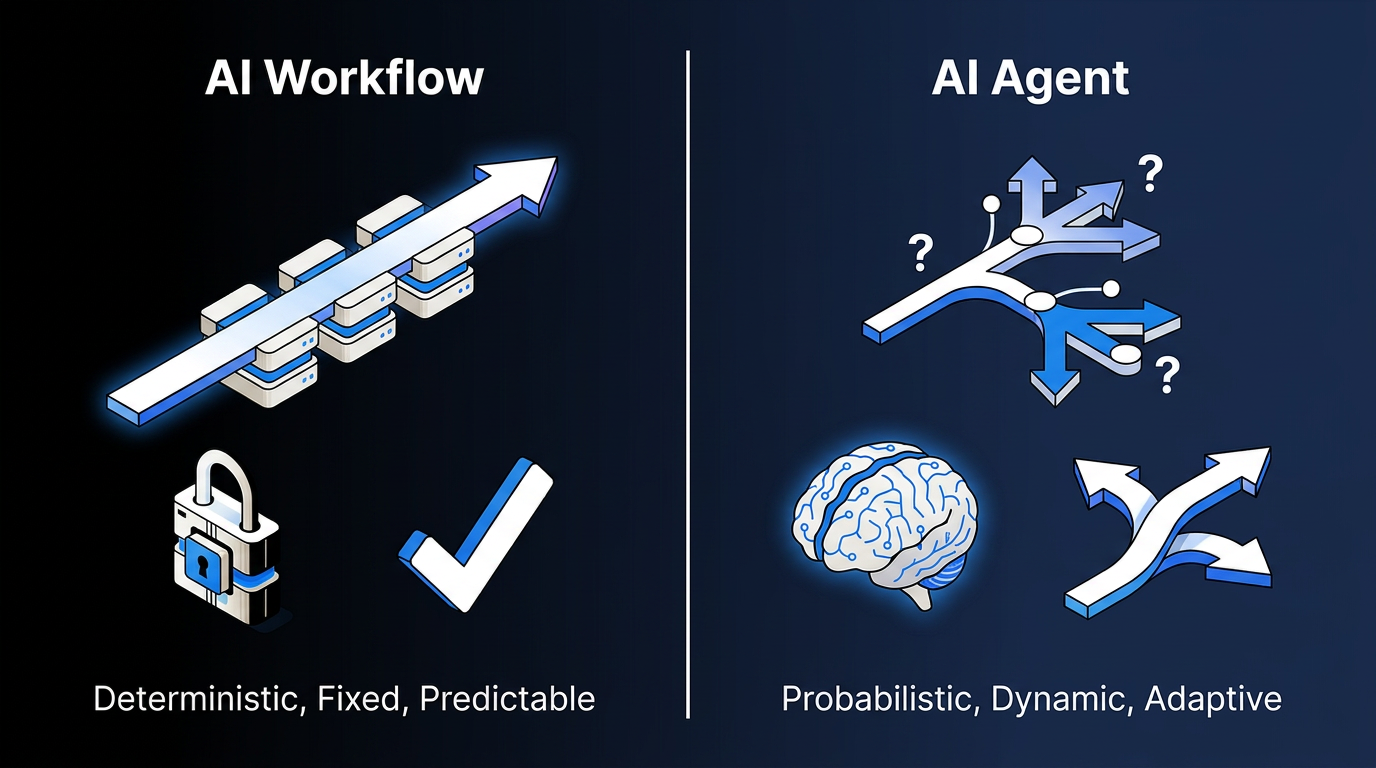
The dimensions below show how each approach behaves across execution, state, and governance, and how those behaviors shape what you can architect, govern, and budget for.
| Dimension | AI Workflow | AI Agent |
|---|---|---|
| Execution model | Deterministic, predefined paths | Probabilistic, dynamically determined |
| Goal vs. rule-driven | Follows explicit rules and sequences | Pursues goals, selects its own process |
| State architecture | Stateless sequences, fixed audit trails | Stateful, memory-enabled across steps |
| Tool invocation | Fixed application programming interface (API) calls, hardcoded integrations | Dynamic tool selection at runtime |
| Governance | Compliance structurally enforced | Requires runtime monitoring; risk management is less straightforward. |
Workflows and agents handle different categories of work. A purchase order approval needs to produce the same result every time. An agent reading a supplier contract to flag unusual terms needs flexibility and reasoning. Deciding which steps need deterministic logic and which benefit from adaptive intelligence can determine whether your AI deployment scales or stalls, because that decision sets where you enforce fixed process control and where you allow interpretation.
Why Agent-Only Approaches Collapse at Enterprise Scale
Agent pilots succeed in controlled conditions. The problems start when you chain agents together across production systems with real data, real compliance requirements, and real volume.
Cascading Reliability Degradation
Benchmarks and execution studies suggest agent reliability can fall sharply when teams measure consistency across repeated runs rather than a single successful attempt. Production systems, by contrast, typically operate within much tighter error tolerances. Single-run benchmark results can hide brittleness that surfaces in real operations.
When agents hand off to other agents, the problem compounds. Across 1,600+ execution traces from seven multi-agent frameworks, researchers identified 14 unique failure modes, ranging from improper task routing to verification failures. Multi-agent systems need architectural controls precisely because errors can cascade across multiple agents.
Missing Governance Infrastructure
Many companies expect to customize AI agents to their business needs, but far fewer appear to have mature governance models for the agents they deploy. The result is governance and operational risk.
Autonomous AI agents now have a separate risk framework covering goal hijacking, tool misuse, identity abuse, memory poisoning, cascading failures, and rogue agents. Those categories sit beyond standard large language model (LLM) security concerns, and the OWASP Top 10 for Agentic AI documents them.
Production Failures Outside Controlled Environments
Reports from analysts and the press describe autonomous systems making operational errors, ignoring constraints, or causing downstream conflicts once they leave the sandbox and hit production. The common thread is the same: an autonomous system running inside a process no one could fully supervise or audit.
The Real Cost of Running AI Agents at Scale
Chief financial officers (CFOs) often cite cost as a major reason teams reevaluate or cancel agentic AI projects, and those economic pressures may persist rather than fade. Per-task inference costs for frontier-model agentic workflows can run high even for routine tasks. Managed inference costs vary widely depending on the model, token usage, and deployment approach. The problem is structural: agents carry the full conversation context forward at every step, so token usage accumulates with each iteration.
Consensus-driven multi-agent approaches that aim to improve accuracy require 5 to 13x as much redundant execution, according to the same multi-agent failure-modes study, thereby multiplying the baseline cost before you've even addressed the underlying reliability problem.
Eighty to ninety percent of the total cost of ownership for AI deployments goes to inference, according to the FinOps Foundation. The architectural decision about what reaches the LLM is therefore the single largest cost lever your team controls.
The Hybrid AI Agent and Workflow Architecture Analysts Recommend
Analyst firms and enterprise architecture sources increasingly describe hybrid approaches that combine deterministic workflows with agentic components. Forrester formalized this as a named market category, Adaptive Process Orchestration, which Forrester defines as "an automation platform that uses AI agents and nondeterministic control flows, in addition to traditional deterministic control flows, to meet business goals, perform complex tasks, and make autonomous decisions."
Use deterministic logic for every step that follows fixed rules: data fetching, parsing, formatting, routing, state updates, logging, and API calls. Use an LLM when the task requires natural language understanding, reasoning, or inference. Use a human when the decision requires judgment, accountability, or domain expertise that can't be codified. Splitting the work this way keeps cost, control, and accountability aligned with the nature of each step.
Three design patterns built on this split tend to hold up in production:
- Deterministic backbone with agentic nodes: The workflow holds the structure constant. Designers insert LLM reasoning only at specific steps where it adds value that rules can't provide. The workflow governs the process; agents handle interpretation within it.
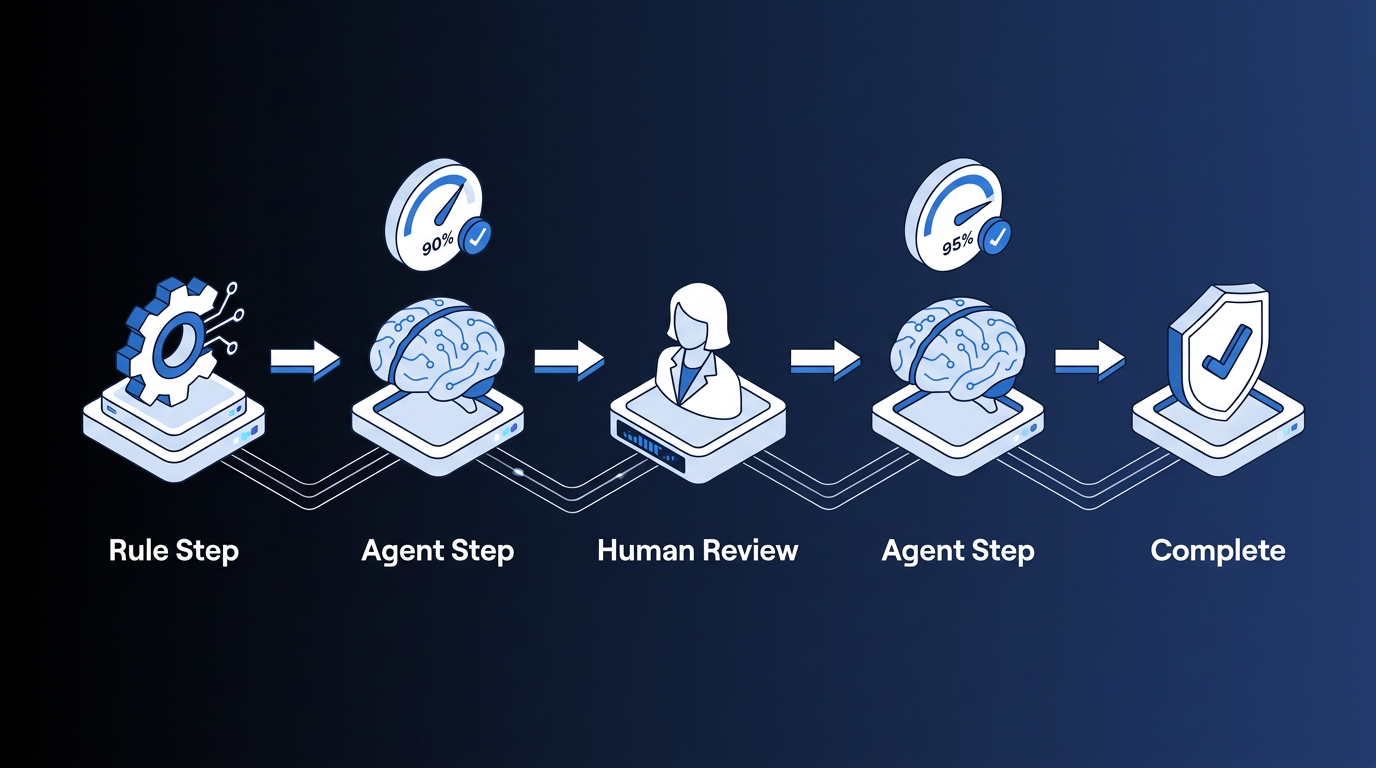
- Confidence-based escalation: An AI agent processes a task and produces a confidence score, a model-generated estimate of how certain the system is about its output. If the score falls below a configurable threshold, the workflow routes the task automatically to a human review queue. The workflow pauses, saves state, and resumes after human approval.
- Hierarchical orchestrator-worker: An orchestrator receives requests, decomposes them into subtasks, and routes each to the appropriate handler: a specialized agent, a rule-based module, or a human approver. Each handler reports back with a completion status or an escalation request.
All three patterns share a common trait: human-in-the-loop controls have to be built into the architecture from the start. For probabilistic AI systems, where outputs vary across runs, risk management is less straightforward, and oversight and control design matter more. Without those controls, the same flexibility that makes agents useful can also make outcomes harder to govern.
How to Evaluate an AI Agent vs AI Workflow for Your Specific Processes
Before selecting an architecture, audit your processes against three criteria that determine whether a step needs an agent, a rule, or a human.
- Variability of input: Does the step receive structured, predictable data (rule candidate) or unstructured content requiring interpretation (agent candidate)?
- Consequence of error: Is the step reversible and low-stakes (agent candidate) or high-stakes and subject to audit (rule or human candidate)?
- Volume and unit economics: At the volume this step runs, does the cost of an LLM call per transaction justify the flexibility it provides? Steps that run thousands of times daily on predictable inputs are prime candidates for deterministic logic.
Those criteria help prevent a common failure mode: using AI everywhere instead of where it changes the outcome.
For example, consider a procurement workflow. Three-way matching, the reconciliation of purchase orders, invoices, and goods receipts, follows fixed logic, so it belongs in a deterministic step. Reviewing a new supplier's contract for non-standard liability terms requires reading and reasoning, which makes it an agent step. Approving a purchase above a dollar threshold requires accountability, which makes it a human step. Revisit the audit as your processes change and as AI tooling continues to shift.
How Elementum Applies the AI Agent vs AI Workflow Decision to Enterprise Operations
The AI agent vs. AI workflow question is an architectural decision about which steps in your process require deterministic logic, adaptive intelligence, or human judgment. Getting this decision right determines whether an AI deployment scales with control or stalls under pressure from cost, reliability, and governance.
We built our AI Workflow Orchestration Platform for exactly this architectural pattern. Our Workflow Engine treats humans, business rules, and AI agents as first-class participants in every workflow. We call this the Trident. A deterministic backbone produces the same result every time, while AI agents handle interpretation and reasoning at specific steps. In deterministic orchestration, every step stays auditable, every decision stays accountable, and the platform logs every execution path. We pre-integrate the platform with OpenAI, Gemini, Anthropic, and Snowflake Cortex, with no LLM vendor lock-in. You can swap models, mix multiple models within a single workflow, and right-size every step for cost and capability.
Configurable confidence scoring determines when an AI agent can act autonomously and when the workflow requires human approval. We log every agent action and keep it revocable. Enterprise compliance controls govern every step, including SOC 2 Type II, General Data Protection Regulation (GDPR), and California Consumer Privacy Act (CCPA). Our Zero Persistence architecture ensures your data is always yours: we never train on it, never replicate it, and never warehouse it.
Production workflows can be deployed in 30 to 60 days because we connect to data where it already lives, rather than requiring a broad migration or warehousing first. Explore how we handle AI agent orchestration within deterministic workflows when you're ready to dig deeper.
The right architecture depends on which steps in your operation can run on rules, which need reasoning, and where human judgment must remain accountable. We work with enterprise teams to make those distinctions concrete inside live processes.
Contact us to map workflow orchestration into your architecture and the rest of your AI roadmap.
FAQs About AI Agent vs AI Workflow
These are the questions information technology (IT) and operations leaders most often raise when weighing how to architect their first agentic AI deployment.
How Should You Distinguish Between an AI Agent and an AI Workflow?
Distinguishing an AI agent from an AI workflow comes down to execution behavior. An AI workflow follows predefined execution paths, in which the same input produces the same output every time. An AI agent interprets goals and decides its own approach at runtime, meaning the execution path can vary across runs. For enterprise teams, the practical difference is that workflows enforce compliance at a structural level, whereas agents require runtime monitoring and governance controls that most organizations haven't built yet.
Should You Replace Existing Workflow Automation Like RPA or BPM With AI Agents?
Replacing robotic process automation (RPA) or business process management (BPM) with AI agents isn't the path most teams should take. Enterprise teams often treat them as complementary rather than as replacements. Start with structured workflow automation for high-volume processes with clear return on investment (ROI), then introduce AI agents for specific steps that require language understanding or reasoning. Hybrid architectures can automate more process steps than either approach alone.
When Should You Use an AI Agent vs. a Deterministic Workflow Step?
Use a deterministic workflow step when a task follows a fixed sequence with predictable inputs and outputs. Use an AI agent when a task today requires a human to read something, interpret context, and make a judgment call. As a working rule: agents handle decisions, automation handles routine workflows, and assistants handle simple retrieval.
Can Your Team Rely on AI Agents for Enterprise Production?
Relying on AI agents for enterprise production requires a governance infrastructure first. Many organizations still lack mature governance models for the agents they're deploying. Agents operating within deterministic workflows, with human-in-the-loop checkpoints, confidence thresholds, and full audit trails, can better meet enterprise reliability requirements. Agents operating autonomously without these controls introduce compounding risk at scale.
What Should You Know About an "Agentic Workflow" vs. a Standalone AI Agent?
An agentic workflow is a governed hybrid: a structured system that coordinates tasks toward a goal while using AI agents only where reasoning or flexibility is genuinely required. The AI handles interpretation at specific steps, while the deterministic workflow governs the overall process, enforces compliance, and maintains auditability.
Keep Reading
Deterministic vs. Probabilistic AI: The Enterprise Guide to Building Workflows That Scale
Human-in-the-Loop Agentic AI: How Enterprise Teams Deploy Agents Without Losing Control
The Enterprise Guide to Agentic AI for ITSM
What Is Agentic AI Orchestration? An Enterprise Guide
Human-in-the-Loop vs. Human-on-the-Loop: When to Use Each for Enterprise Workflows
How to Automate Procurement Workflows with AI Agents and Business Rules