
AI Agent Management: How Enterprises Govern Agents at Scale
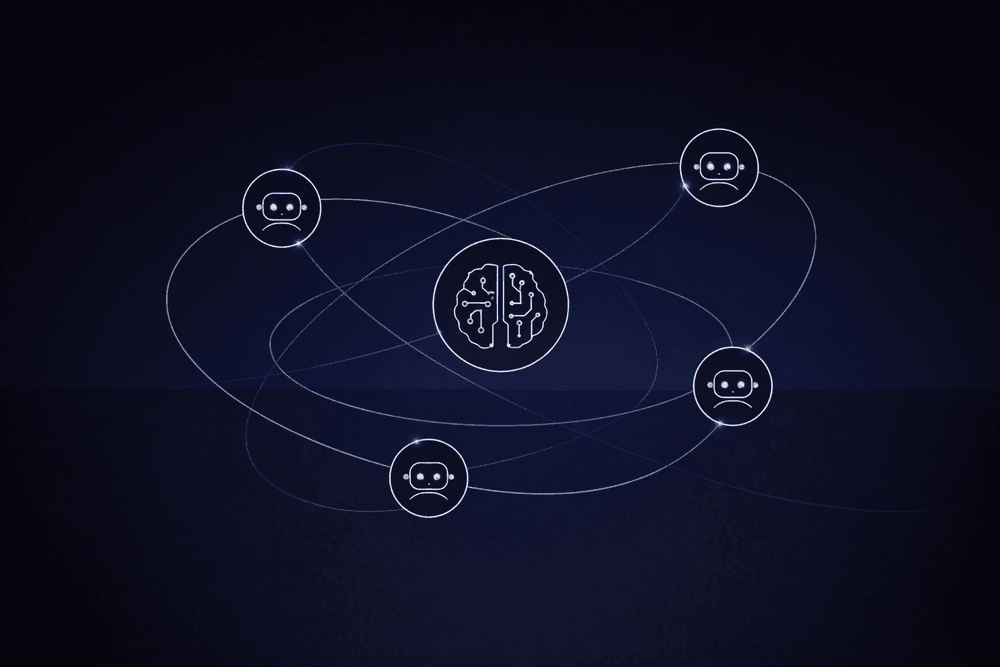
Your organization went from five AI agents in a pilot to 50 across business units in under a year. Now your CISO wants to know what data they're touching, your board wants to know who's accountable when one makes a bad call, and your audit team wants a log of every action taken on behalf of the business. That shift happens faster than most governance models are built to absorb.
AI agent management at enterprise scale requires governance across five domains: data access, workflow orchestration, identity and permissions, audit trails, and architectural flexibility. A gap in any one of them is enough to surface in the next audit cycle, regulatory review, or security incident.
Data-Centric Governance: The Foundation
Most AI agent governance problems start with data governance. Agents act on whatever data they can access, and if your data is scattered across copied datasets and shadow warehouses, your agents inherit that chaos and amplify it at machine speed. Getting the data layer right before scaling agent deployments is the single highest-leverage control you have.
In-Place Data Access
The first principle of data-centric AI agent management is that agents should query data where it lives. When data stays in place, you keep a clear record of where each query came from, with no shadow copies requiring separate governance cycles.
This runs counter to how many enterprise AI platforms operate. Platforms that replicate your data into separate infrastructure for processing create a new attack surface and a new compliance exposure with every copy. An in-place architecture removes that risk by design. The agent orchestration layer executes against your existing data environment and avoids extracting data into a vendor-controlled environment.
Data Access Controls at the Source
When an agent accesses a stale copy of a customer record in one system while the main record has been updated in another, you get inconsistent decisions at scale and no reliable way to trace the error: the governance failure data silos create when they run at machine speed.
Governing agents directly within your existing data platforms, rather than copying data to a separate processing environment, keeps access restricted to the specific tables you authorize with the exact permissions you grant. Your data team avoids new warehouses, sync jobs, and reconciliation work. Every extra copy adds another control point to secure and review, and the surface area grows with each one.
Deterministic Guardrails Before, During, and After Agent Interactions
AI agents are probabilistic systems whose outputs can vary across runs. For tasks like reading unstructured contracts or classifying support tickets, that flexibility is useful. For tasks like approving payments or generating compliance reports, it's a liability.
Deterministic guardrails add hard rules across three phases of every agent interaction:
- Pre-interaction (input): Personally identifiable information (PII) scrubbing and adversarial prompt detection run before any large language model (LLM) call. Rule-based checks are fast and add minimal latency.
- During interaction (in-loop): Guardrails are built into the execution logic. Any bypass path defeats the control and creates an unreviewed decision record.
- Post-interaction (output): Hallucination detection and redaction validate the agent's output before it reaches downstream systems.
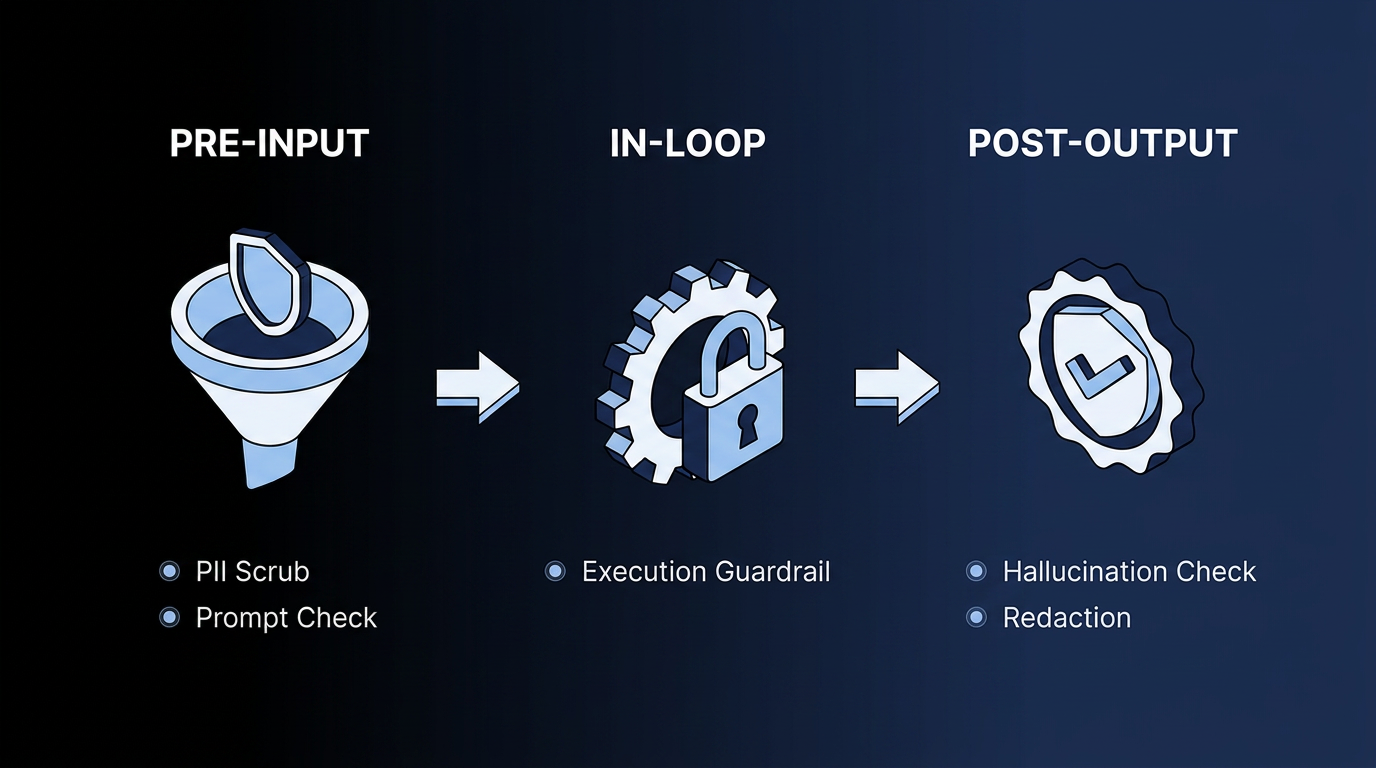
Organizations that build guardrails with clear governance, risk mapping, measurement, and response plans will identify failures faster, contain them to fewer downstream systems, and produce a reviewable record when audits or incidents require reconstruction.
Intelligent Workflow Orchestration
Enterprise AI deployments fail when the workflows surrounding agents lack structure. Without a governing orchestration layer, agents take on tasks they should hand off, skip steps that require human review, and produce decisions with no traceable record. Effective orchestration determines which steps go to AI, which go to deterministic logic, and which require a human, and enforces those boundaries at runtime.
Task Triage for Workflow Steps
Most enterprise processes don't need AI agents for every step. Routing a document or triggering a notification can run faster and be cheaper with deterministic rules. An AI agent adds value when the task is genuinely ambiguous, requires interpreting unstructured inputs, or operates across contexts that can't be fully anticipated.
Projects often stall when teams use agents for steps that deterministic logic could handle faster, cheaper, and more reliably. The workflow should route each step to AI reasoning, deterministic business logic, or human review based on risk and ambiguity. That routing decision is itself a governance mechanism that controls cost and risk.
Multi-Agent Coordination Under a Single Governed Process
Enterprise deployments often run multiple AI models from different providers, each with its own access scope and risk profile. Without a governing orchestration layer, those boundaries fragment and accountability gaps emerge.
Multi-agent coordination brings these agents under a single deterministic workflow. Each agent operates within defined boundaries, hands off to the next step with validated outputs, and logs every action for review.
Agent-to-agent communication across workflows is still an emerging area. Coordination protocols need a governing orchestration layer that evaluates deterministic rules first, routes to AI agents only when reasoning is genuinely needed, and enforces human-in-the-loop checkpoints for high-stakes decisions. Without that layer, coordination becomes another ungoverned surface.
No-Code Configuration for Operations Teams
If every change to an agent workflow requires a developer sprint, governance becomes a bottleneck. Operations teams need the ability to configure agent workflows, adjust decision thresholds, and modify routing rules without writing brittle code. Configurable decision thresholds determine when an agent can act on its own and when it must escalate.
A no-code, governed environment lets IT manage data access and security while business teams self-serve and build automation workflows. This separation keeps governance centralized while distributing operational agility to the teams closest to the work. Delays in workflow changes push teams toward workarounds outside governed systems, producing decisions with no audit record.
Identity and Machine Access for AI Agents
Existing identity and access management (IAM) systems were designed for human users with known roles, predictable access patterns, and auditable sessions, none of which describe how AI agents actually operate. They run continuously at machine speed, accumulate credentials across multiple systems, and can be manipulated through prompts to act in unintended ways.
Enterprises that discover AI access controls that were not production-ready after a security incident face a much harder remediation path than those that enforce controls before deployment.
Warehouse-Native Permissions
The most effective access control for AI agents uses the permissions infrastructure you've already built. Warehouse-native role-based access control (RBAC) applies existing database roles to govern what data an agent can read or act upon. Grant permissions to roles, never to individual users.
Your security team doesn't need to learn a new access control system for every AI deployment. The same RBAC policies that govern your analysts govern your agents. When an agent queries Snowflake, it operates under the same row-level and column-level security policies as any other data consumer. That keeps enforcement familiar and auditable, and it reduces policy drift.
Service Account Boundaries
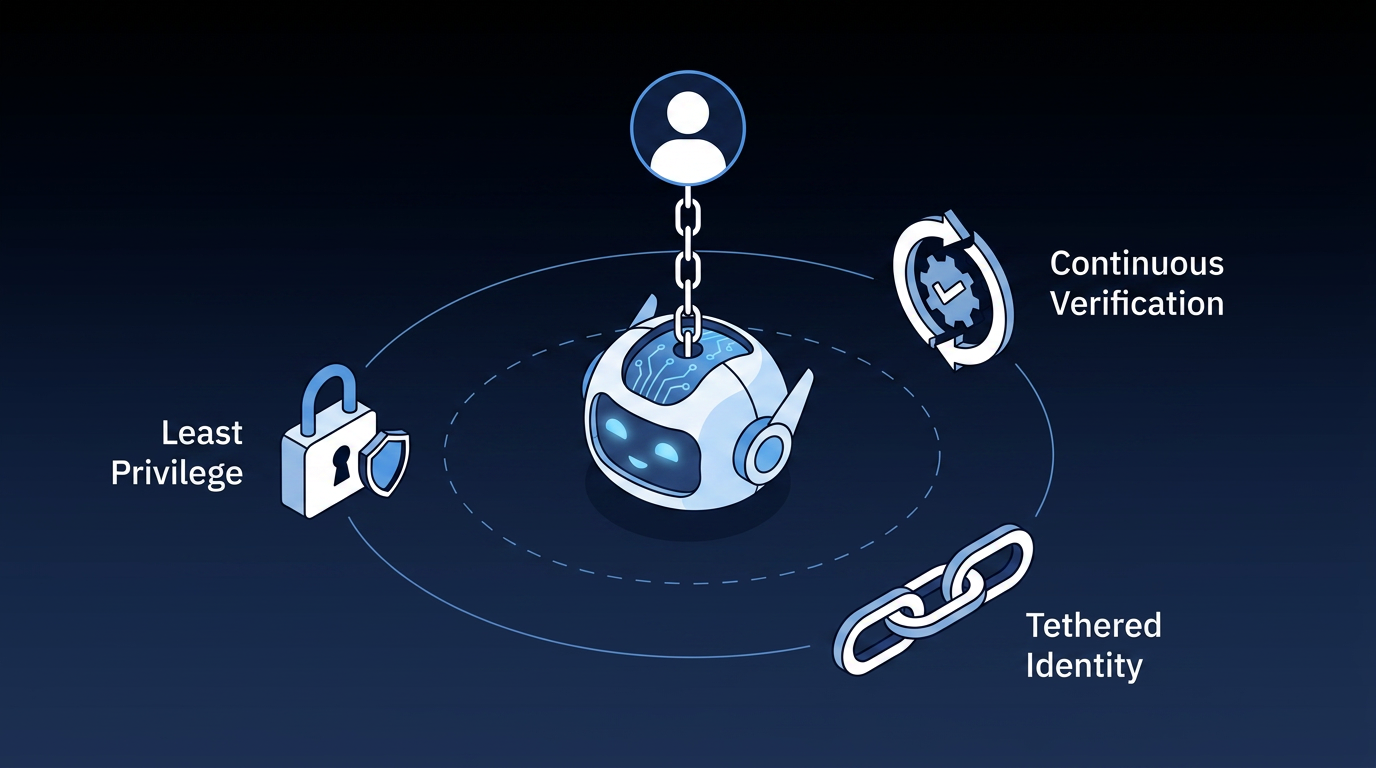
Every AI agent should operate under an isolated service account with scoped permissions and a clear audit trail. Without that boundary, one credential issue can expose multiple systems at once.
Service account design starts with least privilege: minimum permissions required for the specific task. An agent updating CRM records should have no access to financial systems or HR data. Permissions then need continuous verification as context changes, because static role assignments don't account for agents whose access needs vary by task.
Agent identities should also be tethered to human owners, so access is automatically decommissioned when someone leaves the organization, creating an auditable digital labor footprint in which every agent action traces back to both the machine identity that executed it and the human identity that authorized it.
Enterprise-Grade Audit and Traceability
Regulators and internal compliance teams increasingly require organizations to explain what an AI agent did, why it did it, and who authorized the action. That explanation is only possible if the logging architecture was built to support it from the start. If your AI agents operate in regulated or high-risk use cases, logging and human oversight requirements may already apply.
Reasoning Chain Mapping
When an agent makes a decision, you need to reconstruct the step-by-step logic it followed. Prompts, context inputs, model outputs, threshold decisions, and downstream actions should all be logged as linked records. Without reasoning chain mapping, your compliance team can't answer the most basic audit question: why did this agent make this decision?
Configurable decision thresholds determine when agents act autonomously and when the workflow requires human approval. Logging those thresholds alongside each agent decision creates a reviewable record of every autonomous action and every escalation. When a team has to investigate an error or justify a decision to an auditor, that record is the difference between a resolved incident and an open one.
Dual-Audit Trails
A complete audit trail records two identities for every action: the business user who initiated the request and the agent identity that executed the work. This dual-trail architecture supports internal compliance requirements and strengthens the review record for external audits.
AI agent deployments without structured logging leave security teams unable to answer what an agent accessed on behalf of which user when an incident occurs. Dual-audit trails make every agent action attributable, reviewable, and revocable.
Architectural Flexibility and Vendor Independence
The AI vendor market is changing so quickly that the model you deploy today may not be the right choice in 18 months. Locking your workflows to a single provider's API creates architecture debt that compounds as your agent footprint grows. The architecture decisions you make now determine how much optionality you retain.
Model-Agnostic Architecture
Model preferences and platform economics shift on shorter timelines than most enterprise procurement cycles, which means organizations that build tight API dependencies on a single provider accumulate architectural debt faster than they can renegotiate contracts.
Model-agnostic architecture treats the LLM as a swappable component within a governed. Your workflow logic, governance policies, and audit trails should persist unchanged when you swap one model for another. Pre-integration with multiple providers means that model selection occurs at each workflow step, driven by cost and compliance requirements.
Aging Middleware and the Case for Governed Digital Workflows
Older SaaS platforms that layer AI onto earlier architectures can make future flexibility harder because those systems were designed for a world where humans were the only participants in a process.
Replacing aging SaaS middleware with lean, governed digital workforces requires an orchestration layer that runs alongside existing enterprise infrastructure. The transition happens workflow by workflow, with each migrated process governed by the same deterministic controls from day one, reducing disruption while tightening control.
How Elementum Future-Proofs Your Enterprise With AI Agent Management
AI agent management at scale is an architecture problem, not a policy problem. Policies without enforcement in the execution layer leave audit trails with holes. The five domains covered above are interdependent for exactly that reason: a sound data layer makes identity controls enforceable, and strong identity controls are what make audit trails meaningful when something goes wrong.
That is the architecture Elementum is built for. Our Zero Persistence architecture means we never train on, replicate, or warehouse your data. Our CloudLinks query your data in real time where it already lives inside Snowflake, BigQuery, Databricks, and Redshift, so every agent action runs against the authoritative record, not a copy. Our Workflow Engine evaluates deterministic rules first, routes to AI agents only where reasoning adds value, and routes to humans at every checkpoint that warrants one. Agent actions are logged with configurable decision thresholds, creating a reviewable record of every autonomous action and every escalation.
We are pre-integrated with OpenAI, Anthropic, Gemini, and Snowflake Cortex. You can swap models, mix multiple models within a single workflow, and add new providers without rebuilding governance logic. Zero LLM vendor lock-in. Human-in-the-loop checkpoints stay intact regardless of which model runs beneath them.
Many of our customers start with one governed workflow, prove the control and the savings, and expand from there.
Among orchestration platforms in this category, we have the production track record for replacing legacy SaaS at enterprise scale, with named customers including Sanofi, Snowflake, Under Armour, and Elevance Health.
Contact us to map governed AI orchestration into your enterprise architecture and the rest of your AI roadmap.
FAQs About AI Agent Management
These are the questions CISOs and IT leaders most often raise when deploying AI agents at enterprise scale.
How Do You Maintain Human Oversight When AI Agents Operate Autonomously?
Maintaining human oversight when agents operate autonomously starts with configuring approval thresholds based on action type and risk level. Irreversible actions such as payment approvals and data deletions should require mandatory human approval gates. For lower-risk actions, monitoring-after-execution models with full audit logs and revocation capabilities provide oversight without creating bottlenecks.
Who On Your Team Is Accountable When an AI Agent Makes a Mistake?
Accountability when an AI agent makes a mistake requires named human roles mapped to each agent's actions before deployment. The business owner who sets the agent's objectives and the IT team that configures its permissions each carry a defined responsibility. Without that structure, agents operate in an accountability vacuum that no incident response process can resolve.
How Do You Prevent AI Agent Sprawl Across Your Enterprise?
Preventing AI agent sprawl starts with a live inventory of every deployed agent, including those built outside central IT. Define ownership and lifecycle management policies: who built it and what data it accesses. Add clear decommissioning triggers. Without that inventory as a starting point, shadow AI adds breach cost and operational risk with no visibility into what is running or on whose behalf.
What Data Governance Do You Need in Place Before You Deploy AI Agents?
The data governance foundations needed before deploying AI agents include data quality, access control, lineage tracking, and consent frameworks that are already operational, because agents running on fragmented or stale data from older ERPs, spreadsheets, and disconnected CRMs don't slow down to check for errors; they propagate them at machine speed.
How Do You Govern Multi-Agent Systems Where Your AI Agents Coordinate With Each Other?
Governing multi-agent systems where agents coordinate with each other requires defining the authorization scope for each agent in the chain, including any sub-agents an orchestrator can spawn. Every delegation must operate within the scope of the original human authorization.
Keep Reading

AI Guardrails: How to Govern What AI Agents Can Access, Decide, and Do
How to Control and Monitor the Output of AI Agents

Human-in-the-Loop Agentic AI: How Enterprise Teams Deploy Agents Without Losing Control

What Is AI Agent Sprawl And How to Contain It

Are AI Agents Deterministic? Understanding Predictability in Agentic Systems
The Enterprise Guide to Monitoring AI Agent Usage Patterns in Organizations