
How AI Workflow Automation Runs Business Processes
Back-office operating cost is the result a COO or CEO owns. Across most enterprise AI programs, the earnings impact hasn't moved.
Only 37% of respondents say AI has contributed to earnings before interest and taxes (EBIT) in McKinsey's 2026 State of AI survey, essentially unchanged from 2025. AI high performers are the roughly 6% who attribute at least 5% of EBIT to AI. Nearly three-quarters of them have fundamentally redesigned workflows, against one-quarter of other respondents.
AI is a board level mandate. It is not yet an operating model. Many deployments stop at a copilot that drafts, summarizes, or recommends, while a person still runs the process.
AI workflow automation uses AI agents inside a process to resolve the ticket, pay the invoice, or close the HR request. At enterprise volume, that model needs control, because one ungoverned decision can repeat across every case. A deterministic workflow decides, step by step, what an agent interprets, what runs as fixed logic, and what a person approves.
Distinguish AI Workflow Automation From RPA
Robotic process automation (RPA) repeats a person's screen steps by fixed rules, and AI workflow automation adds AI agents for the steps that need reading and reasoning. Expecting one to do the other's job can stall a program.
RPA scripts a bot to repeat what a person does on a screen: it opens the portal and copies the field before pasting it into the ledger. The logic follows if-then rules written in advance, so it runs the same way every time. That fixed design gives RPA its reliability and sets its ceiling.
An RPA bot handles exceptions by stopping. A supplier sends an invoice in a new layout, or a ticket uses wording the rules didn't expect. The bot hands the whole case back to a person.
RPA covers the share of a process that never varies. Back-office work also includes exceptions and unstructured inputs, which sit outside what if-then rules can express.
An AI agent interprets. Give it a goal and context, and it decides how to proceed. The same input can produce different outputs based on what the agent reads.
That behavior suits extracting terms from a contract or classifying a free-text request. Fixed logic should decide whether a payment clears. The deterministic versus probabilistic line, between fixed logic and AI interpretation, runs through every back-office process.
AI workflow automation respects that line: agents handle steps that need reading and reasoning, while fixed logic handles the rest. The process runs through native integrations and APIs.
Avoid Chained AI Agents in Long Processes
A common design uses a chain of agents, where one reads, one decides, one acts, and one checks. It works in a short demo, but in a long purchase-to-pay process, reliability falls and cost rises.
Compounding Error Reduces Reliability
Step reliability multiplies across a sequence. Even with high reliability at each step, end-to-end reliability falls sharply when many independent steps run in order.
A study found that errors in earlier model calls make later mistakes more likely, and that scaling model size alone doesn't remove the effect. One bad extraction early in an invoice run stays in the context all the way to the payment decision.
"I don't want to have Salesforce agents, speaking to ServiceNow agents, going to speak to SAP agents," Sanofi's Chief Digital Officer, Emmanuel Frenehard, told Fortune, describing vendor-by-vendor agent handoffs. Each handoff adds a step. Each step creates another place for an error to enter and for agent sprawl to grow.
Inference Cost Climbs With Each Added Agent
Inference cost is the compute cost of generating model responses. It rises with every model call and retry, so every agent added to a chain raises it. The measure that matters is cost per successful result rather than token counts, according to Gartner.
A step that never needed a model adds tokens and no result. A chain of agents pays that premium at every step.
Checking that a purchase order number exists and applying an approval limit take only a lookup and arithmetic. Run those tasks through a reasoning model and you pay a token bill for work a rule handles without a model call, plus variance in the result.
Govern AI Agents With a Deterministic Workflow
AI agents cannot operate safely or reliably in enterprise environments without structured oversight, according to Gartner. A workflow engine supplies that oversight and keeps both compounding error and inference cost in check.
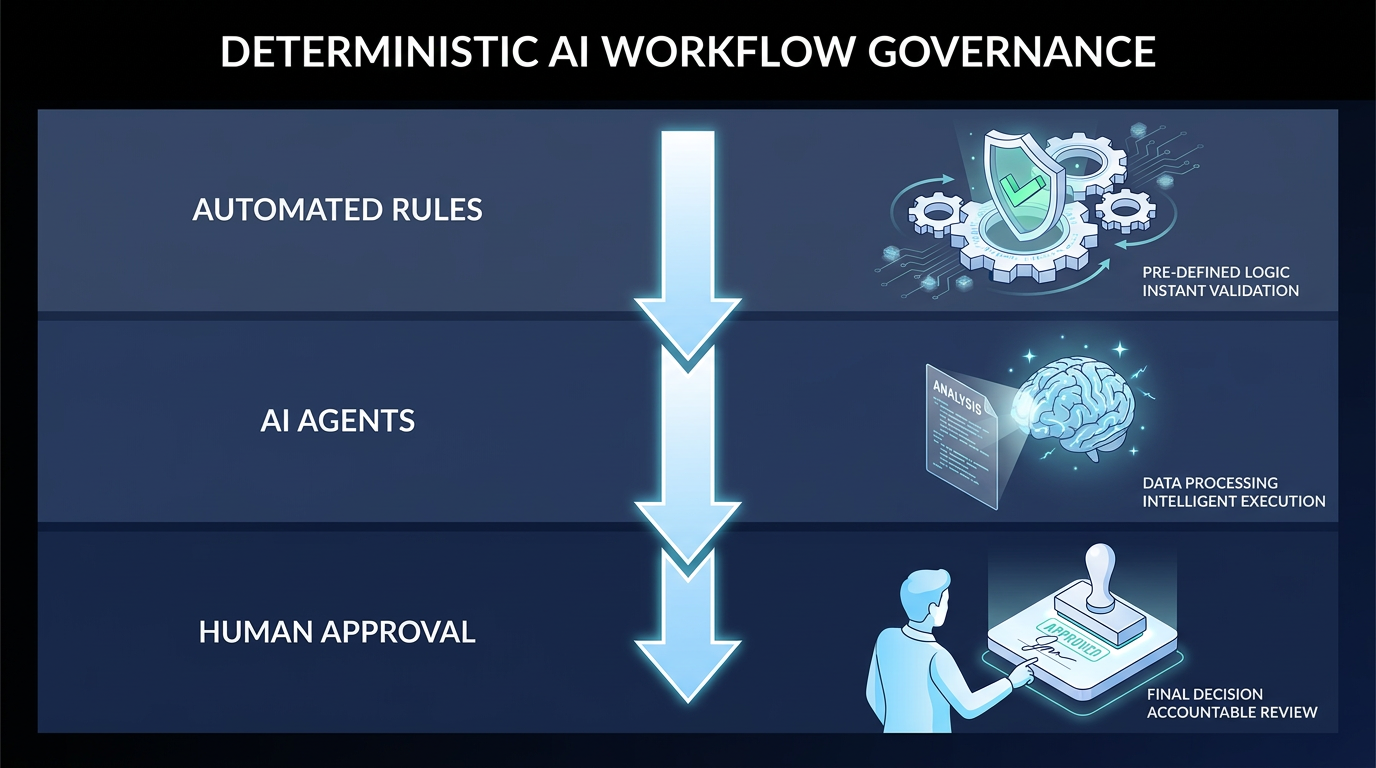
In a deterministic workflow, fixed inputs follow the same sequence and gates, even when an agent's output varies. Agents reason inside the engine's controls, and people make the judgment calls. The engine calls an agent only when something needs to be read or interpreted.
- Rules first: When a step has one correct answer, automated logic handles it: the three-way match that checks an invoice against its purchase order and receipt, approval limits, and routing by cost center, with no model call and no variance.
- Agents for interpretation: Under the engine's guardrails, an AI agent extracts terms from a supplier contract or classifies a ticket against your taxonomy. It can also draft a pre-call plan from account history.
- People for judgment: The person who owns the function approves an exception or releases a payment above a limit. That person also signs off an employee status change.
Decision thresholds draw the line between agents and people. For example, an enterprise might set an invoice-variance tolerance. The agent reconciles anything inside it, while anything outside it goes to a named reviewer with the full case attached.
The finance controller configures the threshold for that process, and the engine enforces the gate.
A checkpoint enforced by the engine won't advance the run until the approval lands, even when a model would route around an instruction in its prompt. This human-in-the-loop design holds at volume. Higher volume raises the stakes of every ungoverned decision.
The system logs every AI decision, with the agent that ran, the workflow it ran in, and the result it produced. For a COO, that trail answers the auditor's question and the board's question in one record. Why did this invoice get paid, and how often does the agent get it right?
Elementum's Workflow Engine follows this split. It puts automated logic and people in one flow with AI agents, and the engine decides which of the three acts at each step.
Start AI Workflow Automation Where It Pays Off
Start with IT service management, then move to procurement, HR, finance, and sales operations. These processes run at high volume and have a clear resolution event. Each mixes fixed logic with interpretation, so rules can avoid model calls on steps that don't need them.
Keep the first application to one process, with one owner and one number. That scope makes ownership and results visible before the rollout expands.
- IT service management: IT teams see 60% of Tier-1 tickets resolved with no human touch. Password resets and access requests are rule-heavy, and the agent's job is to read the request rather than decide policy.
- Procurement: Finance teams get a 3x faster invoice cycle. Matching is logic, reading the invoice and contract is interpretation, and releasing an exception is judgment.
- Sales execution: Sales teams gain 40% more selling time per rep. Pre-call research and post-call updates involve reading and drafting, which an agent can complete before the rep opens the account.
- HR service delivery: HR teams see 80% of HR requests resolved with no human touch. Agents can answer policy and benefits questions against the handbook, while leave requests and status changes route to the owner.
Sanofi applied the same one-process-first principle in a different order: it began with software license management, reinvested the savings into procurement, and is expanding into CRM. Its internal assistant, Concierge, is built on Elementum. Frenehard described the architecture: "With Elementum, we built AI workflows straight onto the data lake, and there's not many people doing that."
Evaluate AI Workflow Automation Platforms on Five Controls
Judge an AI workflow automation platform by what it controls once a process runs at volume. Ask each vendor to show five controls on one of your own processes:
- A deterministic engine: The workflow sets the sequence and the approval gates, and an agent's output can't skip a step.
- Decision thresholds your team sets: The process owner decides which agent outputs proceed and which go to a named reviewer.
- A record of every AI decision: Each entry names the agent, the workflow, and the result, so an auditor can trace any outcome.
- Model calls only where a step needs one: Lookups and arithmetic run as fixed logic, which ties token spend to the steps that need reasoning.
- Data that stays in your data platform: The platform queries data where it lives, so no vendor-held copy builds up.
A platform that passes all five keeps the first process auditable and the second one cheaper to add. Elementum's tools comparison covers specific products side by side.
Roll Out AI Workflow Automation One Process at a Time
Roll out AI workflow automation in four steps, and finish them on one process before the next process starts. The sequence keeps the first application small enough to measure and lets its result fund the second.
- Baseline the process. Record today's volume, cycle time, and cost per case, so the first result has a number to beat.
- Assign each step to a rule, an AI agent, or a person. Steps with one correct answer become rules, steps that need reading become agent steps, and irreversible or high-value decisions stay with a person. No model call then lands on a step a lookup can handle.
- Set decision thresholds before go-live. Decide which agent outputs proceed and which go to a named reviewer, because a threshold added after an incident comes too late for the cases it missed.
- Run in parallel, then expand. Send live cases through the new workflow and the old path together, compare the results with the baseline, and start the next process once the first one holds.
Scale AI Workflow Automation Without Agent Sprawl
A governed application replaces one process in your stack and becomes the starting point for the next. Chained agents add error and spend, and the legacy applications they sit on keep their license cost in place. Each pilot adds a line to the budget, and none removes one.
Another year of ungoverned pilots adds licenses and tokens without changing the EBIT line. On Elementum, the Workflow Engine keeps agents on the steps that need interpretation and logs every AI decision.
Elementum replaces legacy SaaS back-office applications process by process rather than automating steps inside them, and current systems stay sources of record. Elementum is the Enterprise AI Apps Platform. We have the production track record for replacing legacy SaaS at enterprise scale, and global enterprises such as Sanofi, Under Armour, and Elevance Health run on Elementum.
Contact us to bring governed enterprise AI apps into your enterprise application estate and the rest of your AI roadmap.
Frequently Asked Questions About AI Workflow Automation
AI workflow automation combines variable AI reasoning with fixed process control. The right design assigns each step to the tool or person that handles it best.
How Does AI Workflow Automation Work in Your Business?
AI workflow automation runs a business process from intake to completion, with AI agents on the steps that need reading or interpretation, fixed logic on the steps with one correct answer, and people on approvals. A deterministic workflow sets the order and logs every AI decision.
What Does AI Workflow Automation Look Like in Your Back Office?
In accounts payable, an AI agent reads the supplier invoice and contract, fixed logic runs the three-way match and approval limits, and a named reviewer releases any invoice outside the variance tolerance.
When Should You Use RPA or AI Agents for a Workflow Step?
RPA remains the right tool for a stable screen task with no exceptions. AI agents fit steps that involve unstructured inputs or variable context. A deterministic workflow can run both, along with people, inside one process.
Can Your AI Agents Run a Process Without a Workflow?
Not reliably in a long process. A rules-based workflow follows fixed steps and produces the same result for the same input. An AI agent reasons over a goal and chooses its own path, so its output can vary, and errors compound across chained steps. AI workflow automation puts the agent inside the workflow, which fixes the path and confines reasoning to the steps that need it.
Keep Reading
Beginner's Guide to Agentic Automation: What Is Agentic Automation?

7 Best AI Automation Platforms for Enterprises in 2026
7 Best AI Workflow Automation Tools in 2026
Business Process Automation Benefits: Cost, Speed & Quality Gains

What is Business Process Automation? Enterprise Use Cases and Best Practices for 2026
Business Process Automation vs. AI-Driven Automation: Breaking Down the Differences