
How to Measure ROI from Agentic AI Implementations

Your board approved the agentic AI budget. Your CFO now wants numbers. Yet the numbers many programs produce don't hold up: 95% of enterprise generative AI pilots deliver no measurable profit-and-loss (P&L) impact. More than 40% of agentic AI projects will be canceled by the end of 2027, driven by escalating costs, unclear business value, and inadequate risk controls.
Deployments are more likely to clear finance review when they follow a measurement discipline. Before go-live, they document a baseline. Every cost enters the model, including tokens and AI governance. They report savings as line items a controller can audit. Design the return on investment (ROI) proof before deployment so finance can test the result.
Establish the Baseline Before Building the Business Case
If you don't know what a process cost before you deployed the agent, you can't demonstrate what changed after. Reconstructing the baseline after a pilot makes later measurement less reliable. Measure before launch.
Before go-live, document the human baseline for every task the AI will handle. Record process times, error rates, and cost per task. Cost the labor at fully loaded rates. These rates cover total employer-paid compensation rather than base salary. Apply actual adoption rates rather than theoretical coverage when projecting the value of released capacity. Projected coverage often differs from observed usage early in a rollout, so finance may discount optimistic adoption assumptions.
Pick the function-level key performance indicators (KPIs) finance already trusts:
- IT support: Cost per ticket by channel, mean time to resolution, and the share of Tier-one tickets resolved with no human touch.
- Accounts payable: Invoice cycle time, cost per invoice, and touchless processing rate (the share of invoices handled with no human involvement).
- Procurement workflows: Spend under management, sourcing cycle time, and savings as a share of addressable spend (spend procurement can influence).
- Sales: Share of rep time spent in direct selling versus administrative work.
These metrics show finance how workflow performance changes cost, capacity, or revenue. Track them at the use-case level first so the underlying math remains visible. Company-wide P&L impact comes later, once individual workflows have proven their math.
Count Costs Beyond the License
Tokens are the text units a model processes. Inference is the computation used to generate an answer. Their consumption is where agentic AI budgets can break.
An agentic workflow can plan, call tools, retry, and refine its output. Each model interaction adds token cost. Answer checks and rework also consume tokens. Because the first response accounts for only part of the cost, later interactions must remain visible in the estimate.
AI inference costs per agentic workflow will rise more than fivefold through 2028, so a business case built on today's per-interaction cost understates tomorrow's. Price every retry and refinement pass so the forecast reflects actual consumption.
Usage-based pricing compounds the problem. A vendor may charge per seat, per conversation, or per agent action. Because the AI line scales with adoption in each case, it can push the forecast off course every quarter.
We charge a flat annual fee per application. We have no per-seat license, per-conversation charge, or per-action charge for AI agents. Customers still pay for the tokens their processes consume. Elementum’s deterministic engine skips the model call on steps that don't need one. It routes the steps that do to a model appropriate to the task rather than the most expensive one available.
The total cost of ownership (TCO) model should include human-in-the-loop controls and compliance review, plus the infrastructure required for audit trails. These governance costs belong in the model from day one, not layered in after a regulator or auditor asks for evidence.
Include integration labor, recurring maintenance, agent usage monitoring, retraining, and applicable compliance work. Add them to the TCO model for every year the system stays in production. This prevents recurring costs from disappearing after the initial business case.
Governance belongs in the benefit model too. Use documented control evidence and complete run logs when estimating external audit hours, and model incident and regulatory risk, since that exposure may not show up in a savings model until it materializes.
Prioritize Hard Savings Over Averaged Time Savings
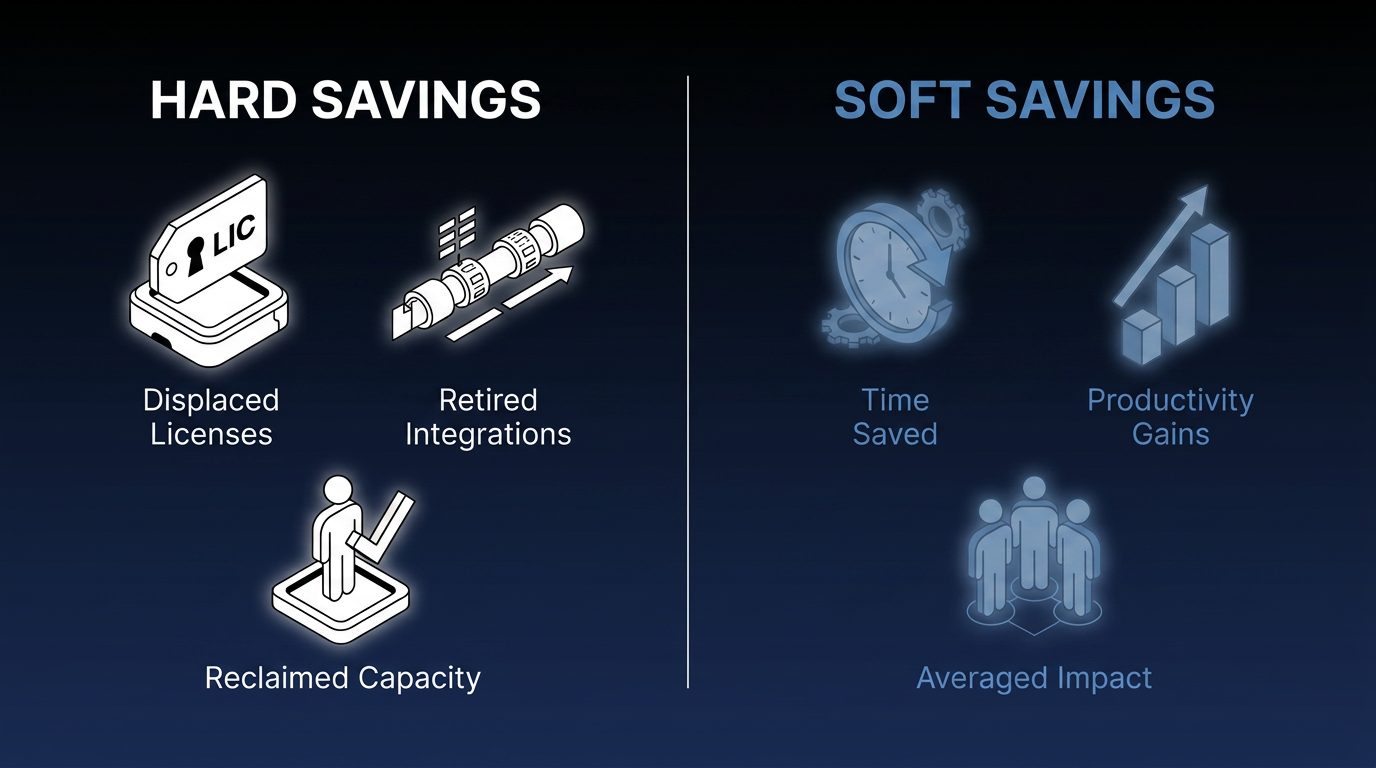
Averaged productivity estimates often don't convert directly to P&L impact. Count fewer required hours as hard savings only when they cut paid labor. This can mean lower contractor spend or overtime, or less planned hiring. Otherwise, report the hours as reclaimed capacity. Capacity is different.
Gains can also vary by role. Validate productivity at the workflow and user-group level rather than relying only on a workforce-wide average. This shows finance where the measured change occurred.
Tool displacement is real evidence, but it's incomplete on its own: a team can reduce its use of an adjacent tool once an agentic workflow takes over a task, yet the company can still keep every system it had and pay for it. Finance should book savings only after licenses or spend leave the company's own budget. Book only facts.
The replacement ledger records displaced licenses and the digital labor full-time equivalents (FTEs) it reclaims. Retired integration and pipeline maintenance create a separate line.
When an agentic application replaces a legacy system rather than layering on top of it, those items become auditable. Finance can build each line from the company's own baseline. External service-desk and accounts-payable benchmarks can then help a controller test the cost-per-ticket and cost-per-invoice math.
Sanofi is running this replacement pattern across enterprise functions. Its internal assistant, built on our workflows, is used across roughly 80% of the company's global workforce, and the goal is for AI agents to autonomously resolve up to 80% of employee IT support requests, a target projected to save the company €10 million a year.
That kind of target produces a clean audit trail: the resolution rate and the license spend it displaces are both numbers finance can verify against the pre-deployment baseline.
Review ROI Frequently and Keep Results Audit-Ready
An ROI number that no one re-checks stays a projection. Review early deployments on a fixed, frequent cadence. The finance review team can then correct or stop underperforming workflows before costs compound.
The finance review team should compare monthly booked savings against the approved base case, since that base case is the yardstick the program was funded against.
Build a counterfactual too. A counterfactual estimates what results would have looked like without the agent. Seasonality and headcount changes move the same metrics, as do parallel projects. Test the counterfactual.
Finance teams can test the counterfactual in two ways. In either case, the comparison must control for major differences. Hold out a comparable team or region on the old process for a quarter. Or compare the same month year over year, with volume and headcount normalized. Finance can then see what the metric did without the agent.
Present the business case as scenarios rather than a point estimate. Include conservative and optimistic cases around the base case. State the token-consumption assumptions explicitly. This approach is more credible than one precise number resting on variables you'll only observe in production. Those variables include exception rates and the volume of grounded searches, where the model retrieves company data to answer a request.
Put those scenarios in a format finance reviewers already use. Forrester's Total Economic Impact method, for example, reports a three-year risk-adjusted present value that discounts future benefits and reduces estimates to reflect uncertainty.
Finance can verify a reported saving later only if it can reproduce the evidence. That evidence includes the baseline and run records, with cost inputs documented alongside them. Deterministic workflows keep the sequence, rules, and approval gates consistent for the same input. Any AI agent they invoke may still produce variable output, which makes logging and review necessary. Every run should also leave a trail. Keep the trail.
Our Workflow Engine records the invoked agent, the workflow, and the result for every request. Finance can verify it. For example, a saving reported in one quarter can then withstand internal audit testing two quarters later.
Ground Your Agentic AI ROI in Displaced Spend
Establishing the baseline and counting the full cost side is what keeps a deployment out of the cancellation numbers cited above. Distinguish hard savings from soft savings. Put the baseline and full cost model in place before deployment. Finance can use documented displaced spend to justify phase two.
Elementum is the AI-native enterprise application platform: the AI-native replacement for legacy SaaS. Each application we deploy replaces a system or a manual process, and we run fewer systems with every deployment. The ROI story is built from licenses removed and digital labor FTEs reclaimed.
Our Workflow Engine sequences the steps. It calls AI agents only where reasoning is required. The engine logs every agent action and allows teams to revoke it. Human-in-the-loop checkpoints keep judgment with the people who own it. The engine runs inside your own Snowflake or Databricks tenant. It retains nothing at the execution layer once a run completes.
Your data is always yours. We never train on, replicate, or warehouse your data.
We have the production track record for replacing legacy SaaS at enterprise scale, including Sanofi's expansion from software license management into procurement and CRM workflow replacement.
Contact us to map workflow orchestration into your cost-reduction architecture and the rest of your AI roadmap.
FAQs About Agentic AI ROI
These are the questions finance and operations leaders most often raise when building an agentic AI business case.
How do you calculate ROI for agentic AI?
You calculate agentic AI ROI with the standard formula: ROI = (total benefits − total costs) / total costs × 100%. Total benefits are verified savings or value measured against a pre-deployment baseline.
Total costs include build and integration labor, token consumption, governance and human-in-the-loop review, and ongoing maintenance in addition to the license. Count reclaimed capacity as a hard benefit only when it reduces paid labor, contractor spend, overtime, or planned hiring.
How quickly can you see ROI from agentic AI?
You can see ROI from agentic AI fastest in a high-volume workflow with a clean baseline and a tracked cost per interaction. Enterprise-wide P&L impact takes longer. Stage the rollout so early wins that finance can verify and fund the later phases.
Why might your agentic AI project fail to show ROI?
Missing baselines, undercounted costs, and soft-savings business cases can prevent a project from showing ROI. A documented pre-deployment baseline helps finance determine whether a workflow changed costs or output.
What KPIs should you track for agentic AI value?
Track the function-level metrics finance already trusts: cost per resolved ticket and autonomous resolution rate in IT support, invoice cycle time and touchless processing rate in accounts payable, spend under management in procurement, and the share of rep time spent selling. Assign each one a named owner and a documented baseline. The owner resolves data disputes and explains variance when finance reviews the result.
Keep Reading

How Companies Use Agentic AI Across the Enterprise
The Enterprise Guide to Agentic AI for ITSM

Agentic AI for ITSM: A Practical Architecture for Enterprise IT
What Is Agentic AI Orchestration? An Enterprise Guide

Agentic AI vs. Generative AI: Why Enterprise Workflows Need Both

Beginner's Guide to Agentic Automation: What Is Agentic Automation?