Agentic AI for ITSM: A Practical Architecture for Enterprise IT
Enterprise agentic AI projects fail for a few predictable reasons: costs overrun forecasts, the promised value fails to materialize, and the guardrails arrive too late to matter. Each problem is harder to solve inside IT operations. CMDB data quality has frustrated automation projects for a decade; legacy ITSM platforms were never designed for AI agents, and existing governance models were built before AI began making decisions on its own.
If you're building a business case for agentic AI in your IT service management (ITSM) environment, the question worth answering up front is what production-ready looks like for your stack. The pressure to answer is already on, with 63% of IT leaders actively integrating agentic AI into their existing applications and processes.
What does Agentic AI Mean for ITSM?
Traditional ITSM automation runs on if-then rules. A ticket lands; the system matches it against a routing table, and it goes to the SRE on call or whoever owns that incident type. Chatbots wrapped a conversational layer around that logic, but they still kicked the ticket to a human the moment anything fell outside their script. Exceptions, escalations, and anything the rules hadn't anticipated still went to people.
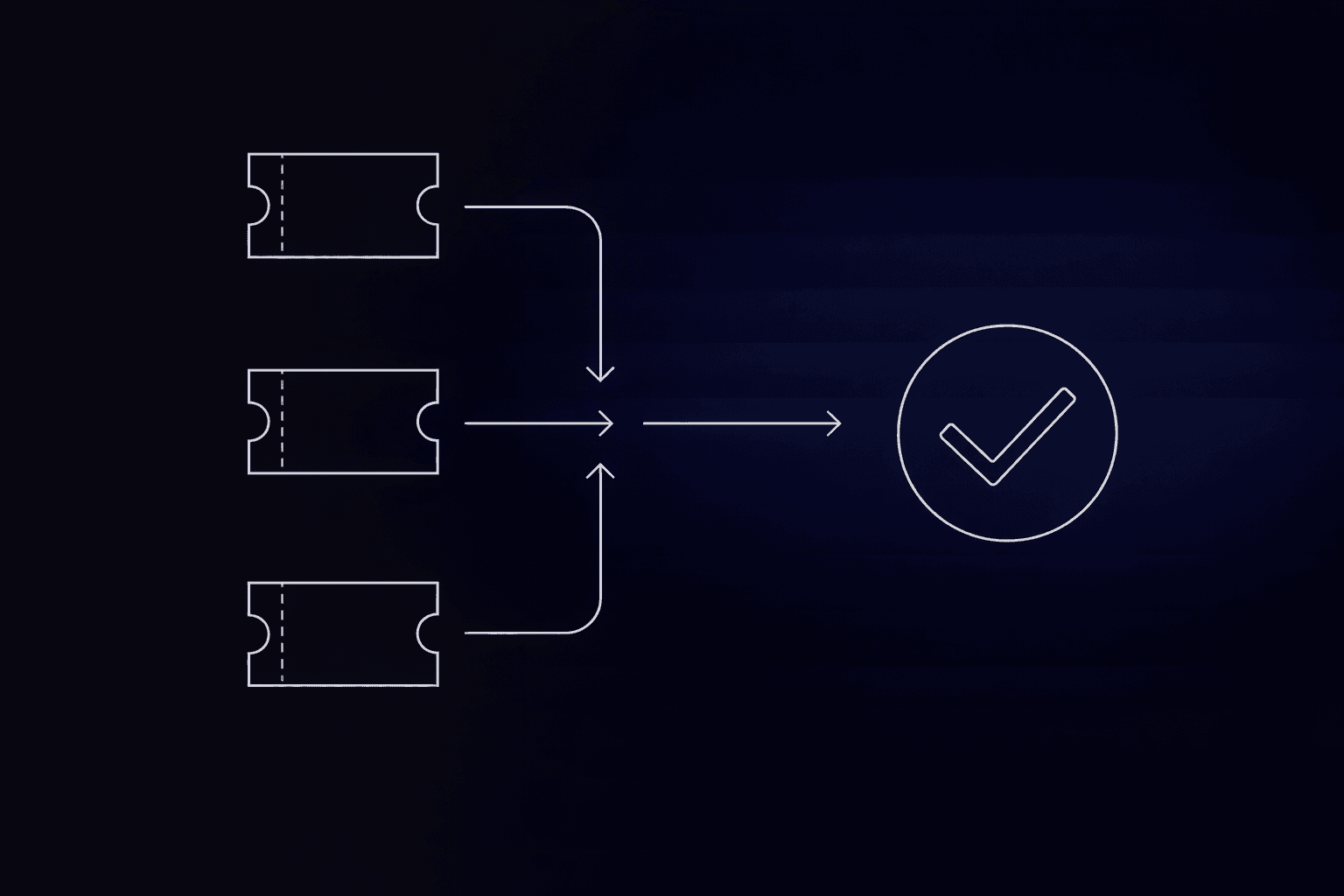
An agentic system handles those cases differently. It reads the incident, pulls context from the involved systems, decides what to do, takes action, checks whether it worked, and closes the ticket. There's no routing table behind it; the agent is reasoning through each step.
That reasoning is also where the governance problem starts. Two tickets that look identical on the surface can take different paths through the agent depending on what data it pulled, which model it called, and how the model interpreted the inputs. A password reset agent that occasionally takes an unexpected path is not a crisis. A change agent that occasionally takes an unexpected path against production infrastructure is a different conversation.
The buyer-side risk is sorting real agentic products from agentwashing. Plenty of products in this category are chatbots and AI assistants with a new label. Before signing anything, get the vendor to walk through a scenario where their agent acts on its own, with no human in the loop, and verify that what they're describing actually matches what the product does in production.
Focus Agentic AI on Real ITSM Value
Three ITSM use cases dominate the agentic AI conversation: incident triage, knowledge management, and change management. They are not equally mature. Build your business case around those with the strongest production evidence, and treat the others as pilot territory.
Incident Triage and Resolution
Incident triage is the most production-ready of the three. Agents can read alerts, pull configuration data from the systems involved, run diagnostic queries, execute remediation steps, and close tickets without a human in the path. The business case is well understood: high ticket volume, repetitive resolution patterns, and a long history of automation in this category make unit economics easier to model. Most credible enterprise references in the agentic ITSM space are here. If your business case starts with a single use case, this is usually the right one. Incident-related workflows are where most teams will see the first returns.
Knowledge Management and Ticket Deflection
Knowledge management is often the lowest-risk place to start. The agent surfaces existing knowledge base articles or generates an answer aligned with the user’s question, allowing the user to resolve the issue without filing a ticket.
Because the agent retrieves information rather than executing changes, the risk profile is contained: a bad answer is a bad answer, not a broken production environment. The business case is straightforward: every deflected ticket is a ticket your service desk doesn’t have to staff. The hardest part is often getting the knowledge base structured, up to date, and searchable enough for an agent to use effectively.
Change Management and Vendor Claims
Change management is where vendor claims often get furthest ahead of production reality. Any agent that can modify production infrastructure can also break it, so most enterprise change workflows still require human approval or supervision.
When a vendor claims agentic AI for change management, ask whether the system actually executes changes or merely generates suggestions for review. Ask for a named customer using it in production, and ask whether a human approval step is still required. If neither answer is concrete, the product likely does not do what the pitch implies.
Mitigate the Risks That Sink ITSM AI Projects
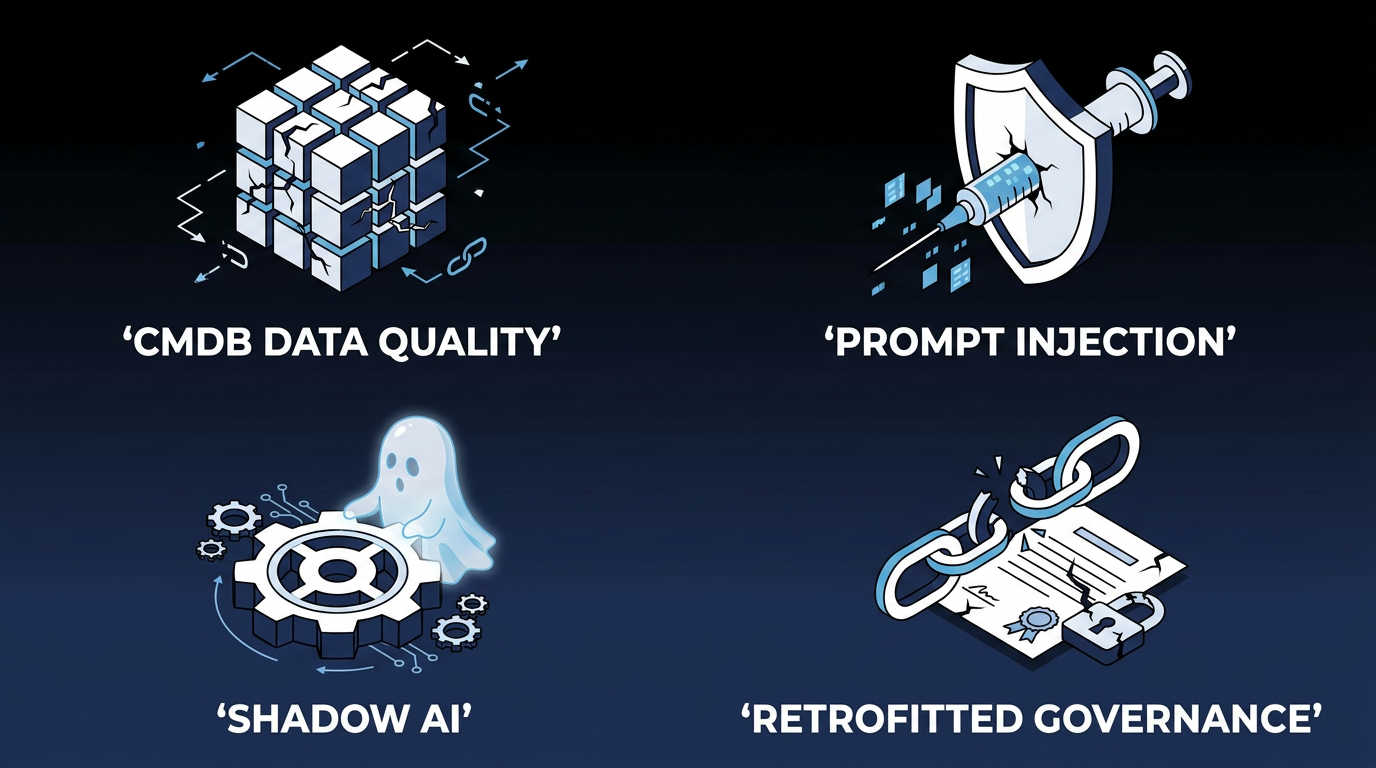
Most ITSM AI failures stem from conditions around the model: bad data, exposed attack surfaces, ungoverned agent proliferation, and governance designs that don't account for autonomous action. Four risk categories are worth covering in any business case.
- CMDB data quality determines success or failure: it is the prerequisite most enterprise architects treat as non-negotiable, and the configuration management database often makes the difference between a working agentic ITSM rollout and an expensive one that doesn't ship. Legacy environments often contain fragmented or inconsistent CMDB data, undermining agent reliability long before any model-level issue surfaces.
- Prompt injection is a service desk attack surface: OWASP identifies prompt injection as a top risk for large language model applications, and ITSM deployments are exposed whenever they process untrusted input and trigger downstream actions. A malicious ticket submission can instruct an agent to escalate privileges, exfiltrate configuration data, or execute unauthorized changes. Agents that read emails, tickets, and knowledge base articles are all exposed to external content that may carry embedded adversarial instructions.
- Shadow AI has evolved into shadow operations: The threat has shifted from what users disclose to an AI to what autonomous agents can do on their behalf. Most enterprise users still run personal, unmanaged AI applications outside IT's view, and shadow agents that gain high-privilege access create risks to enterprise integrity without development, security, and operations (DevSecOps) oversight.
- Governance can't be retrofitted: Forrester's AEGIS framework lays out governance controls across multiple domains for governing agentic AI, and its core argument is direct: point-in-time audits and static policies can't manage systems that reason and act independently. Teams need to build governance into the orchestration layer from the beginning, with human oversight running alongside it rather than bolted on after deployment.
Each of these risks compounds the others. A weak CMDB, a prompt-injection-exposed agent, ungoverned shadow agents, and retrofitted governance are the architecture most failing programs share. The business case has to address all four, not just the most visible one.
Use Deterministic Orchestration Alongside Agents
Any ITSM workflow operating at enterprise scale needs deterministic execution at its core. Applying agentic reasoning to tasks that don't require it generates unnecessary compute expenditure and introduces variability where consistency is required.
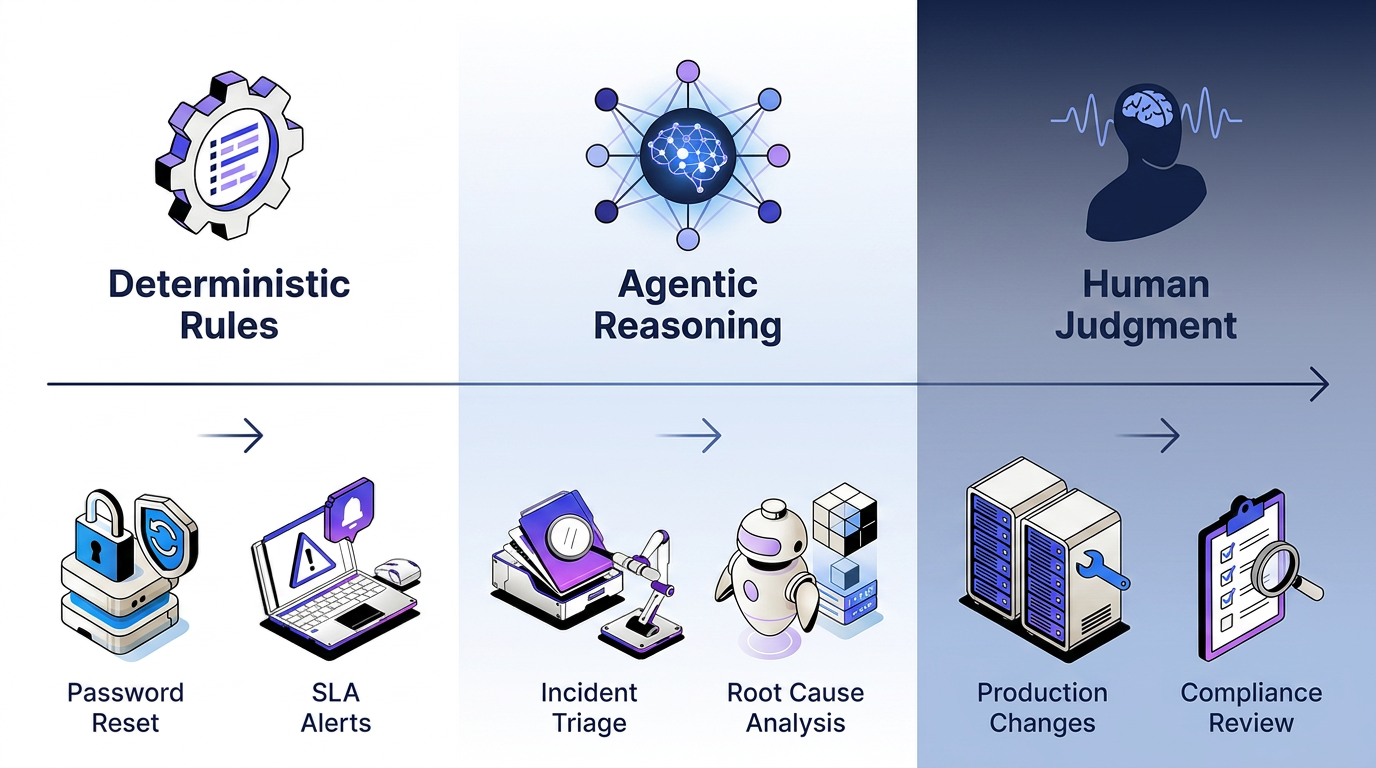
The right architecture for enterprise ITSM maps each workflow step to the appropriate handler. Password resets, Service-Level Agreement (SLA) breach escalation, and compliance-mandated approval chains need deterministic execution: same input, same output, every time. Incident triage across heterogeneous systems, root cause analysis, and unstructured document interpretation need agentic reasoning. High-stakes decisions involving production systems, privilege changes, or regulatory reporting typically require human oversight for critical actions. Keep that split in place because it protects consistency in low-risk work and control in high-risk work.
Guardrails belong in the same architectural layer as the workflow itself, not as a wrapper applied after deployment. In a service desk context, that means input validation runs before the agent reads a ticket, action whitelists run before the agent calls a tool, and audit logging runs on every decision the agent makes. Bolted-on guardrails fail the moment an attacker finds a path around them, which is most of the time.
Model-level vendor lock-in compounds the architectural risk. Foundation model deprecation, repricing, and acquisition can turn AI vendor dependency into an operational single point of failure. That risk is distinct from historical platform lock-in, and most ITSM procurement frameworks haven't addressed it yet.
How Elementum Applies Agentic AI to ITSM
Only a small share of enterprises have deployed AI agents, while broad expectations for deployment in the next two years create a compressed decision window. Organizations that delay pilots while governance decisions remain unresolved may lose time relative to faster-moving competitors. Organizations that deploy agents without governance risk being in the half that fails.
A practical path runs through architecture. Deterministic workflows should govern the process. Agentic reasoning belongs where it adds value. Human judgment should stay in place where stakes demand it. That architecture also needs to be model-agnostic because the model you choose today may be deprecated, repriced, or acquired tomorrow.
We built our AI Workflow Orchestration Platform and AI Agent Orchestration layer on this principle. Our deterministic Workflow Engine (Trident) treats humans, business rules, and AI agents as equals in any process. Configurable decision thresholds determine when AI acts autonomously and when human review takes over.
We pre-integrate the platform with leading model providers, which means you can swap models without rebuilding workflow logic. Our Zero Persistence architecture addresses the data sovereignty concerns that block many ITSM AI deployments: we never train on, replicate, or warehouse your data. CloudLinks query it in real time through encrypted connections where it already lives. We maintain compliance with SOC 2 Type II, GDPR, CCPA, SOX, and HIPAA requirements.
Many of our customers start with one workflow inside ITSM, prove the savings, and expand into adjacent processes across IT, HR, and finance. We have the production track record for replacing legacy SaaS at enterprise scale, with named customers including Sanofi, Snowflake, Under Armour, and Elevance Health.
Contact us to map agentic AI orchestration into your ITSM architecture and the rest of your AI roadmap.
Answer Common Questions About Agentic AI for ITSM
IT and operations leaders most often raise the following questions when evaluating agentic AI for ITSM.
How Does Agentic AI Differ From the Chatbots Already in Your ITSM Platform?
Agentic AI differs from chatbots in autonomy and scope. Chatbots use scripted conversational flows and escalate to humans for resolution. Agentic AI reasons about context, plans multi-step actions, executes them across systems, and validates results autonomously.
What's One of the Biggest Risks in Your ITSM AI Deployment?
One of the biggest risks in ITSM AI deployments is CMDB data quality, which most enterprise architects treat as a prerequisite for any successful rollout. Agents that make decisions on incomplete or inconsistent configuration data produce compounding errors, not compounding value.
Can Agentic AI Handle Change Management Autonomously?
Agentic AI cannot fully autonomously handle change management in most enterprise environments today. Production platforms already support automated risk scoring, impact analysis, and approval routing. Publicly available named enterprise case studies with quantified outcomes specifically attributable to agentic AI or autonomous change-management capabilities remain limited. High-risk changes should retain human-in-the-loop approval for architectural design, not be used as a workaround.
How Do You Avoid High Failure Rates in ITSM AI Projects?
To avoid the failure rates that sink most ITSM AI projects, start with data readiness, specifically your CMDB. Fragmented or inconsistent underlying data undermines agent reliability before any model-level issues arise. Route each workflow step to the right handler: deterministic rules for predictable tasks, agentic reasoning for ambiguous ones, human judgment for high-stakes decisions. Adopt a model-agnostic orchestration layer so you aren't locked into a single vendor's AI roadmap.
What Should You Ask ITSM AI Vendors Before Committing?
Before committing to an ITSM AI vendor, ask whether their agents are task-based or reasoning-capable. Ask for named enterprise references with quantified outcomes. Ask how their orchestration layer handles model swaps, audit trails, and human-in-the-loop thresholds. If the answers are vague, the product likely leans more toward an AI assistant than toward agentic AI.