
Run an ITSM Migration Off ServiceNow in Five Phases

Your ServiceNow renewal is nine months away. The first quote repackages your IT service management (ITSM) tiers around AI nobody on your team asked to buy. The quote makes renewal materially more expensive through its ProPlus and new AI-native SKUs. That uplift adds cost to a decade of customizations nobody fully owns. Your CFO also wants to know what each resolved ticket costs.
Start there.
Most ServiceNow alternatives content stops at a vendor list. The harder question is how to leave one module at a time without degrading service for a single day. You also need to prove the savings in numbers finance already trusts.
Assess Renewal Pressures Before Choosing ServiceNow Alternatives
Four pressures hit at renewal. Each one compounds if you sign another multi-year term before addressing it.
Term pricing: ServiceNow consolidated its legacy tiers into Foundation, Advanced, and Prime. It also bundled Now Assist into the new packaging. AI cost now rides on licensed fulfillers, the staff assigned to fulfill requests. That includes people who never open an AI feature. The new packaging carries a new price. The stated uplift is the opening position.
Metered AI consumption: Now Assist uses consumption-based metering, and testing can count toward use. Each tier includes a finite pool. An agentic workflow can draw down that pool faster than a single incident summary. That makes the AI line hard to forecast before you've run it.
Customization drift: An upgrade may touch a base data object your team also modified. The upgrade can then leave a record that someone must review, merge, or revert. Over a decade, the people who made those changes leave. Their reasons leave too. A quick change can become a multi-week effort. An upgrade can become a funded project.
Supported-model limits: ServiceNow's knowledge base defines an unsupported release as anything older than the current family and the one before it. Fall to N-2, and ServiceNow stops providing patches, hotfixes, service-level agreement (SLA) coverage, and defect coverage. The end-of-life upgrade then becomes mandatory. Two release families a year put every customized instance on an annual upgrade clock.
The platform still works. Its economics changed.
The executive who owns the instance may say an exit is impossible because of the configuration management database (CMDB) and the range of processes built on it. The constraint is real. ServiceNow is harder to displace for exactly that reason. That is why the plan below never moves the CMDB.
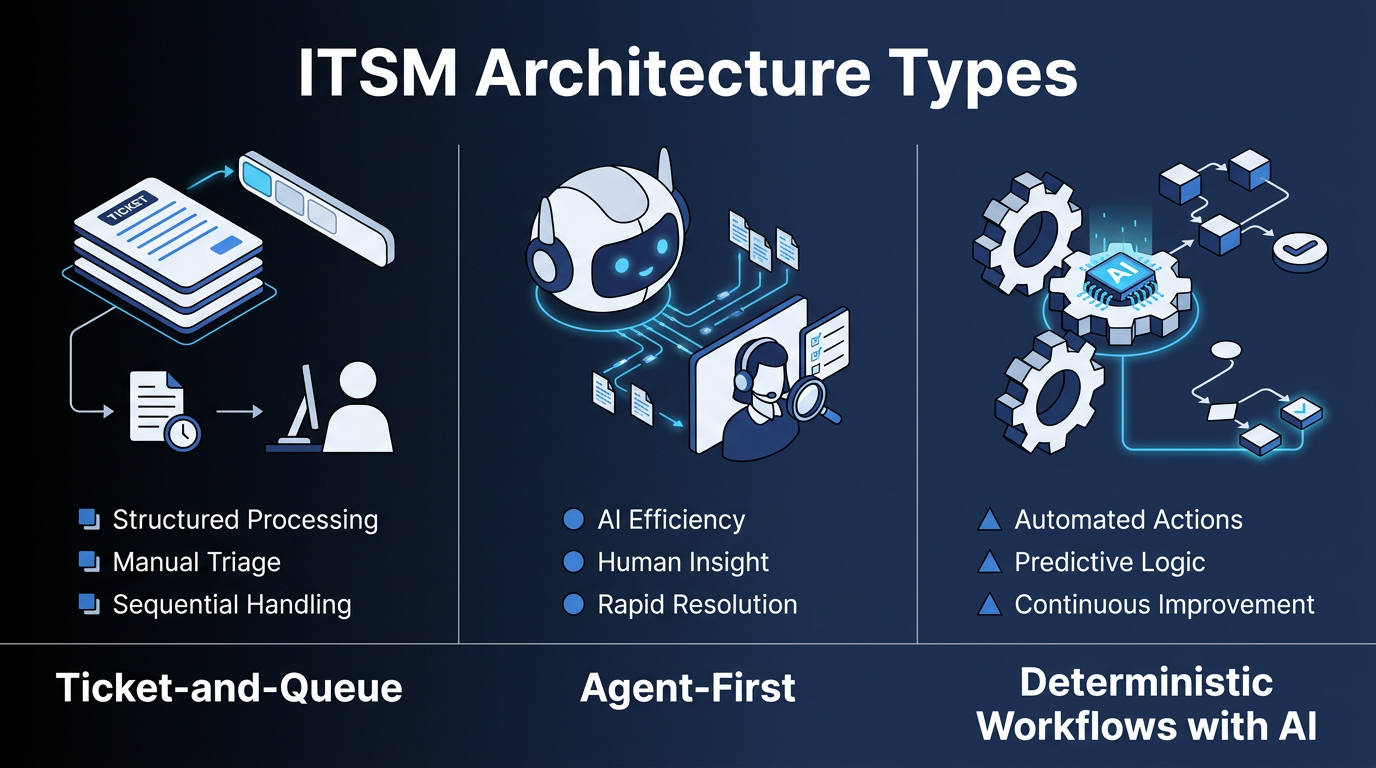
Choose Among Three Replacement Architectures
- Ticket-and-queue ITSM suites: A user logs a request, fixed escalation rules route it, and a person works it to resolution. The process is consistent and auditable. But every request still enters a human queue, so cost per ticket moves with headcount.
- Agent-first service desks: A large language model (LLM) reads the request and uses tools in a loop until it resolves the issue. This approach can handle ambiguous inputs. Repeatability is weaker because published agent benchmarks show success rates falling when the same task must succeed on every attempt. A sequence of autonomous steps is also hard to audit afterward.
- Deterministic workflowswith AI at interpretive steps: A fixed process owns SLA timers, routing, approvals, and the audit trail. It calls an AI agent only when a step needs interpretation. Examples include classifying a request against your taxonomy or processing an attached document. The workflow sends exceptions to a named reviewer.
"Volume does not justify agents; contextual intensity does," explains the guidance on when to agentify. Design the high-volume floor of an IT desk, including password resets and status checks, as deterministic workflows without a model call. Keep it bounded. Agents earn their inference cost on the smaller share of work that requires interpretation.
The third architecture also gives the incumbent's owner a clearer review path. SLA clocks, routing, and change-freeze windows stay deterministic. The workflow calls the agent inside those controls.
Follow the Five-Phase Migration Plan
Each phase has an exit test. Without one, the migration scope can grow before teams prove the previous phase.
Phase One: Inventory and Sequence Modules
Inventory what ServiceNow actually does for you. This work shows the module boundaries, operating costs, and dependencies that set the migration order.
List modules in use, ticket volume by category, SLAs, escalation rules, knowledge articles, CMDB classes, system integrations, and every customization with a living owner. Count licensed fulfillers against active ones. That difference is your first negotiating lever and your first potential saving.
Sequence by module, never by vendor footprint. Service request and incident management go first because they carry the volume and labor. Incident management can use high-level services and support groups before the CMDB is pristine.
Change, problem, and asset follow once teams clean the catalog and configuration data.
Start with boundaries.
Exit test: a signed module list with a named owner per process, a baseline cost per ticket by tier, and a sized CMDB read integration.
Phase Two: Design the Target Workflow
Design the target process from the service consumer's point of view. The IT Infrastructure Library (ITIL) incident management guidance, updated in 2023, tells practitioners to view incidents from that perspective rather than hide behind SLAs.
Give every existing customization one of three verdicts: rebuild it as a deterministic step, hand it to an AI agent at an interpretive step, or retire it.
Next, mark every decision a person must make. Production access, a change outside its window, and anything irreversible each need a human-in-the-loop checkpoint with a named approver. No exceptions. These checkpoints prevent an automated path from making a high-impact decision without accountable review.
Exit test: a process map where every step is labeled rule, agent, or person.
Phase Three: Migrate Data Selectively and Keep the CMDB
Move only the records the new process needs. Recent closed history moves for reporting. Keep older closed incidents in the legacy instance in read-only mode so auditors can still reach them.
Teams close open tickets in ServiceNow while every new ticket starts in the target. This approach prevents migrated records from triggering SLA notifications again.
The CMDB stays put. ServiceNow remains its source of record, and the new workflow reads that data in place. Prove this design early. Pulling a complete configuration item, such as a server or application, through ServiceNow's APIs may require several chained requests. Size that integration in Phase One.
A full CMDB migration can break relationships or duplicate configuration items. It also repeats a costly ITIL practice without proving that the target process needs a copy.
Sanofi's own Concierge for Field, built on the Elementum platform, runs on governed Snowflake data.
Exit test: the target process resolves a live incident using CMDB data read from ServiceNow, with no CMDB copy made in the target.
Phase Four: Run Systems in Parallel and Stage Cutover
A staged cutover protects service levels. Each migrated slice must prove itself before traffic expands.
Run both systems for a set window per module. Route a defined slice of traffic through the new process, such as one region or one request category. ServiceNow keeps the rest.
Compare resolution times and reopen rates against the Phase One baseline. Then widen the slice.
Expand carefully.
Count resolved tickets rather than deflected ones. A request that returns three days later can cost more than the ticket it supposedly avoided.
Exit test: baseline resolution times held for two consecutive weeks on the migrated slice, with no critical issues open.
Phase Five: Stabilize Each Module Through Hypercare
Hypercare stabilizes each module before the next migration begins. Without it, unresolved issues from one module can spill into the next rollout.
Keep a dedicated lead on the ground during each module's migration and hypercare window. Document every validation and task status as the team closes it. Set the window based on migration complexity. It may run from a few weeks to a quarter.
Exit signals are issue volume back at baseline, users working without added support, and no critical issues open. Then the next module starts.
Build the Business Case a CFO Will Accept
Build the case from your own baseline rather than a vendor-commissioned return on investment (ROI) study. Nestlé's CFO set the standard in a McKinsey interview: "I've got no patience for cost avoidance and dressing up a saving that you were going to make anyway as an additional saving." Three budget lines can meet that standard.
- Modules retired: Reduce the fulfiller licenses tied to service request and incident work at the renewal date. Include any assist reduction your pooled contract allows. Every other module stays until its replacement is live.
- Support capacity freed: Price Tier-1 volume that now resolves without a person at your fully loaded Tier-1 cost per ticket. List end-user productivity time separately as a soft benefit. It becomes hard savings only when it changes the budget.
- Deployment cost avoided: Include deployment, upgrade, and customization-remediation spending already in next year's budget for the retired modules. Add funded admin hours that teams will no longer spend maintaining them. Count only budgeted spending; anything else is the dressed-up saving the Nestlé quote rejects.
Use hard numbers.
Together, these lines treat labor as reclaimed capacity rather than removed headcount. The capacity flattens hiring needs over time instead of reducing costs on day one. The goal is for those savings to fund the next module.
Systems of record have a 36- to 60-month buffer because regulatory requirements and centralized data slow replacement. That timeline fits a module-by-module pace. The replacement target is the application layer. The CMDB and enterprise resource planning (ERP) system both stay put.
Use a Phased Plan to Make ServiceNow Alternatives Credible Before Renewal
A module-by-module exit makes ServiceNow alternatives credible. Each retired module connects to tested service levels and finance-ready savings. Run Phase One before the quote arrives. You will enter the renewal with a baseline, a module list, and a tested exit route for the two modules carrying the labor.
Elementum is The Enterprise AI Apps Platform. It replaces legacy SaaS back-office systems rather than automating steps inside them. It runs complete business processes end to end.
For IT service management, Elementum runs service request and incident management as named processes. The plan above targets those two ServiceNow modules. ServiceNow's CMDB and your other systems of record stay in place.
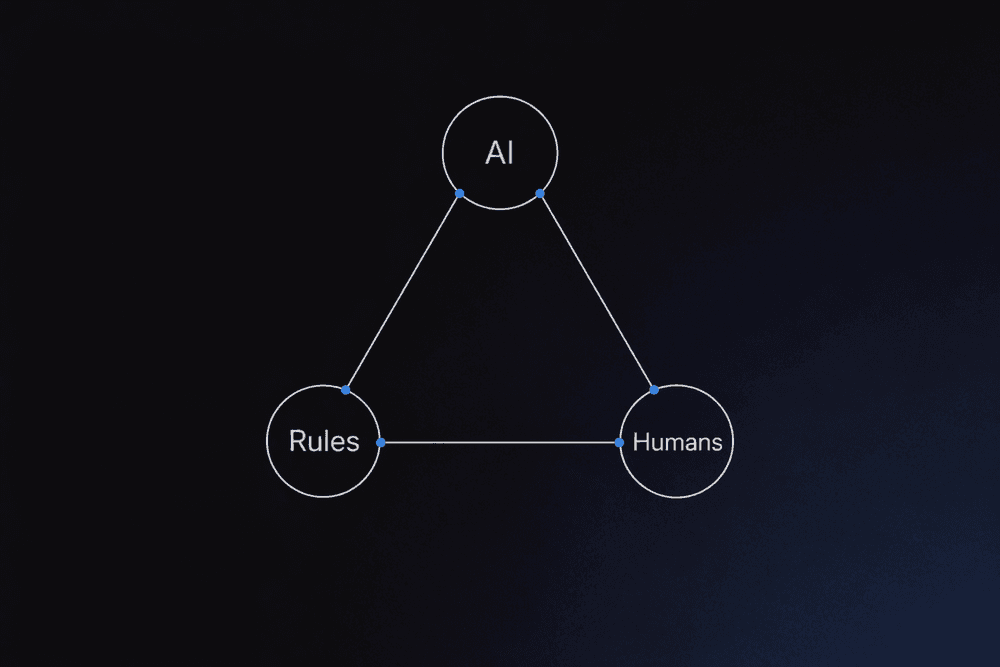
The Workflow Engine sequences AI agents, automated logic, and human approvals in one flow. It calls AI agents where reasoning is required and executes automated logic where it is not. The engine routes exceptions and approvals to the people who own them. The Workflow Engine logs every AI determination and makes it citable.
Elementum reports that its process resolves 60% of Tier-1 tickets with no human touch. Employees can reach the process through Concierge, Elementum's chat-based agentic interface. Elementum and the customer build the first application together. The customer can then build independently.
Elementum charges a flat annual fee for each application. There is no separate fee per seat, conversation, or AI action. No per-action AI charges.
The zero persistence architecture retains nothing at the execution layer once a run completes. Critical business data stays within the customer-governed data cloud. Customers can change the AI model, the data, the data platform, and the interface. Elementum supports Snowflake in production today and has Databricks on a minimum viable product (MVP) track.
Keep scope module-specific. That boundary keeps the CMDB and other current systems as sources of record.
Global enterprises including Sanofi, Under Armour, and Elevance Health run on Elementum. Contact us to map AI-powered request and incident resolution into your ServiceNow setup. Start from your own Phase One baseline.
Match ServiceNow Alternatives to Your Replacement Scope
The right replacement scope depends on your renewal pressures, module boundaries, and existing service architecture. These questions help define where to start and what should remain in place.
Why Should You Evaluate ServiceNow Alternatives Before Renewal?
Renewal brings four pressures at once: consolidated tier packaging that bundles AI into fulfiller licenses, metered assists that can overrun their pool once agents enter regular use, customization drift, and the supported-release upgrade clock.
Enterprise IT teams can inventory module use and cost per ticket before signing. That work gives them a credible exit path during negotiations instead of leaving the quote as the only option.
How Can You Replace ServiceNow One Module at a Time?
You can scope replacement to a named module. Service request and incident management move to the new process. The CMDB and remaining modules stay as sources of record, while the legacy instance keeps historical tickets in read-only mode.
The business case aims to have each retired module fund the next.
When Should You Keep ServiceNow Instead?
Stay when deep workflow customizations would cost more to rebuild than the renewal saves. The same applies when HR service delivery or IT operations management carry investments you aren't ready to move. You should also stay when process maturity, rather than the tool, is the real problem.
Diagnose utilization first.
Can Jira Service Management Fully Replace ServiceNow for Your Team?
The answer depends.
For IT and DevOps teams already standardized on Atlassian, vendor-published accounts describe Jira Service Management replacing ServiceNow. Enterprise IT teams running cross-functional service may instead use it as a partial replacement.
Either approach swaps one ticket-and-queue suite for another. Because requests still enter human queues, cost per ticket remains tied to the people required to resolve them.
Keep Reading

The Enterprise Guide to Agentic AI for ITSM

Agentic AI for ITSM: A Practical Architecture for Enterprise IT

AI for ITSM: How Agentic Orchestration Modernizes IT Service Management
ITSM Workflow Automation: Combining Agents, Rules, and Human in the Loop

8 ServiceNow Alternatives for Enterprise Automation in 2026