
What Is a Deterministic Workflow and When Should You Use One?
Your AI strategy probably includes AI agents, as it should. But before a single agent touches a production workflow, you need to answer a basic architecture question: which parts of this process need to produce the same result every time, and which parts benefit from reasoning or interpretation?
That question leads directly to deterministic workflows, an architectural backbone for making agentic AI systems more reliable and governable. In many enterprise environments, getting this distinction right often determines whether AI reaches production scale or remains stuck in early experiments.
What is a Deterministic Workflow?
A deterministic workflow is a process in which identical inputs produce identical outputs through the same execution path every time. No ambiguity, no interpretation, no variation. The process model defines exactly what will happen before execution begins, with behavior specified at design time rather than determined at runtime.
In enterprise settings, that property supports auditability, control, and clear operating boundaries. Every decision traces to documented, pre-specified logic. Audit trails map directly to business rules that humans reviewed and approved. Rollbacks work because state transitions are explicit, meaning the process can return to a known earlier state when something fails.
Several characteristics define a deterministic workflow in an enterprise context:
- Predictability: When inputs are complete and no exception handling is required, state transitions are known in advance, and service calls follow predetermined patterns.
- Repeatability: Deterministic execution and controlled inputs help produce the same outcome across invocations in production systems.
- Auditability: Every decision traces to a specific rule. Audit trails are a structural property of the architecture, captured automatically during execution.
- Rule-based execution: Outcomes can be entirely scoped and defined by a set of rules, with logic fully encoded before runtime.
- Compliance suitability: This depends on implementing the specific controls and governance required under frameworks such as the Sarbanes-Oxley Act (SOX), the Health Insurance Portability and Accountability Act (HIPAA), the General Data Protection Regulation (GDPR), and the European Union (EU) AI Act.
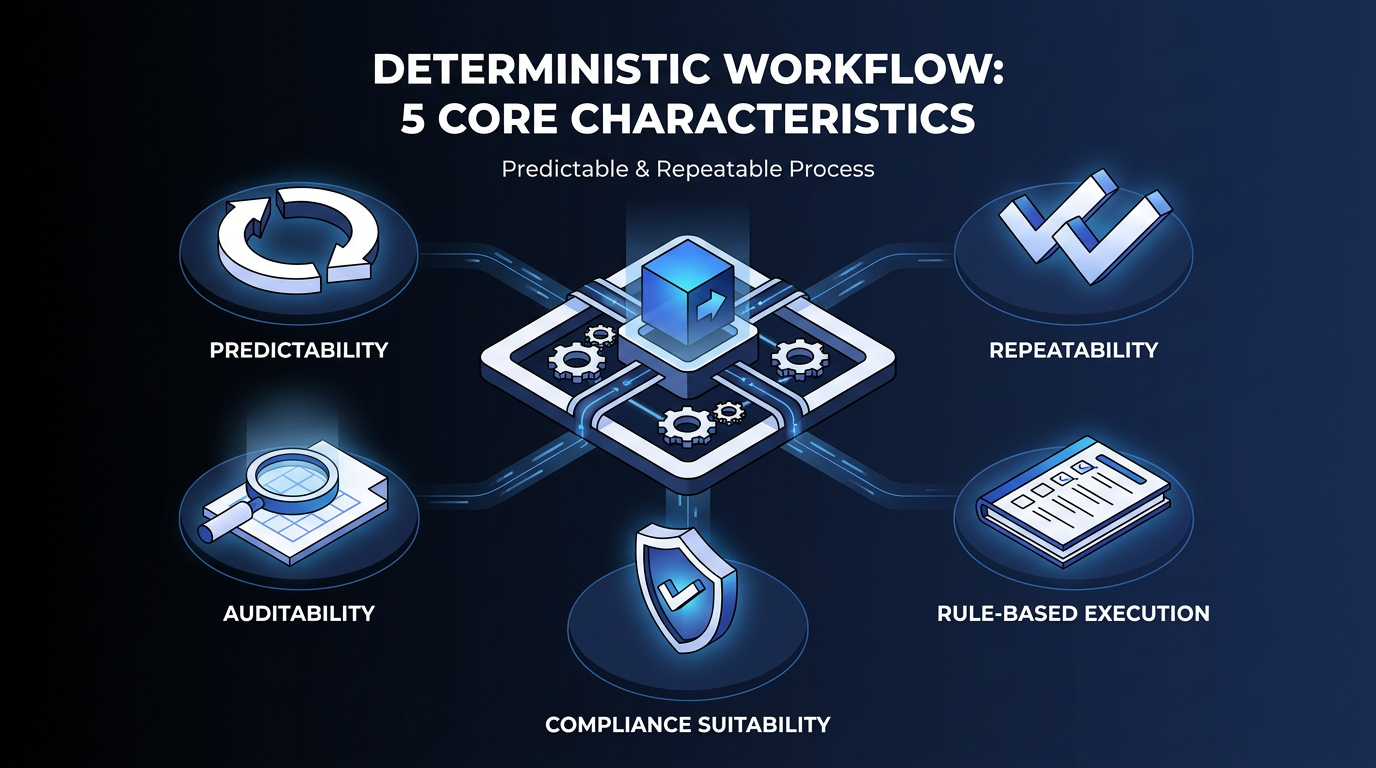
These characteristics make deterministic workflows well-suited to enterprise processes that require consistent execution, clear review paths, and controlled operating boundaries.
Deterministic workflow orchestration is architecturally different from legacy Robotic Process Automation (RPA). RPA mimics human actions on interfaces through screen scraping and user interface (UI) automation.
Deterministic workflow orchestration coordinates across multiple systems through application programming interfaces (APIs), rule engines, and services. It uses formal state management, rollback support, and transactional integrity, so each step either completes successfully or leaves the system in a consistent state.
Key Differences Between Deterministic Workflow and Agentic AI
Deterministic workflows and agentic AI behave differently across six dimensions that matter for enterprise risk: reliability, error behavior, cost, auditability, governance, and flexibility. Hybrid architectures balance these trade-offs.
The table below summarizes how the two approaches compare at a glance:
| Dimension | Deterministic workflows | Agentic AI |
|---|---|---|
| Reliability | Predictable by design on known inputs. | Probabilistic and multi-agent coordination can introduce additional failure points. |
| Error behavior | Throws an explicit error when inputs fall out of bounds. | Can produce plausible but incorrect outputs without explicit error signaling, making review and containment harder. |
| Cost structure | Executes the same logic at low marginal cost as volume increases. | Can add inference costs at scale, especially in routine, high-volume workflows. |
| Auditability | Every decision path maps to approved rules; audit trails are structural. | Traceability is harder, which can weaken accountability and complicate regulatory compliance. |
| Governance | Existing IT controls apply more directly. | Often requires AI-specific governance for model behavior, prompt handling, and tool use. |
| Flexibility | Can't handle scenarios outside pre-programmed rules without re-engineering. | Can interpret goals, read unstructured documents, and adapt to context. |
Each approach is strong where the other is weak. Deterministic workflows hold the line on consistency, audit, and cost predictability. Agentic AI brings interpretation where rules can't reach. The architectural question for enterprise teams is where each one belongs inside the same process.
When to Use a Deterministic Workflow in Enterprise AI
If a process has known inputs, predictable logic, and a correct answer that does not change based on inference or probability, using a non-deterministic approach is using the wrong tool for the job. Reaching for AI in that context is often less a technology decision than a misallocation.
A handful of practical signals tell you a process belongs in a deterministic workflow rather than an agentic one:
- The process is deterministic by regulatory design: SOX-governed financial close processes, payment disbursement, and regulatory reporting typically require consistent, reviewable outputs and strong audit trails. Three-way matching (matching a purchase order, goods receipt, and invoice before authorizing payment) in accounts payable, service-level agreement (SLA) routing thresholds in IT Service Management (ITSM), and payroll calculation in HRMS (human resource management systems) all fall under this category.
- Auditors have already approved the governance framework: Regulated industry transactional systems, including Enterprise Resource Planning (ERP), ITSM, and HRMS, typically operate inside established governance and compliance frameworks. Adding AI agents to these processes requires working within those existing frameworks, not replacing them.
- Error recovery cost is high: Even a small model error rate can compound in multi-step processes. In payment processing or compliance reporting, that compounding risk is unacceptable.
- The process runs at high volume: Cost economics favor deterministic logic when thousands of transactions per day follow the same rules. At enterprise scale, deterministic workflows can run at low marginal cost per transaction, whereas AI agent-only approaches incur inference and compute costs that scale with usage.
Where Agentic AI Adds Value Within a Deterministic Workflow
Agentic AI takes on work deterministic rules can't reach: end-to-end cognitive tasks like research, analysis, and planning, where no single correct answer exists. This plays out clearly in specific enterprise functions, where deterministic logic anchors the process and AI agents handle the steps that require interpretation.
Accounts Payable
Three-way matching, approval thresholds, and payment execution stay deterministic. But when a discrepancy occurs in invoice matching, an AI agent can flag the exception, route it based on rules and workflow context, and recommend the most likely next step, with human review when escalation is required. The authority limit that defines what the agent can auto-resolve is itself a deterministic rule, meaning there is a preset boundary for the decisions the agent can make independently.
Procurement
Requisitions become purchase orders; purchase orders move through approval chains; suppliers invoice; and finance performs a three-way match before payment. That core process logic remains intact. AI agents add value at intake classification, supplier contract extraction, and demand signal interpretation, tasks where language understanding and context are needed.
IT Service Management and Human Resources
In ITSM, SLA routing, change approval gates, and escalation rules remain deterministic, while AI agents handle incident triage of unstructured tickets and root cause analysis. The same split applies in HR: payroll calculation and benefits rules stay deterministic, while AI agents coordinate onboarding tasks and answer policy questions across multiple systems.
Across accounts payable, procurement, ITSM, and HR, deterministic logic governs the process end-to-end, while AI agents handle the specific steps that need reasoning and interpretation. That division of labor keeps hybrid workflows reliable at enterprise scale.
The Hybrid Deterministic Workflow Architecture for Enterprise AI
Many enterprise teams are converging on hybrid AI architectures that combine agentic capabilities with deterministic orchestration and governance, instead of treating them as a strict either-or choice. The recurring shape is deterministic orchestration as the control layer, with agentic AI as a bounded component within governed process steps.
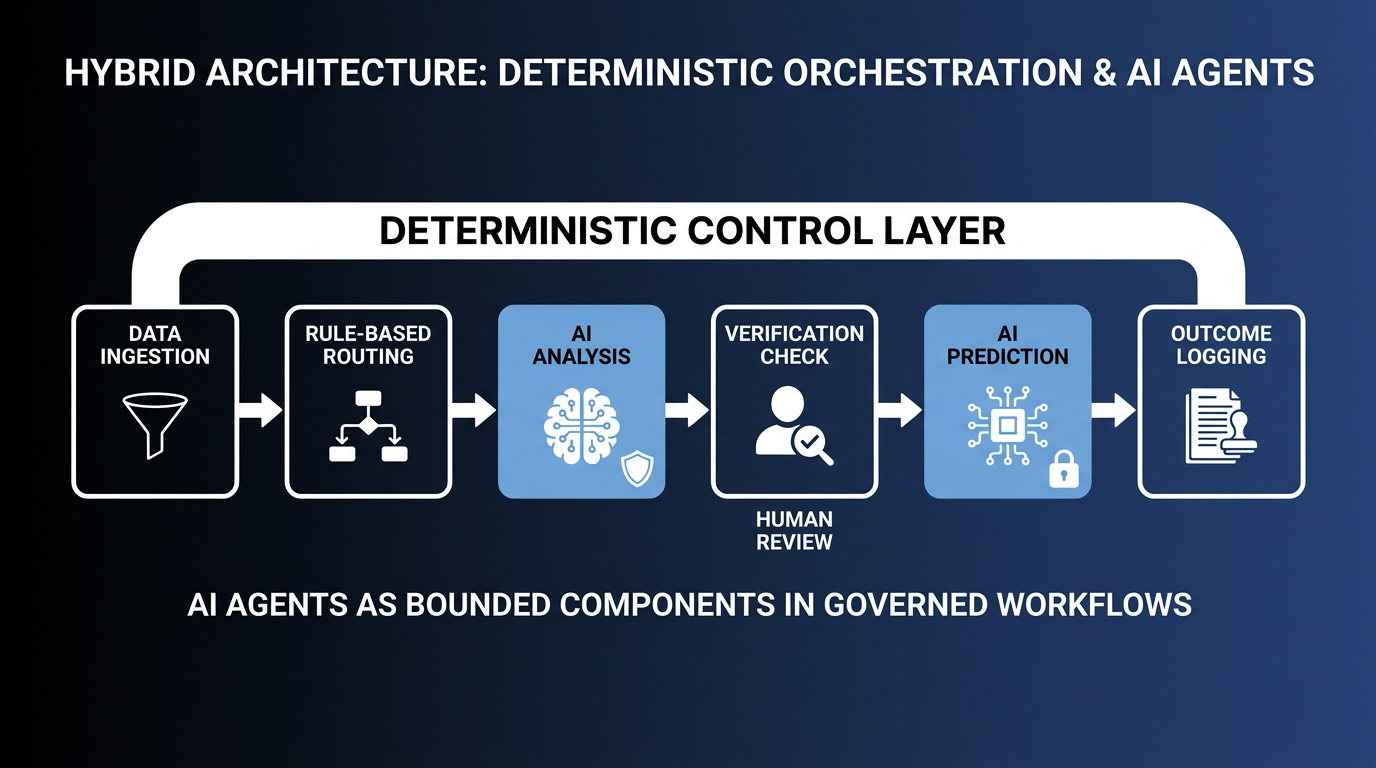
In that model, orchestration provides durable coordination while agents handle cognition. Many organizations will continue to run deterministic automation alongside newer agentic workflows because questions about ROI, governance, and reliability arise when an agent is added to the stack.
Critical controls like privilege separation and authorization bounds checks need to stay deterministic and auditable, not delegated to an LLM. Prompt injection can escalate from data disclosure to broader system compromise in agentic systems with tool-use capabilities. A deterministic governance layer helps contain that risk by keeping control logic explicit and reviewable.
Failure in agentic systems can compound across multiple agent steps before detection, resulting in wasted spend from looping supervisors, runaway token costs, and intermittent failures that surface only after the budget impact becomes visible.
Apply the Deterministic Workflow Decision to Your AI Strategy
The question facing VPs of AI and enterprise operations leaders is where deterministic logic and agentic AI each belong within the same workflow. Drawing that line accurately separates an AI roadmap that compounds value over time from one that stalls under pressure from governance, cost, or reliability.
Deterministic workflows provide the governance, auditability, and cost predictability that regulated enterprise environments require. AI agents provide the interpretation that deterministic rules can't replicate. The architecture that works at enterprise scale uses both within the same process, with each assigned to the work it is best suited to do.
Elementum’s Workflow Engine (Trident) and AI Agent Orchestration are built for this hybrid architecture. The Workflow Engine treats humans, business rules, and AI agents as equal first-class participants in every process, with a deterministic backbone that produces the same result every time.
AI agents from any provider (OpenAI, Gemini, Anthropic, Amazon Bedrock, Snowflake Cortex) operate within governed workflows, not outside them. Configurable confidence thresholds determine when agents act and when humans decide, with full audit trails on every step.
Our patented Zero Persistence architecture keeps your data where it already lives. We never train on your data, never replicate it, and never store it in a warehouse. CloudLinks query your data warehouses in real time, with no ETL pipelines, no copies, and no new data stores.
The Workflow Engine then orchestrates actions across enterprise systems through governed workflows and APIs. Every agent action is logged and revocable, with human-in-the-loop checkpoints and enterprise compliance controls (SOX, HIPAA, GDPR) governing every interaction.
If you're building the business case for deterministic workflow orchestration with governed AI agents, contact us to talk through how this fits your broader AI roadmap.
FAQs About Deterministic Workflows
These are the questions IT and operations leaders most often raise when designing AI workflows that need both consistency and reasoning.
How Should You Distinguish a Deterministic Workflow From RPA?
Deterministic workflows and RPA solve different problems. RPA mimics human actions on interfaces through screen scraping and UI automation. Deterministic workflow orchestration coordinates work across multiple systems through APIs and rule engines, with formal state management, transactional integrity, and audit trails as structural properties of execution. A deterministic workflow can orchestrate dozens of systems in a single process. RPA automates individual tasks through software bots.
Can Your Workflow Stay Deterministic If It Contains AI Components?
Yes, a workflow can stay deterministic in its control flow while containing probabilistic AI components at specific steps. The execution path, including the sequence of steps, data passing, failure handling, and completion logic, is defined at build time. An AI agent may generate probabilistic output at one node, but the workflow routes that output through predetermined rules and human approvals before it affects downstream systems.
What Regulations Should You Consider When Designing Deterministic Workflows?
Regulations to consider include SOX, HIPAA, GDPR, and the EU AI Act, all of which increase the importance of auditability, traceability, human oversight, and repeatable controls. In practice, that makes deterministic workflows a strong fit for high-stakes processes where organizations need consistent execution and reviewable decision paths.
When Should Your Team Use Agentic AI Instead of a Deterministic Workflow?
Agentic AI is well-suited to tasks involving end-to-end cognitive work, language-heavy and context-dependent processes, and scenarios where encoding every rule in advance would be prohibitive. The key requirement is that your organization needs the monitoring infrastructure to validate agent outputs before they affect systems of record. Most production deployments embed AI agents as bounded components within a deterministic workflow, rather than choosing one approach over the other.
How Should You Think About Cost Differences Between Deterministic and Agentic Approaches at Scale?
Cost differences between the two approaches widen as volume grows. Deterministic rules execute at low marginal cost as volume increases. Agentic workflows can carry higher per-task inference and compute costs for routine work. At enterprise transaction volumes, that difference compounds into a meaningful budget impact, which is why right-sizing each workflow step (deterministic where consistency is needed, AI where reasoning is needed) keeps costs predictable at scale.
Keep Reading
Deterministic vs. Probabilistic AI: The Enterprise Guide to Building Workflows That Scale
Are AI Agents Deterministic? Understanding Predictability in Agentic Systems
How to Automate Procurement Workflows with AI Agents and Business Rules
9 Best Workflow Orchestration Tools in 2026
What Is Workflow Automation? A Guide for Enterprise
Human-in-the-Loop Workflows: Definition and How to Build Them