
How a Global Pharma Leader Replaced Legacy Workflows with Orchestrated Intelligence
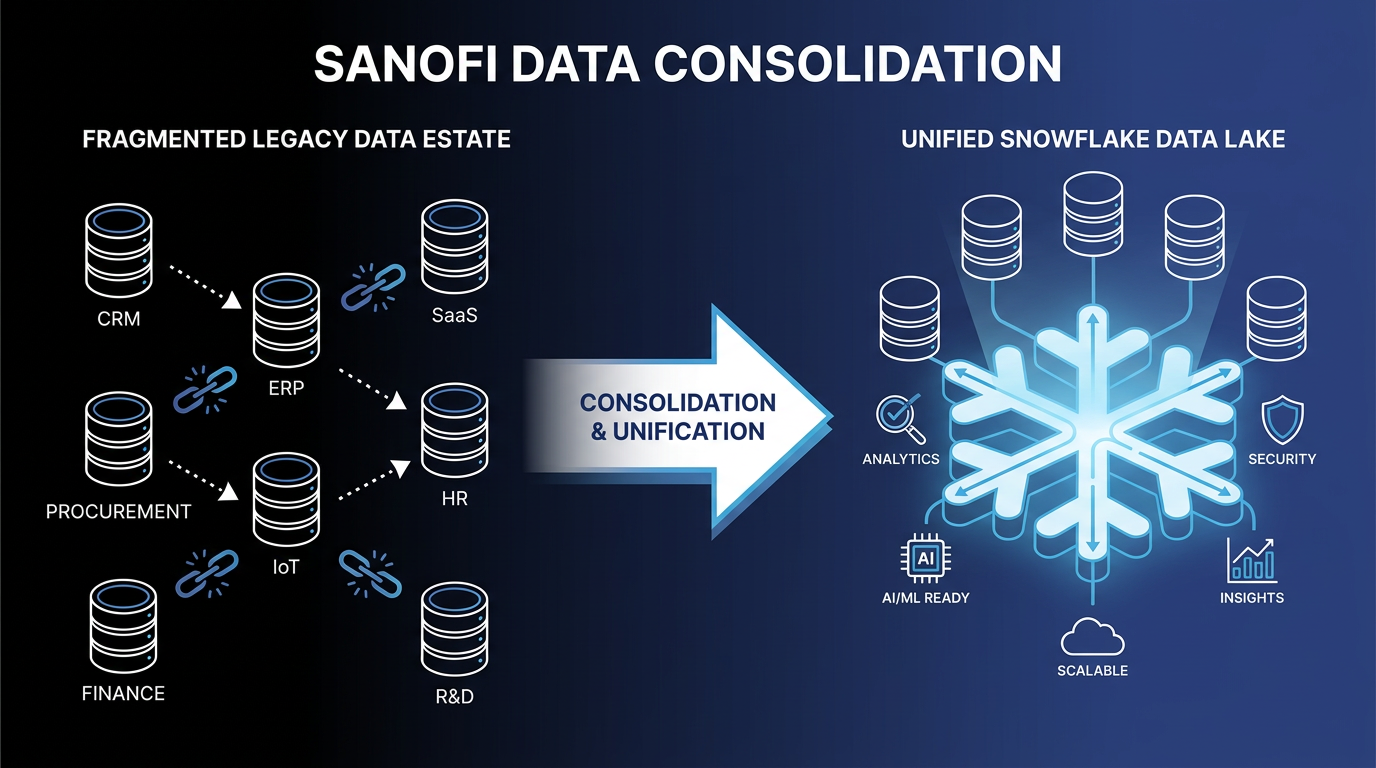
Sanofi's enterprise systems ran on disconnected vendor agents with no shared coordination layer. For years, the company built complex pipelines just to move data in and out of expensive software to reach its own data, according to Chief Digital Officer Emmanuel Frenehard. He wanted one way to run AI workflows on Sanofi's governed Snowflake data instead of adding another vendor agent to the stack: "I don't want to have Salesforce agents, speaking to ServiceNow agents, going to speak to SAP agents."
With Snowflake and Elementum, Sanofi built AI-native enterprise applications that run directly on its data lake instead of buying more legacy SaaS. This article covers why legacy workflow replacement stalls in regulated industries, what Sanofi built instead, and how deterministic governance keeps AI inference auditable.
Why Legacy Workflow Replacement Stalls in Pharma
Every legacy system covered by regulated good-practice (GxP) rules requires system validation. GxP, the quality and validation standards regulators apply to pharma manufacturing and data, means teams must follow those rules for any regulated work the system touches. Each system also has its own access rules and integration requirements. Changing one system therefore rarely affects only that system. This keeps modernization plans in planning documents year after year.
Many life sciences organizations remain anchored to legacy systems and outdated architecture. Sending that data to a third party creates another concern: most life sciences organizations are wary of copying regulated data into another vendor's platform because of data and IP exposure. Copying batch data, quality records, or physician-level commercial data into another vendor's platform adds another system and more data to manage. Quality and compliance teams must validate both. They must also defend both during an inspection.
The conventional fixes carry their own risk. Large, multi-year IT modernization programs are a familiar risk for enterprise buyers: the longer the program, the more chances for scope, budget, and priorities to drift before anything ships.
Rip-and-replace migrations remove existing systems but put all the risk into a single cutover. Layering copilots onto the existing systems avoids the migration. It requires another vendor relationship, plus a license and an integration to maintain.
The goal is "a fundamentally new operating model," Sanofi says. In that model, AI workflows built with our Workflow Engine run directly on Snowflake, cutting the friction and cost of traditional enterprise software instead of adding to it.
Up to $234 billion in enterprise application spending is exposed to what Gartner calls agentic arbitrage by 2030, as AI agents complete cross-system work that used to require the underlying software's interface. Sanofi's pattern replaces the application itself with AI workflows running on the company's own data. Modernization can then remove systems instead of adding them.
What Sanofi Built Instead of Buying More SaaS
Sanofi's AI workflows now run on its existing data infrastructure. Elementum’s deterministic Workflow Engine runs complete business processes without moving or replicating enterprise data. "With Elementum, we built AI workflows straight onto the data lake, and there's not many people doing that," Frenehard said.
Concierge as a Single Employee Entry Point
Concierge is Sanofi's internal AI assistant, launched in 2024 and now used by roughly 60,000 employees, about 80% of the company's workforce. It draws on data from ServiceNow, Workday, and Sanofi's internal policies and org charts, and it runs on our workflows. Frenehard's target is autonomous resolution of up to 80% of employee IT support requests, a shift Sanofi projects will save 10 million euros a year.
Concierge for Field's Pre-Call Planning
Sanofi launched Concierge for Field. The AI agent helps global sales representatives prepare for physician and provider visits.
That preparation happens inside the workflow. It uses customer data already sitting in Sanofi's Snowflake environment. No separate extract or reporting layer stands between the rep and the visit.
One Data Foundation for Procurement and CRM
Sanofi's first application covered software license management. This puts a high-value, lower-risk process first. The spend is large, and a bad run affects a licensing decision rather than a batch record or patient-facing process. That limits the risk. The application focused on reducing Sanofi's software license spend.
Sanofi expanded into procurement workflows and CRM workflows on the same data. Savings from a completed replacement can help fund the next phase. This works when the eliminated license and maintenance costs exceed rollout costs. That creates a different budget conversation from committing capital to a multi-year program before anything ships.
Replacing one workflow at a time limits what each cutover affects. It avoids putting all the risk into a program-wide cutover.
Why the Data Never Leaves Sanofi's Cloud
We run inside Sanofi's Snowflake environment. Our AI agents can use Snowflake Cortex, Snowflake's service for model integration. Encrypted CloudLinks connect to approved data. They query it in place, with no extraction and no copies to maintain. The data stays in Sanofi's own Snowflake account. Row-level and column-level security policies control which records and fields each agent can access.
Regulated data raises the stakes on this design choice. Under the FDA's Part 11 rules for electronic records and signatures, pharma companies must validate the systems that create, modify, maintain, or transmit those records. They must keep secure, computer-generated, time-stamped audit trails and limit system access to authorized individuals.
Additional vendor-held copies can give quality and compliance teams more data to handle and oversee. Querying data where it already lives keeps that boundary within existing access controls. Quality and compliance teams already manage those controls.
Validation is not a one-time exercise either. Cloud-native platforms deploy frequently, while AI systems change through retraining. Both therefore require ongoing validation and monitoring rather than one-time validation.
Bound AI Inference with Deterministic Governance
Teams must decide which steps run deterministically and which use AI. If teams get it wrong, a batch release or payment approval could execute on an inference. Nobody could reproduce, review, or explain it to an inspector. Traditional automation follows explicit rules. The same input produces the same output. Every run.
An AI agent interprets a goal. The same input can therefore produce different outputs depending on context. That flexibility belongs on tasks like reading a contract or ranking a physician list. A deterministic workflow should govern payment approval or batch-release controls. The same rules, checks, and approval paths then apply to the same inputs.
Generative AI can produce plausible but incorrect outputs without explicit error signaling. That makes review and containment harder than with a rule that either executes or fails visibly.
We pair the two: a deterministic engine sequences the steps and calls AI agents only where reasoning is required. It executes automated logic elsewhere and routes exceptions and approvals to the people who own them through human-in-the-loop checkpoints. The Workflow Engine logs every agent action and makes it auditable.
That also limits cost. AI vendors that meter by token can produce bills that are hard for finance teams to forecast.
The deterministic engine invokes a model only at steps that need reasoning. This limits inference to specified workflow steps instead of letting it run freely across every interaction. Inference cost tracks the reasoning steps actually invoked.
Start Legacy Workflow Replacement with One Application
Sequence the work. Under our model, one use case maps to one application. Each application can replace a system or manual process. Savings from the first phase can help fund those that follow when the economics support it.
Waiting on a multi-year migration plan can leave teams paying legacy maintenance and AI experimentation costs at the same time. Neither may yet produce the savings needed for the next step.
Elementum as the AI-Native Replacement for Legacy SaaS
Pharma CIOs sequencing legacy workflow replacement are really deciding how much risk to take on at once: a single-cutover migration, a copilot layered onto what already exists, or an application-by-application replacement that runs on the data they already govern.
We are the AI-native replacement for legacy SaaS: workflows that run directly on the data infrastructure our customers already govern, instead of asking them to move it to us.
Open Orchestration is why Sanofi didn't have to commit to Snowflake forever to get here. Its workflows run on Snowflake today, and swapping in another model, agent, or data cloud later wouldn't require rebuilding the underlying workflow logic.
Orchestrated Intelligence is why Concierge doesn't wait on a human for every ticket, and why a batch-release approval still runs on a fixed rule instead of a model's best guess. Humans handle judgment, rules handle steps that must produce the same result every time, and AI agents handle the reasoning work in between.
Zero Persistence is why a GxP-regulated company could hand AI workflows real work in the first place: we never train on, replicate, or warehouse your data. Sanofi's records stay inside its own Snowflake account, not in a copy we hold.
Many of our customers start with one workflow, prove the savings, and expand into adjacent processes, the same pattern Sanofi followed from software license management into procurement and CRM.
We have the production track record for replacing legacy SaaS at enterprise scale, including pharma customers like Sanofi expanding from software license management into procurement and CRM workflow replacement. Snowflake named us its 2026 Product Partner of the Year for Agentic Transformation.
Contact us to map workflow orchestration into your architecture and the rest of your AI roadmap.
FAQs About Legacy Workflow Replacement
These are the questions pharma CIOs and digital leaders most often raise when they evaluate replacing legacy systems with AI-native workflows.
What is legacy workflow replacement?
Legacy workflow replacements replace or upgrade outdated enterprise systems, ranging from cloud rehosting to full application replacement. In a GxP environment, each replaced system carries its own validation package, so teams measure project scope in revalidation work, not just code. The AI-native approach replaces the application with workflows that run on the existing data platform, which can avoid copying data into a separate vendor platform, but it doesn't eliminate all integration or validation work.
Should organizations modernize or replace their legacy systems?
Modernize a system when it still meets core needs and its interfaces support integration. Replace it when customization debt approaches the cost of replacement, or when licensing and maintenance no longer justify what it does. In pharma, teams must also factor in validation. Any option must preserve audit trails and data integrity under GxP regulations.
How long does legacy workflow replacement take?
The timeline depends on the scope and replacement approach. Large modernization programs that bundle every system into one migration plan tend to run long and create budget and schedule risk. A phased replacement can shorten the path to the first production application, because teams don't have to wait for a full-estate migration, and savings from each replacement can help fund the next phase.
Why can a legacy workflow replacement project fail?
A project can fail after a concentrated cutover. Hidden business logic may emerge only at go-live while business and technical priorities drift apart. Replacing one workflow at a time contains each risk within a single application instead of exposing the whole program.