
Snowflake Agentic AI: A Guide to Cortex Agents in Enterprise Workflows

In Snowflake agentic AI, a Cortex Agent runs under the calling user's default Snowflake role. It honors the same row-access and masking policies as a human analyst. Every turn leaves a trace. Nobody can edit it. For a CAIO or CDO measured on what leaves the perimeter, that is a strong starting position. The reasoning step stays where the data lives. The pressure comes later. The process needs separation of duties: the requester can't approve their own request. It also needs a human sign-off. Write-back means writing a record to Coupa, ServiceNow, Workday or Salesforce, with one audit trail across all of it. Snowflake's documentation covers the agent run inside the account. It says little about the steps after it. Data leaders must decide how to run the rest on Snowflake data without copying it out.
Use Snowflake Cortex AI to Build Governed Agents
Snowflake's AI suite is Snowflake Cortex AI. Its AI Functions run models from OpenAI, Anthropic, Meta, Mistral AI and DeepSeek. All run within the Snowflake Service perimeter; calls through vendor endpoints are excluded. The agent stack has four named components. At Summit 26, Snowflake Intelligence became Snowflake CoWork. The docs still use both names.
- Cortex Agents: Snowflake defines it as "a fully managed agentic platform for building and running AI agents within Snowflake's governed environment." An agent is a schema-level object that bundles a model, tools and instructions. It has been generally available since November fourth, 2025.
- Snowflake CoWork (formerly Snowflake Intelligence): the conversational application for business users. It routes questions to the Cortex Agent API, "which powers Snowflake CoWork." The two share one runtime.
- Cortex Analyst: generates SQL from natural language over a semantic view, which is where business definitions and metric logic live.
- Cortex Search: a hybrid vector and keyword search service for unstructured data, generally available since October fourth, 2024.
Cortex Agents can run Claude and OpenAI GPT models. Gemini is in public preview. Snowflake recommends the auto setting, which picks the highest-quality model for the account. Model choice sits inside the governed perimeter. So does the agent. The question for an architect is what the agent does with that access.
Query Governed Data Through Cortex Agents
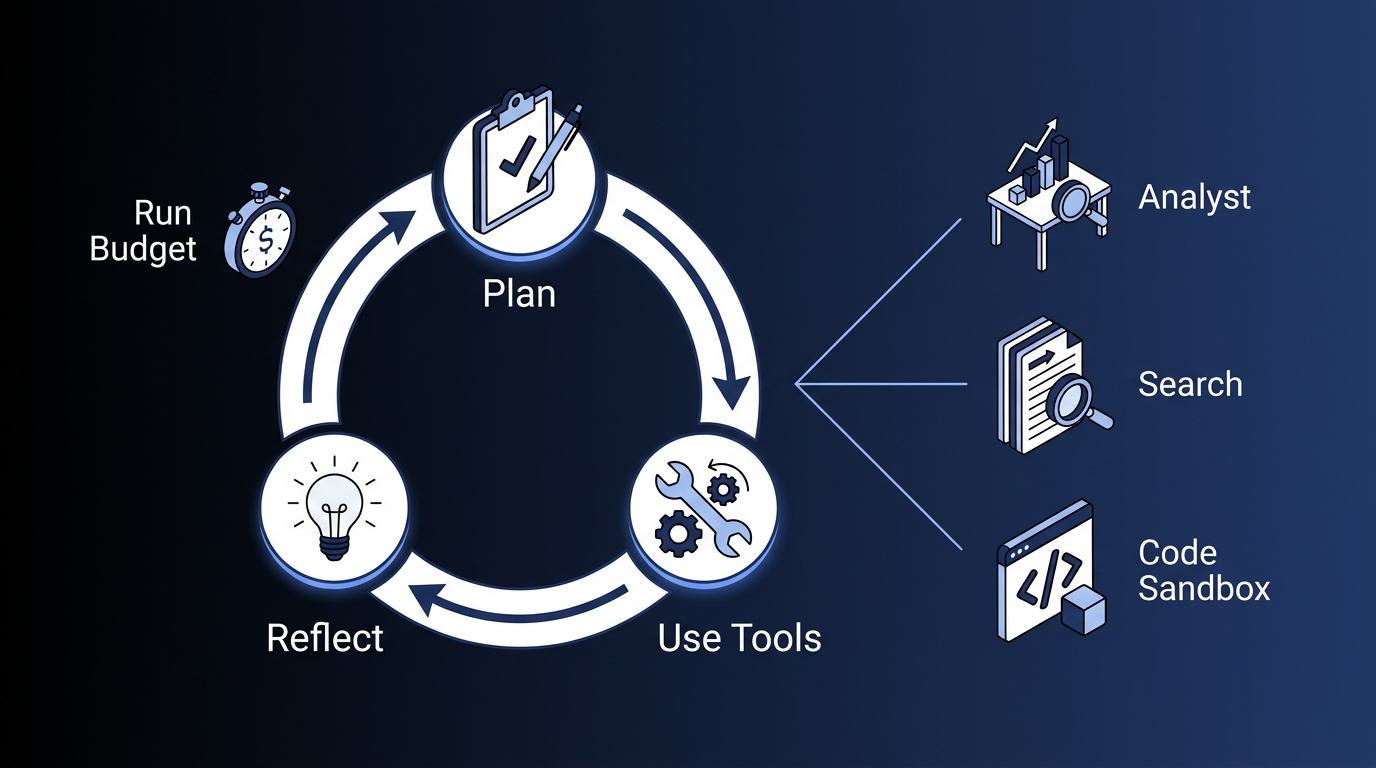
A Cortex Agent runs a model-driven loop: plan, use tools, reflect. Each step inherits your existing access controls. [TKTK: verify source] Those controls already govern access inside Snowflake. A separate governance layer for AI can duplicate those controls. That happens when it repeats the same role and policy checks. [TKTK: verify source]
The plan step reads the request and asks for details when questions are vague. Snowflake's example about Acme Supplies shows this. It splits complex requests into subtasks. Then chooses tools. The agent calls Cortex Analyst for structured data or Cortex Search for documents. It can also use the code execution tool, which runs Python in an isolated sandbox. After each result, the agent decides whether to clarify, iterate or answer. A per-run budget caps each run in seconds and tokens.
Three Snowflake controls limit access, screen tool calls and record agent activity:
- Role-Based Access Control (RBAC): "Because the agent runs with the querying user's default role, that role also needs privileges on the objects used by the agent's tools," according to Snowflake's access control docs. To call an agent, a user needs SNOWFLAKE.CORTEX_USER or the least-privilege SNOWFLAKE.CORTEX_AGENT_USER role. The user also needs grants on the agent, its database and schema. Grants must also cover the default warehouse and the objects its tools use.
- Horizon governance: "Governance policies execute at the query engine layer, not the application layer." Row-access policies, masking and classification tags therefore apply to an agent's SQL exactly as they do to a BI tool.
- Guardrailsand audit: Cortex AI Guardrails detect indirect prompt injection in tool calls. [TKTK: need verified source] QUERY_HISTORY carries an
agent_typecolumn to audit queries started by agents. Every turn writes an OpenTelemetry trace to an event table. Its entries can't change. [TKTK: need verified source]
Each agent has a resource budget. Quotas for each user can block users who hit their AI quota.
Extend Cortex Agents Into Cross-System Business Processes
A business process requires more than an agent's answer. Your Snowflake agentic AI program needs approval and write-back steps to replace an application. Consider an invoice exception. A Cortex Agent can read the supplier contract. It can pull the purchase order through a semantic view and flag a payment-term mismatch. Approvals come next. In this example, the workflow must choose a reviewer by amount threshold. The requester can't approve their own request. The process must write a hold to Coupa and create a ServiceNow ticket if the vendor record is wrong. It also needs one record of who decided what, in sequence, the same way every time.
Snowflake documents the mechanisms for reaching outward. Custom tools are stored procedures and UDFs. MCP connectors let an agent create Jira tickets, update Salesforce records or post to Slack. Authentication uses OAuth only. Permissions apply per tool. The listed user-auth types are Atlassian, GitHub, Glean, Linear and Salesforce. ServiceNow, Workday and Coupa don't appear in the connector documentation reviewed here. Snowflake documents its ServiceNow and Workday connectors for ingestion into Snowflake.
Snowflake documents human approval for the coding agent and the code execution tool. Their permission_policy setting defaults to always_ask. The agent emits a tool_use event and stops. It resumes only when the caller sends a permission_decision. The documentation reviewed doesn't say whether the policy covers custom tools or MCP connector calls. Nor does it describe a durable multi-step workflow with automatic retry and resume. The trace and the agent_type audit record end at the Snowflake boundary. The pages reviewed describe no matching record inside Coupa or Workday.
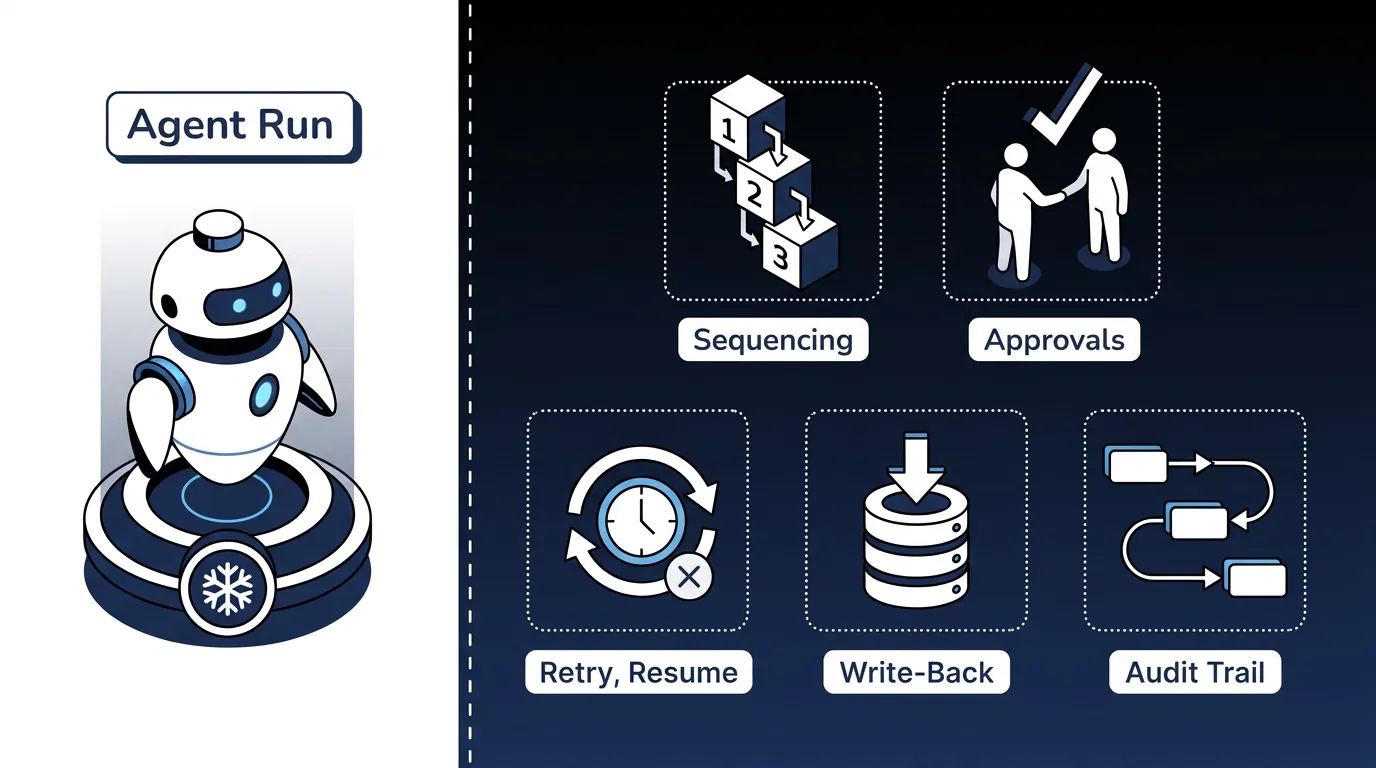
High-stakes transactional actions call for mandated human oversight. Rollback "cannot reverse every outcome," according to Gartner's guidance. [TKTK: verify source] The process needs deterministic sequencing and approval chains with separation of duties. It must retry and resume across waits that can last days. It also needs write-back to systems of record such as Coupa and one audit trail across all these steps.
Assign Reasoning, Governance and Decisions to Separate Participants
Assigning each step to a reliable participant is an architecture decision. The split keeps reasoning that can vary separate from fixed approval rules. Data stays in Snowflake, where the process queries it in place. A deterministic workflow engine sequences the process. Same input. Same path every run. AI agents, Cortex Agents included, handle steps that need reasoning. They read contracts, classify requests and draft summaries. People make the judgment calls the process routes to them.
The split exists because agents are probabilistic. The same prompt can return a different output on a second run. That flexibility helps extract payment terms from an unstructured contract. That variation creates a risk when invoice approval must follow the same steps for audit. Make the deterministic versus probabilistic decision for each step. The documented agent controls cover the Snowflake run, while approvals and audit records must span systems.
The "we'll build it on Cortex ourselves" plan needs an estimate for the whole process. Snowflake has made the agent a managed object you can create in SQL. The surrounding work remains. Your team must maintain workflows that can wait, retry and resume. It also owns approval chains with separation of duties and write-back adapters to systems of record. Add an audit trail you can replay and safe promotion across development, test and production. Including these controls makes the estimate cover the whole process. Use production evidence to assess build versus buy. Count the self-built agents that run complete business processes end to end. That count tests the estimate against what the team has already delivered.
Snowflake's Native App model installs a vendor's app in the consumer's Snowflake account. "Your data does not leave Snowflake by default." Outbound calls require an External Access Integration. The consumer must approve it.
Run Snowflake-Based Processes With Elementum
Elementum is the Enterprise AI Apps Platform. Its Workflow Engine runs the process on your Snowflake data. It queries that data in place through CloudLinks. The engine sequences AI agents, automated logic and human approvals as equal participants in one flow. CloudLinks are encrypted query-in-place connections to Snowflake and other data platforms. The process reads source data where it lives, under your existing RBAC and row-level and column-level policies. The Workflow Engine uses API integration to access systems of record: SAP, Salesforce, Oracle, SaaS platforms and custom APIs. For example, a custom API can write a hold in Coupa or a ticket in ServiceNow. Tasks and Approvals sends reviewers their approvals over email, Slack or Microsoft Teams. Every AI determination leaves a logged, citable record.
Cortex Agents can handle the reasoning step in a process, and Cortex is also a model option. Elementum's AI agents come pre-integrated with Snowflake Cortex alongside OpenAI, Anthropic, Gemini and Amazon Bedrock. One step can run on Cortex and the next on another model without rebuilding the process. Requests enter through Concierge, the agentic front door. They can also enter through employees' existing interface, such as Copilot, Claude or a corporate GPT.
Sanofi runs workflows on its centralized data lake after it partnered with Elementum and Snowflake. Its Chief Digital Officer, Emmanuel Frenehard, put it plainly: "With Elementum, we built AI workflows straight onto the data lake, and there's not many people doing that." Snowflake named Elementum 2026 Product Partner of the Year for Agentic Transformation.
Run Snowflake Agentic AI Inside Complete Business Processes
Generally available Cortex Agents need approval routing and cross-system audit before taking transactional actions. Otherwise, your team may need to add those controls after deployment. [TKTK: need verified source] If the routing rule stays unchanged, later transactions can reach the same wrong reviewer. An audit can flag each misrouted approval.
Elementum is the Enterprise AI Apps Platform. It replaces legacy SaaS back-office systems at the process or module level. It runs the complete process. Your current systems, such as Coupa and Salesforce, stay sources of record. Elementum changes how the work gets done. Critical business data stays within your customer-governed data cloud. The zero persistence architecture retains nothing at the execution layer once a run completes. You can change the AI model, the data, the data platform and the interface. Elements map your business entities to the Snowflake tables you already govern. CloudLinks provide the query-in-place connections.
Our production track record includes replacing legacy SaaS at enterprise scale. Sanofi expanded from software license management into procurement and CRM workflow replacement.
Contact us to scope a business process on your Snowflake data. See where an Enterprise AI App replaces the module that slows it down.
Resolve Snowflake Agentic AI Runtime and Governance Questions
Cortex Agents handle reasoning over governed Snowflake data, while a deterministic workflow handles approvals, write-back and audit across systems.
What AI Tool Does Snowflake Use for Agents?
Snowflake's AI suite is Snowflake Cortex AI. Developers build agents with Cortex Agents. Business users reach them through Snowflake CoWork (formerly Snowflake Intelligence). The agents run Anthropic and OpenAI models inside Snowflake's perimeter. Google's Gemini is in public preview.
Is Snowflake Good for Agentic AI Workloads?
For governed reasoning, yes. Agents inherit the caller's role, and Horizon policies apply at the query engine. Guardrails screen tool calls; each run leaves an immutable trace. The documentation reviewed covers the agent run inside Snowflake. Use a deterministic engine for approvals across custom tools, durable retry and resume, write-back to systems of record and cross-system audit.
How Do Cortex Agents Differ From Snowflake Intelligence?
Cortex Agents is the developer-facing building block. Developers create reusable agent objects in Snowsight, SQL or REST and call them through agent:run. Snowflake Intelligence, renamed Snowflake CoWork, is the business-user application built on the Cortex Agent API. Both became generally available on November fourth, 2025.
How Do You Govern AI Agents That Need to Act Outside Snowflake?
Put a deterministic workflow around the agent rather than widening the agent's permissions. The workflow sequences steps and routes high-stakes approvals to a named owner with separation of duties. It writes to systems of record through API integration and logs every determination in one trail. Agents reason. Engines govern. People decide.
Run Cortex Agents Within Complete Business Processes
A deterministic workflow gives Cortex Agents the sequencing, human approvals and cross-system audit trail that a complete business process needs.
Keep Reading

Elementum Named 2026 Snowflake Product Partner of the Year - Agentic Transformation
Four Takeaways from Snowflake Summit 2026
AI Agent Observability and Monitoring: The Enterprise Stack
Enterprise Workflow Software: 5 Top Platforms and How to Choose

What Is Workflow Automation? A Guide for Enterprise

7 Best AI Agent Platforms for Enterprise Deployments in 2026