
Enterprise AI Orchestration: The Complete Architecture Guide
Task-specific AI agents are moving from a minority of enterprise applications toward a majority within this year alone. Enterprises are also trying to coordinate sprawling application and data environments. Agent adoption is accelerating. Agents are multiplying. The coordination layer is not keeping pace.
Enterprise AI orchestration is that layer. It manages how AI models, agents, data, business rules, and human decisions work together across end-to-end workflows. Production orchestration needs workflow controls, agent coordination, data access, governance, model routing, and human review. AI reasoning belongs only at defined decision points. This article covers the architecture layers that make that work, the failure modes to avoid, and how to choose between deterministic and agentic execution at each step.
Define Enterprise AI Orchestration
Existing workflow automation follows explicit rules: if X happens, do Y. Every time. An AI agent, by contrast, interprets a goal and decides how to achieve it. The same input can produce different outputs depending on context. That flexibility helps with unstructured documents and ambiguous requests. It becomes a liability when approving payments or routing regulated transactions.
Enterprise AI orchestration coordinates both types of work within a single architecture. It separates fixed logic from AI reasoning and adds human review gates where judgment is required. That is the difference between an AI that drafts an email and an AI that closes tickets, triggers payments, and updates records.
Compared with earlier automation, enterprise AI orchestration treats people and automated controls as equals in the same workflow. The automated step may use an AI agent or a deterministic business rule. The orchestration layer decides which.
Build the Six Layers of Production AI Orchestration
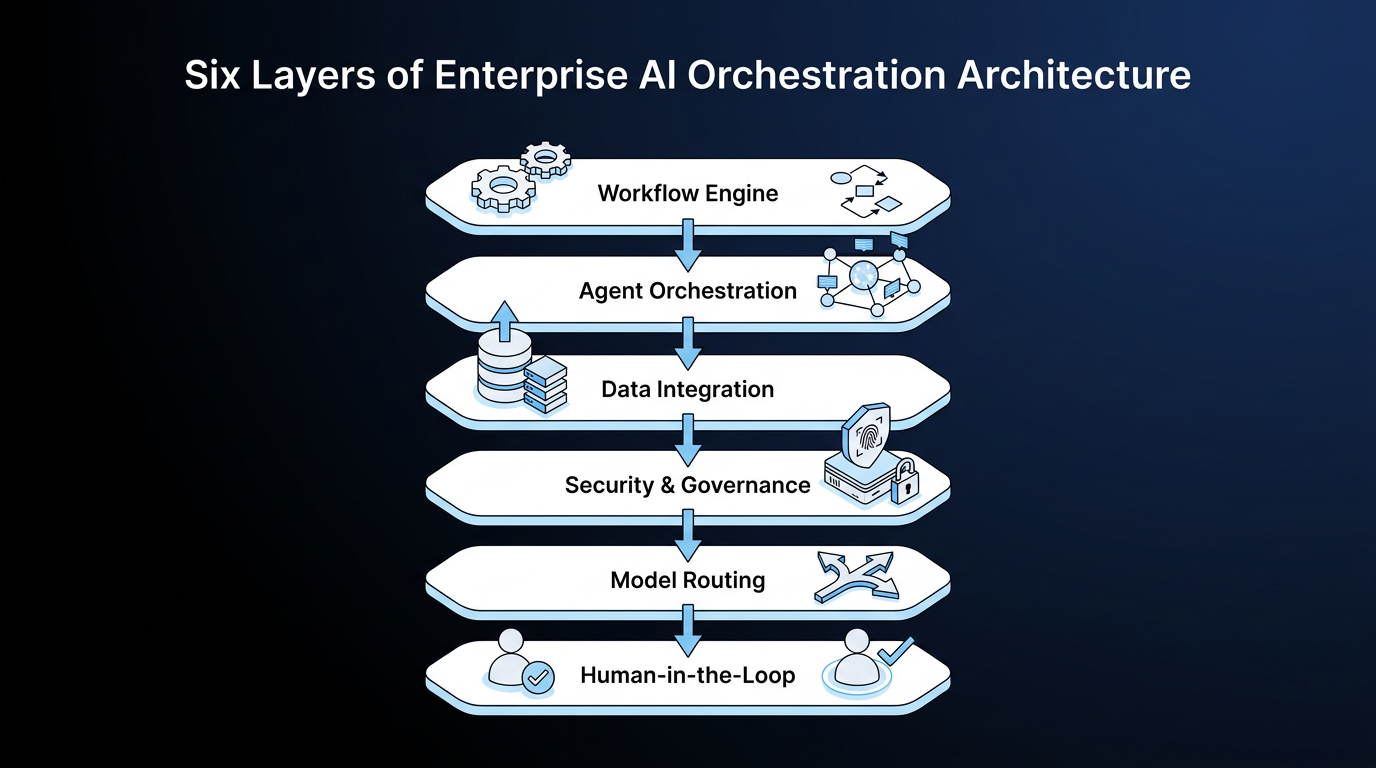
Production AI orchestration requires six layers. Each layer has a distinct job. Remove one, and the system behaves differently as workflow volume rises.
- Workflow and process engine: The deterministic backbone for execution. This layer handles routing, sequencing, retries, and failure isolation. Without it, workflows have fewer controls for containing failures as volume rises.
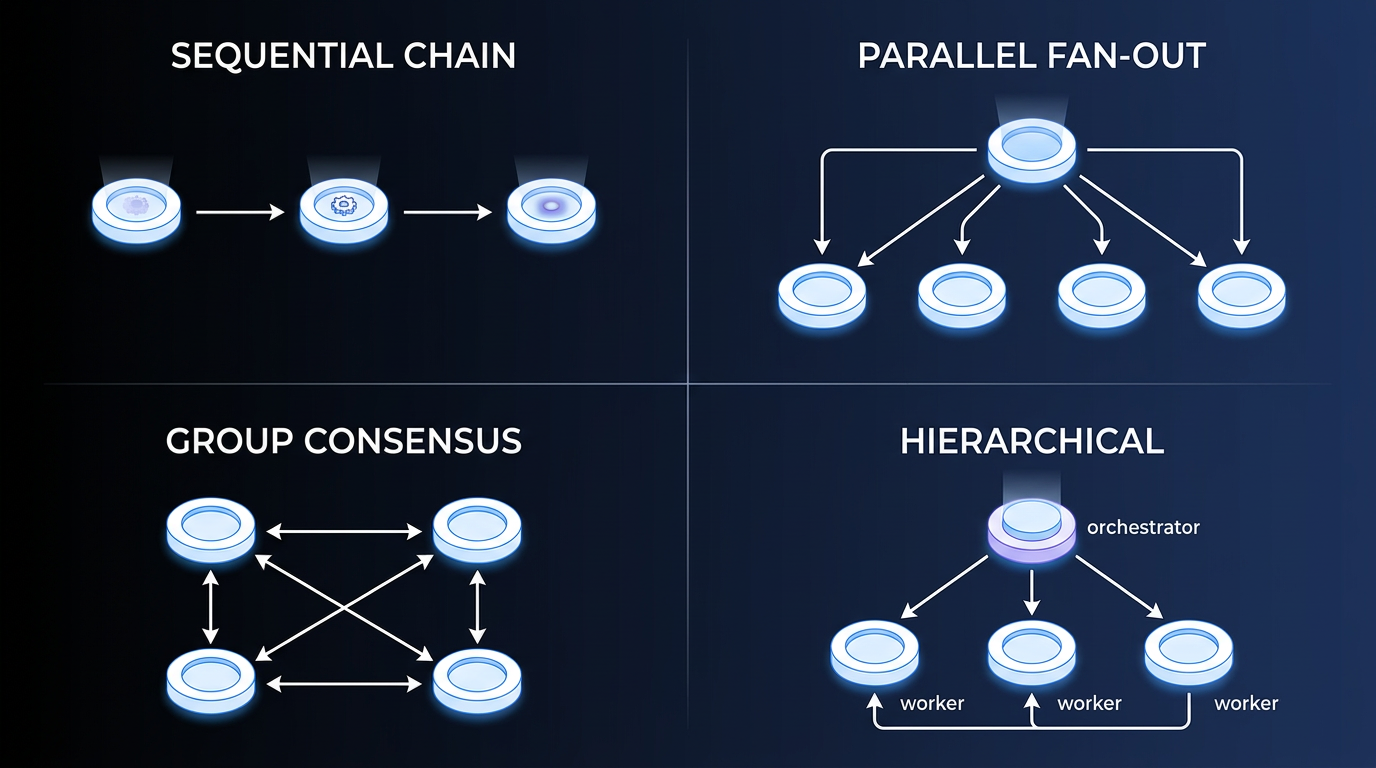
- Agent orchestration: The coordination pattern for multi-agent work. Multi-agent workflows commonly rely on sequential chaining, parallel fan-out, consensus-oriented collaboration, and hierarchical orchestrator-worker structures. The right pattern depends on the workflow. Some workflows require strict sequencing. Others need parallelized throughput or multi-agent consensus. A poor fit increases unchecked handoffs and expands the risk of workflow failure.
- Data integration: Agents require business context, factual data, graph relationships, and history. The orchestration layer gathers that context and passes it into each large language model (LLM) context window. This layer handles retrieval that respects permissions from enterprise systems. Without it, agents act with less context and weaker grounding.
- Security and governance: Policies, audit trails, identity management, and guardrails are enforced during execution rather than as part of a quarterly review. According to Gartner, required controls include continuous monitoring, enforced guardrails, rapid rollback mechanisms, and circuit breakers that halt agent operation upon threshold violations, alongside clear ownership of agent behavior. Without this layer, teams discover control failures after incidents rather than during execution.
- Model routing and selection: This layer assigns the right model to each step based on cost, latency, and task complexity. Not every step needs the same level of reasoning. Orchestration routes work accordingly. Without this layer, a single model choice can increase costs or latency across the entire workflow.
- Human-in-the-loop (HITL) controls: At critical checkpoints, the workflow pauses for human review before proceeding. Teams need to decide whether human input is optional or mandatory at each gate, and whether the response is an approval or feedback for iteration. Without clear gates, high-impact decisions proceed without the necessary review.
These six layers coordinate agents, rules, data, and human decisions in production workflows. Each one earns its place.
Avoid Agent-Only Architectures in Enterprise Workflows
Agent-only architectures carry compounding risk across four failure points. Understanding each one before building is what separates projects that reach production from those that get canceled along the way.
- Pre-production cancellation: Over 40% of agentic AI projects will be canceled by the end of 2027, according to Gartner. Many use cases positioned as agentic today do not require agentic implementations. Integration difficulties also prevent enterprise AI pilots from demonstrating business impact.
- Post-production control failures: A separate Gartner prediction from May 2026 addresses what happens after deployment: 40% of enterprises will demote or decommission autonomous AI agents by 2027 due to control failures identified after production incidents. These are two separate failure points: one before production and one after deployment.
- Error propagation: Gartner's analysis of multi-agent systems highlights how error rates compound as agent interactions multiply. Small design flaws become larger workflow failures when too many agent-to-agent handoffs are left unchecked.
- Token costs: As more reasoning steps are delegated to agents, costs increase faster than workflow complexity. Every additional agent call adds inference spend, and with enterprise volume, those costs compound quickly.
These risks appear before production and after deployment, and grow as multi-agent complexity increases. The risk is higher when deterministic workflow controls are limited or absent.
Apply the Hybrid Deterministic-Agentic Architecture
A hybrid pattern limits those risks. Deterministic rules and process orchestration handle most workflow execution. AI reasoning applies only at specific, defined decision points.
Use an agent when a step requires reasoning. Use deterministic automation when consistency is required. That decision, made at the workflow design stage, is what keeps AI reasoning bounded and costs predictable at scale.
This architecture limits AI reasoning to the steps that genuinely need it. The benefits show up in three concrete ways.
- Cost: Deterministic rules handle logic that does not require AI reasoning. This limits where tokens get used to tasks that genuinely need them.
- Reliability: A deterministic backbone produces consistent results for rule-governed steps. It also reduces some of the specification and design risks that emerge in multi-agent systems.
- Governance: Every step in the workflow is logged, auditable, and attributable. Configurable decision thresholds are set when AI agents act and when humans review. The governance layer becomes more critical as volume increases.
Sanofi puts this architecture into practice at enterprise scale, targeting autonomous AI resolution of 80% of IT requests and projecting annual savings of 10 million euros by running agentic workflows directly on its own data infrastructure, according to Fortune.
How Elementum Delivers Enterprise AI Orchestration
Getting the architecture right is the difference between AI that runs inside a governed system and AI that runs unsupervised until something breaks. Most organizations building agentic workflows today are doing it without all six layers in place, which is exactly where the failure rates show up. The organizations that get there build the orchestration layer first and let agent complexity grow into it.
Our AI Workflow Orchestration Platform and AI Agent Management capabilities are built for this architecture. Our Workflow Engine treats human judgment and automated execution as equals in every workflow. The automated step can use deterministic logic or an AI agent. It applies AI reasoning only where interpretation is needed and deterministic logic where consistency is required. The platform is pre-integrated with OpenAI, Gemini, Anthropic, Amazon Bedrock, and Snowflake Cortex, supporting model flexibility across workflows without requiring workflow logic to be rebuilt as models change.
Our Zero Persistence architecture keeps your data where it already lives. We never train on, replicate, or warehouse your data. CloudLinks query your Snowflake, Databricks, AWS, or Azure environment in real time without copying a single row.
Many of our customers start with one workflow, prove the savings, and expand into adjacent processes. Among orchestration platforms in this category, we have the production track record for replacing legacy SaaS at enterprise scale, with named customers including Sanofi, Snowflake, Under Armour, and Elevance Health.
Contact us to map enterprise AI orchestration into your architecture and the rest of your AI roadmap.
FAQs About Enterprise AI Orchestration
These are the questions IT architects and AI program leads most often raise when designing production orchestration for enterprise workflows.
How Do You Distinguish Enterprise AI Orchestration From Workflow Automation?
Enterprise AI orchestration coordinates automated reasoning and deterministic execution, with human review where needed. Existing workflow automation follows fixed if-then rules with humans as the only decision-makers. Enterprise AI orchestration adds AI agents and deterministic business rules to that model, controls where human judgment enters, and separates reasoning steps from consistency-driven execution. Enterprises need both interpretation and consistency across end-to-end execution.
What Causes AI Agent Failures in Enterprise Workflows?
AI agent failures in enterprise workflows come primarily from architecture and workflow design, not from model capability alone. Multi-agent systems fail due to structural issues: unclear specifications, misalignment among agents, weak verification, and insufficient stopping conditions. These are design problems, and they're fixable before deployment.
Should You Use an AI Agent for Every Workflow Step?
No, AI agents should be used only where a workflow step requires interpretation rather than consistency. Deterministic rules handle predictable steps at a fraction of the cost of AI inference. Reserve agents for steps that require interpreting or classifying unstructured data. That is the core logic behind the hybrid architecture.
How Can You Prevent AI Agent Sprawl Across Your Enterprise?
Centralized orchestration with governance controls is the answer. Agent volume increases operational risk if execution isn't auditable and controlled. Gartner projects the average Fortune 500 enterprise will have more than 150,000 agents by 2028, up from fewer than 15 in 2025. A centralized orchestration layer with auditable governance controls and configurable decision thresholds is the control point for managing agents at that scale.
What Is the Biggest Barrier to Scaling Agentic AI in Your Enterprise?
Data architecture is a barrier to scaling agentic AI for many enterprises. Many organizations cite data limitations as the primary roadblock, according to McKinsey. Enterprises cannot scale agentic AI if data remains hard to find, reuse, or govern. Data searchability and reusability also create recurring obstacles in enterprise AI adoption.
Keep Reading
What Is Agentic AI Orchestration? An Enterprise Guide
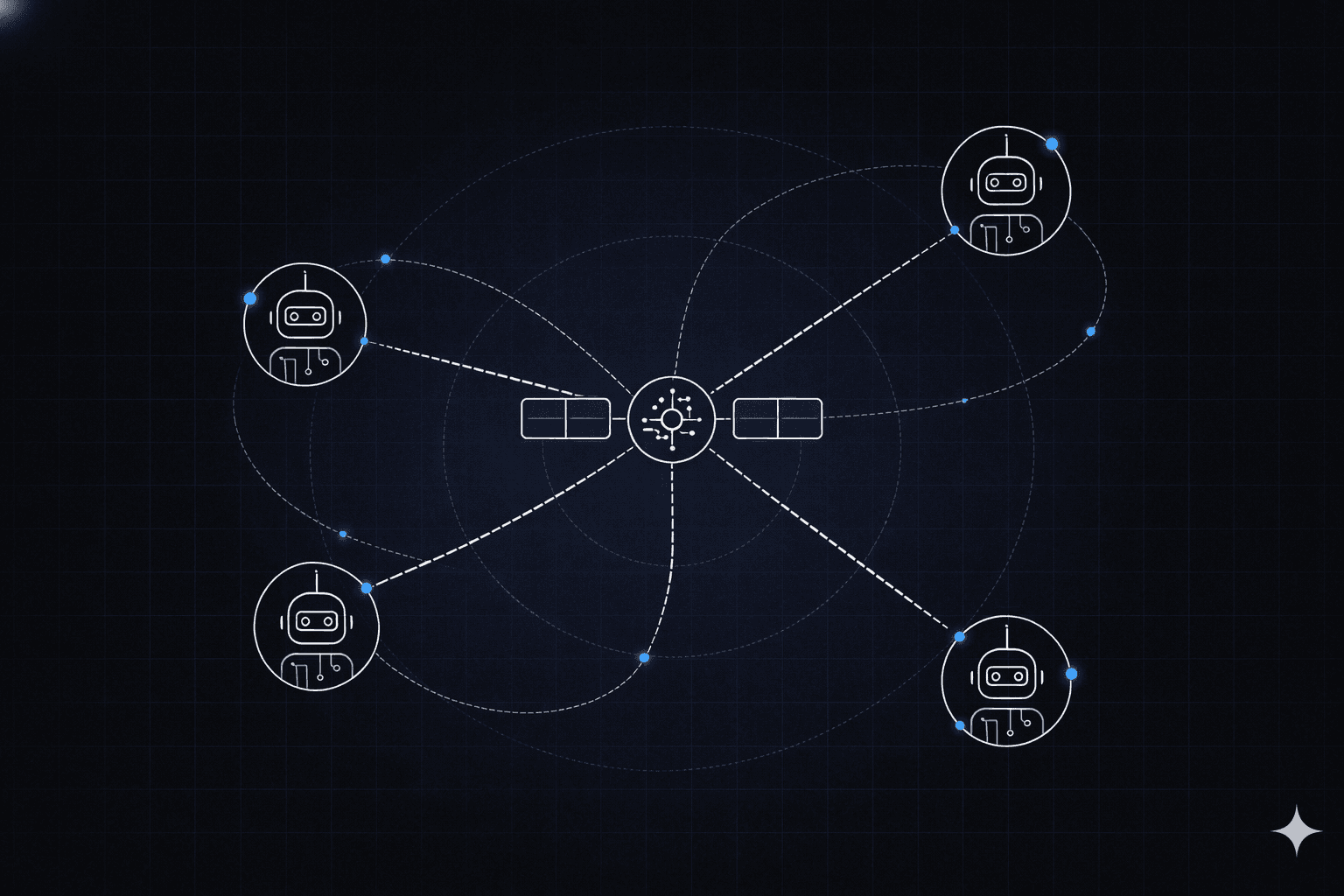
9 Best AI Orchestration Tools in 2026: Enterprise Evaluation Guide
Are AI Agents Deterministic? Understanding Predictability in Agentic Systems

Deterministic vs. Probabilistic AI: The Enterprise Guide to Building Workflows That Scale

What Is AI Agent Sprawl And How to Contain It

How to Prevent AI Hallucinations in Enterprise Workflows with a Four-Layer Defense Framework