
How to Use Agentic AI in Contract Management
A single enterprise contract can pass through legal, procurement, finance, and multiple approval chains before anyone signs it. Each handoff introduces delay. Every time.
Each system stores a different version of the truth, and the legal team reviewing clause deviations at 11 p.m. follows the same playbook every time. Both problems have the same root cause: contract workflows were designed around human steps, and adding systems on top did not change the underlying process
Agentic AI changes how contract teams run this work, but scaling it is harder than building it. Approval workflows, audit controls, and system access cut across multiple systems and teams. For operations leaders in 2026, governance is often one of the hardest problems to roll out. Getting to production requires the right use cases, the right governance architecture, and a phased deployment sequence. Most pilots who stall are missing one of the three.
Redesign Contract Operations with Agentic AI
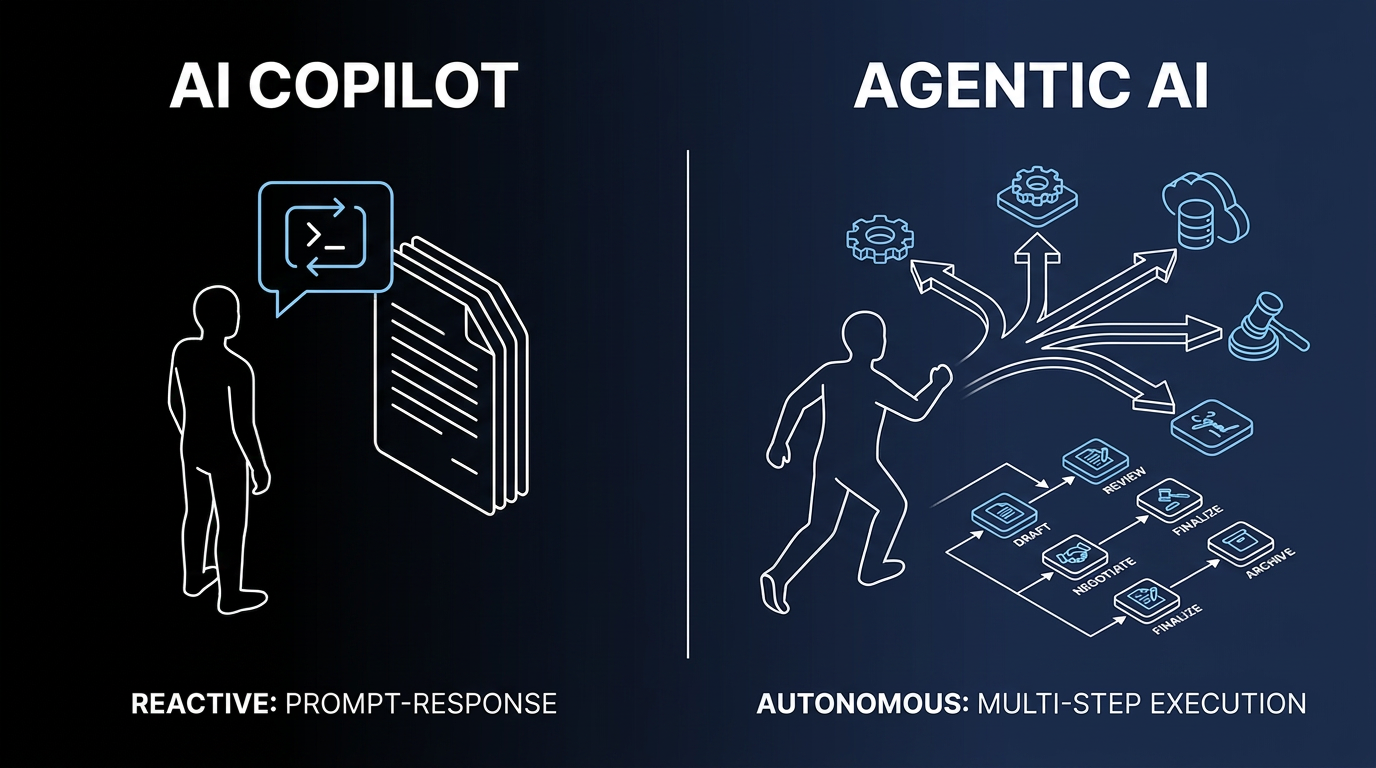
Earlier AI copilots in Contract Lifecycle Management (CLM) platforms respond to prompts. A lawyer asks a question; the system answers. Agentic AI works differently. It initiates and completes workflows on its own, executes multi-step sequences, integrates with CLM and other systems, and responds to defined triggers without needing a human prompt for each action.
Agentic CLM moves contracting beyond small workflow improvements toward a model in which AI handles routine execution and escalates decisions requiring human expertise. Teams need to decide which decisions require human accountability.
That difference affects how teams design workflows, approvals, and controls. Most enterprise leaders report adopting agentic AI, while only a minority have it running in broad production use. The adoption curve is steep, and most organizations are still in the early stages of deployment.
Apply AI Agents Across the Contract Lifecycle
Contract work has repeatable patterns throughout, so AI agents can handle volume while deterministic rules enforce policy. Five use cases are relevant starting now.
- Legacy contract extraction: Structured contract data is the foundation on which everything else depends. AI agents extract metadata, including parties, dates, key terms, and obligations, from unstructured legacy contracts in PDFs and scanned documents, providing a reliable data layer for downstream routing, monitoring, and reporting.
- Intake and request triage: Agentic workflows remove obvious administrative friction at intake. AI agents receive contract requests, classify the request type, determine the right templates, and route to the appropriate workflow without human triage. A modular rollout can scope each function to a single agent: one for intake, one for clause review, one for approval routing and one for reporting. Scoping each agent with defined boundaries reduces the risk of change and accelerates time-to-value.
- Risk identification and redlining: AI helps with the repetitive review work legal teams handle today. By surfacing deviations quickly, it narrows human attention to higher-risk decisions. AI agents scan contract drafts against enterprise playbooks, score clause-level risk, flag deviations from standard positions, and suggest redlines with rationale. Teams piloting this approach consistently report narrowing the legal review cycle.
- Obligation tracking and compliance monitoring: Once contracts are active, the challenge shifts from review to execution. AI agents continuously monitor active contracts for obligation milestones and SLA compliance, including performance thresholds. Proactive escalation replaces periodic human check-ins. For process-centric service contracts, the cost of manual monitoring narrows sharply when agents handle volume monitoring, and humans handle judgment calls.
- Procurement contract orchestration: Procurement combines repeatable policy checks with high transaction volume, making it a strong fit for agentic execution. AI agents automate tender preparation, supplier prequalification, bid analysis, and contract validation against procurement policy. A McKinsey proof of concept across 190 contracts in four languages achieved approximately 96% evaluation accuracy.
Together, these five use cases span the contract lifecycle from intake to post-signature monitoring, and each one benefits from the same underlying governance architecture.
Build Governance with Deterministic Orchestration
The business case for agentic AI in contract management can be strong. Many deployments slow down or stall during governance design. Three governance challenges deserve specific attention before scaling begins.
Hallucination Risk in High-Stakes Legal Workflows
Large language models (LLMs) produce probabilistic outputs. The same input can produce different outputs depending on context. In legal and compliance workflows, unmonitored probabilistic output creates an unacceptable operating model.
Legal-task hallucination rates can make unmonitored outputs unreliable, and retrieval-augmented generation in commercial legal AI tools can leave the problem unresolved. For contract workflows, this variability conflicts with compliance requirements. The same flexibility that lets an agent extract payment terms from unstructured contracts becomes a liability when invoice approvals must run identically every time for SOX compliance.
Deterministic orchestration addresses this by applying AI agents only to steps that require language understanding, while deterministic rules govern the steps that must produce the same result every time.
Legal Liability Falls on the Deploying Organization
Autonomous agents executing contract actions create liability and oversight questions that enterprise teams still need to resolve in deployment and procurement decisions. Accountability remains with the organization deploying the agent throughout.
Vendor terms often require close legal review, especially around accuracy, fitness for purpose, and responsibility for agent actions. The EU Product Liability Directive (Directive 2024/2853), which member states must transpose by December 2026, explicitly covers software and AI systems under its strict liability regime. The deploying organization is responsible for internal oversight. That does not transfer to the vendor.
Auditability Requires Architecture, Not Afterthoughts
If a contract decision cannot be reconstructed, no one can defend it later. Build auditability into the workflow design before deployment, not as a retrofit afterward.
When regulators require proof that an AI-driven contract decision was lawful and unbiased, organizations without structured audit trails have no clear way to provide it. Monitoring and traceability, including logging, are foundational governance requirements in agentic systems. Organizations that cannot trace AI-driven contract decisions back to a governed workflow may also struggle to show clear returns from those same agents.
Phased Deployment for Contract Workflow Automation
Mature deployments pair deterministic rules with AI agents and reserve defined escalation points for human judgment. A phased approach reduces risk at each stage.
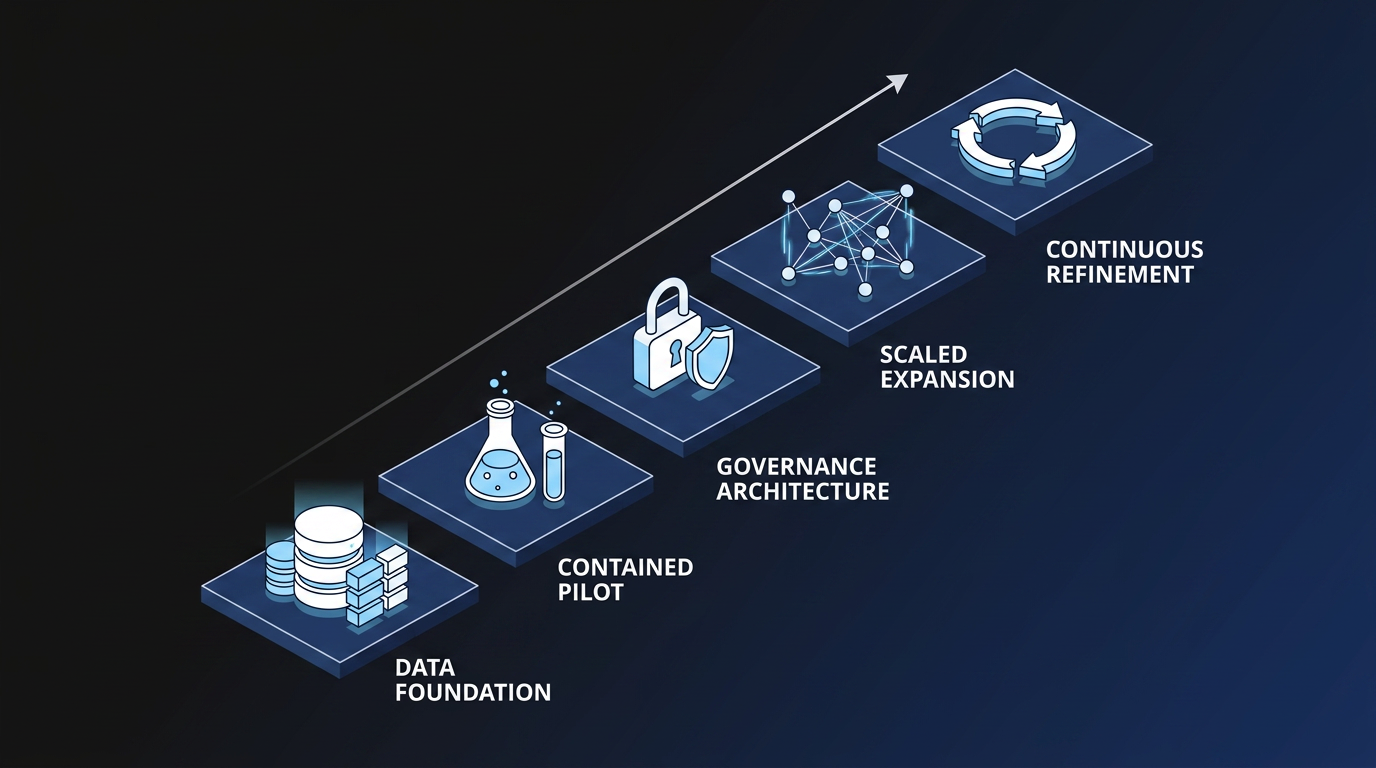
Phase 1: Data Foundation
This phase establishes whether later automation has anything reliable to run on. Centralize the contract repository and standardize templates and clause libraries. Define baseline Key Performance Indicators (KPIs) for time-to-signature and contract volume by type.
Assemble a cross-functional team spanning IT, legal, finance, and procurement. AI agents can only plan and act in real time if the underlying data is structured and accessible.
Phase 2: Contained Pilot
The pilot should prove control as much as efficiency. Start where risk is bounded, and performance can be measured clearly.
Start with high-volume, low-complexity contract types: non-disclosure agreements (NDAs), standard vendor agreements, routine renewals. These are often good pilot candidates because they have well-understood risk profiles, established playbooks, and enough volume to generate meaningful performance data. Set clear rules on what AI can and cannot do. Build human checkpoints at every step before completion, and monitor performance closely.
Phase 3: Governance Architecture
This phase defines when agents act, when they pause, and when humans intervene.
Define escalation triggers explicitly. Establish human-in-the-loop controls for approving individual agent actions and human-on-the-loop monitoring for portfolio-level oversight.
Existing detection controls designed for earlier AI may fall short when observing agentic AI across multi-step actions and system handoffs. Agentic systems can reach their goals without human-in-the-loop oversight, so many teams need continuous monitoring to see what agents did, when, and why. Build this governance architecture before scaling autonomous operations.
Phase 4: Scaled Expansion
Scale after validation. Extend validated workflows from a single contract type to multiple types, from one department to cross-functional deployment. Connect core systems during this phase, because stable agent workflows are needed before integrating downstream systems.
Phase 5: Continuous Refinement
After workflows go live, performance data should continuously improve the rules, thresholds, and escalation logic around each workflow. Use agent performance data to refine playbooks and escalation thresholds. The KPI baseline from Phase 1 becomes the evaluation instrument.
One deployment principle applies across all five phases: calibrate autonomy to contract risk profile. Standard NDAs and routine renewals with known counterparties can be handled with full AI autonomy within the playbook's boundaries. High-value or regulatory-sensitive contracts remain human-led processes, with AI providing analytical support. Applying uniform governance across all contract types wastes human capacity on low-risk work while undergoverning high-risk decisions.
Build Governed Agentic Contract Workflows with Elementum
Deploying agentic AI for contract management requires that agents, business rules, and human judgment work together within the same workflow across multiple systems, with a full audit trail. Operations leaders who defer that governance question may face the same pattern many organizations face today: agentic AI adoption without clear returns.
Elementum's AI Workflow Orchestration Platform is built for this architecture. Our Workflow Engine treats humans, business rules, and AI agents as equals in enterprise processes. Each workflow step routes to AI, deterministic rules, or human intervention based on where each adds value.
AI agents from any provider, including OpenAI, Anthropic, Gemini, Amazon Bedrock, and Snowflake Cortex, operate within governed workflows with no model lock-in. Configurable decision thresholds determine when agents act on their own and when they escalate to a human reviewer.
Every agent action is logged and revocable, with human-in-the-loop checkpoints for high-stakes decisions. Our Zero Persistence architecture means we never train on, replicate, or warehouse your data. The platform operates across ERP, CRM, and enterprise data platforms without replicating or owning customer data.
Many of our customers start with one workflow, prove the savings, and expand into adjacent processes. Among orchestration platforms in this category, we have the production track record for replacing legacy SaaS at enterprise scale, with named customers including Sanofi, Snowflake, Under Armour, and Elevance Health.
Contact us to map workflow orchestration into your contract management architecture and the rest of your AI roadmap.
FAQs About Agentic AI in Contract Management
These are the questions legal, procurement, and operations leaders most often raise when evaluating agentic AI for contract workflows.
How should you think about the difference between agentic AI and an AI copilot in contract management?
Copilots and agentic systems differ in who initiates the work and carries it forward. AI copilots produce outputs in response to user prompts. Agentic AI initiates and completes workflows on its own. It executes multi-step sequences and responds to triggers without a human prompt for each action. The agentic CLM model is exception-driven: AI handles routine execution and escalates only the decisions that require human expertise.
Can you use agentic AI without replacing your existing CLM platform?
In most cases, yes. AI and CLM software handle different functions and are more effective when used together. AI automates content-level tasks such as summarization and clause analysis, while CLM platforms govern operational lifecycle functions such as approvals and audit trails.
Who carries the liability if an AI agent makes an incorrect contract decision?
The oversight burden stays with the deploying organization. In practice, enterprise legal teams need to negotiate vendor contracts specifically regarding accuracy standards, update notification requirements, and liability caps that are proportionate to actual exposure. Agent autonomy does not reduce the organization's obligation for oversight.
How accurate should you expect AI to be at reviewing contracts?
Accuracy depends on the task. Structured extraction is generally more reliable than higher-judgment legal interpretation. McKinsey documented approximately 96% evaluation accuracy in a proof-of-concept across 190 contracts in four languages. Common extraction tasks, such as party names and dates, are often more reliable than complex judgments, such as obligation identification and risk classification.
How do you maintain audit trails when AI agents make contract decisions?
You maintain them by designing for traceability from the start. Every AI agent action in a contract workflow, including the data accessed and the reason for the decision, needs to be logged with traceability and revocation controls. Organizations that deploy AI agents without this infrastructure face both regulatory exposure and an inability to prove that any given contract decision was lawful and unbiased.
Keep Reading
How to Deploy Agentic AI: A Guide for Enterprises

Are AI Agents Deterministic? Understanding Predictability in Agentic Systems

Human-in-the-Loop Agentic AI: How Enterprise Teams Deploy Agents Without Losing Control
AI Guardrails: How to Govern What AI Agents Can Access, Decide, and Do
How to Control and Monitor the Output of AI Agents
AI Agent vs AI Workflow: Orchestration vs Automation