
AI Governance Framework: A Guide for Organizations

Between board pressure to demonstrate measurable AI return on investment (ROI), Chief Information Security Officer (CISO) concerns about data exposure, and the fact that most EU AI Act provisions become binding on August 2, 2026, the margin for running AI without a formal governance structure has closed.
Most enterprises have not yet built a formal AI governance structure: only 12% of enterprises have mature AI governance processes in place, according to HFS Research and Infosys, even as agentic AI deployment moves into production at scale across most large organizations.
This guide covers the major AI governance frameworks shaping enterprise programs in 2026, the structural pillars every framework relies on, and the execution-layer problems that derail governance investments before they reach production.
When Governance Lags Behind Deployment
AI agent deployment has accelerated faster than most organizations can govern it. Boards now expect AI ROI on a fiscal-quarter horizon, while compliance teams are still working through the policies that should have shaped deployment from the start.
Under Article 99 of the EU AI Act, violations involving prohibited AI practices can carry penalties of up to €35 million or 7% of global annual turnover, whichever is higher, which is the top tier of fines under the regulation. Lower tiers apply to other categories of non-compliance, and the operational cost of ungoverned AI shows up beyond fines, in shadow deployments, agent sprawl, and incidents that surface during board reviews rather than compliance audits.
Organizations with a mature governance approach scale AI differently. AI use that can be approved, monitored, and documented as a repeatable process turns scaling into a planning exercise rather than a risky one, and leadership has a defensible record when regulators, auditors, or boards ask how the program is being run.
Compare the Major AI Governance Frameworks
No single framework covers every enterprise requirement, and most global organizations end up using two or three at once, layered by jurisdiction, industry, and the risk profile of specific systems. Three frameworks shape the majority of enterprise governance programs in 2026.
NIST AI RMF as the U.S. Baseline
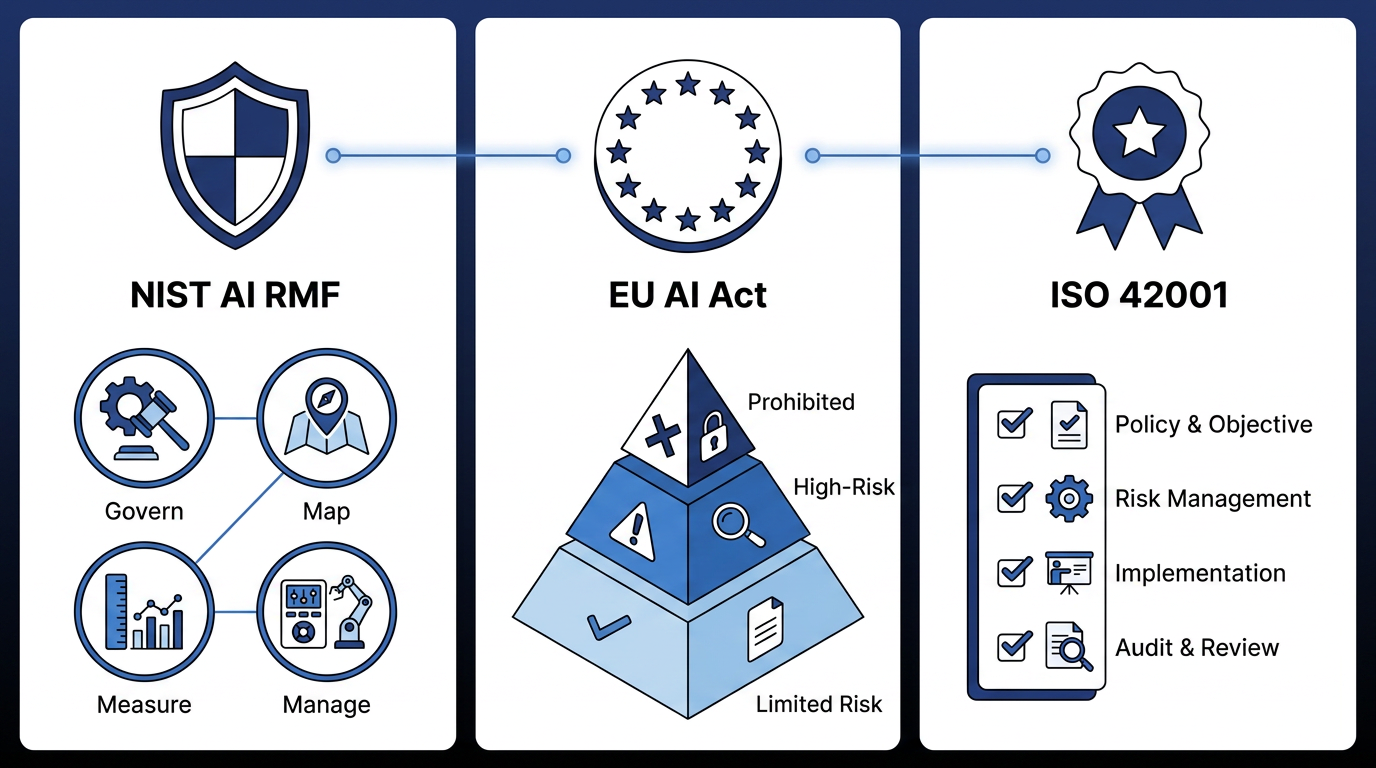
The NIST AI Risk Management Framework is the most widely used reference architecture for U.S. enterprise AI governance. It is voluntary, but it is often used alongside EU AI Act compliance efforts and ISO-based governance work in regulated industries.
The framework organizes around four functions: Govern for cross-cutting accountability, Map for contextualizing risks, Measure for continuous testing and monitoring, and Manage for prioritizing and treating risks. NIST also defines seven characteristics of trustworthy AI: validity and reliability, safety, security and resilience, accountability and transparency, explainability and interpretability, privacy enhancement, and fairness with harmful bias managed.
NIST has continued expanding its AI governance resources, including the AI RMF Playbook, the Generative AI Profile, and the December 2025 draft Cybersecurity Framework Profile for AI. These are sector-specific extensions built on the same core framework.
EU AI Act for Binding Cross-Border Obligations
The EU AI Act is the first major binding horizontal AI regulation, meaning it applies across sectors rather than to specific industries. Its rollout follows a phased timeline that runs through 2027 and applies to any organization operating in or selling into the EU, including non-EU organizations whose AI outputs reach EU users.
The Act classifies AI systems into risk tiers: prohibited, high-risk, general-purpose AI (GPAI) models such as large language models, and limited or minimal risk. Prohibited practices were banned outright in February 2025. GPAI model obligations, including technical documentation and copyright compliance, took effect August 2, 2025.
High-risk AI systems under Annex III, which include employment, biometrics, and critical infrastructure use cases, received a provisional extension to December 2, 2027 through a political agreement. Chief Information Officers (CIOs) should treat that as a planning deadline for systems covering recruitment, promotion, task allocation, and performance monitoring, while preparing for the earlier-phased obligations already in force.
ISO/IEC 42001 for Management-System Governance
ISO/IEC 42001 is the first certifiable global standard for AI management systems. It translates regulatory expectations and ethical principles into operational requirements covering ethics, accountability, transparency, data privacy, and risk assessment across the AI lifecycle.
The standard and the EU AI Act serve complementary roles. ISO 42001 provides a management system framework governing how the organization handles AI as a discipline. The AI Act requires system-specific conformity assessments for high-risk systems, which check that a specific deployed system meets the rules that apply to it. The scopes and obligations differ, so most enterprise programs treat them as two layers within the same control architecture rather than as alternatives.
Build the Core Pillars of an AI Governance Framework
Specific controls vary by framework, but authoritative sources point to the same structural pillars. A governance program missing any one of them creates exposures that compound as AI scales across the organization.
- Governance structure and accountability: Board-level oversight, executive ownership of AI strategy, and clear lines of responsibility for AI risk decisions. NIST's Govern function requires executive leadership to take responsibility for AI risk decisions explicitly, not implicitly. Without that ownership, risk decisions stall and accountability breaks down at the moments that matter most.
- Risk management: AI risk is decentralized, embedded in vendor software, and increasingly deployed by individual business units without centralized oversight, so risk management must be built into AI programs from the start rather than added after the fact. Waiting until deployment raises the likelihood of rework, policy breaches, and stalled rollouts.
- Human-in-the-loop controls: Human oversight is required to maintain regulatory and legal compliance in AI systems, and the humans conducting that oversight must understand how the AI works, where human judgment is irreplaceable, and how to perform meaningful review rather than rubber-stamping outputs. Without meaningful review, teams miss harmful outputs and lose the human judgment that high-stakes decisions require.
- Transparency and explainability: Model cards, algorithmic impact assessments, and documentation of decision logic. The EU AI Act requires GPAI providers to maintain technical documentation and publish sufficiently detailed summaries of the content used to train their models. Without that documentation, teams cannot explain decisions consistently or review models against a shared standard.
- Data governance: Policies covering data quality, provenance, lineage, privacy, and access. Static policies and periodic audits cannot keep pace with real-time AI decision-making, and weak data governance makes subsequent AI controls harder to enforce.
- Audit trails and documentation: Systematic records of AI system behavior, decisions, data lineage, and governance actions. NIST states that documentation enhances transparency and improves human review. Without audit trails, teams cannot reconstruct decisions during incidents or audits.
- Security and technical controls: AI-specific protections for training data, model integrity, access controls, and agent identity governance. Information security teams need continuous assessment for prompt injection risks and other AI-native vulnerabilities. Without those controls, AI systems are harder to defend and harder to govern in production.
- Continuous monitoring: Ongoing testing and monitoring tied to key performance indicators (KPIs), with defined triggers for escalation. Without continuous monitoring, drift, misuse, and control failures compound until they become larger operating problems.
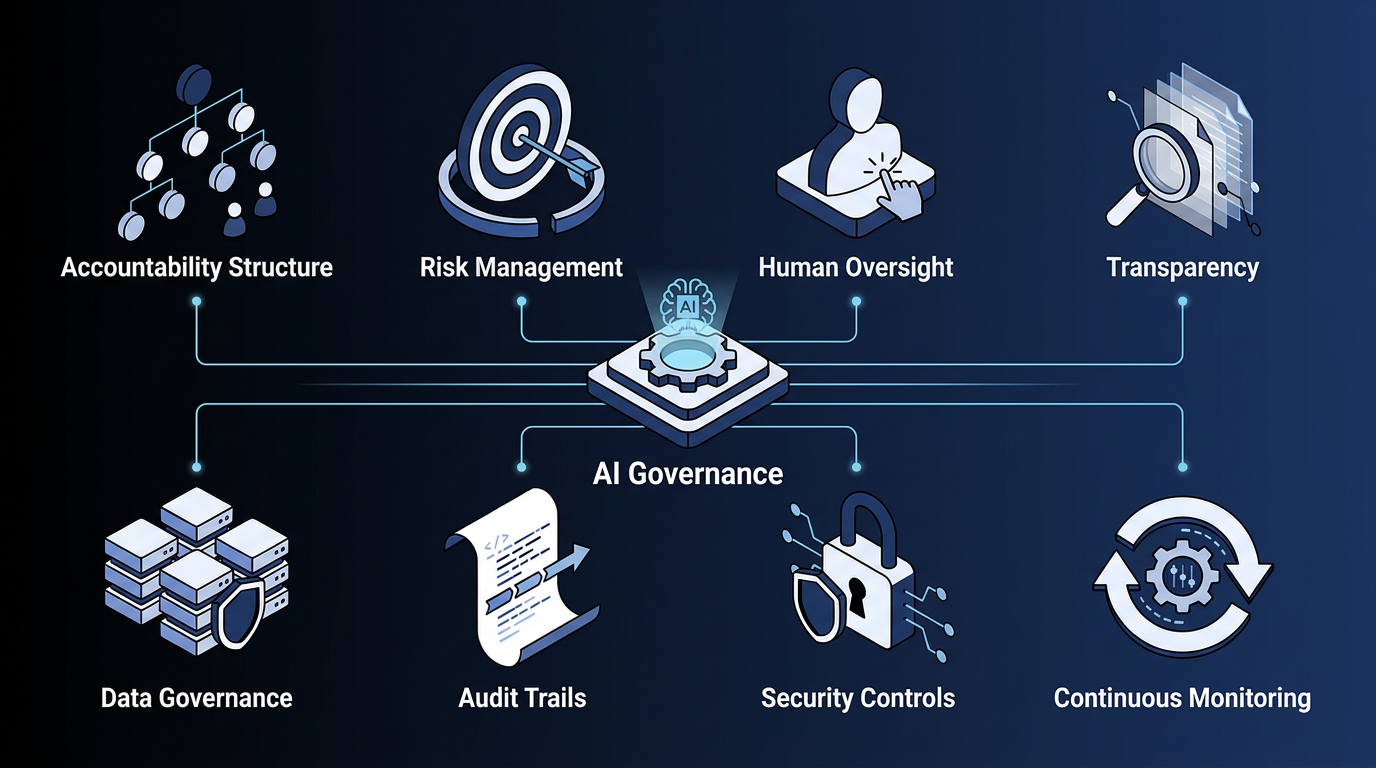
These pillars work as a connected system; if any one of them is weak, the issues move from policy into production, which is where most enterprise AI governance programs run into trouble.
Remove the Barriers That Delay Governance Programs
The most common failure mode in AI governance is not the absence of policy. It is the absence of enforcement infrastructure to make the policy operational. Here are four execution-layer problems that recur across enterprise programs:
- Policy without enforcement infrastructure: Many organizations publish AI policies without building the infrastructure to enforce them. Only 41% of employees report that their organization has a generative AI usage policy, according to KPMG, and 44% have already violated it. Governance investment must extend to workflow controls, agent monitoring, and access management, because documentation alone does not enforce anything.
- Shadow AI outpacing sanctioned tools: Enterprise AI procurement still lags behind employees' actual use of AI tools, often through personal accounts outside IT oversight. Workforce surveys consistently show that the share of employees using AI far exceeds the share using employer-approved tools. If the governed system is harder to access than the shadow alternative, policy alone will not change user behavior.
- Agent sprawl without orchestration: As teams gain access to AI tools, success produces sprawl: multiple retrieval-augmented generation (RAG) stacks, different model providers, overlapping copilots, and no shared guardrails. According to Microsoft's Cyber Pulse report, 80% of Fortune 500 companies use AI agents, and adoption has consistently outpaced security maturity. As sprawl grows, organizations need an orchestration layer that manages agents, workflows, and governance across the enterprise from a single control plane.
- Data foundations that cannot carry AI workloads: Many data leaders report that their data security and secure-access strategies are not keeping pace with AI adoption. Data governance must come first in the scaling sequence because weak data controls make later AI controls harder to enforce; mature programs treat data governance as a prerequisite rather than a parallel workstream.
How Elementum Builds AI Governance for Production
The pattern across these execution-layer problems is consistent: policy-layer governance does not control runtime behavior. Governance has to operate where the AI systems actually run. That is the architectural problem Elementum's AI Workflow Orchestration Platform and AI Agents are built to solve.
Our deterministic Workflow Engine (Trident) treats humans, business rules, and AI agents as equals in any process, routing each step to the appropriate handler. Configurable decision thresholds determine when an agent acts autonomously and when the workflow pauses for human review. Every agent action is logged with a full audit trail, and human-in-the-loop checkpoints support high-stakes decisions where judgment is non-delegable.
The Workflow Engine is pre-integrated with OpenAI, Gemini, Anthropic, Amazon Bedrock, and Snowflake Cortex, so models can be assigned to workflow steps and swapped out without rebuilding the underlying logic. Approval chains and runtime guardrails enforce enterprise governance at the point where agents act, not at the point where policies are written.
Data sovereignty is structural. Our Zero Persistence architecture means your data is always yours: we never train on, replicate, or warehouse your data. CloudLinks query your data in real time where it already lives, in Snowflake, Databricks, BigQuery, or Redshift, with your existing access controls and governance policies still in force. Built-in guardrails and input validation across every model interaction defend against prompt injection, which OWASP identifies as the leading large language model (LLM) vulnerability.
Many of our customers start with one workflow, prove the controls, and expand governance coverage across IT, HR, finance, and operations as adoption compounds. Production deployment typically takes weeks rather than the extended timelines of traditional enterprise rollouts. We have the production track record for replacing legacy SaaS at enterprise scale, with named customers including Sanofi, Snowflake, Under Armour, and Elevance Health.
Contact us to map governed AI orchestration into your enterprise architecture and the rest of your AI roadmap.
FAQs About AI Governance Frameworks
These are the questions enterprise teams most often raise when scoping or strengthening an AI governance program.
How Should You Think About AI Governance Compared to AI Compliance?
AI compliance is the practice of satisfying specific external legal requirements. AI governance is the broader way the organization runs its AI decisions: who owns which decisions, how policies are enforced, how risks are escalated, and how accountability is maintained across the full AI lifecycle. Governance makes compliance more durable because it sets the operating rules that produce compliant behavior in the first place.
Which AI Governance Framework Should You Adopt?
Most global organizations adopt a combination rather than a single framework. NIST AI RMF provides an internal risk management methodology. ISO/IEC 42001 provides a certifiable management system. The EU AI Act imposes mandatory obligations on AI providers, deployers, importers, distributors, and manufacturers whose AI systems or outputs enter the EU, with a risk-based set of obligations and specific exclusions.
Who Should Own AI Governance in Your Enterprise?
AI governance ownership is cross-functional, with the CIO as the accountable executive. The CISO should not bear sole responsibility for AI governance. Effective governance requires product, engineering, operations, legal, and business leaders to define shared standards together, which is what makes the CIO the natural integrator across those functions.
Do Existing Governance Frameworks Cover AI Agents?
Governance frameworks designed for static AI models often fail to fully address agentic AI. Multi-agent systems introduce emergent behaviors, questions about agent identity, and boundaries of autonomy that require more specific controls, including orchestration rules, defined autonomy limits, and human oversight triggers for high-stakes decisions.
What EU AI Act Deadlines Should You Plan for in 2026 and 2027?
The AI Act follows a phased rollout with major obligations beginning across 2025, 2026, and 2027. High-risk AI systems under Annex III, including employment, biometrics, and critical infrastructure AI, are covered by a provisional political agreement to extend the compliance deadline to December 2, 2027, while other obligations apply earlier. Penalties for violations of prohibited practices can reach up to €35 million or 7% of global annual turnover.\