
Business Process Automation vs. AI-Driven Automation: Breaking Down the Differences
A single purchase order passes through SAP, Salesforce, and three spreadsheets before it reaches an approver. A procurement specialist spends hours on three-way matching, comparing purchase order (PO) numbers, receipt confirmations, and invoice amounts row by row. These inefficiencies exist in organizations that have already invested in automation.
Business process automation (BPA) and Robotic Process Automation (RPA) handle structured, rule-based work well, but stall on unstructured inputs such as PDFs and email threads. AI-driven automation covers that ground, yet 95% of enterprise generative AI pilots deliver no measurable impact on profit and loss, a finding from MIT NANDA's 2025 State of AI in Business report.
This article breaks down the structural differences between BPA and AI-driven automation, maps where each fits, and explains why many enterprises are treating them as distinct layers within a single workflow.
Architectural Differences Between BPA and AI-Driven Automation
BPA/RPA and AI-driven automation aren't different versions of the same technology. In practice, they often require different governance models, infrastructure choices, and accountability structures.
Seven dimensions in particular shape how the two approaches diverge in practice:
- Execution model. BPA/RPA is deterministic; the process is defined in advance, and the bot follows the steps exactly as programmed. We call this deterministic execution, a setup where every step is predictable and reproducible. If something changes outside its predefined rules, it fails. AI-driven automation operates probabilistically, meaning identical input can produce different output depending on context. AI systems adapt dynamically, making context-aware decisions within defined guardrails rather than executing scripts.
- Data handling: BPA/RPA requires structured inputs: rows and columns. Roughly 80% of enterprise data is unstructured, locked in PDFs, email threads, chat logs, and scanned documents that traditional automation can't process. AI-driven systems can work across text and other unstructured formats, making them better suited to document-heavy and variable-input workflows.
- Decision capability: RPA bots follow predefined scripts with all decision logic explicitly programmed before deployment. AI-driven automation operates on goal-oriented reasoning: humans set the goals, and the system determines how to fulfill them. This requires a different design discipline, one built on prompt design, model selection, and outcome validation rather than flowchart scripting.
- Error handling: RPA fails predictably but can break on unexpected inputs or interface changes. AI-driven automation handles exceptions through contextual reasoning, but it introduces hallucination as a failure mode with no equivalent in deterministic systems.
- Scalability: RPA scales horizontally through bot replication: more bots running the same script in parallel, with lightweight compute requirements. AI-driven automation scales by expanding the types of processes it can handle, but it typically brings higher compute costs and more latency.
- Governance: RPA actions can be logged and reproduced when the platform and process are designed with appropriate audit controls. Given the same input, the bot always produces the same output. AI agent governance requires a different framework. The question for managers shifts from "How do we set guardrails for tools?" to "How do we assign decision rights, accountability, and oversight to systems we own but don't fully control?"
- Organizational impact: RPA executes decisions already made by humans without materially altering accountability structures. AI agents can participate in decision-making, requiring a formal redesign of who or what holds decision authority. Deploying AI agents is often as much an organizational governance decision as a technology one.
When to Use BPA, AI-Driven Automation, or Both
Many enterprises treat automation as a continuum rather than a clean, replacement-cycle process. Different approaches govern different steps within the same workflow rather than replacing prior stages wholesale.
Four practical tests can help decide where BPA/RPA fits and where AI-driven automation earns its place.
- Data structure: Structured, predictable inputs directly support BPA/RPA. Unstructured or variable inputs such as PDFs, emails, and scanned documents usually require an AI processing layer before deterministic execution can proceed.
- Decision logic type: Rule-deterministic decisions, where an explicit conditional always produces the same output, are appropriate for BPA/RPA. Context-dependent decisions, where the correct output depends on factors that can't be exhaustively pre-specified, are better suited to AI-driven automation.
- Exception rate: Low exception rates with well-defined human escalation paths support BPA/RPA. High exception rates or novel exception types are better candidates for AI-supported handling.
- Compliance requirements: Zero-error-tolerance regulated processes usually require deterministic BPA/RPA as the execution layer, with AI used only in preparatory, extraction, or classification steps.
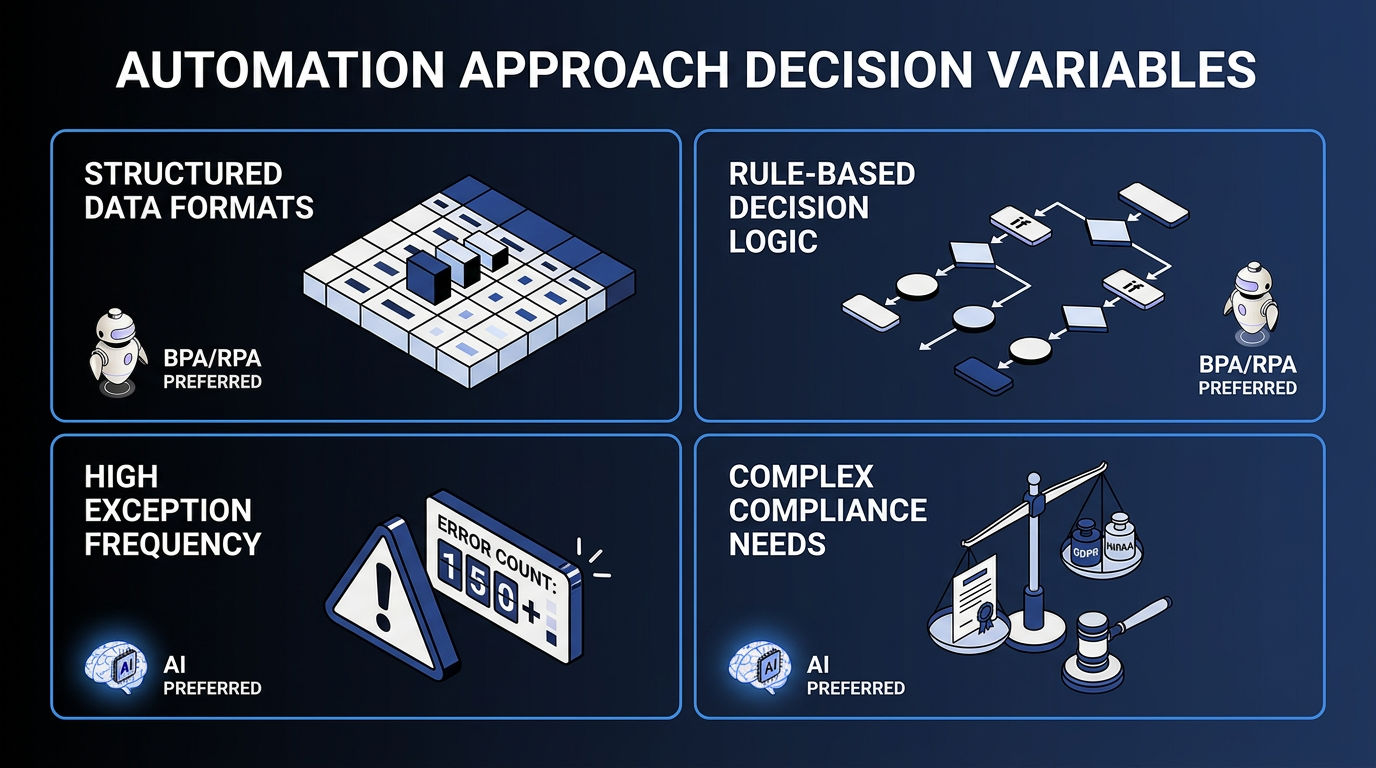
Taken together, these variables help determine where deterministic execution should remain in control and where AI should interpret, classify, or resolve ambiguity before the workflow continues.
What Hybrid Automation Looks Like in Practice
Invoice processing illustrates how production automation architectures pair AI interpretation with deterministic execution to handle both structured and unstructured inputs within a single workflow.
The table below shows which steps belong in each layer:
| Workflow step | Best-fit layer | Why |
|---|---|---|
| Receiving invoices in standard format from known vendors | BPA/RPA | Predictable structure, exact-match rules |
| Comparing PO numbers against exact-match rules | BPA/RPA | Rule-deterministic logic |
| Posting validated transactions to ERP systems | BPA/RPA | Requires auditable, repeatable action trails |
| Extracting structured data from variable-format vendor PDFs | AI | Unstructured inputs, variable layouts |
| Handling discrepancies tied to vendor relationships and contract history | AI | Context-dependent reasoning |
Pure BPA/RPA is sufficient only when all vendors submit invoices in a single consistent structured format, and exception rates are extremely low. Pure AI is inappropriate because payment execution and ERP posting require deterministic, auditable action trails. In practice, many enterprises use a hybrid production architecture for this kind of workflow.
Hybrid splits like this show up across procurement, IT service management (ITSM), human resources (HR), and financial compliance. ITSM is a clear example:
| ITSM task | Best-fit layer | Why |
|---|---|---|
| Password resets and account unlocks | BPA/RPA | Fully deterministic, zero judgment required |
| Classifying novel or ambiguous incidents | AI | Context-dependent interpretation |
| Predicting outages through cross-domain pattern recognition | AI | Requires reasoning across signals |
Organizations that deploy AI classification before establishing well-defined deterministic routing categories can create misrouting risk at scale.
Where BPA and AI-Driven Automation Break Down
Both BPA/RPA and AI-driven automation have distinct failure patterns. Understanding the risk profile of each shapes how they should be combined.
BPA/RPA Failure Patterns
Many BPA projects fail due to a lack of understanding of the process being automated. Organizations often discover mid-implementation that processes are more complex than initially documented, driving rework, cost overruns, and deployment delays. RPA implementations are particularly prone to failure when applied to dynamic, frequently changing tasks and to complex tasks spanning multiple systems.
Governance has often lagged RPA expansion into control-sensitive environments. Formal governance guidance for RPA in financial reporting emerged only after many organizations had already deployed RPA in those contexts. Automation expands faster than the surrounding control framework, which is one reason why failures concentrate in regulated workflows.
Where AI-Driven Automation Falls Short
Integrating with existing systems and addressing risk and compliance concerns rank among the top challenges organizations cite when adopting agentic AI. The savings picture is similarly uneven: many organizations report that realized returns from generative AI (GenAI) have so far fallen short of early expectations.
Only 23% of organizations report scaling an agentic AI system anywhere in their enterprise, and in any given business function, no more than 10% are scaling AI agents. Much of the value remains concentrated in isolated pilots rather than consistently realized at enterprise scale.
Governance frameworks for agentic AI are still taking shape. AI governance requires answering whether an agent stayed within authorized bounds across dozens of sequential decisions that were never individually approved, rather than only whether a single model produced a correct output.
The Industry Is Converging on Hybrid Orchestration
Many enterprise architectures route deterministic steps to rules-based execution and non-deterministic steps to AI agents within a shared orchestration layer. In that sense, "BPA vs. AI" is often the wrong evaluation frame.
Current enterprise patterns point toward deterministic control flows and probabilistic AI systems coexisting rather than replacing one another. Across enterprises, that means integration at the base, deterministic control flow in the middle, and AI-driven execution where reasoning is needed.
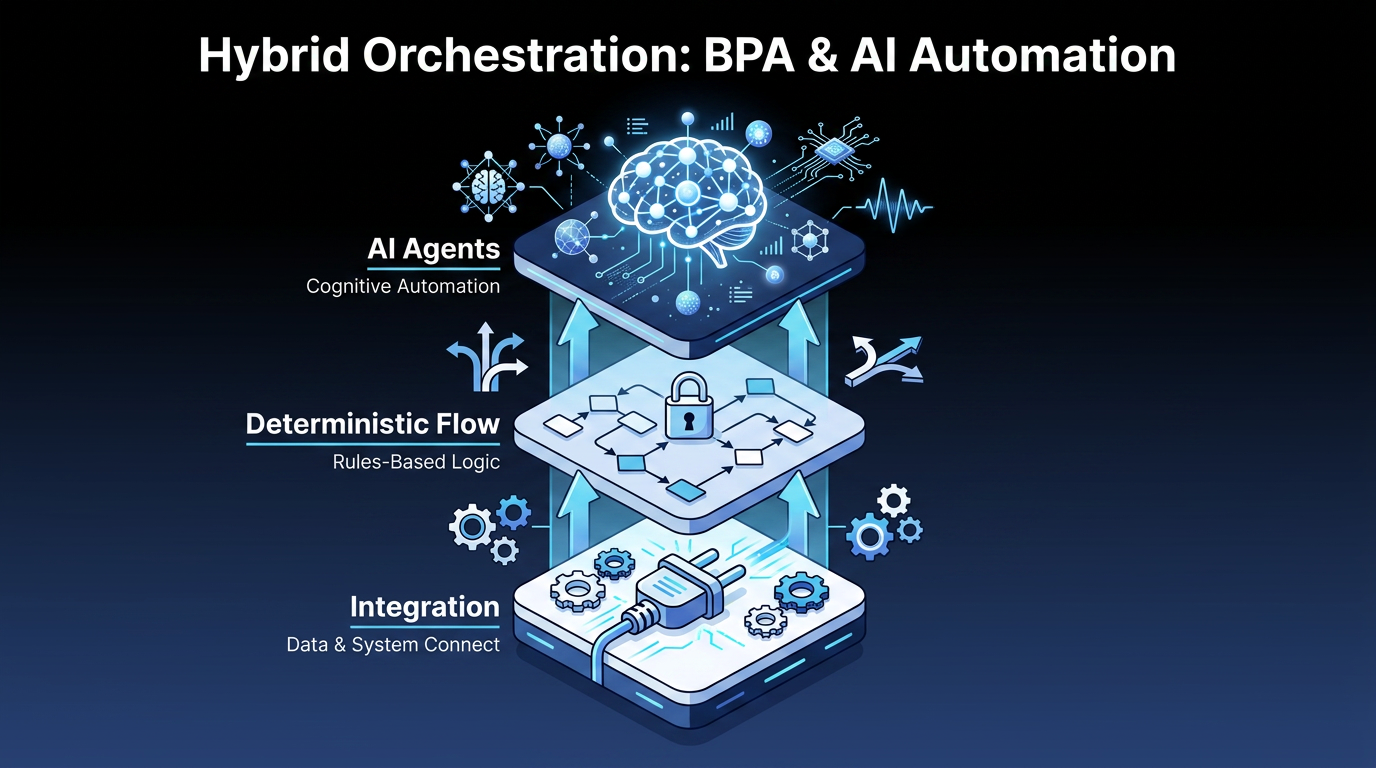
The underlying principle is that agents need workflows, not the other way around. Deterministic workflow orchestration provides the governance structure within which AI agents operate. AI doesn't replace the orchestration layer but operates within boundaries it defines.
A few barriers still stand in the way of full convergence. Data searchability ranks among the top obstacles organizations cite when deploying agents. Most organizations haven't yet begun scaling AI across the enterprise, and the majority remain in pilot mode. Centralized visibility, usage policy enforcement, and protection against AI-specific risks must be in place before hybrid orchestration can be deployed at regulated-industry scale.
How Elementum Bridges Business Process Automation and AI-Driven Automation in One Platform
How you split work between BPA and AI-driven automation shapes three concrete outcomes: whether a finance close runs clean or stalls on exceptions, whether auditors can trace every approval back to its rule or model, and whether a procurement or ITSM workflow moves from a pilot on one team to enterprise-wide adoption.
The path to return on investment (ROI) typically runs through hybrid orchestration that right-sizes every step; deterministic rules where consistency is required, AI agents where reasoning and interpretation are needed, and human judgment where accountability demands it.
Elementum’s AI Workflow Orchestration Platform and AI Agents are purpose-built for this architecture. Our deterministic Workflow Engine treats humans, business rules, and AI agents as first-class participants in any process, routing each step to the appropriate handler. We call this the Trident Model.
The Workflow Engine is pre-integrated with OpenAI, Gemini, Anthropic, and Snowflake Cortex, so you can assign different models to different steps and swap them without rebuilding logic. Configurable confidence thresholds determine when a workflow proceeds automatically and when it pauses for human review.
Data sovereignty is structural, such that our patented Zero Persistence architecture means your data is always yours: we never train on it, we never replicate it, and we never warehouse it. CloudLinks query your data in real time where it already lives, in Snowflake, Databricks, BigQuery, or Redshift, with zero copies, zero syncing, and zero new warehouses.
At enterprise scale, deterministic workflows and AI-agent-only approaches have different cost profiles. We continuously select the right agent, the most cost-effective large language model (LLM), and the right tool for each step, so you're not defaulting to premium models for tasks that don't require them.
Many of our customers start with one workflow and expand across procurement, IT, HR, and finance as adoption compounds. Production deployment typically occurs within weeks, rather than the extended timelines of traditional enterprise automation rollouts.
Contact us to map workflow orchestration into your architecture and the rest of your AI roadmap.
FAQs About Business Process Automation vs. AI-Driven Automation
These are the questions IT and operations leaders most often raise when evaluating BPA, RPA, and AI-driven automation side by side.
Is Your Team Replacing RPA With AI Automation?
RPA is being augmented, not replaced. It remains the appropriate tool for rule-based, structured automation. AI agents expand the types of processes that can be automated, particularly those involving unstructured data and context-dependent decisions, but they operate within orchestration layers built on deterministic foundations.
How Should Governance Requirements Differ Between BPA and AI-Driven Automation?
Governance requirements diverge along audit-trail design. BPA/RPA governance relies on deterministic audit trails where identical input always produces identical output. AI agent governance requires statistical validation across outcome distributions, model drift monitoring, confidence scoring, and human-in-the-loop escalation paths. Governance frameworks for agentic AI are still taking shape.
Should You Redesign Processes Before Applying AI Automation?
Yes, process redesign should come before AI automation. Many BPA projects fail because organizations automate processes with more decision points and exceptions than initially documented. AI accelerates automation, which increases the risk of automating a broken process at scale. Map the process, identify which steps are deterministic and which require judgment, then apply the appropriate automation to each.
Which Processes Should Stay Rule-Based vs. Move to AI-Driven Automation?
Rule-based processes belong in BPA/RPA when they have structured inputs, explicit conditional logic, and low exception rates: PO approval routing, system provisioning, transaction posting, password resets. Processes involving unstructured data, context-dependent decisions or high variability benefit from AI: contract clause extraction, vendor risk scoring and anomaly detection. Most end-to-end enterprise workflows require both within a hybrid architecture.
Why Are So Many Agentic AI Projects Projected to Be Canceled?
Cancellations cluster around three causes: escalating costs, unclear business value, and inadequate risk controls. Current AI models don't have the maturity to autonomously achieve complex business goals or follow nuanced instructions over time. Many enterprises are embedding AI agents within governed, deterministic workflow orchestration rather than deploying them as standalone autonomous systems.
Keep Reading
Beginner's Guide to Agentic Automation: What Is Agentic Automation?
How to Automate Employee Provisioning with IT Software: A Step-by-Step Guide
How to Automate Procurement Workflows with AI Agents and Business Rules

7 Best AI Automation Platforms for Enterprises in 2026

What is Business Process Automation? Enterprise Use Cases and Best Practices for 2026
7 Best AI Workflow Automation Tools in 2026