
Business Process Automation vs Robotic Process Automation: Key Differences
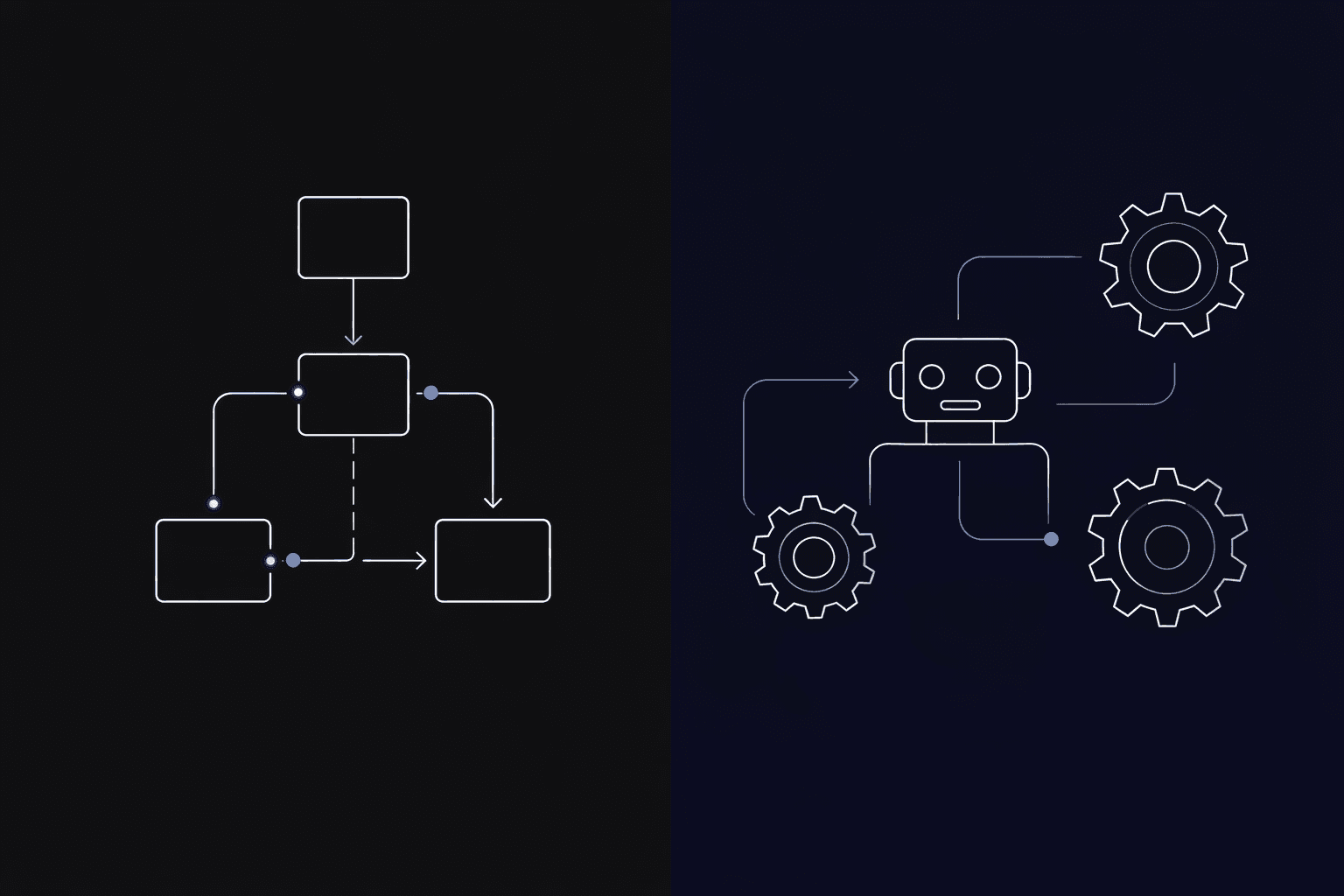
Robotic process automation (RPA) scripts a discrete task. Business process automation (BPA) orchestrates the end-to-end process within which the task sits. Enterprise teams that treat the two as substitutes deploy bots successfully, then discover that automating individual steps doesn't fix the handoffs around them.
AI agents make the architectural choice harder to reverse. An agent that approves invoices, drafts contracts, or resolves incidents needs an execution layer that defines when it can act on its own and when it has to escalate to humans. This article covers how RPA and BPA differ, where each fits, and how to choose an architecture that holds as agents enter the stack.
RPA Automates Tasks While BPA Orchestrates Processes
RPA uses software scripts that emulate human interaction with the application user interface (UI). Teams configure each manual task as a script, and that script is the unit of work.
BPA process design covers the design, execution, and monitoring of business processes involving diverse sets of systems and people. RPA operates at the task level, while BPA operates at the process level, covering design, execution, monitoring, and coordination across an entire workflow.
An RPA bot handles task-level work in stable, rule-based environments accessible through existing UIs. BPA governs the end-to-end procure-to-pay process: the full workflow from purchasing through payment. It determines when an invoice gets routed, who approves it, what budget threshold triggers escalation, and how procurement, finance, and legal handle exceptions.
The table below summarizes where the two approaches differ across the dimensions that matter most to enterprise decisions.
| RPA | BPA | |
|---|---|---|
| Scope | Individual task automation | End-to-end process orchestration |
| Integration layer | Presentation layer (UI scripts) | System level (APIs and process models) |
| Governance model | Organizational overlay, typically a Center of Excellence | Built into process models and decision logic |
| Maintenance pattern | Increases non-linearly as bot estates grow | More stable; API integrations are less brittle |
| Human decision handling | Not native | Conditional approvals and routing are built in |
| AI compatibility | Bolted on through vendor acquisitions | Native agents governed inside workflow models |
| Audit trail | Varies by implementation | End-to-end, built into process architecture |
How Integration Architecture Shapes Long-Term Viability
How an automation tool connects to enterprise systems determines how much it costs to maintain as those systems change. RPA operates at the presentation layer: bots interact with application user interfaces (UIs) by clicking buttons and reading screen positions. BPA integrates at the system level through application programming interfaces (APIs) and process models.
In one example of a maintenance failure, an automated process worked until a third-party provider updated the interface. The submit button changed from green to blue. The bot, hardcoded to look for green pixels at specific coordinates, failed silently.
That fragility compounds in large bot estates: collections of many bots maintained across the enterprise. A single enterprise resource planning (ERP) migration or software-as-a-service (SaaS) UI refresh can break multiple automations at once. Even after RPA vendors added API connectors through acquisitions, bot architecture often remained the underlying model.
BPA's API-native integration layer is more resilient to UI changes. When an underlying system changes, the integration point is explicit in the architecture rather than a UI-scripted coordinate. BPA tools center process models rather than screen-level mimicry.
Why RPA Scaling Stalls at Enterprise Scale
RPA pilots often succeed under controlled conditions: stable processes, limited exceptions, and dedicated developer attention. Production deployment introduces more variability and more exceptions than pilots can absorb.
Early RPA success does not automatically translate into broad-scale, consistent ROI, or durable governance. Operating model choices explain as much of that failure as the tooling itself. Three failure patterns repeat across enterprise RPA programs.
- Maintenance overhead scales non-linearly: As bot counts grow, more team capacity shifts from building new automations to maintaining existing ones. Upkeep consumes the efficiency gains that justified the initial investment.
- Governance breaks down at scale: Scaling RPA at the enterprise level typically depends on a dedicated Center of Excellence (CoE): a group responsible for standards, oversight, and scaling, staffed with C-level champions, change management experts, solution architects, and compliance staff. Organizations layer that structure on top of the technology rather than build it in.
- RPA scripts encode broken processes: Organizations frequently deploy RPA to automate workarounds rather than addressing root causes. Deploying RPA before redesigning the underlying process accelerates technical debt rather than eliminating it.
BPA addresses these challenges more structurally because Gartner's BPA definition includes process models and related business, decision, and data models as native components rather than purely organizational overlays. BPA ties governance into the architecture, and process modeling as a prerequisite step surfaces broken logic before automation encodes it.
When to Use BPA vs RPA in Your Enterprise
RPA and BPA operate at different layers of the automation stack. The right choice depends on the structural characteristics of the target process.
RPA is often the right choice when the work is discrete, rule-based, stable, and accessible only through existing UIs. Back-end operations such as password resets, account unlocks, and routine data extraction are where RPA's speed-to-value advantage is real.
BPA is often the better fit when the process spans interlinked workflows, requires conditional approval logic, involves human decision points, or must maintain an end-to-end audit trail: a record of who did what, when, and why. Financial close cycles, incident management workflows, and full procure-to-pay processes all require the orchestration layer that BPA provides.
Combined approaches work when a process includes both legacy UI-only systems and modern API-connected platforms alongside human decisions. Employee onboarding, for example, involves rule-based account provisioning, where RPA fits, and conditional approval workflows across managers and departments, where BPA fits. A single bot does not constitute an orchestration layer for conditional sequencing across systems, human approvals, and legacy UI actions.
Programs that treat orchestration and governance as the foundation can use RPA as one execution component inside that structure. The inverse approach starts with bots and requires organizations to impose governance afterward.
A Third Architecture: Business Orchestration and Automation Technologies
Analysts are grouping both BPA and RPA into a broader architectural pattern. Gartner has formally created a new market category: the BOAT category, short for business orchestration and automation technologies, described as "a consolidated software platform that delivers enterprise process automation by enabling capabilities including orchestration of business processes, enterprise connectivity, low code development and agentic automation."
Enterprise orchestration now has to cover more than scripted tasks and API calls. It also has to govern AI-driven steps, human approvals, and system actions within a single operating model.
In practice, that points to deterministic orchestration with bounded AI components. AI agents handle tasks that require interpretation and reasoning: reading unstructured documents, classifying exceptions and generating recommendations. Deterministic workflows govern routing, approvals, compliance enforcement, and audit trails. Humans stay in the loop at defined checkpoints where decisions require human judgment.
Applying AI to isolated tasks is different from redesigning the process within which the task sits. Technology deployment without process redesign produces activity, not the operational result enterprises are after.
Where Elementum Fits in Your Automation Architecture
For enterprise operations leaders, the architectural question is whether to build on an orchestration layer that coordinates AI agents, deterministic rules, and humans, or to keep adding automation tools that don't govern one another. We built our AI workflow orchestration platform to serve as that coordination layer. Here's what that looks like in practice:
- Workflow Engine: Treats humans, business rules, and AI agents as equals in every process, with a visual no-code builder and integrations across enterprise systems.
- AI Agents: Come pre-integrated with OpenAI, Gemini, Anthropic, Amazon Bedrock, and Snowflake Cortex, so teams choose the right model for each step rather than defaulting to a single vendor.
- Tasks and Approvals: Adds human-in-the-loop checkpoints at decision points that require judgment, with intelligent routing and full audit trails.
- Zero Persistence architecture: Queries data in real time where it already lives through CloudLinks. We never train on your data, replicate it, or warehouse it.
- Compliance: SOC 2 Type II certified, with built-in support for GDPR, CCPA, SOX, and HIPAA, and designed as an architectural foundation from day one.
If you're evaluating where BPA, RPA, and AI agents fit in your automation strategy, contact us to see how orchestration works on your data and your processes.
FAQs About Business Process Automation vs Robotic Process Automation
These are the questions IT and operations leaders most often raise when evaluating BPA and RPA for enterprise automation.
Can You Use RPA and BPA Together in the Same Enterprise?
Yes, the combined approach is common for processes that span both legacy UI-only systems and modern API-connected platforms. BPA orchestrates the end-to-end workflow: routing, approvals and exception handling. RPA handles specific task-level interactions where systems lack APIs.
Is RPA Being Replaced by AI Agents?
RPA isn't disappearing, but vendors are repositioning it. The BOAT category now treats RPA as one component within broader orchestration products rather than as a standalone answer. AI agents handle tasks requiring contextual reasoning, while RPA remains useful for structured, rule-based UI interactions on systems that don't expose APIs.
What's the Biggest Risk of Starting with RPA Before BPA?
The main risk is encoding broken processes into automation scripts. When teams deploy RPA before redesigning the underlying process, they make a dysfunctional workflow execute faster without correcting the root cause. Maintenance costs rise as bots accumulate around the workaround rather than around the correct process.
How Do Governance Requirements Differ Between BPA and RPA?
Organizations typically impose RPA governance through dedicated structures, such as CoEs staffed with architects, compliance leads, and executive sponsors. Scaling depends on that organizational overlay because the tooling doesn't provide it. BPA tools embed governance more directly through process models, decision logic, role-based access, and audit trails.
How Does Agentic AI Change the BPA vs RPA Decision?
Agentic AI adds a third category of participant alongside deterministic rules and human decisions. These systems can interpret context, process unstructured inputs, and make bounded decisions within a workflow. The critical requirement is a deterministic orchestration layer: a workflow layer that governs when and where agents act, so costs, controls, and approvals remain bounded as automation expands.