
Best Architecture for Managing AI Agent Orchestration in Enterprises
Gartner predicts that over 40% of agentic AI projects will be canceled by the end of 2027. Cost, unclear ROI, and weak risk controls are the main reasons. Most of that risk traces back to one early decision: how much of a workflow runs on fixed logic, and how much runs on a model's judgment. Get it right, and agents scale. Get it wrong, and security, cost, and compliance all inherit the problem.
Some parts of a workflow need the same result every time. Others benefit from a model's reasoning. The architecture question is simple: which parts belong where. The rest of this article covers deterministic versus multi-agent orchestration, why reliability and cost break down at scale, and what a governed architecture looks like in production.
Separate Deterministic Control from Multi-Agent Autonomy
The two dominant orchestration patterns differ in one place: who decides what happens next. Get this distinction wrong and you either lock adaptive tasks into rigid pipelines or hand critical decisions to systems that produce a different answer every run.
Deterministic Orchestration
In deterministic orchestration, teams define workflow steps at design time. The orchestration engine decides the next step based on process logic teams validate before deployment. The workflow follows the same path for the same conditions every time.
If it invokes a model, the workflow still governs when that call happens. It controls what data the model receives and what approval gate follows. This fits consistency-critical work such as compliance workflows and financial approvals. Teams can test, debug, and certify fixed pipelines with known model calls.
Multi-Agent Orchestration
In AI-directed or multi-agent orchestration, a central orchestrator breaks a goal into subtasks. It then delegates them to specialized worker agents. Some orchestrators use a model at runtime. The model decides routing based on prior outputs. This fits adaptive tasks that need specialist skills across concurrent workstreams. It especially helps when the work is too large for a single agent's context window, the amount of information a model can consider at once.
In enterprise production planning, hybrid patterns are often safer. They use deterministic workflows and add AI skills for domain expertise. No single pattern wins every use case. The right choice depends on reliability requirements, data sovereignty, fault tolerance, and regulatory context.
Why Multi-Agent Reliability Degrades in Production
Chained agent workflows can fail faster than teams expect because each step compounds the prior step's error rate. In a simplified model where each step has the same independent success probability p, a pipeline of n steps succeeds with probability p^n. Miss this math and you ship a workflow that demos perfectly and collapses in production.
As dependent steps increase, even high per-step accuracy can produce materially lower end-to-end reliability. Across long chains, small error rates can dominate the outcome. In multi-agent systems, a single agent error can make later steps worse and lower reliability.
Coordination itself is a source of failure. Multi-agent architectures introduce handoffs, shared context, role conflicts, and state synchronization problems. These problems do not exist in the same way inside a single-agent workflow. Centralized coordination can contain some of that risk. Decentralized agent meshes are harder to debug. In those designs, agents coordinate with one another without a single controlling workflow. That makes it harder to isolate where a failure began. Each additional agent multiplies the number of coordination paths.
Start with the simplest agent architecture that can complete the task. Add multi-agent complexity only when the workflow demands it. More agents can add specialist skills and parallelism. They also add coordination overhead, including conflicting assumptions and more places for errors to compound.
Agents belong inside a deterministic backbone that governs sequencing and contains failure.
The Cost Economics Most Teams Underestimate
Agent-only orchestration gets expensive at volume. Boards can approve pilots on token math that looks negligible. Then retries, tool calls, and agent handoffs scale. The bill grows.
A deterministic workflow executing a decision tree carries low marginal cost per transaction. An agent making repeated model calls with tool use introduces inference cost, retry cost, context cost, and coordination cost. The multi-agent coordination tax compounds this. Each additional agent adds prompts, handoffs, shared context, and verification work before any performance benefit appears. Those costs compound.
The cost shift starts when one pilot becomes a shared service. Enterprise deployments can get expensive quickly when adoption expands across employees and workflows. AI-agent return on investment (ROI) calculations also differ from conventional software ROI. Usage-based inference costs, complexity, retries, and model choice all move with volume.
Right-size each workflow step before volume exposes the cost curve. Use agents for reasoning and interpretation. Keep routine consistency checks in deterministic rules. Require human review when judgment or compliance risk is high.
At enterprise scale, deterministic branches protect the budget because they do not call a model for every routine decision. Agentic steps introduce model and tool-use costs, plus orchestration overhead. That cost difference can reach as high as 20x at enterprise volume.
The Point Where Ungoverned AI Cancels Projects
When teams deploy AI faster than they govern it, AI adoption can create security and compliance risk. That is how projects get canceled. Skip governance and you inherit an audit trail you cannot reconstruct after a production incident. The trail breaks when you need it most.
The risk grows when agent adoption moves faster than standard oversight. Enterprise teams connect AI systems to more tools. That multiplies agent sprawl: non-human identities, service accounts, API keys, and agent credentials. Ownership of AI identities is often unclear. Agent execution should link an action back to the person behind it. It should also link the action to the policy and scope that govern it. Without that link, teams cannot reliably prove which person directed an agent action. They also cannot prove which policy applied or whether the agent stayed within scope.
Security risk scales with agent count. Prompt injection creates direct large language model (LLM) application risk: crafted input can alter model behavior to disclose data or trigger unauthorized actions. In multi-agent chains, injections can spread across agents. Shared context can also leak regulated data across domain boundaries.
One-size governance is the wrong answer. Unlimited autonomy is too. Enterprises that apply uniform governance across AI agents, either locked down or fully trusted, risk agentic AI failure. The regulatory frameworks confirm the middle path: NIST AI RMF, ISO/IEC 42001, and EU AI Act Article 14 emphasize human oversight, accountability, documentation, and auditability. They do not make every agent action identical in risk.
As AI handles more workflow steps, the deterministic governance layer carries more weight: higher volume raises the stakes for every ungoverned decision. Sanofi's work with Elementum reflects this. The company started with software license management, achieved $10M+ in software license spend reduction, and expanded into procurement, ITSM, and CRM workflows. Sanofi is now targeting autonomous resolution of up to 80% of employee IT requests on the same architecture.
Control Planes and Orchestration Engines Do Different Jobs
Enterprise buyers can conflate these layers when vendors package governance and execution under the same orchestration label. That confusion can leave execution unmonitored or decisions ungoverned. Each layer needs separate coverage.
A deterministic workflow orchestration engine executes a defined sequence of steps with state management, tracking each workflow's status, data, and history as it moves from step to step, and with auditability. The orchestration engine decides what happens next: this is the execution layer.
An agent control plane sits above execution. It provides governance, security, cost management, and observability through usage monitoring, behavior logging, compliance reporting, and anomaly detection. Effective control planes combine cost, usage, and performance data with policy enforcement and agent observability. Control planes watch and govern. They do not execute your business logic.
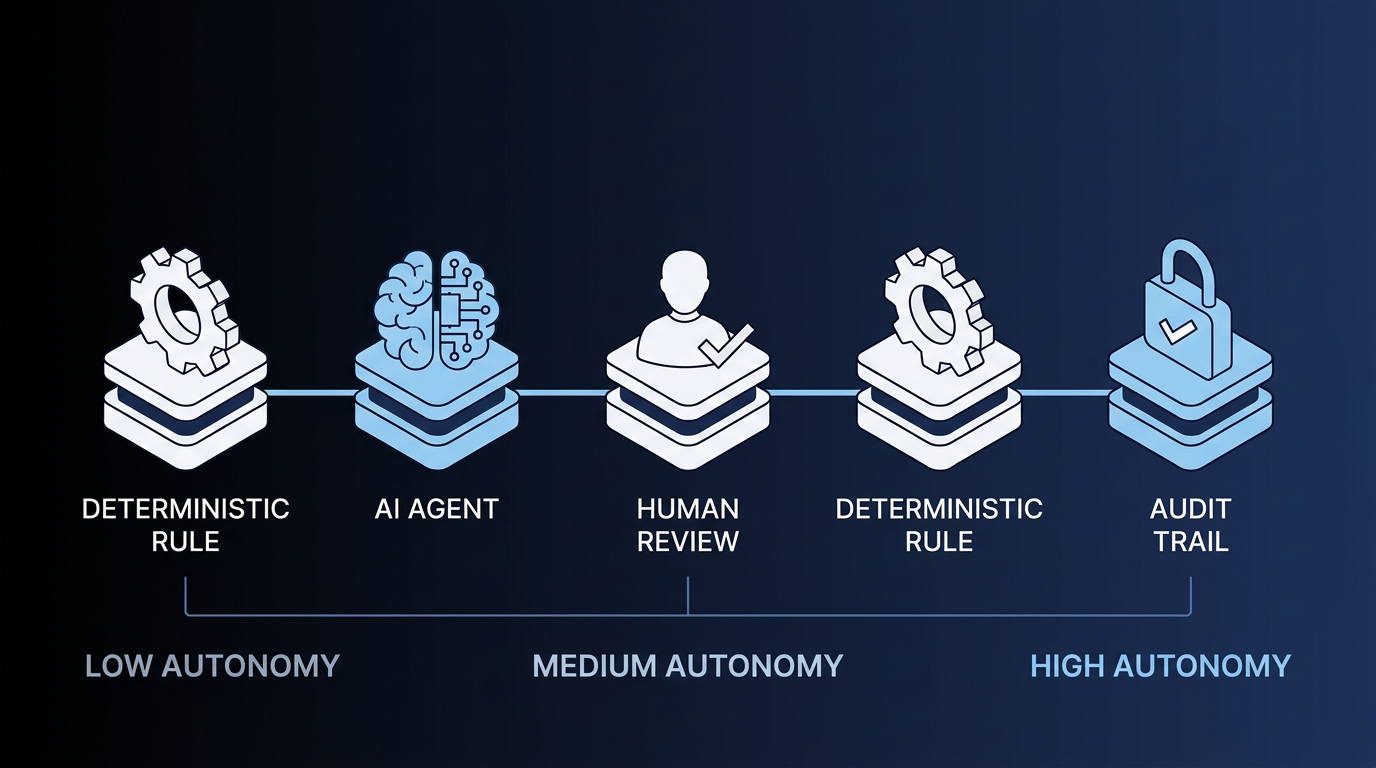
A practical architecture can keep autonomy tiers simple. Discovery tasks can run under high-autonomy agents if they have strict budget caps and escalation paths. Internal operations often fit medium-autonomy sequenced agents. Compliance-heavy tasks should stay in low-autonomy deterministic nodes. In those nodes, the execution engine stays rule-based and auditable.
Preserve Interoperability to Avoid Vendor Lock-In
Enterprise AI environments use many systems by design. An orchestration architecture bound to one model or one vendor breaks the moment procurement, compliance, or a better model forces a change. Enterprise teams should expect that change. Enterprise AI strategies increasingly require a model portfolio. Teams now span many models and agent architectures across modalities.
Open protocols make it easier for systems to work together. Model Context Protocol (MCP) gives agents a standardized way to connect with external tools and data sources. Agent-to-Agent (A2A) protocol gives agents a common way to communicate and hand off work across systems.
A2A adoption also reflects growing demand for cross-agent interoperability. Vendor-embedded AI can struggle here. A governance program built around one model breaks down as model count expands.
Data governance follows the same principle. Elementum's preferred enterprise pattern queries data where it lives rather than replicating it, so data stays put. Audit attribution is the control point when AI accesses regulated data through a service account and logs do not identify which individual directed the access.
Design Your AI Agent Orchestration Architecture around a Deterministic Backbone
For most enterprises, the answer is a deterministic backbone: agents plug into the steps that need reasoning, with human checkpoints at high-risk decisions and full audit trails throughout. That matches the oversight NIST AI RMF, ISO 42001, and the EU AI Act require, and it holds up under cost and security review when incidents happen.
We built our AI Workflow Orchestration Platform for exactly this. Our Workflow Engine treats AI agents as equals to humans and business rules, keeping every process on the same governed path. Open Orchestration means no lock-in to one model or vendor. Orchestrated Intelligence right-sizes spend across rules, agents, and human decisions. Zero Persistence means we never train on, replicate, or warehouse your data, because our architecture queries it where it already lives.
Among orchestration platforms in this category, we have the production track record for replacing legacy SaaS at enterprise scale, with named customers including Sanofi, Snowflake, Under Armour, and Elevance Health.
Contact us to map workflow orchestration into your architecture and the rest of your AI roadmap.
FAQs About Best Architecture for Managing AI Agent Orchestration
Enterprise teams usually evaluate orchestration architecture through reliability, cost, governance, and data-control questions. In production, the deterministic-backbone pattern ties those questions to execution paths, approval gates, and audit trails.
What Architecture Should You Use for AI Agent Orchestration in Enterprises?
The architecture to use is a deterministic workflow backbone that invokes AI agents only for steps requiring reasoning, with human-in-the-loop checkpoints at high-risk decisions and complete audit trails. This hybrid pattern is a safer production architecture because it contains error compounding. It also controls cost and satisfies the governance frameworks auditors use to evaluate enterprise AI programs.
Why Can Your Multi-Agent Systems Fail at Enterprise Scale?
Multi-agent systems fail at enterprise scale because errors multiply across chained steps rather than add, so even workflows with high per-step accuracy can degrade sharply as step count rises. Decentralized agent architectures add coordination overhead, shared-state risk, and more places for errors to propagate. Coordination failures can become a major cause of degradation, alongside individual model errors.
How Do You Control AI Agent Costs as Usage Grows?
You control AI agent costs as usage grows by right-sizing every workflow step: put deterministic rules on logic that needs no reasoning, reserve agents for interpretation, and choose the most cost-effective model for each step. Agent-only approaches can cost far more per transaction than deterministic workflows, so architectural discipline is the primary cost lever.
How Should You Think about the Difference between a Control Plane and an Orchestration Engine?
Think of an orchestration engine as the layer that executes business logic with state management and transactional integrity, deciding what happens next in a workflow while tracking status and history and completing critical steps reliably rather than leaving the process half-finished. A control plane sits above execution and handles governance, security, cost monitoring, and observability across all agents. You need both: the engine runs the process, the control plane oversees it.
How Do You Govern AI Agents without Replicating Data?
You govern AI agents without replicating data by querying it where it already lives rather than copying it into new stores, and by enforcing policy at the moment of action with row-level and column-level security that controls which records and fields an agent can access. Regulated-data access should log which individual directed it and which service account was used.