
Supplier Management Software: AI-Powered Platforms for Enterprise Procurement in 2026
Every purchase order your team touches passes through three or four systems that were never built to talk to one another. At a few thousand orders a month, the handoffs are where the money leaks: a missed discount here, a duplicate payment there, a compliance check that quietly never ran. AI-powered supplier management software is supposed to fix this, yet most teams that piloted AI in procurement have not reached large-scale deployment.
Procurement operations leaders are working through the move from pilot to production right now. The job before committing to a budget is to evaluate AI readiness, adoption risk, and platform architecture. The rest of this article works through that evaluation across the capabilities where procurement volume and compliance risk run highest.
Understand Why AI Procurement Spending Outpaces Production
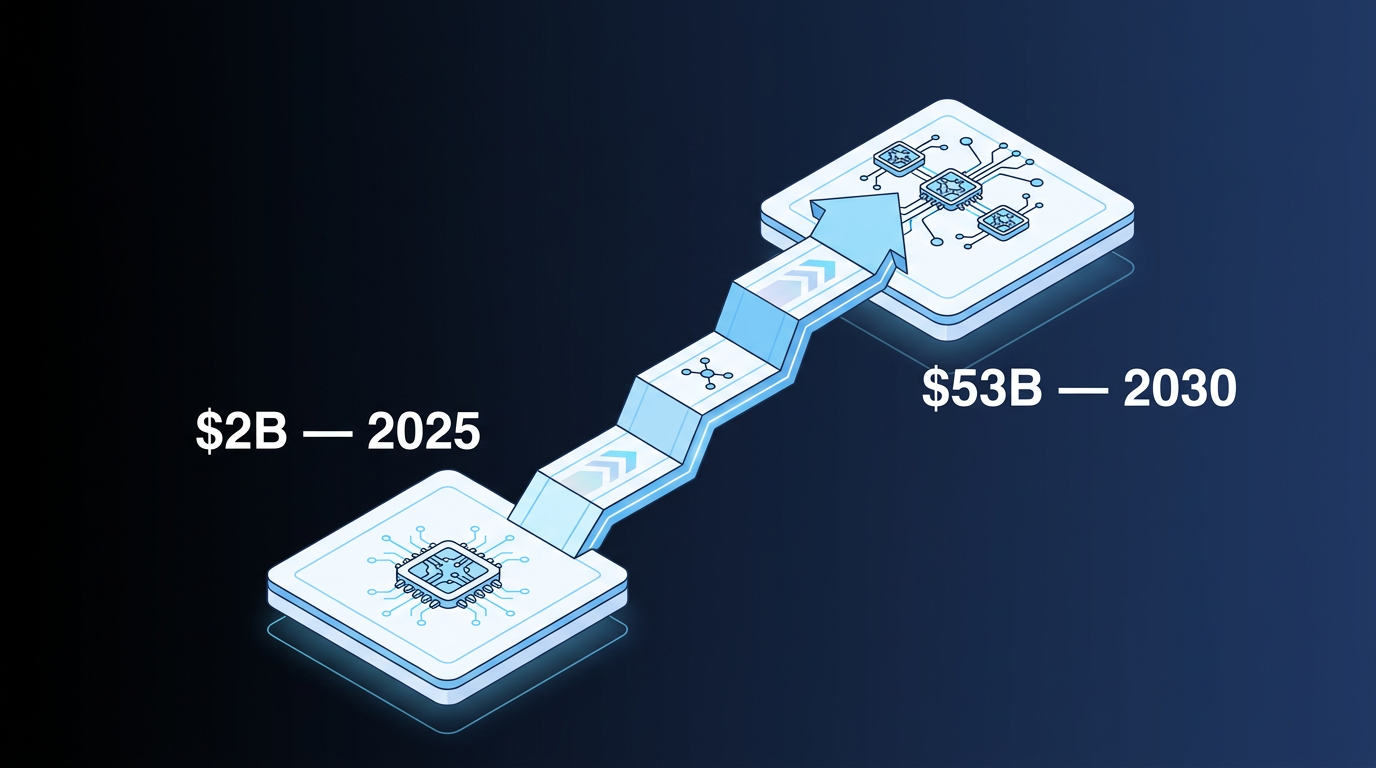
Supply chain management software with agentic AI capabilities will grow from under $2 billion in 2025 to $53 billion by 2030, according to Gartner. Spending forecasts are outpacing production readiness.
Generative AI for procurement has reached the trough of disillusionment, where early interest meets uneven returns. Fragmented data, high costs, complex integration, and regulatory requirements are slowing progress.
Procurement volume keeps rising while headcount and operating budgets stay flat, and staffing up will not keep pace. Teams that add AI without the right architecture create a problem of their own: ungoverned agents making procurement decisions nobody can audit.
Moving past pilots without that outcome is the real job before committing budget, and it starts with knowing which AI capabilities are production-ready.
Prioritize AI Capabilities Ready for Enterprise Supplier Management
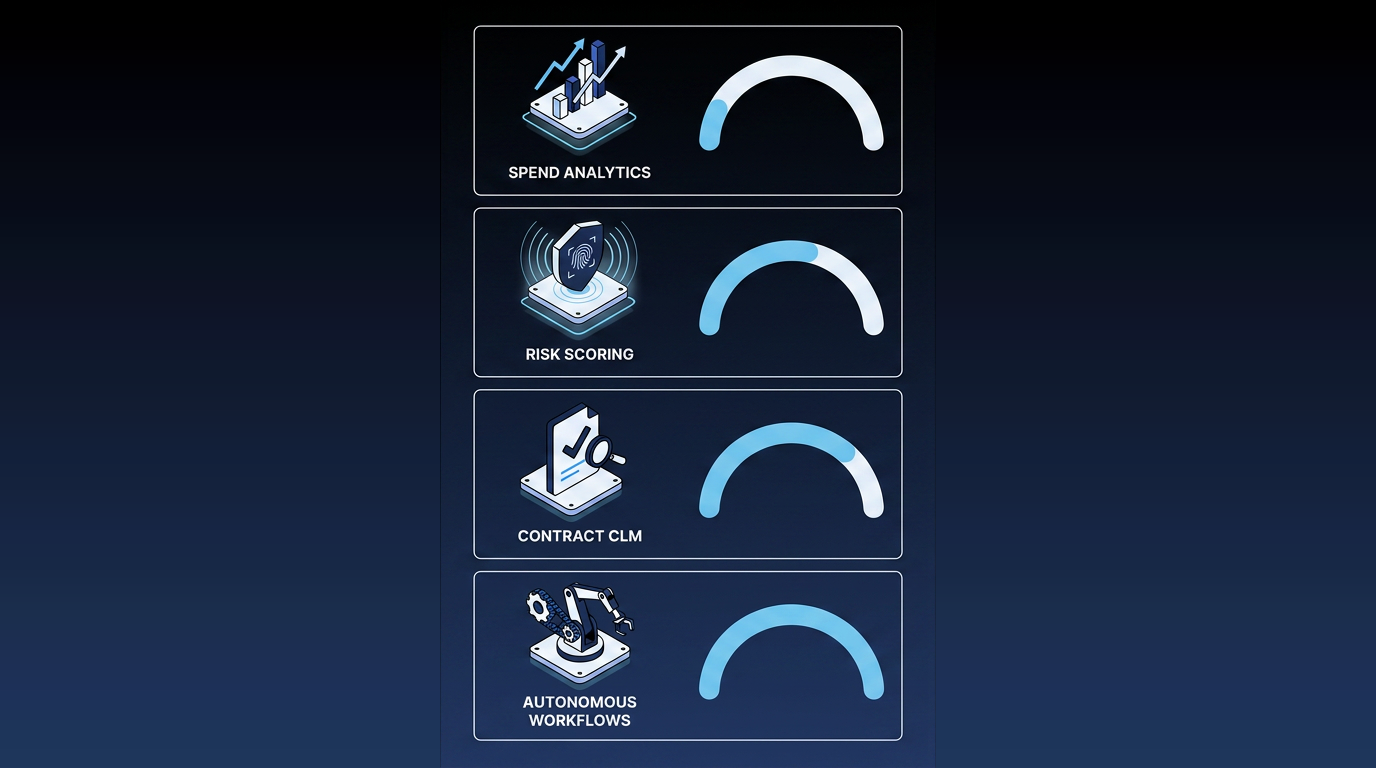
Spend analytics, supplier risk monitoring, contract lifecycle management, and autonomous workflows sit at different stages of maturity. Some already earn their place in production. Others still break down on governance, integration, or return on investment (ROI).
Spend Analytics and Classification
Spend analytics is one of the most common AI use cases for chief procurement officers (CPOs), yet many teams still run reporting through manual or spreadsheet-based processes. This persists because spend data lives across multiple systems with inconsistent taxonomies. AI classification works when the data foundation is clean. Without that foundation, automation runs against the wrong categories from the start.
Supplier Risk Scoring and Continuous Monitoring
Supplier risk monitoring is one of the more established AI applications in procurement. The shift is from annual questionnaires to continuous scanning of financial health, delivery performance, ESG ratings, sanctions lists, and global news across supplier populations no human team could track by hand. Fewer teams plan to use generative AI specifically for risk, which suggests established machine learning (ML) approaches remain the preferred tool here.
Flag the distinction internally. Vendors marketing GenAI-powered risk scoring may be overselling, since ML-based scoring is the more established approach for this use case.
Contract Lifecycle Management With AI
Contract lifecycle management (CLM) is among the more mature AI-adjacent procurement capabilities. AI reads contracts, extracts key terms, flags risk clauses, and links obligations to supplier records, compressing review cycles that once ran for weeks. Buy-side CLM has moved past experimentation for many procurement teams.
Autonomous Procurement Workflows
Vendors pitch agentic AI as a way to cut manual handoffs in procurement. ROI and governance challenges keep most organizations on deterministic automation for now, with agents added only where they earn it.
For procurement operations leaders, deterministic workflows give the control and auditability that high-frequency, high-compliance processes need. AI agents earn their place at the steps where interpretation and judgment matter. Use each where it fits.
Evaluate Supplier Management Software Before You Buy
Data readiness and governance usually decide whether supplier management software delivers value or becomes shelf-ware. Test lock-in risk before you sign.
Data Architecture and Integration Complexity
Many technology investments underdeliver due to integration complexity and data quality issues. Operations and supply chain leaders point to both as the leading causes when new platforms fall short of expectations.
Before selecting a platform, audit your data architecture. AI procurement platforms expose data-quality problems on day one. If supplier records are fragmented across five systems and have inconsistent naming, a pilot starts with cleanup rather than value. Assess data readiness before you issue a request for proposal (RFP).
Before selecting a platform, audit your data architecture. AI procurement platforms expose data-quality problems on day one. If supplier records are fragmented across five systems, homegrown tools, Coupa, SAP Ariba, and other established suites**,** and have inconsistent naming, a pilot starts with cleanup rather than value.
AI Governance and Human Oversight
Procurement teams now need formal AI governance before they select a platform. Procurement, IT and data, legal and compliance, risk, and finance each need a defined role. The hard problems usually sit in data quality, compliance, and integration.
For workflows that touch purchase order approvals or supplier payments, you need configurable thresholds that set when AI acts on its own and when it routes to a human reviewer. You need a full audit trail on every decision, at every step, with compliance controls for SOX, HIPAA, and GDPR. Without them, a single misconfigured agent can approve transactions that would never clear a human reviewer thousands of times before anyone notices.
Vendor Lock-In and Architectural Flexibility
Once a vendor holds your data and workflows, leaving gets structurally hard. The risk compounds with AI because proprietary model formats and data structures raise switching costs.
Settle the key questions before you sign:
- What are the contractual terms for data ownership and export, including model and workflow portability?
- Does the platform sit above your existing systems, or does it require a rip-and-replace?
If you wait until after signing, architectural flexibility becomes a negotiation you no longer control.
The market splits into two models: procurement orchestration layers that coordinate workflows across your existing systems and enable faster deployment, and dedicated suites like Coupa and SAP Ariba that offer deeper out-of-the-box features but require larger rollouts. The right choice depends on your stack and how much of it you are willing to replace.
Strengthen Your Supplier Management Software Stack With Elementum
Enterprises that scale AI keep deterministic workflows as the base and add targeted AI with human oversight. They assign the right participant to each step. Deterministic rules handle three-way matching and compliance checks. AI agents extract documents. People stay responsible for high-stakes approvals.
Getting the architecture right while procurement volume outpaces headcount is how operations leaders deliver results within a single budget cycle.
Elementum's AI Workflow Orchestration Platform is built for this. Our Workflow Engine treats humans, business rules, and AI agents as equals in every procurement process.
A purchase request triggers a workflow. It checks the budget in real time, routes to the appropriate approver based on amount and category, pulls vendor data from the system of record, and logs every step. Agents handle bounded tasks like document extraction and spend classification. Rules manage routing and compliance. People come in at defined decision points.
We connect to SAP, Oracle, and Salesforce through API integrations, and we query your data in real time from your own Snowflake, Databricks, AWS, or Azure environment through CloudLinks. No data migration required. The architecture holds SOC 2 Type II, GDPR, and CCPA readiness.
The platform runs on three principles:
- Open Orchestration: we let you swap AI models, clouds, or tools without rebuilding workflow logic, so you are not locked into one vendor's roadmap.
- Orchestrated Intelligence: we right-size spend across deterministic rules, AI agents, and human decisions.
- Zero Persistence: we never train on, replicate, or warehouse your data.
We typically build the first workflow with you, then your team takes over with an agentic, no-code builder, with no permanent vendor engineering dependency. Many of our customers start with one workflow, prove the savings, and expand into adjacent processes. Production deployment typically takes 30 to 60 days, compared with the extended timelines of traditional enterprise rollouts.
Among orchestration platforms in this category, we have a production track record of replacing legacy SaaS at enterprise scale, including Sanofi's expansion from software license management to procurement and CRM workflow replacement.
Contact us to map workflow orchestration into your procurement architecture and the rest of your AI roadmap.
FAQs About Supplier Management Software
These are the questions that procurement and operations leaders most often raise when evaluating AI supplier management software.
How Do You Integrate AI-Powered Supplier Management Software With Existing ERP Systems?
Integration runs through an orchestration layer that sits atop your existing enterprise resource planning (ERP) systems. We preserve your system-of-record investments and add workflow automation and intelligence across them, so you are not ripping out SAP or Oracle to get AI into procurement.
What ROI Can You Expect From AI Supplier Management Software?
The ROI you can expect depends on workflow scope, data quality, rollout discipline, and your operating environment, so results vary by use case. The strongest returns tend to come from high-frequency workflows where automation removes manual handoffs and reduces cost.
What Is the Biggest Obstacle You Will Face When Rolling Out AI Supplier Management Software?
The biggest obstacle most teams face is data readiness. Fragmented supplier records, inconsistent taxonomies, and weak integration across systems make it hard to move from pilot to production, which is why a data audit belongs before platform selection.
Are Agentic AI Features in Procurement Software Ready for Enterprise Use?
Agentic AI features are ready for enterprise use at specific, bounded steps. Most organizations still need deterministic workflows, governance controls, and human review for high-compliance processes, and apply agents where interpretation adds value.
How Do You Keep Supplier Data Secure Inside an AI Platform?
Keeping supplier data secure comes down to a few questions: whether the platform keeps your data in place or replicates it, whether your data is used to train the vendor's models, and whether you get clear auditability, access controls, and compliance support for regulated environments. We built our Zero Persistence architecture for exactly this, so we never train on, replicate, or warehouse your data.
Keep Reading
How Can AI Analyze and Score Supplier Bids?
How to Use AI in Procurement
How to Automate Procurement Workflows with AI Agents and Business Rules
7 Best Procurement Software for Automating Purchasing Processes in 2026
How to Implement Procure-to-Pay Automation in 2026
AI Agent Management: How Enterprises Govern Agents at Scale