
How to Use AI in Procurement
A single purchase order can pass through SAP, Salesforce, and three spreadsheets before it reaches an approver. Procurement teams spend significant time on repetitive matching work, contract reviews stack up, and spend data sits fragmented across systems, limiting confidence in analysis.
AI has clear applications across the board, but generative AI for procurement has entered the trough of disillusionment, and few procurement organizations have moved beyond pilots to large-scale deployment.
This article covers where AI fits in procurement workflows, what separates organizations that are scaling it from those stuck in pilots, and how to build an implementation approach that delivers measurable outcomes rather than another stalled proof of concept.
Where AI Delivers Measurable Value in Procurement
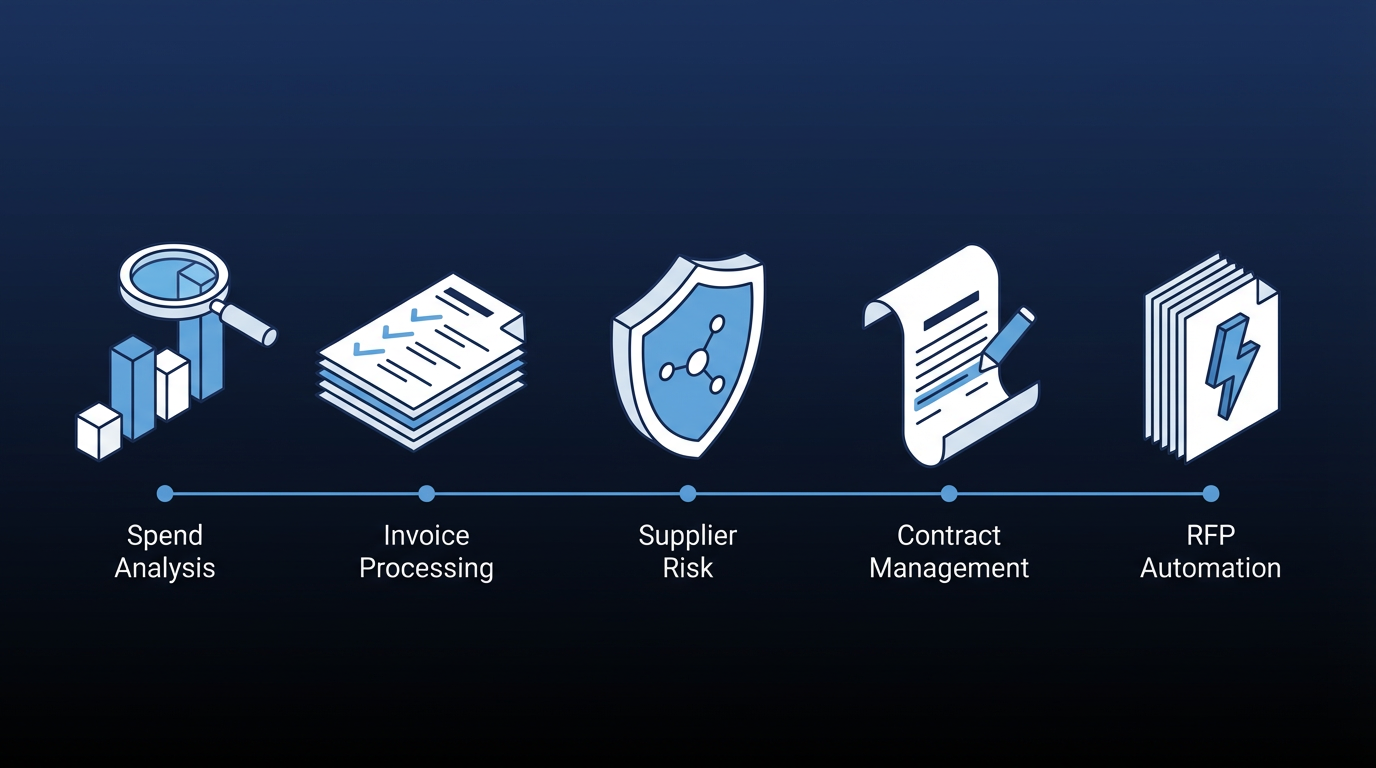
AI in procurement spans multiple applications across the source-to-pay lifecycle (the process from sourcing suppliers through purchasing and payment), and each has a different evidence base and maturity level. The use cases with the strongest documented outcomes cluster around spend intelligence, invoice processing, supplier risk, and contract analysis.
Spend Analysis and Intelligence
Spend analytics sees the broadest early adoption. Among enterprises deploying AI in procurement today, spend analytics, contracting, and sourcing are the most common starting points, with spend visibility dashboards among the first applications to gain traction.
AI turns unstructured spend data into usable intelligence, including taxonomy classification (proposed ways to group purchases into categories) and category management support.
Invoice Processing and AP Automation
Invoice processing and accounts payable (AP) automation have the clearest production pathway among these use cases. AI extracts and codes invoice data at volume, routes it for two- or three-way matching (comparing a purchase order, goods receipt, and invoice to confirm they align), and when all business rules are met, straight-through processing (the transaction moving through without human intervention) proceeds automatically. The deterministic matching logic handles volume without error accumulation.
Supplier Risk Monitoring
Supplier risk monitoring uses AI to synthesize financial health indicators, news feeds, and logistics signals into earlier warnings of disruption. Procurement teams get time to identify backup suppliers before a supply issue reaches operations rather than after. Without that lead time, a single supplier failure can delay production, breach contract terms, and trigger a manual scramble that ties up the same team AI was supposed to free up.
Contract Lifecycle Management
Contract lifecycle management applies AI to extract key terms, flag compliance issues, surface renewal timelines, and identify pricing anomalies across large volumes of contracts. This results in faster review cycles and fewer missed obligations.
In organizations managing hundreds or thousands of active contracts, the manual alternative means legal and procurement teams reviewing documents reactively, often after a renewal window has already closed or a pricing clause has gone unnoticed for months.
Strategic Sourcing and RFP Automation
Strategic sourcing and request for proposal (RFP) automation compresses two slow manual steps. Supplier offer comparison and tender drafting move faster with AI, shortening the time between requirement definition and shortlisted suppliers.
Enterprises have documented production deployments across each of these use cases. There is also an architectural nuance: even when AI integration delivers results, many procure-to-pay platforms reach a ceiling beyond which additional AI capability doesn't materially change outcomes.
In many enterprises, the real ceiling is architectural. Systems built around documents and static policies can absorb AI at the edges, but core business logic remains locked within existing applications and approval chains, where most of the manual work actually lives.
Why Most AI Procurement Initiatives Never Reach Scale
Moving from pilot to production remains the central challenge in enterprise procurement AI. The investment is there, the use cases are identified, and the pilots run cleanly, but the jump to production exposes issues in data quality, integration architecture, and organizational readiness that controlled pilots never surfaced.
Data Quality Amplifies Every Mistake
AI can magnify existing data problems: duplicate suppliers skew spend analysis, inconsistent category taxonomies break reporting, and fragmented master data causes automation errors and compliance failures. When an AI system processes poor-quality procurement data, it produces wrong outputs at machine speed, affecting supplier awards, risk flags, and spend commitments before human review can intervene.
Data cleanup typically takes a large share of the implementation timeline. Teams that defer it see the same outcome after launch: automation errors and compliance failures caused by data quality issues that were visible from the start.
Integration Complexity Across Existing Systems
Enterprise procurement runs inside SAP, Oracle, Microsoft Dynamics, and older procure-to-pay platforms designed before AI integration was a consideration. Systems with limited application programming interface (API) capabilities create immediate barriers.
Multiple enterprise resource planning (ERP) instances across business units, disparate procurement tools requiring custom integration, and data silos that impede cross-system analysis compound these barriers in ways that AI capability alone cannot resolve.
Organizational Readiness Gets Underinvested
Seventy percent of the total value AI generates in procurement comes from people, through change management, talent development, governance design, and process redesign, according to BCG. Organizations that invest primarily in vendor selection while underinvesting in change management consistently underperform their technical potential.
Internal resistance can materially slow adoption. When employees perceive AI agents as direct replacements rather than tools, they have reasons to resist, and in procurement, buyer relationships and institutional knowledge make that resistance particularly damaging.
How to Implement AI in Procurement
Most procurement AI implementations that fail do so for the same reasons: the wrong use cases get prioritized first, data problems surface after deployment, and governance structures get built around the technology rather than before it. The steps below reflect the sequence that separates teams that fail from those that don't.
- Assess digital maturity before deploying anything: Baseline your technology infrastructure, team capabilities, process digitization, and data architecture. Scaling AI in procurement requires embedding solutions into workflows, upskilling users, and securing leadership commitment. A maturity baseline shows where deployment risk is highest before budgets expand.
- Audit data readiness as a prerequisite: Address gaps in master data, transactional records, and supplier information before selecting tools. Rushing this step means building on a foundation that produces wrong answers at scale. Cleaner data reduces avoidable errors before they spread across procurement workflows.
- Start with two or three use cases that have a clear business case: Spend analytics, contract summarization, and RFP/tender assistance are practical starting points. Deploying across multiple initiatives simultaneously without clear prioritization is a documented failure mode. A narrow scope makes early wins easier to measure and defend.
- Harden system integrations with technical guardrails: When AI agents interact with ERP systems, integration guardrails constrain transactions and data entry. That reduces the chance of errors cascading across connected systems and limits the operational blast radius (the scope of downstream impact) when outputs are wrong or incomplete.
- Establish governance structures before scaling: Most enterprises structure governance as business-led reporting to the chief information officer (CIO). Embed clear accountability from the start; shared committees are fine at early stages, but create ambiguity at scale. Clear ownership helps when decisions, exceptions, and failures need escalation.
- Run parallel deployments before full rollout: Deploy the new version alongside existing systems to monitor performance without operational risk. This catches integration failures and unreliable output patterns before they reach live procurement decisions. In procurement, errors can carry financial and legal consequences.
- Track value through productivity, quality, and satisfaction metrics: Teams that can't connect AI investments to business-case levers lose budget when scrutiny increases. Measuring these outcomes gives teams a clearer case for continued investment and expansion.
Execution against these steps takes longer than most pilot timelines suggest. Plan for an extended cycle from pilot to production and resource accordingly. That expectation helps procurement and IT leaders avoid treating a pilot timeline as a production timeline.
Why Procurement AI Needs Deterministic Orchestration, Not Just Autonomous Agents
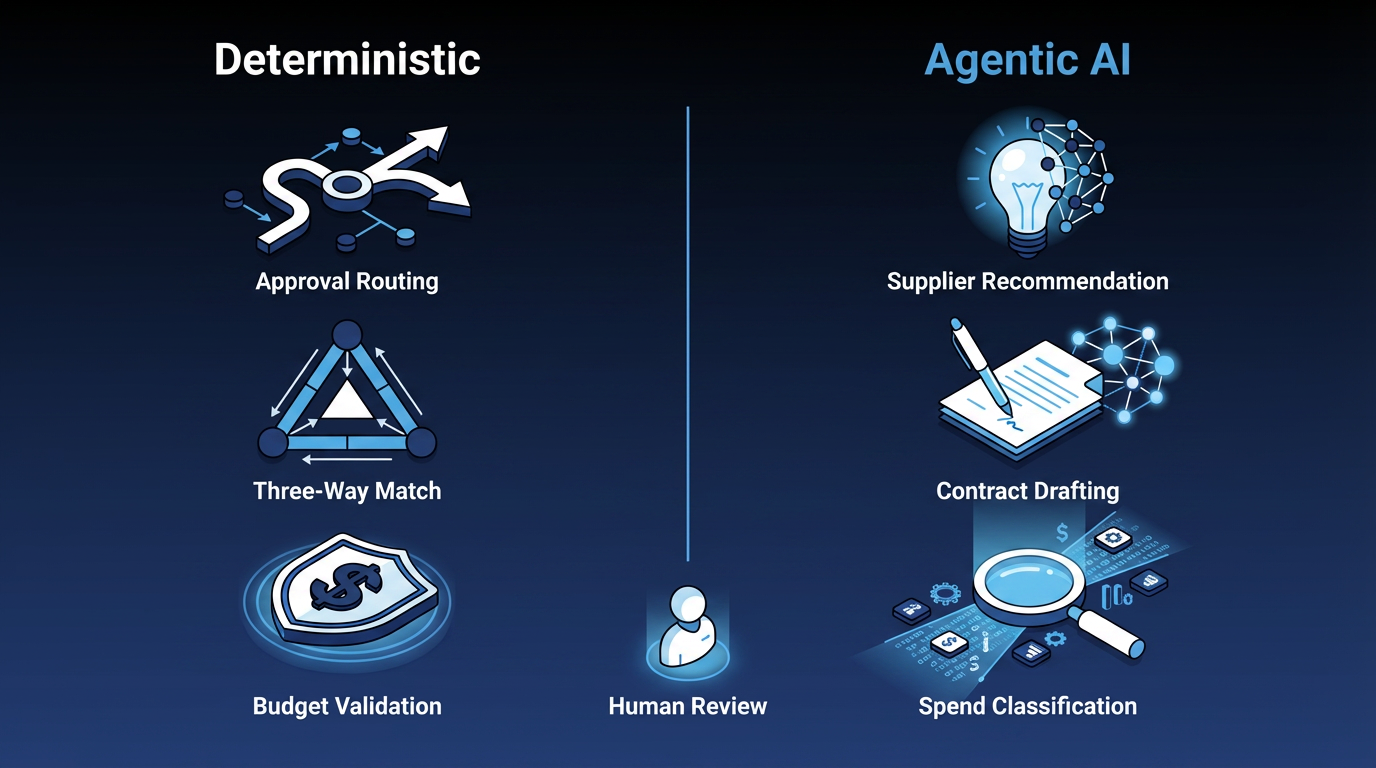
Agentic AI (in which AI agents independently perceive, decide, and act) is now included in most enterprise procurement AI evaluations. Procurement leaders most often land on a hybrid architecture: deterministic workflows anchor the process, while AI agents handle specific steps that require interpretation. Deterministic orchestration refers to a workflow design where each step produces the same result every time, every decision is logged, and process behavior is predictable at scale.
Most enterprises running AI agents in live business processes haven't defined which decisions agents can make independently, built real-time monitoring of agent behavior, or established audit trails capturing the full chain of agent actions. In procurement, where a single misconfigured agent can approve a payment or issue a purchase order, those issues carry direct financial and legal consequences.
Reliability degrades as more probabilistic components are chained together. In procurement, where a payment approval or purchase order carries financial and legal consequences, that degradation creates operational risk.
Deterministic steps such as budget validation, approval routing, purchase order issuance, and invoice matching need to produce the same result every time. Agentic steps such as supplier recommendation, contract drafting, and issue investigation benefit from AI's ability to interpret and reason. The hybrid architecture keeps autonomy within explicit boundaries.
Legal and compliance exposure reinforce the need for governance. When an AI system provides misleading information or takes an inappropriate action inside a live workflow, the consequences are operational and financial.
For procurement leaders evaluating AI architecture, the priority is to embed agents within deterministic workflows in which every decision is auditable, and every process step runs consistently at scale.
How Elementum Applies AI Workflow Orchestration to Procurement
A purchase order routed incorrectly or an approval bypassed by an autonomous agent moves downstream into payments, supplier relationships, and audit exposure before anyone catches it. The organizations scaling AI in procurement build a deterministic structure around the steps that have to be right every time, and deploy AI where interpretation and reasoning actually belong.
Our AI workflow orchestration platform is built for that architecture. Our Workflow Engine treats AI agents, deterministic business rules, and human decision-makers as equal participants in every process, so the right resource handles each step rather than routing every decision to an autonomous agent.
For procurement specifically, that means:
- Human-in-the-loop checkpoints govern high-stakes decisions with configurable confidence thresholds, so that consequential actions automatically escalate to human review.
- Every agent action is logged in a full audit trail aligned to SOC 2 Type II, GDPR, and CCPA requirements.
- Pre-built integrations cover OpenAI, Gemini, Anthropic, Amazon Bedrock, and Snowflake Cortex, with no LLM vendor lock-in.
- Our CloudLinks technology query your data in real time across Snowflake, Databricks, BigQuery, and Redshift, with no replication and no data leaving your environment.
- Native and API-based connections handle SAP, Salesforce, and Oracle.
- Our patented Zero Persistence architecture means we never train on your data, never replicate it, and never warehouse it.
- Most customers reach production in 30 to 60 days.
Most customers start with one procurement workflow and expand into adjacent processes across IT, finance, and sales as results come in. Contact us to map workflow orchestration into your procurement architecture and the rest of your AI roadmap.
FAQs About AI in Procurement
These are the questions procurement and IT leaders most often raise when building the case for AI in enterprise procurement workflows.
What ROI Should You Realistically Expect From AI in Procurement?
ROI from AI in procurement tends to arrive faster from targeted use cases than from full source-to-pay overhauls. Spend analytics, invoice automation, and RFP assistance are usually easier to connect to time savings and process improvement than broad transformation programs. The clearer the business case connection at the start, the easier it is to demonstrate value before budgets tighten.
How Long Should You Expect Enterprise AI Procurement Implementation to Take?
Most enterprise AI procurement implementations require a longer cycle than the initial pilot suggests. Many procurement teams ran pilots in 2024 and 2025, but few reached large-scale deployment. Enterprise buyers should plan timelines that extend beyond the initial pilot and begin with two to three specific use cases before expanding the scope.
How Should You Think About AI Automation vs. Agentic AI in Procurement?
AI automation performs predefined tasks, such as purchase order creation and invoice matching, within set rules. Agentic AI (in which AI agents independently interpret goals and decide how to act) is better suited to specific tasks such as supplier recommendation and contract drafting. Deterministic orchestration anchors critical financial processes, while agentic steps handle the interpretation work that rules-based systems can't.
What Data Quality Standards Should You Meet Before Deploying AI in Procurement?
Clean master data, accurate transactional records, and reliable supplier information are prerequisites for AI deployment in procurement. AI can magnify poor data quality, turning duplicate records and inconsistent taxonomies into errors that propagate at machine speed. Audit and remediate data before selecting tools.
Should Your Team Build AI Capabilities In-House or Buy a Dedicated Tool?
This is a central strategic decision for procurement leaders. Evaluate whether the use case offers a competitive advantage, what internal resources exist for development, how sensitive your data is, and whether ready-made tools meet your compliance standards. Integration fit and long-term vendor alignment matter more than isolated model performance.
Keep Reading
How to Automate Procurement Workflows with AI Agents and Business Rules
How to Build an IT Issue Escalation Process That Scales
How Can AI Analyze and Score Supplier Bids?
7 Top Coupa Alternatives in 2026

Deterministic vs. Probabilistic AI: The Enterprise Guide to Building Workflows That Scale
Human-in-the-Loop vs. Human-on-the-Loop: When to Use Each for Enterprise Workflows