
How to Implement Procure-to-Pay Automation in 2026
Procurement workloads are tracking 8% higher this year, even as headcount and operating budgets decline. AI-enabled technology has entered the top three procurement priorities for 2026 for the first time, joining supply continuity and cost reduction. The pressure to automate procure-to-pay (P2P) is already part of the plan for many operations leaders.
However, deploying P2P tools and achieving end-to-end automation are two different things. Many enterprise organizations have rolled out P2P software, yet end-to-end automation across requisitioning, invoicing, and payments remains out of reach for many teams. The constraints often include methodology, data readiness, and architectural decisions around AI governance.
This article outlines a phased implementation approach grounded in analyst-validated frameworks, the pitfalls that derail enterprise rollouts, and the architectural choice between pure agentic AI and orchestrated workflows that will define P2P success in 2026.
The Business Case for Procure-to-Pay Automation
The return on investment (ROI) case for procure-to-pay automation rests on well-documented benchmarks. Best-in-class accounts payable (AP) teams consistently outperform their peers on the three metrics that matter most to finance leaders: cost per invoice, cycle time, and touchless processing rate.
Best-in-class AP teams clear invoices in 3.1 days, compared to 17.4 days for the rest of the field, while their touchless processing rates reach 49.2%. Exception rates show the same divide, with top performers resolving far fewer invoices through manual handling than the industry average. Touchless processing is the underlying driver, since invoices that flow straight through cost a fraction as much as those that require exception handling.
That performance spread translates into real money at enterprise scale. For finance teams processing high volumes of invoices, closing the gap to best-in-class benchmarks can meaningfully reduce AP processing costs, freeing up budget and headcount for higher-value analysis rather than tactical invoice inquiries.
Digital procurement leaders extend that same advantage into strategic outcomes. Organizations that combine digital maturity with disciplined process design tend to meet or exceed their cost-saving targets more often than peers that still operate with fragmented systems and capture stronger returns from agentic AI investments.
If you're building an internal business case, these numbers do the heavy lifting. The harder question is how to avoid the implementation failures that keep many AP teams from full automation.
A Phased Procure-to-Pay Automation Methodology
Getting processes, requirements, and operating models in shape before scaling technology is a consistent theme across implementation frameworks from major advisory firms. Clear requirements definition, executive sponsorship, and change management repeatedly appear as success factors in digital procurement programs.
Phase 0: Readiness Assessment Before Vendor Engagement
A readiness assessment places three activities before any technology evaluation: identifying differences between the current and target states, prioritizing improvement needs based on those findings, and defining a target-state operating model. Change management framework development belongs in the earliest phase, not after technology selection.
ROI analysis should inform value before investment and help measure results after deployment. If you're calculating expected returns after you've already selected a platform, you've reversed the sequence.
Phase 1: Current-State Diagnostic
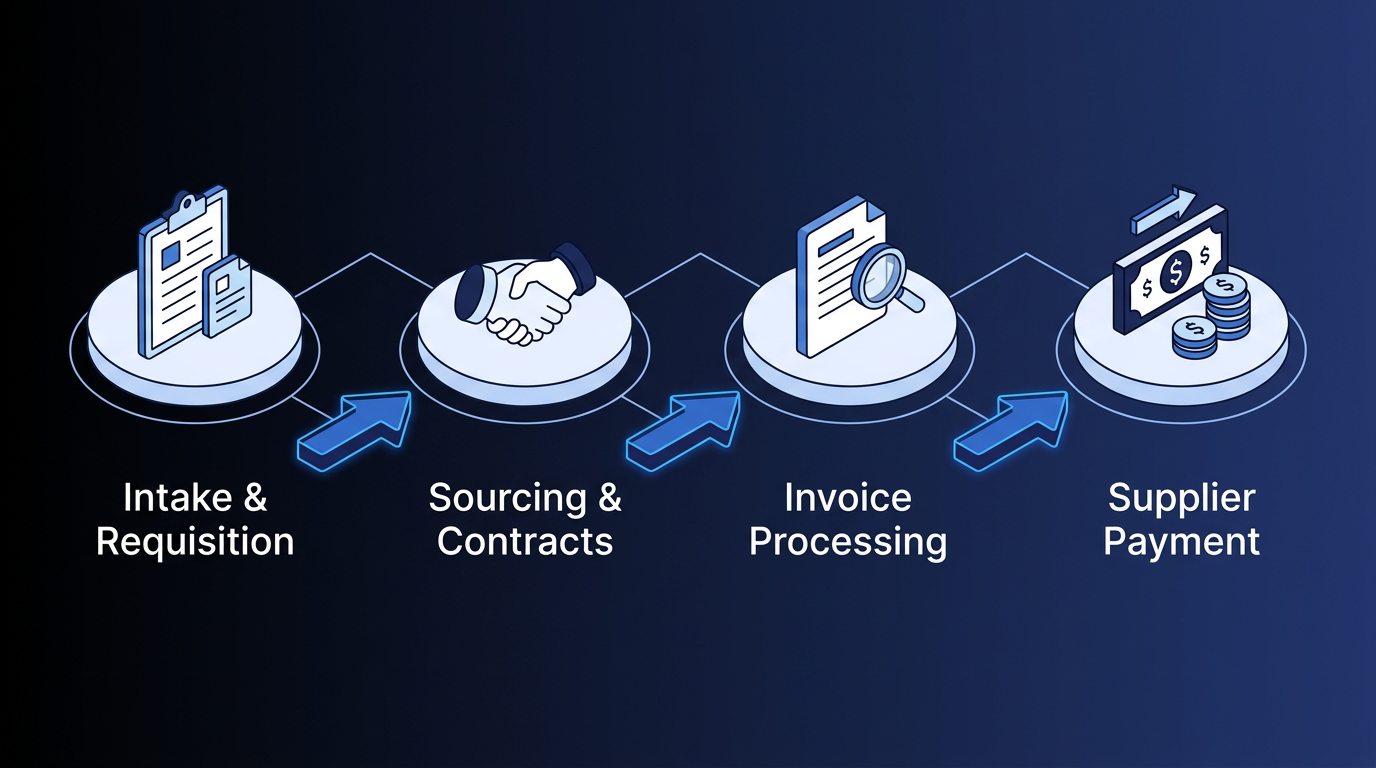
A full diagnostic should cover the main P2P stages: intake and requisitioning, sourcing and contract utilization, invoice processing, and supplier payment. Enterprise deployments at a global scale typically start from a complex landscape of fragmented systems and disjointed processes, then converge on a single, standardized P2P process before automation is layered on top.
Audit vendor master data quality as part of the diagnostic. Poor data slows automation and compounds downstream exceptions.
Phase 2: Target State Design and Technology Selection
In this phase, business case validation, including formal ROI analysis, is a required deliverable. The validated business case serves as the decision gate before technology selection proceeds. Move to vendor evaluation only after the cost-benefit analysis is complete and approved.
Phase 3: Foundation Building
This phase has major implications for long-term success. Root causes of invoice exceptions often include poor purchase order (PO) management, missing goods receipts, and incomplete supplier data, all of which must be eliminated at the process level before automation is layered on top. Automating without this foundation will scale errors.
Foundation activities often include vendor master data deduplication, PO discipline enforcement, budget management system integration, and process standardization prior to the deployment of automation.
Phase 4: Phased Deployment
Many organizations favor phased rollouts to reduce risk and manage change during implementation. Compliance controls work best when embedded in the buying experience. Spending limits, approval thresholds, and preferred supplier requirements should automatically guide buyers toward compliant choices rather than create friction after the fact.
Phase 5: Change Management as a Concurrent Workstream
Change management remains a major success factor in digital procurement programs. Large organizations routinely face obstacles when implementing procurement change initiatives. This workstream runs alongside Phases 3 and 4, not after them.
Where Procure-to-Pay Automation Breaks Down
Poor ROI on P2P technology often stems from weaknesses in change management and operating model maturity rather than the technology itself. There are five failure patterns that recur in enterprise P2P programs, and each tends to trace back to operating-model decisions made well before any platform went live.
- Automating broken processes: The goal is to automate a clean process. Structural process issues have to be addressed before automation can deliver stable results.
- Master data misalignment: Poor data creates friction across the entire source-to-pay cycle, slowing supplier onboarding, complicating requisitions, and introducing errors in invoicing. Unresolved data debt directly raises the risk of AI failure as automation scales.
- Supplier enablement shortfalls: Even best-in-class organizations have work to do on supplier e-invoicing. Investments in P2P software frequently underdeliver when suppliers continue to submit paper invoices, blocking the touchless processing gains the platform was meant to provide.
- Siloed cross-functional ownership: Procurement owns buying rules, finance owns payment controls, and AP owns invoice resolution. When something breaks, no single team owns the fix. That operating-model issue can delay P2P stabilization more than technical issues do.
- Over-customization and IT dependency: Heavy reliance on IT can create a structural bottleneck that limits scale and speed. IT backlogs lead to outdated configurations, broken integrations, and frustrated end users who revert to manual processes.
Orchestration or Pure Agentic AI: Choosing the Right P2P Architecture
This architectural choice affects enterprise P2P programs by determining where deterministic controls remain enforceable, which in turn shapes auditability, consistency, and exception handling. AI agents are rapidly entering procurement workflows: up to 40% of enterprise applications will include task-specific AI agents by 2026, up from less than 5% in 2025. But the speed of adoption does not equal production readiness.
Traditional automation follows explicit, rule-based instructions. AI agents, by contrast, are built for tasks that require interpretation and decision-making. That flexibility is valuable for reading unstructured invoices or summarizing supplier contracts. It carries more risk for approving payments or routing POs through compliance checks.
A practical operating model uses AI agents for decisions or interpretation and deterministic orchestration for routine workflows. We call this deterministic orchestration: a setup where every step is auditable and every decision is accountable. In enterprise finance and procurement, governance and oversight matter because high-stakes workflows need auditability, consistency, and accountability.
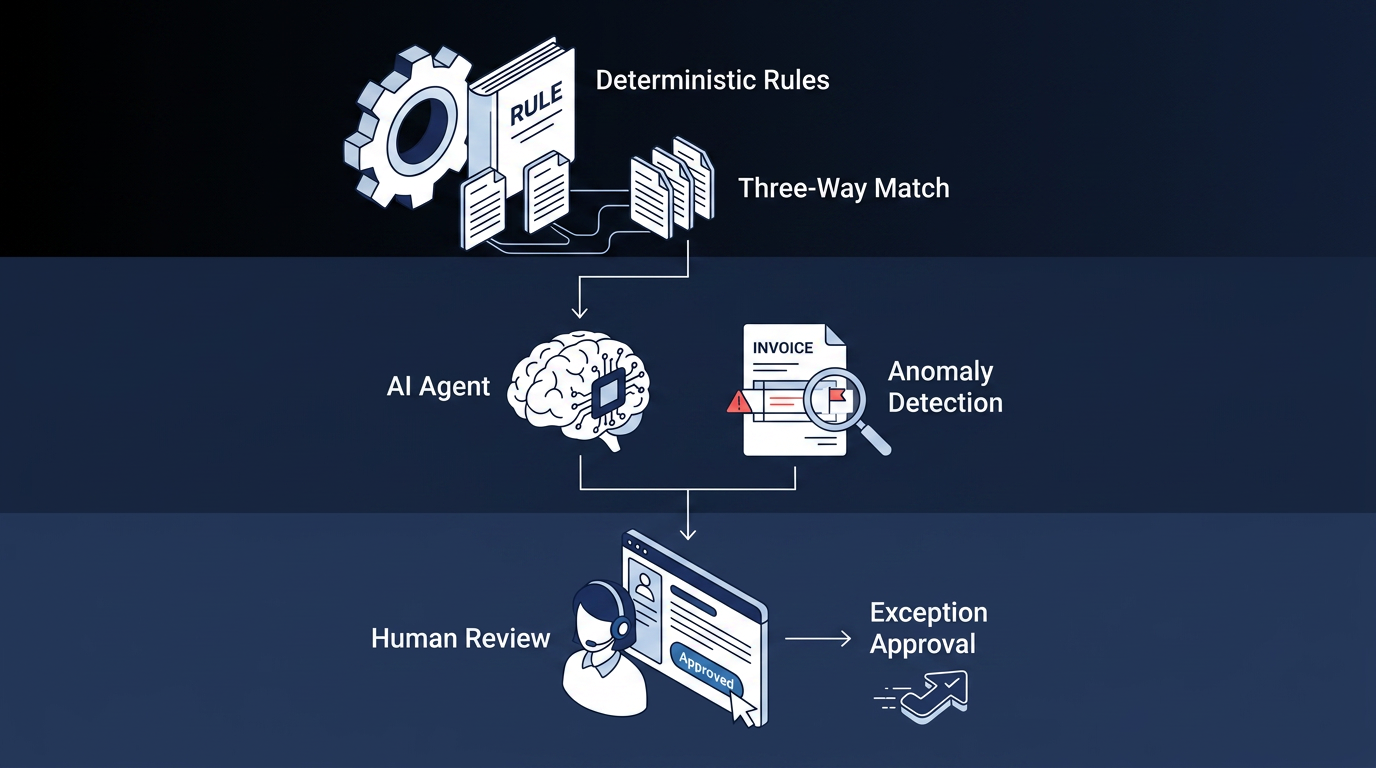
Many enterprise teams are evaluating hybrid designs. Deterministic rules can govern the overall process flow, with AI agents deployed at specific steps that require language understanding: invoice classification, contract summarization, supplier bid scoring and anomaly detection. That orchestration layer sits above both automation and agent components.
Consider a procurement workflow as an example: a purchase requisition routes through deterministic compliance checks (spending limits, preferred supplier validation), an AI agent classifies the request category and surfaces relevant contract terms, and a human reviewer approves anything above a configured risk threshold. Each participant handles what it's best at: rules for consistency, AI for interpretation, humans for judgment. The deterministic backbone keeps the process consistent, while AI adds value at the steps that genuinely require interpretation.
How Elementum Future-Proofs Procure-to-Pay Automation
Procure-to-pay automation in 2026 requires clean processes, clean data, phased rollout, cross-functional governance, and an AI architecture that separates what should be deterministic from what benefits from adaptive intelligence. If that architecture is poorly designed, it can add cost, complexity, and risk rather than reduce them.
Our AI Workflow Orchestration Platform and AI Agent Management capabilities are built for this model. Our Workflow Engine treats humans, business rules, and AI agents as equal participants in every process. A single workflow can route a PO through deterministic compliance checks, use an AI agent to classify an ambiguous invoice, and escalate flagged discrepancies for human review. Configurable confidence thresholds determine when AI acts autonomously and when decisions are routed to a human reviewer.
We connect to SAP, Salesforce, Oracle, and many other enterprise systems without requiring data migration. Our patented Zero Persistence architecture means your data is always yours: we never train on customer data, never replicate it, and never warehouse it. For procurement workflows governed by SOX, HIPAA, or data sovereignty requirements, that architecture can reduce data-handling complexity while preserving governance.
Enterprise teams often start with one scoped workflow as a de-risked entry point, then expand into adjacent processes. The orchestration layer carries forward as new workflows come online.
Contact us to map workflow orchestration into your architecture and the rest of your AI roadmap.
FAQs About Procure-to-Pay Automation
These are the questions IT, finance, and operations leaders most often raise when evaluating procure-to-pay automation programs.
What's the difference between P2P and S2P for your team?
P2P and S2P cover different scopes of the procurement lifecycle:
- P2P (procure-to-pay): Transactional execution, including requisition, PO management, invoice processing, and payment.
- S2P (source-to-pay): Everything in P2P, plus strategic sourcing, supplier selection, and contract management.
Organizations with mature sourcing functions seeking transactional efficiency evaluate the P2P scope. Those digitizing the full lifecycle from supplier selection through payment evaluate S2P.
How long should your P2P automation implementation take?
Implementation timelines vary by scope and organizational complexity. Foundation-building, including data cleansing and process standardization, often takes significant time. Phased pilot deployment follows, with enterprise rollout proceeding only after pilot success metrics are achieved. We typically deploy a first scoped workflow in a short cycle, then expand from there.
What KPIs should your team track to measure P2P automation success?
Key performance indicators (KPIs) for P2P should target the metrics that move the business case. Useful benchmarks include invoice cycle time (best-in-class at 3.1 days), exception rate, touchless processing rate (best-in-class at roughly 49%), and cost per invoice. AP cost as a percentage of revenue is also a useful normalized metric across organizations of different sizes.
Can your team fully automate P2P with AI and no human involvement?
Fully autonomous P2P isn't realistic yet, and governance requirements may mean it shouldn't be. Some reconciliation tasks still require human judgment. Financial transaction approval without governance guardrails creates audit and accountability risk. A hybrid architecture keeps deterministic workflows in control of the process, uses AI agents for interpretation-heavy steps, and retains human authority over high-stakes decisions.
What's the biggest mistake your enterprise can make with P2P automation?
The biggest mistake is scaling automation before addressing process weaknesses. User adoption and process alignment are often bigger barriers to ROI than raw technology capability. Automating a broken process doesn't fix it. It amplifies every defect at the speed of your new platform.
Do you need a full end-to-end platform replacement to improve P2P?
Full platform replacement isn't always necessary. Many organizations automate specific AP or procurement activities without achieving fully integrated end-to-end orchestration. Accounts payable automation has become relatively common, while adoption of broader P2P, supplier relationship management (SRM), and e-sourcing software still lags. For many enterprises, the opportunity lies in connecting existing systems and workflows more effectively before replacing everything wholesale.
Why is governance so important for AI in your P2P workflows?
Governance matters because enterprise finance and procurement processes need auditability, consistency, and accountability. In practice, that means using AI where interpretation adds value, while maintaining deterministic controls over approvals, compliance, and payment decisions. Governance is what lets automation scale without turning exceptions into systemic risk.
Keep Reading
7 Best AI Automation Platforms for Enterprises in 2026
What Is Agentic AI Orchestration? An Enterprise Guide
AI Governance Explained: Frameworks and Compliance Tips
How to Use AI in Procurement
How to Automate Procurement Workflows with AI Agents and Business Rules
What Is a Deterministic Workflow and When Should You Use One?