
How to Automate Procurement Workflows with AI Agents and Business Rules

Procurement teams face pressure to automate workflows that affect Sarbanes-Oxley Act (SOX) financial reporting controls, supplier contracts, and general ledger entries, without sacrificing the repeatability auditors expect.
This guide lays out a confidence-gated handoff model that harnesses the power of AI agents, deterministic business rules, and human review, enabling you to automate high-volume procurement work without weakening the controls around it.
Why Procurement Workflow Automation Fails
Procurement automation projects inherit the problems of the processes they automate. Most enterprise procurement spans too many tools, too many data formats, and too many handoffs for simple automation to hold up. Before the labor costs show up, there is an underlying systems problem.
High accounts payable (AP) processing costs, exception rates, and supplier inquiry volumes are the baseline for most enterprise procurement operations, not the edge case. They persist because the underlying processes span multiple systems: enterprise resource planning (ERP), contract management, supplier portals, and AP platforms.
Procurement teams are increasingly prioritizing AI-enabled technology, and deployment activity is rising. Generative AI for procurement has entered a “trough of disillusionment,” signaling that the category is moving past hype and into the reality of implementation. The next wave of procurement AI likely belongs in the orchestration layer, where rules, agents, and humans can coordinate as a single workflow.
How the Confidence-Gated Handoff Model Works
If you want to automate procurement workflows at enterprise scale, the key design choice is to separate reasoning from consistency. AI agents own the reasoning, deterministic rules own the consistency, and humans keep authority over high-stakes actions.
AI agents are good at interpreting unstructured inputs, like reading a supplier certificate, classifying an ambiguous spend category, or extracting line items from a non-standard invoice PDF. Deterministic business rules are good at enforcing policies, such as routing approvals based on dollar thresholds, blocking payments that exceed tolerance limits, and applying delegation-of-authority matrices.
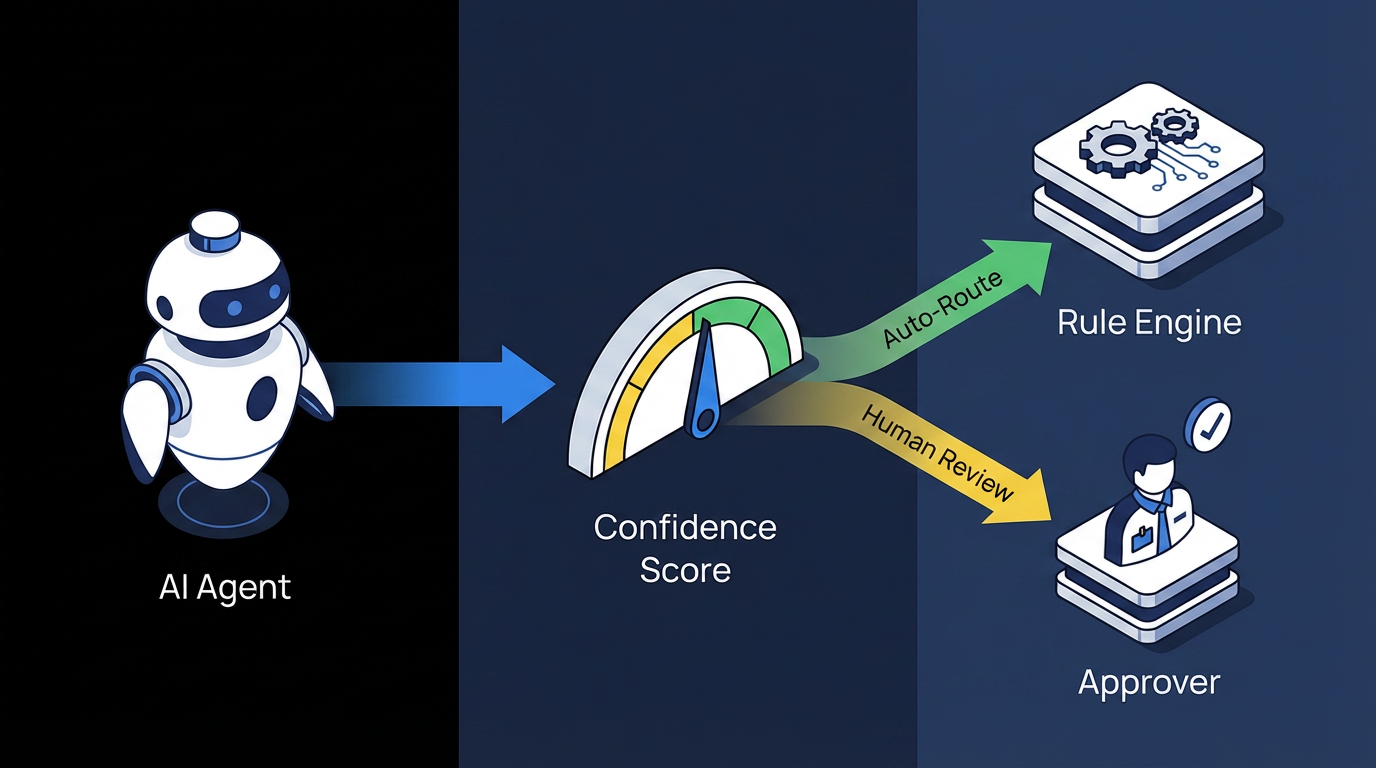
The confidence-gated handoff model connects these two layers through a structured sequence:
- AI agents process unstructured inputs and then produce structured outputs with confidence scores. A confidence score indicates how certain the agent is about its output on a 0-to-1 scale, with higher values indicating greater certainty.
- Confidence thresholds determine routing: Above the threshold the platform owner sets (commonly 0.9 for financial actions), the deterministic rule layer proceeds automatically. Below it, the output routes to a human reviewer before rules execute.
- Rule engines enforce policy deterministically: Approval routing, budget checks, tolerance matching, and compliance gates produce the same result every time, regardless of what the AI agent did upstream. Procurement controls fail when outcomes vary from one run to the next.
- Human-in-the-loop gates protect high-stakes scenarios. New supplier activations, contract awards above defined thresholds, and exception resolutions with financial commitments require human review regardless of AI confidence. Some decisions carry financial and legal consequences that should stay under explicit human authority.
Equally important: the risk management, compliance, monitoring, and internal controls that already govern financial processes must extend to every AI-influenced decision within those processes. A SOX control does not stop applying because an AI agent touched the step.
Metrics to Track in AI Procurement Automation
A miscalibrated confidence threshold or a drifting agent looks fine until an audit finding lands. These four metrics are how you catch problems before that happens:
- Exception rate by workflow: How often items fall below the confidence threshold and route to human review. Trends upward when agents handle inputs outside their training scope.
- Human override rate on rule-layer decisions: How often reviewers change the outcome the rule engine produced. A rising override rate signals that the rules themselves need revision.
- Time-to-resolution on flagged items: Median time a low-confidence item sits in a human reviewer's queue. A direct measure of whether the review layer is a bottleneck.
- Audit completeness: Percentage of AI-influenced decisions with a full traceable record covering input data, confidence score, rule outcome, and reviewer identity. The target is 100 percent; anything below that is a finding that auditors will write up.
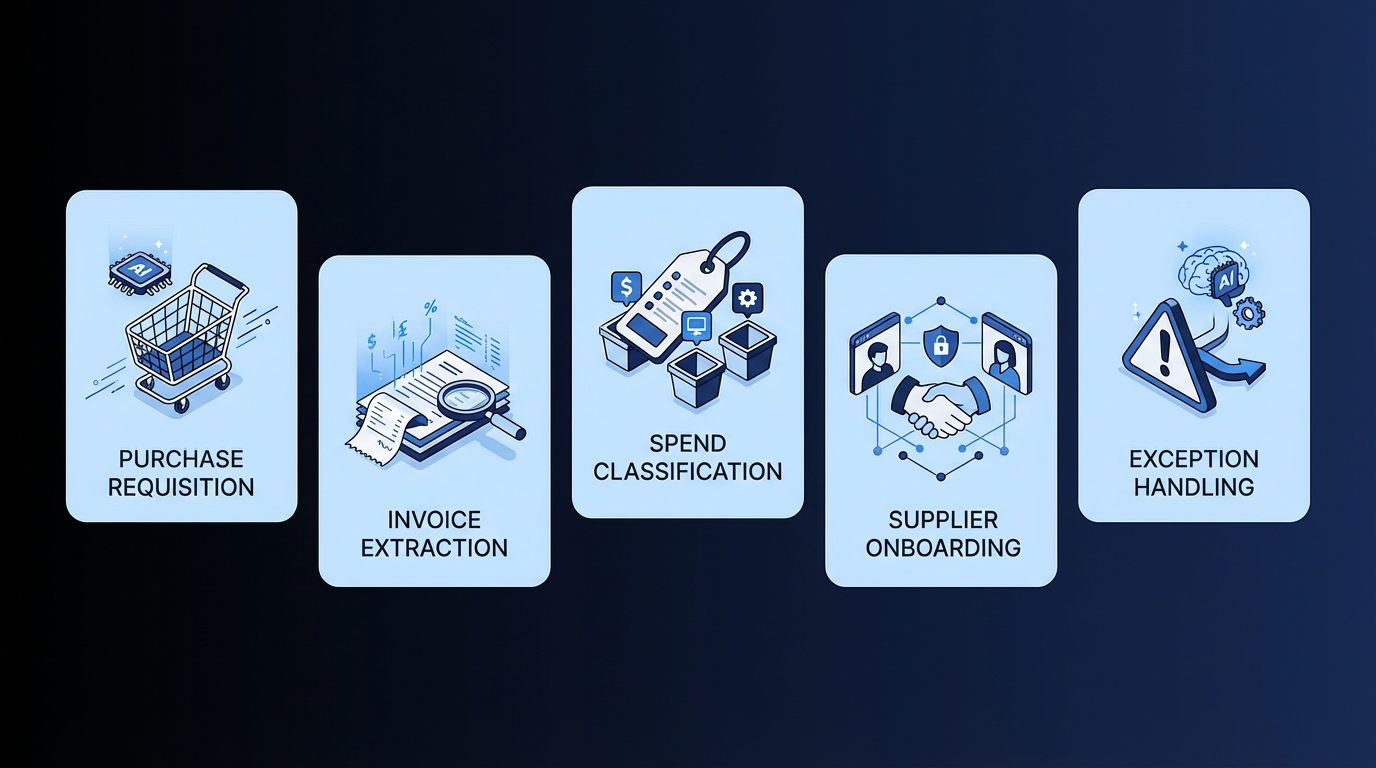
5 Procurement Workflows You Need to Automate First
In each workflow below, agents interpret, rules decide, and humans retain authority where the stakes are high.
1. Automating Purchase Requisitions
Purchase requisition processing is a strong early candidate for automation because it combines unstructured input (free-text item descriptions) with clear policy enforcement (dollar thresholds, preferred suppliers, budget availability).
AI agents interpret free-text descriptions, map requested items to catalog entries, classify spend categories, and populate ERP fields. The deterministic rule layer then takes over: approval routing by dollar threshold, preferred supplier constraints, and hard-stop budget availability checks.
The agent produces a structured, classified requisition with a confidence score and a policy flag summary. The rule engine consumes that output and routes according to a fixed policy.
2. AI Invoice Processing and Three-Way Matching
Invoice extraction is where many teams first see value in AI-assisted procurement automation, with AI handling document interpretation and deterministic rules handling the matching itself.
AI agents extract structured data (vendor name, invoice number, line items, amounts, tax, payment terms) from unstructured documents like PDFs, scanned images, and non-standard supplier formats. Three-way matching, the process of comparing an invoice against its corresponding purchase order (PO) and goods receipt to verify accuracy, stays deterministic.
If the invoice amount exceeds the PO amount by more than the configured tolerance, the rule engine blocks and escalates the invoice. If the goods receipt quantity is less than the invoice quantity, the rule engine holds the payment.
When an AI agent acts on stale or low-quality data, it can approve payment for goods the supplier never delivered.
3. Spend Classification and Approval Routing
Classification errors route transactions down the wrong approval path, creating both a data-quality problem and a financial control failure.
AI agents classify expenditures using a taxonomy such as the United Nations Standard Products and Services Code (UNSPSC), a standardized commodity classification system that handles ambiguous line items that keyword matching cannot resolve. The rule engine then applies the delegation-of-authority matrix to set the approval path based on spend category and dollar amount. Those approval paths are financial controls, so they have to produce the same result every time.
When the agent's confidence score falls below a configured threshold, the classification routes to a human before the rule engine executes. This prevents a misclassified spend item from triggering the wrong approval path, a direct SOX exposure in regulated industries.
4. Supplier Onboarding and Risk Screening
In supplier onboarding, AI can accelerate review without replacing control gates. The documents are messy, but the final decision criteria should stay explicit.
AI agents ingest unstructured documentation (certificates of insurance, financial statements, quality certifications, and beneficial ownership disclosures), synthesize risk signals from external sources like sanctions lists and financial ratings, and produce a scored risk summary for each supplier.
The rule engine then runs the hard-gate checks: minimum insurance coverage, mandatory commodity-specific certifications, OFAC/EU/UN sanctions screening (checking suppliers against government and international restricted-party lists), and conflict-of-interest flags. A human category manager makes the final call on activation after reviewing the AI summary and the rule-gate results.
5. Procurement Exception Handling and Escalations
Exception handling is where many automation efforts break down. The context is messy, but the ownership and escalation path should stay fixed.
AI agents analyze exception context, retrieve relevant contracts and prior correspondence, assess urgency, and recommend resolution paths. Escalation routing rules remain deterministic: which exceptions go to which resolution owner, within what timeframe and with what authority level.
Without that deterministic backbone, an AI agent resolving an invoice discrepancy could authorize a payment adjustment without human confirmation, committing company funds with no audit trail to support the adjustment.
Three Mistakes to Avoid in Procurement AI
Most procurement automation programs fail because their data, governance, and control design are weaker than the demands of the workflow. These four mistakes are the difference between a business case that survives internal scrutiny and one that the Chief Information Security Officer (CISO) flags on first review.
1. Bad Supplier Data Breaks AI Agents
Procurement AI is only as reliable as the supplier data it reads. Stale or conflicting records can turn a confident-looking agent output into an incorrect answer, and the rest of the workflow acts on it.
A generative AI hallucination produces an incorrect answer that a human can evaluate. An agent acting on hallucinated or stale data takes the wrong action before anyone sees it, and the consequences land directly on suppliers and systems of record:
- Submitting incorrect data to a supplier portal
- Making a faulty application programming interface (API) call against the ERP
- Sending a supplier information that contradicts the contract
Two things have to be true about your data before procurement AI earns its place: you have to reconcile supplier master data across the systems of record, and the agent has to query those systems in real time rather than work from a stale copy.
2. Agent Sprawl and Compliance Exposure
When each team builds its own procurement agent without central oversight, access rules, data classifications, and audit trails are handled differently each time.
When business units deploy sub-agents outside centralized governance, each agent operates with its own access to tools and failure modes. A procurement agent accessing supplier financial data without data classification controls creates compliance exposure under the General Data Protection Regulation (GDPR), SOX, and internal financial control frameworks.
Agent sprawl often becomes visible only after deployment has widened, by which point centralizing control means rebuilding access controls, audit logs, and integrations that individual teams stood up on their own.
3. When AI Speed Breaks Compliance Controls
Faster cycle times are only a win if the automated path still routes around the same approval thresholds, preferred-supplier rules, and delegated authority limits a human would have enforced.
AI agents that optimize for cycle time can break compliance controls by bypassing approval thresholds, selecting non-preferred vendors, or executing contracts outside delegated authority limits. Until the workflow layer can reliably constrain AI behavior, full automation should apply only to low-risk, reversible decisions: routine spend categories, low-value requisitions, and non-strategic suppliers.
For anything above those thresholds, AI augments human judgment through human-in-the-loop review rather than replacing it.
How Elementum Automates Procurement Workflows
Workloads keep climbing, budgets do not, and manual processes still dominate much of invoice volume. The teams that come out ahead automate the highest-volume workflows without giving up the approval thresholds, audit trails, and delegated authority limits their auditors already rely on.
We built our AI workflow orchestration platform to execute the confidence-gated pattern described above: AI agents governed by deterministic rules, with human-in-the-loop gates on high-stakes actions. We treat humans, business rules, and AI agents as equal participants in the same workflow.
Our capabilities map directly to what the architecture requires:
- Every agent action is logged in an audit trail that supports governance and review.
- When confidence falls below your threshold, the platform escalates automatically to human review.
- Pre-built integrations cover OpenAI, Gemini, Anthropic, Amazon Bedrock, and Snowflake Cortex, with no LLM vendor lock-in.
- CloudLinks queries data in real time across Snowflake, Databricks, and BigQuery.
- Native and API-based connections handle SAP and Oracle.
- Our patented Zero Persistence architecture means we never train on your data, never replicate it, and never warehouse it.
- Most customers reach production in 30 to 60 days.
Many customers start with a single procurement workflow and then extend the platform to adjacent processes across IT, finance, and sales.
If auditability has to be part of your AI roadmap from day one, we can help you sequence it. Contact us to map workflow orchestration into your architecture and the rest of your AI roadmap.
FAQs About Automating Procurement Workflows
These are the questions procurement, finance, and IT leaders raise most often when scoping AI workflow automation.
How Do You Integrate AI Procurement Automation With Your Existing ERP Systems?
Integrating AI procurement automation with existing ERP systems begins with a connector layer that preserves core platforms. Enterprises have significant ERP sunk costs, and spend classification tools can normalize and categorize data from existing systems without touching them.
An orchestration layer connects AI agents to ERPs via API integrations and to data platforms via real-time connectors, without requiring data migration or system replacement.
What Is the Difference Between AI-Powered Procurement Automation and RPA?
The difference between AI-powered procurement automation and rule-based robotic process automation (RPA) comes down to the kind of work each tool does well. RPA scripts interact with software interfaces to automate repetitive, fixed-sequence tasks where you know every step in advance.
AI agents interpret unstructured inputs, classify ambiguous data, and make context-dependent recommendations, with the steps depending on the input's content.
In practice, procurement needs both AI agents for interpretation and reasoning and deterministic rules for policy enforcement and financial controls. The two layers connect through the confidence-gated handoff model described above.
What Procurement Processes Should You Automate First?
The procurement processes to automate first are those where document interpretation is high-volume, but the control logic is clear. Invoice extraction is often one of the earliest areas where procurement teams see real gains from AI-assisted automation because the inputs are messy, but the matching rules are explicit.
From there, expand to spend classification and requisition processing, where AI confidence scoring can reduce manual touchpoints without removing policy controls.
How Do You Ensure Compliance When AI Agents Touch Procurement Data?
Every AI-influenced decision that produces a financial commitment, whether a PO release, invoice approval, contract award, or supplier activation, needs a traceable audit record covering what data the agent processed, what it output, what confidence score it assigned, whether a human reviewed it, and what rule produced the final action.
Restrict full automation to low-risk, reversible decisions and require human authorization for anything with irreversible financial or legal implications. That reduces the chance that speed gains will lead to control failures later.
Keep Reading
How Can AI Analyze and Score Supplier Bids?
7 Top Coupa Alternatives in 2026

Deterministic vs. Probabilistic AI: The Enterprise Guide to Building Workflows That Scale
Human-in-the-Loop vs. Human-on-the-Loop: When to Use Each for Enterprise Workflows

What Is AI Agent Sprawl And How to Contain It

AI Guardrails: How to Govern What AI Agents Can Access, Decide, and Do