
Purchase Order Automation: How to Automate the Full PO Cycle
In many enterprises, purchase orders still move through multiple systems and unresolved process breakdowns before anyone approves them. Multiply that by tens of thousands of POs per month, and the cost adds up fast.
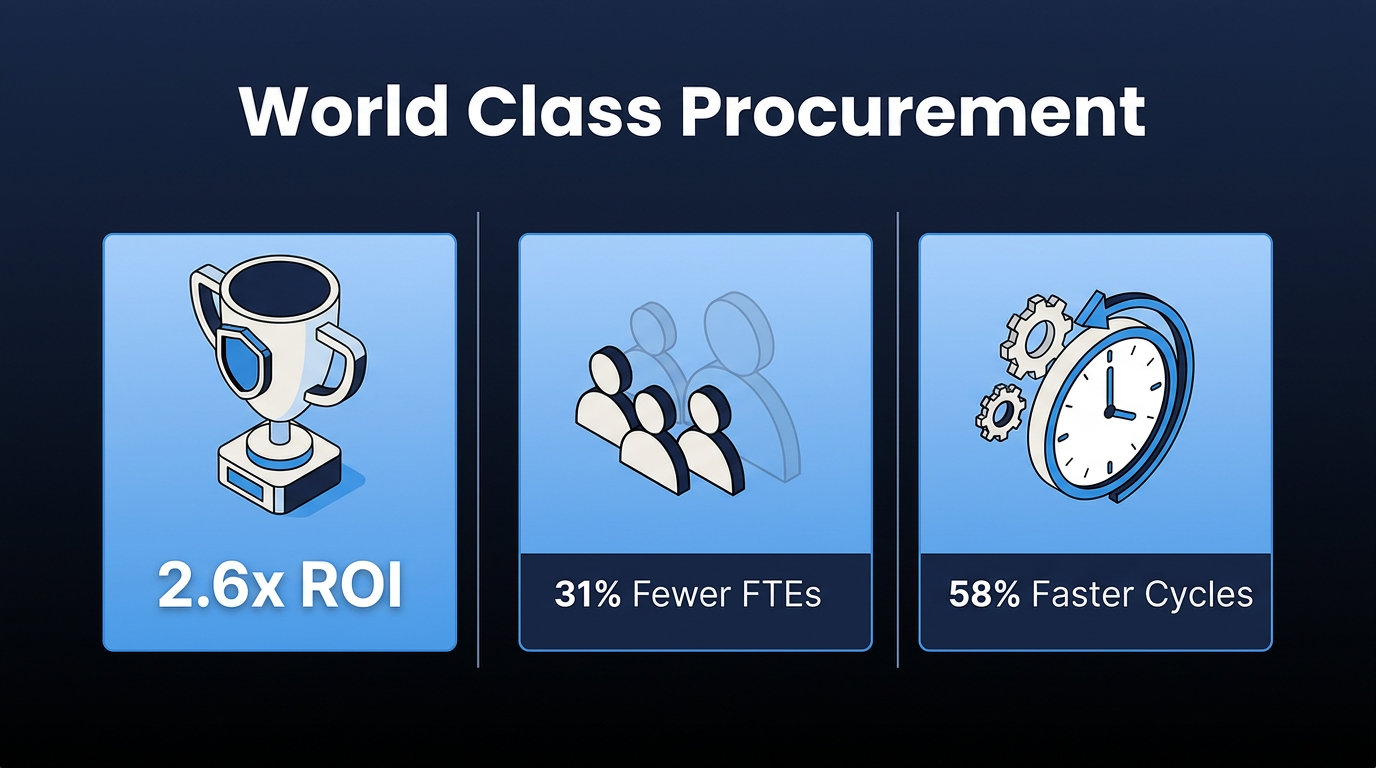
High-performing procurement teams continue to outperform their peers on ROI and cycle time while operating with lower staffing needs. Digital World Class procurement organizations achieve 2.6x greater ROI than their peers, operate with 31% fewer full-time employees, and reduce requisition-to-PO cycle times by 58%. Architecture determines how data moves and how rules and AI execute together.
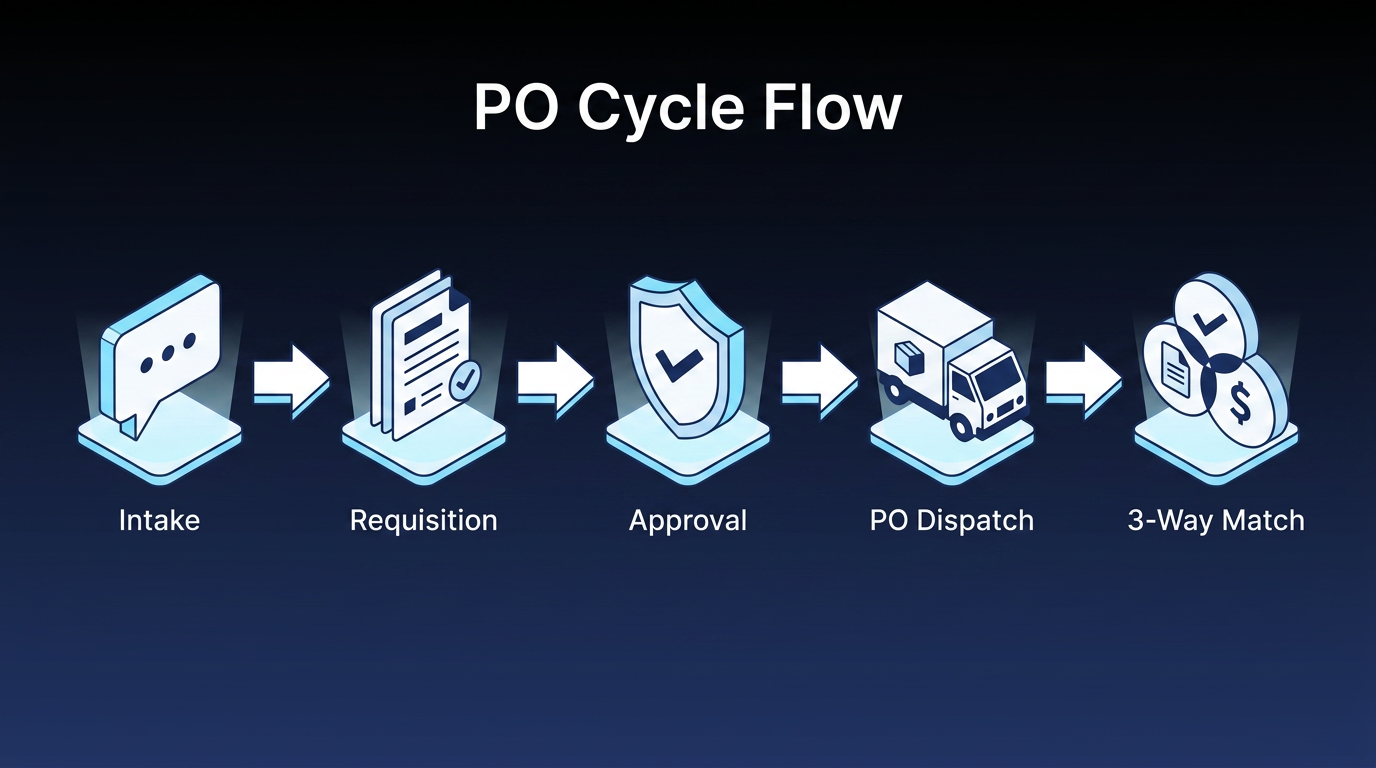
Full-cycle purchase order (PO) automation covers intake, approvals, supplier dispatch, three-way matching, and execution inside the data cloud.
Eliminate the Problems Older P2P Systems Create
Older procure-to-pay (P2P) platforms often add another application layer for procurement data and logic. At enterprise scale, the first effects show up in governance exposure and rollout drag.
Older P2P platforms commonly ingest copies of vendor masters, POs, contracts, and spend transactions into multi-tenant environments. Procurement data, including supplier pricing and negotiated rates, sits among an enterprise's most sensitive commercial datasets. Replicating it to a vendor's multi-tenant cloud can conflict with enterprise data governance strategies.
Before a single PO flows through the system, teams often spend months on ETL (extract, transform, load) pipelines and field mapping across systems, then reconcile data formats during rollout. Cross-system complexity reliably introduces data mismatches and adds weeks of delay before any automation project delivers measurable value.
Fragmentation compounds the problem at scale. Nearly two-thirds of invoices still require manual intervention: the industry-average touchless invoice processing rate sits at 35.4%.
Cut the Integration Tax With Data-Native Execution
In a warehouse-native model, automation logic runs within the customer's cloud data platform, using live enterprise data under the customer's governance controls. No data moves to a vendor environment, which removes an entire category of governance exposure before procurement logic ever runs.
Some cloud data platforms have gone further by building native application frameworks that allow third-party software to run directly inside the customer's own environment. Snowflake's Native App Framework, for instance, lets an application run inside the customer's Snowflake account with live, governed access under the customer's own Role-Based Access Control (RBAC), data masking, and row-level security policies. Platforms built on this model, like Elementum, provide encrypted, real-time query access to Snowflake, Databricks, BigQuery, AWS, and Azure environments without requiring procurement data to leave the enterprise's control.
This architecture can remove much of the integration work that typically precedes older P2P deployment. Supplier pricing, contract terms, and spend data stay where they are. The automation runs to the data rather than the data running to the automation.
Automate the Full PO Cycle: Five Layers That Have to Work Together
Full-cycle PO automation requires five functional layers to operate as a single governed process. Each layer depends on the one before it.
Intelligent Intake and Structured Requisitions
Purchase intent becomes structured, governable workflow data at intake. If it isn't, every downstream step inherits the disorder. A fragmented intake layer, where requests arrive by email, phone, and informal messages with no consistent fields or routing, is where most automation projects lose control before they start.
A single intake layer captures requisition data in a consistent format: requestor identity, cost center, item details, preferred supplier, delivery date, budget code, and business justification. Required fields, data formats, and routing rules should all be configurable without engineering involvement. When intake is structured, every downstream step (approval routing, PO creation, matching) runs on reliable data.
Automated File Processing and Data Extraction
Downstream automation depends on reliable structured data, even when source documents are inconsistent. When PO documents arrive as PDFs, scanned images, or email attachments, extraction logic pulls core order details, including vendor information, PO identifiers, line items, and shipping information, into a format the workflow can validate and route.
The quality of extraction logic matters more than most teams expect before go-live. Non-standard supplier document formats, inconsistent field labeling, and low-resolution scans all degrade extraction accuracy. Evaluate vendors on their handling of edge cases, not just their headline extraction rates on clean documents.
Deterministic Approval Routing
Approval routing keeps speed from undermining policy. Deterministic rules ensure that the same requisition conditions lead to the same approval outcome every time, rather than the outcome that depended on which approver was available that day.
Well-designed approval workflows run sequential chains (manager to director to CFO), support simultaneous legal and finance reviews, and include conditional paths for purchases that require security, capital expenditure, or asset management review. Every approval action should be timestamped and logged to an audit trail. Before any automation configuration, procurement teams must still define when a purchase order is required and what the appropriate spend approval thresholds are. The rules enforce policy; the policy has to exist first.
PO Dispatch and EDI Integration
Once approvals are complete, the process has to translate cleanly into supplier communication. Standardized dispatch closes the loop between internal approval and external execution.
Approved requisitions convert into standardized PO formats for supplier communication. For suppliers with electronic data interchange (EDI) requirements, this means structured purchase-order exchange. For suppliers without that capability, API-based connections or PDF notifications via email handle the remainder. Supplier readiness varies more than most enterprise teams plan for. Identify your supplier base before committing to a dispatch architecture.
Three-Way Matching and Exception Handling
Three-way matching is the reconciliation of purchase orders, goods receipt notes, and vendor invoices before payment authorization. During three-way matching, AI and deterministic rules must work together. Getting this wrong means either paying invoices you shouldn't or delaying payments to suppliers you depend on.
The matching architecture has three layers, each handling a different type of decision:
Hard controls sit at the base and return pass/fail results. These are non-negotiable. AI model outputs should not override them because they safeguard financial data and underpin internal audit. Typical controls include:
- Matching invoice identifiers against vendor and PO records
- Preventing duplicate invoice submission
- Validating line-item math
- Enforcing period controls for correct accounting treatment
Tolerance bands sit above the hard controls. An enterprise can configure a small price or quantity variance to auto-approve without escalation, so minor discrepancies resolve without unnecessary work while the fundamental controls remain intact.
AI exception handling sits above both. Its role is to manage ambiguity that rules alone cannot resolve efficiently: classifying exceptions, detecting anomalies, handling partial-shipment calculations, and routing discrepancies to the appropriate resolver based on context. AI recommendations require human review and approval before any payment is authorized. Every agent action should be logged and revocable.
The architecture that works treats humans, business rules, and AI agents as equals: deterministic rules handle what is fixed and repeatable, AI handles what is ambiguous, and humans decide what is high-stakes.
Apply Purchase Order Automation With Elementum
CIOs are under increasing pressure to show measurable AI value. The PO cycle has high transaction volume and measurable handoffs, approvals, exceptions, and duplicate-invoice checks. Automated handoffs and duplicate-invoice prevention produce concrete savings that survive a board presentation; so does every exception that resolves without human intervention.
Elementum’s AI Workflow Orchestration Platform runs natively inside your Snowflake, Databricks, or cloud environment through CloudLinks. Our Zero Persistence architecture means we never train on, replicate, or warehouse your data. The Workflow Engine pairs deterministic rules with AI agents from multiple providers so you can swap models without rebuilding workflow logic. Many of our customers start with one workflow, prove the savings, and expand from there.
Among orchestration platforms in this category, we have the production track record for replacing legacy SaaS at enterprise scale, with named customers including Sanofi, Snowflake, Under Armour, and Elevance Health.
Contact us to map workflow orchestration into your procurement architecture and the rest of your AI roadmap.
FAQs About Purchase Order Automation
These are the questions procurement and finance leaders most often raise when evaluating purchase order automation.
How Should You Think About PO Automation Versus AP Automation?
PO automation covers requisition capture, approval routing, PO creation, and supplier dispatch, while accounts payable (AP) automation covers invoice data capture, three-way matching, and payment authorization. The two functions sit in different parts of the procure-to-pay cycle, even when they work together. Many enterprises need both to achieve touchless processing from requisition to payment.
Can Purchase Order Automation Work Across Your Multi-Site or Multi-Entity Environment?
It can, but multi-site deployments expose complexity that single-entity implementations don't. Partial deliveries, blanket orders, multi-currency invoices, and cross-entity PO references are the cases where platforms adequate for simple scenarios begin to fail. Multi-site consolidation requires deliberate changes to the operating model alongside technology deployment.
Why Do PO Automation Projects Fail in Practice?
Most failures start before workflow logic ever runs in production. Failures usually begin with data quality problems or unmapped business rules before go-live. Adoption also fails when organizational behavior overrides technical capability. In some organizations, enforcement policy drives adoption more than the technology itself.
Will Purchase Order Automation Reduce Jobs on Your Procurement Team?
Purchase order automation changes the task mix more than it changes headcount. Transactional and execution tasks carry the highest automation opportunity, while exception handling, supplier negotiation, and category management are less automatable in current implementations. A more accurate framing is that automation can substantially increase the amount of work one person can handle for planning and PO creation tasks, while the work itself shifts toward higher-judgment activities.
How Can Purchase Order Automation Support Your SOX Controls?
Automated three-way matching can support SOX-aligned internal controls, such as PO matching before payment, duplicate-prevention checks, vendor master file access controls, and period controls to ensure correct accounting classification. Every action is timestamped in an audit log, including the matching engine version, tolerance thresholds active at the time of matching, exception flags, and the human approver's identity.
Keep Reading
7 Best Procurement Software for Automating Purchasing Processes in 2026
How to Automate Employee Provisioning with IT Software: A Step-by-Step Guide
How to Automate Procurement Workflows with AI Agents and Business Rules
How Organizations Automate IT Processes for Efficiency with AI Agents
IT Monitoring with Automated Incident Management
The Enterprise Guide to Agentic AI for ITSM