
How Organizations Automate IT Processes for Efficiency with AI Agents
Most enterprise AI automation projects reach production on one architecture and stall on the other two. The architectural choice made in the first few weeks of a project usually determines the outcome, but it often receives less attention than model selection or budget.
This guide covers the three architectures teams choose between, why the agent-only path fails in IT operations, and the governance and data controls that production deployments share.
Where Enterprise IT Automation Stands in 2026
AI adoption is now broad across at least one business function, but breadth is not the same as scale. In many functions, including IT operations, most organizations are still at the pilot or early‑use stage rather than in widespread production deployment.
Cost reduction is the main reason enterprises are investing. Infrastructure and operations leaders adopt AI to cut costs more than for any other motivation. Few enterprises are capturing meaningful impact on earnings, and most programs remain stuck in single-function pilots.
IT teams almost always automate the same set of workflows first:
- Employee support and help desk triage
- Incident classification and resolution
- Access provisioning and deprovisioning
- Password resets and identity requests
- Ticket routing across enterprise systems
These workflows share two traits that make them worth starting with: the first is that volume is high enough that a percentage-point improvement in cycle time pays for the deployment. The second is that the process is structured enough for AI agents to classify and route requests.
3 IT Automation Architectures That Enterprises Use
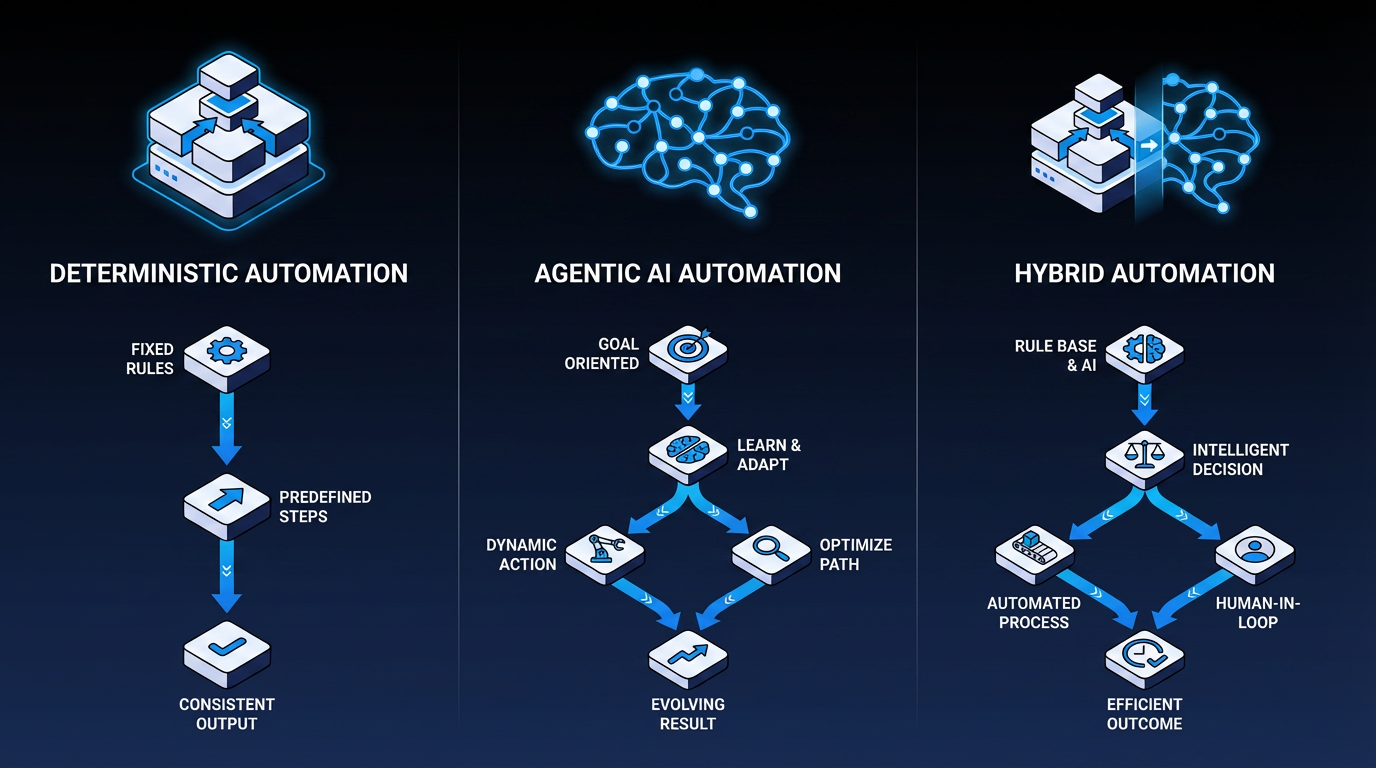
Every IT automation deployment commits to one of three architectural models. The choice determines how the system handles exceptions, how governable it is, and how it scales.
Deterministic Workflow Orchestration
Deterministic orchestration means every step in a workflow is pre-specified. The same input, under the same conditions, produces the same result. That property makes deterministic orchestration the right fit for compliance-sensitive, high-volume IT workflows like SLA enforcement, approval routing, and escalation chains, where consistency is the point of the process.
The limitation is that deterministic systems only handle conditions that someone has defined in advance. In an environment spanning on-premises, multi-cloud, and software-as-a-service (SaaS) systems, the list of edge cases grows faster than any team can codify.
Agent-Only Architecture
Agentic AI fixes the goal and lets agents figure out how to reach it. They plan, invoke tools, evaluate intermediate results, and iterate. The flexibility is real. So are the structural failure modes.
A 2% error rate at one step becomes a 10% error rate across five steps, and no amount of tuning a single agent fixes a property of the chain. Every retry, every re-plan, and every fallback adds tokens, and the cost of a single transaction rises as the chain deepens. Agent-only deployments that work in a three-step pilot tend to break in a fifteen-step production workflow.
Hybrid Architecture
Hybrid architecture uses deterministic orchestration for the predictable core of a process and applies agentic AI selectively to the parts that require judgment: exception handling, routing decisions, and reasoning-intensive subprocesses. This is the direction most enterprise research now points.
Deterministic rules run the steps that need consistency, such as SLA enforcement, escalation, and approval routing. AI agents perform the steps that require interpretation, such as ticket classification, context assembly, and impact analysis. Humans run the steps that need accountability.
3 Reasons Why IT Automation Projects Fail
When an agentic AI project fails in production, the cause is usually one of three things:
- Data access is fragmented: Agents need consistent, queryable access to data across systems. When that data sits in silos, agents cannot pull the context they need to make good decisions, and routing logic runs on incomplete information.
- Agent sprawl outpaces governance: Enterprise applications increasingly include task-specific AI agents, and independent teams build more of them without formal governance. Breaches involving unauthorized AI use cost more to remediate than standard security incidents, and the inventory problem compounds with every quarter an organization delays implementing controls.
- Governance arrives after deployment: Most existing IT governance models assume systems that execute instructions, not systems that make decisions. Enterprises that deploy agents without an identity, audit, and access framework for those agents find the missing controls in production.
AI Governance Requirements for Enterprise IT
Governance is the architectural layer that decides whether an IT automation initiative survives contact with production.
The NIST AI Risk Management Framework (RMF) requires organizations to establish clear, documented policies for AI risk management, emphasizing transparency, accountability, and auditable oversight of AI systems.
Industry guidance increasingly treats AI agents as managed identities that require full‑lifecycle oversight, with provisioning, access review, and retirement practices similar to those for privileged human users.
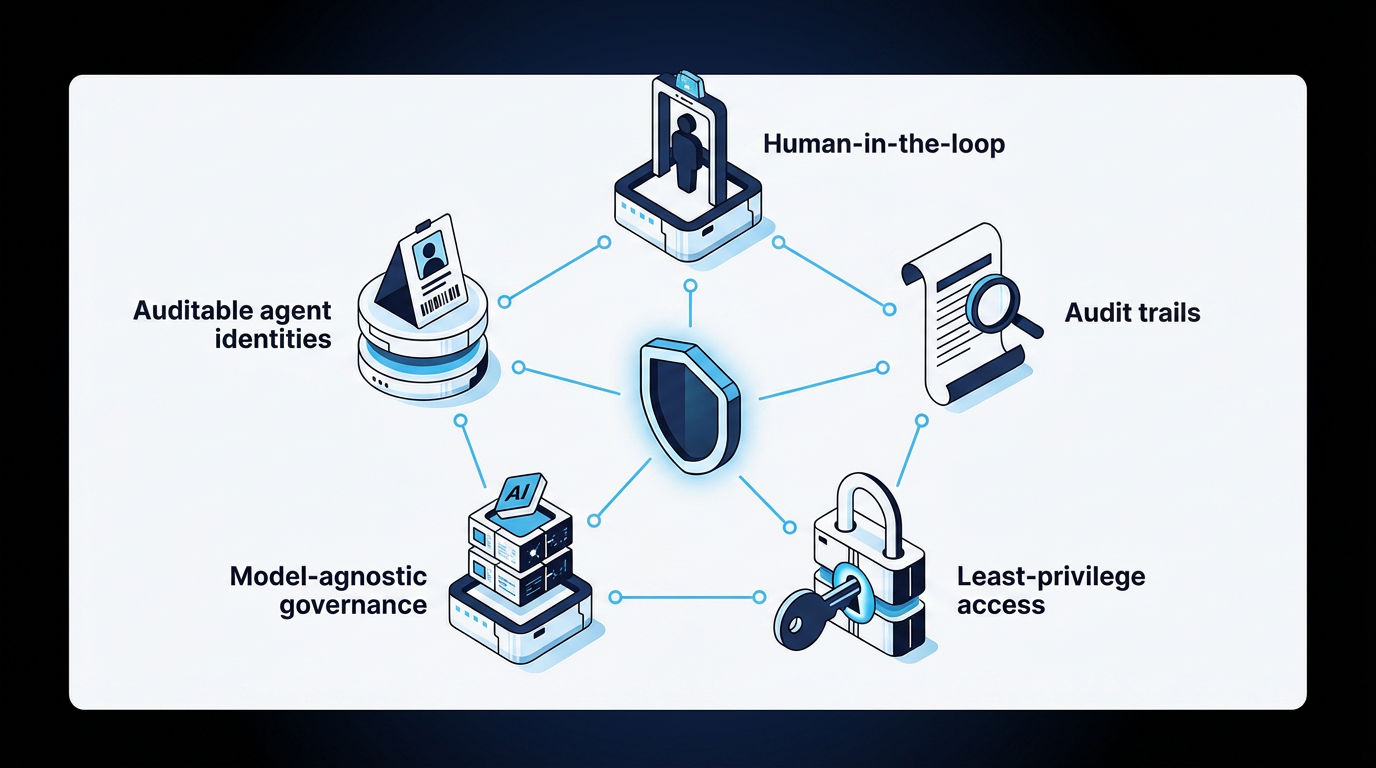
Here are five requirements that come up in almost every framework:
- Human-in-the-loop design with explicit escalation points: Without configurable approval thresholds, a single misconfigured agent can approve transactions or trigger escalations that should require human judgment. One agent can make that mistake thousands of times before the workflow surfaces it.
- Audit trails covering every agent action, tool invocation, and data access: Continuous logging and traceability let security teams investigate incidents after the fact and produce compliance reports on demand.
- Least-privilege access applied to agent permissions: AI agents should operate with the minimum access required for each task. Inheriting broad system credentials turns a single compromised agent into a breach of every system it can reach.
- Model-agnostic governance above the AI layer: Governance tied to a single model vendor breaks down the moment a team needs to swap models, which happens whenever pricing or capabilities shift.
How Elementum Automates IT Processes with AI Agents
When it comes to automating IT processes for efficiency, the decision is architectural; the model, the budget, and the vendor matter less than whether the architecture can run a production workflow at scale with the governance and data controls a board will accept.
We built Elementum for that decision. Our platform combines deterministic workflow orchestration with selective AI agent reasoning, governed by the same audit and access controls that cover privileged human users.
Our Workflow Engine runs the deterministic backbone, so the same process produces the same result every time. Our AI agent orchestration applies models from OpenAI, Gemini, Anthropic, Amazon Bedrock, or Snowflake Cortex to the steps that need interpretation.
Our patented Zero Persistence architecture keeps your data in your environment: we never train on it, replicate it, or warehouse it. We connect to Snowflake, BigQuery, Redshift, and Databricks through encrypted CloudLinks, and we're SOC 2 Type II, GDPR, and CCPA compliant.
Enterprise customers typically start with a single IT workflow and expand into HR, finance, and procurement over the first year, on the same architecture.
IT automation that reaches production is an architectural problem. Contact us to map workflow orchestration into your architecture and the rest of your AI roadmap.
FAQs About How Organizations Automate IT Processes for Efficiency
These are the questions IT leaders, operations executives, and process owners most often raise when planning, implementing, or expanding IT process automation.
Will AI Automation Replace IT Staff or Change Their Roles?
AI automation reshapes IT roles more often than it eliminates them. The near-term labor-market impact from AI is limited across industries, and most of the change shows up as reassigned work rather than headcount reduction. Larger organizations move faster on role redesign because they have the resourcing and data access to rebuild workflows, but the common pattern is multiyear adjustment.
The clearer cost-savings story often comes from organizations that rely on external business process outsourcing providers for IT functions. Automation that reduces BPO scope delivers measurable savings without requiring internal headcount cuts. For enterprises building the ROI case, that is frequently where the numbers are most visible.
What Is the Risk That IT Automation Initiatives Fail?
IT automation initiatives fail more often than they succeed at enterprise scale because costs escalate as chains deepen, error rates compound across steps, and governance arrives too late. Poor enterprise integration and a lack of governance drive more failures than model quality does.
What Criteria Should Enterprises Use to Evaluate AI Automation Vendors?
The criteria for evaluating AI automation vendors should start with the business outcome. Many enterprise leaders worry about single points of failure in AI vendor relationships, and the common response is to run multiple vendors in parallel to reduce lock-in. The three priorities worth setting early are model-agnostic architecture, data sovereignty controls, and governance interoperability across existing systems.
What Are the Security Risks of Automating IT Processes with AI Agents?
Security risks associated with automating IT processes using AI agents fall into several categories: tool misuse, goal hijacking, privilege abuse, and cascading failures. Mitigating them requires least-privilege access, continuous monitoring, and human-in-the-loop checkpoints on any action with material business impact.
Keep Reading
The Enterprise Guide to Agentic AI for ITSM

Deterministic vs. Probabilistic AI: The Enterprise Guide to Building Workflows That Scale

What Is AI Agent Sprawl And How to Contain It

AI Guardrails: How to Govern What AI Agents Can Access, Decide, and Do

Human-in-the-Loop Agentic AI: How Enterprise Teams Deploy Agents Without Losing Control
How to Implement IT Process Automation for Enterprise Teams in 2026