
Multi-Agent Orchestration: Coordinating Agents Across Enterprise Workflows
In the second quarter of 2026, 53% of C-suite leaders reported deploying AI agents, and 18% had progressed to coordinating multiple agents across a single workflow, up from 9% the previous quarter, according to KPMG's AI Pulse Survey. Coordination is still the harder problem. More than 40% of agentic AI projects will be canceled by the end of 2027 because of rising costs, unclear business value, or weak risk controls, according to Gartner.
Multi-agent orchestration is the practice of coordinating several specialized AI agents so they complete one business process together. Another agent or a deterministic process can coordinate that work, and the coordinator determines whether the result survives an audit and holds up to review from budget or security teams. That choice comes first. Make it before the second agent goes live.
What multi-agent orchestration means for enterprise workflows
A multi-agent system puts several independent AI agents to work on a goal none of them could finish alone. Each agent has its own tools and a narrow job. Multi-agent orchestration is the coordination discipline that determines execution order and transferred state, including how the system handles an incorrect output. Skip the last question and the first two don't help you.
Every multi-agent architecture rests on a choice between deterministic control and agent-led control. The two behave differently under load. In a deterministic process, fixed logic decides the path. Given the same input and unchanged rules and configuration, the same steps run in the same order. Changing source data or external services can still change the result. An AI agent works from a goal instead. A large language model (LLM) reads the situation, decides what to do next, and picks its tools. The same input can therefore produce a different path on the next run.
That flexibility is what makes an agent useful for reading a supplier contract or classifying an inbound request. It's also what makes an agent the wrong choice for setting a service-level agreement (SLA) value or generating a ticket ID, where a second interpretation is a defect. The deterministic vs. probabilistic distinction should be an early decision in a multi-agent design because it shapes who coordinates whom. The risk compounds.
Why agent-led coordination breaks in enterprise production
When an LLM supervisor decides how to divide and route work before merging it, the failure modes of one probabilistic model can multiply across handoffs. The result is a process that works in a demo but may produce different answers and costs each time it runs in production, along with different audit trails.
Errors compound at every handoff
A 2025 UC Berkeley study analyzed more than 200 execution traces across seven multi-agent frameworks and catalogued 14 distinct failure modes across three categories: specification issues, inter-agent misalignment, and task verification. Inter-agent misalignment accounted for roughly a third of the failures.
In those cases, agents ignored each other's input or withheld information, while others derailed from the task. Roughly a quarter were verification failures, where no agent checked an output before passing it on. Upstream hallucinations arrive downstream as verified fact.
For example, a revenue query routed to a finance agent and a sales agent can return two correct answers that disagree. Finance calculates on recognition rules; sales calculates on booking dates. A supervisor agent cannot reconcile the two unless it knows they define revenue differently. A deterministic process can require teams to define and encode revenue before either agent runs.
Token costs scale with coordination
A supervisor-and-subagent research system consumed about 15 times the tokens of a chat interaction. Multi-agent systems only make economic sense where the task value covers that premium. Duplication adds cost. In a stateless LLM API request, the API does not automatically preserve prior calls. Each agent therefore re-sends its history on every call. A supervisor that sends work to several agents pays that overhead for each of them before work begins.
Without retry limits, an agent that hits an error and loops can keep adding to the bill. Routing that varies between runs also makes token use harder to forecast before it starts. A CIO may not know the final token cost until the run ends.
Nondeterministic paths fail the audit
An LLM can return a different output for the same prompt. Sampling settings control how a model selects outputs. Serving configurations define how the model runs. Small numerical differences can also add variation when an inference server, the system that runs the model, processes groups of requests. The same prompt and model can still produce a different result. When the model is drafting a summary, that's tolerable. A different loan assessment for the same applicant on consecutive runs is a compliance finding. So is picking a different approver for the same purchase request. No replay.
Agent-to-agent handoffs also widen the attack surface. In a confused deputy attack, instructions hidden in a document can compromise a low-privilege agent. That agent then passes the instructions to a high-privilege agent, which executes them. Left ungoverned, a fleet of specialized agents becomes the next form of shadow IT: AI agent sprawl with no shared audit trail and no single owner.
Choose the right coordination pattern
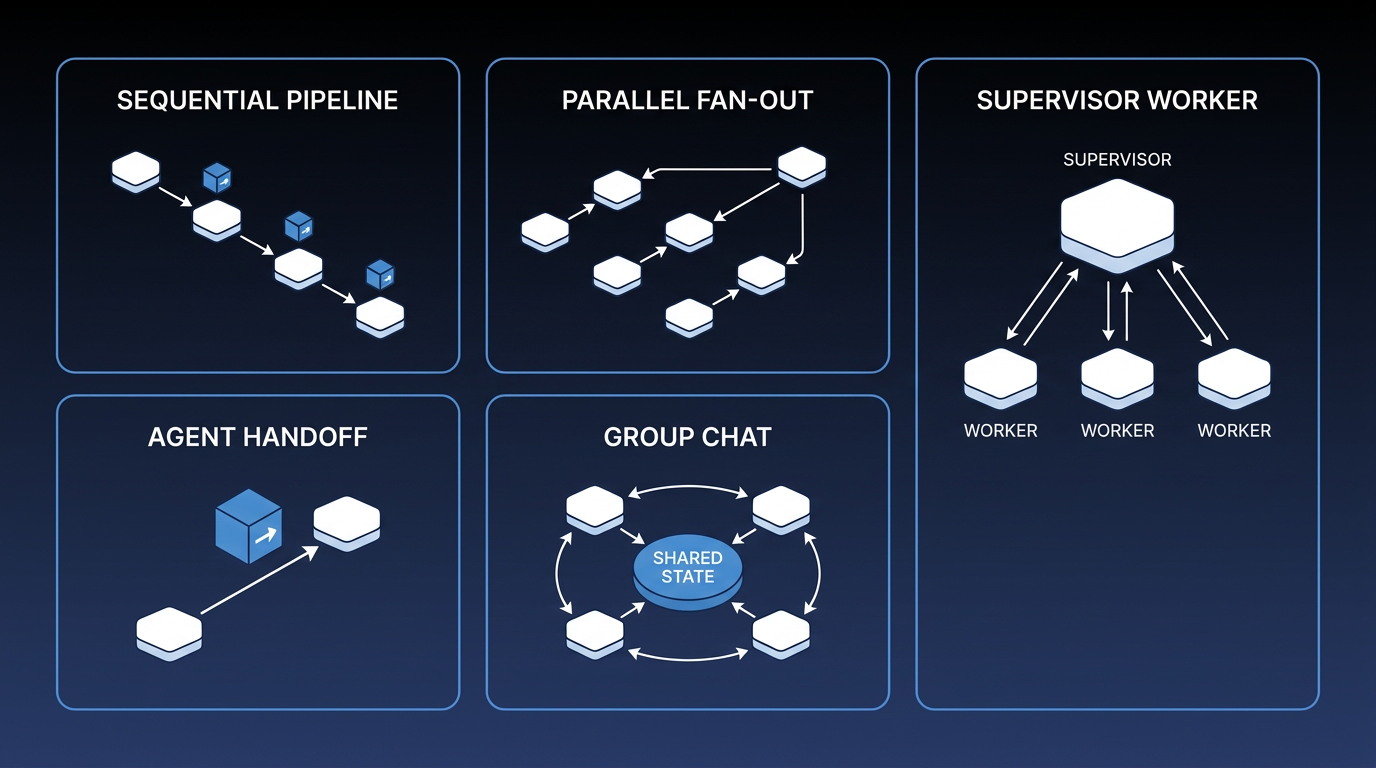
The coordination pattern determines token cost, repeatability, and what auditors can review. Choosing one by default can become an expensive multi-agent design mistake. Each common pattern trades flexibility against repeatability in a different place.
- Sequential pipeline: Each agent passes its output to the next in a fixed order. It often offers greater path predictability and auditability, but can be slower when steps can't overlap. Fits invoice processing through validation and approval before posting, as well as staged compliance review.
- Parallel fan-out: One task goes to several agents at once, and a merge step combines the results. This cuts elapsed time at the price of running every agent simultaneously; subtasks must be independent and known in advance. Fits concurrent credit and transaction checks alongside watchlist screening.
- Supervisor (orchestrator-worker): A central agent decomposes the task, delegates to workers, and synthesizes. Useful where the coordinator can't predict the number of subtasks. Routing is LLM-driven, so determinism drops and token cost rises steeply.
- Handoff: Control passes from one agent to another on a rule or a detected intent, with one agent active at a time. Cheaper than a supervisor; the handoff can lose context at the boundary. Fits a hiring agent passing a signed offer to an onboarding agent.
- Group chat and shared-state: Agents debate in a shared conversation or write to a shared workspace. The flow and outcomes are unpredictable, and the shared memory surface is a primary target for prompt injection, malicious or hidden text that tries to redirect an agent.
Start simple. Use the simplest pattern that fits the process and move up only when you hit a concrete limitation. Sequential and rule-triggered handoff patterns keep the path fixed. Supervisor, group chat, and shared-state patterns hand the path to a model. Fixed paths are easier to reproduce. Model-led paths can still provide logs, but another run may not produce the same result.
Treat agents as equals inside a deterministic process
A production system can treat AI agents and people as equals alongside automated logic. One deterministic process then decides who acts next. That order matters. Let an agent decide instead, and those failure modes become part of the system.
Each step gets the participant its risk profile calls for. Because they have one correct interpretation, a fixed SLA by ticket type and an ID sequence run as automated logic and never touch a model. A three-way match also uses automated logic to compare the purchase order, goods receipt, and invoice. Some steps need interpretation, such as reading a contract clause or classifying a request. Those steps go to an agent under guardrails the process sets. Steps with irreversible consequences, such as a payment release or a supplier commitment, wait at a human-in-the-loop approval gate.
Configurable decision thresholds put that routing into practice. For example, a process can route an agent's output to a human reviewer when the output doesn't meet the defined bar for that task. It might do the same for a request above a set dollar limit. The reviewer's decision then triggers the next automated step. When every participant's action lands in the same log, the record can support the EU AI Act's automatic logging requirement and Sarbanes-Oxley (SOX) internal control testing.
Governance tightens as volume grows. Volume raises the stakes. An agent can repeat an ungoverned decision across many requests before anyone notices, so the deterministic backbone becomes more important as adoption grows.
Sanofi's Chief Digital Officer Emmanuel Frenehard told Fortune that the company wanted to avoid chaining Salesforce, ServiceNow, and SAP agents together. Sanofi built Concierge instead, an internal assistant.
Put multi-agent orchestration inside a deterministic process
Multi-agent orchestration decided by an agent inherits unpredictable paths and hard-to-forecast token spend from the model doing the deciding. It can also produce a trail that auditors may be unable to reproduce exactly.
Gartner's cancellation forecast describes programs that discovered the true cost and risk only after several agents were already live. Retrofitting governance costs more with every workflow that comes to depend on the ungoverned version. Governance must come first. Make the architecture decision before the second agent ships.
Elementum is the Enterprise AI Apps Platform, the AI-native replacement for legacy SaaS. We built a deterministic engine that runs complete business processes across AI agents and people, alongside automated logic. Elementum runs natively inside your own cloud data platform.
Our Workflow Engine sequences each step and calls AI Agents only where reasoning is required, and the model stays optional. We pre-integrate with OpenAI, Gemini, Anthropic, Amazon Bedrock, and Snowflake Cortex, so you can mix models within one process and swap any of them without rebuilding the logic.
Configurable decision thresholds send outputs that don't clear the bar to human review, and the Workflow Engine supports human checkpoints for other high-stakes decisions. For every run, the log records the workflow and agent invoked, along with the result. Requests can enter through the Single Front Door, Elementum's own chat interface, or through Microsoft Copilot, Claude, or a corporate GPT already in use.
We run natively inside your Snowflake tenant, your organization's own Snowflake environment. Databricks support is available today through an active MVP program. Under your existing access controls, we query source systems in place.
Once a run completes, nothing is retained at the execution layer. Your data stays yours. This is our Zero Persistence architecture: we never train on, replicate, or warehouse your data. Our license is a flat annual fee per application, with no per-seat license, no per-conversation charge, and no per-action charge for AI, so the AI line doesn't scale with adoption.
Elementum's production use includes Sanofi's expansion from software license management into procurement, and its continuing expansion into CRM. Among enterprise AI apps platforms in this category, we have the production track record for replacing legacy SaaS at enterprise scale, with named customers including Sanofi, Snowflake, Under Armour, and Elevance Health.
Contact us to map governed AI apps into your architecture and the rest of your AI roadmap.
FAQs about multi-agent orchestration
These are the questions IT and operations leaders most often raise when they start coordinating more than one AI agent.
What is multi-agent orchestration?
Multi-agent orchestration is the coordination of several specialized AI agents so they complete a single business process together. It covers which agent runs when, what state passes between agents, and how errors, exceptions, and approvals get handled. The coordinator can be another LLM or a deterministic process. That choice drives cost and repeatability while determining auditability.
When should you use multi-agent orchestration instead of a single AI agent?
You can use a single agent when one set of permissions and tools can handle the task within one context window, the amount of information a model can process at once. Use a multi-agent system when a complex job spans several domains and benefits from specialists. You'll take on additional handoffs and tool calls, along with more places where definitions can diverge or data can leak. The split adds overhead. A multi-agent system can consume far more tokens than a chat interaction, which raises the bar for when the split is worth it.
How can you use MCP and A2A in multi-agent orchestration?
You can use the Model Context Protocol (MCP) to standardize how an agent reaches its tools and APIs, including the data they expose. You can use the Agent2Agent (A2A) protocol to standardize how agents delegate to each other across framework and vendor boundaries. Both define message formats and authentication. Protocols do not govern. Your process must still decide which agent may call each tool and what happens when a call fails or returns something unexpected.
How do you keep multi-agent orchestration costs predictable?
Every step that doesn't need reasoning should use automated logic, so it generates no model call. For steps that require reasoning, choose a model appropriate for the task rather than the most expensive option. A license that doesn't meter AI further limits variable charges. Our flat annual fee per application removes the per-action and per-conversation charges that make the AI line hard to forecast before a run finishes.
Keep Reading
How Companies Use Agentic AI Across the Enterprise
The Enterprise Guide to Agentic AI for ITSM
Agentic AI for ITSM: A Practical Architecture for Enterprise IT
What Is Agentic AI Orchestration? An Enterprise Guide
How to Measure ROI from Agentic AI Implementations
Agentic AI vs. Generative AI: Why Enterprise Workflows Need Both