
LLM Orchestration: How Enterprises Route, Chain, and Govern Model

A single purchase request can trigger four large language model (LLM) calls before an approver sees it. One model classifies the request, a second extracts line items from the attached quote, and two more check the vendor against policy and draft the justification. LLM orchestration is the control logic that decides which model handles each of those steps, what data it receives, what happens when a call fails, and how the output gets checked before anyone acts on it. In an enterprise, those controls belong to the business process, so the same request follows the same steps under the same rules every time.
Over 40% of agentic AI projects will be canceled by the end of 2027, due to escalating costs, unclear business value or inadequate risk controls, according to Gartner. Escalating costs and unclear business value make routing and sequencing architectural concerns. Inadequate risk controls do the same for governance. Teams should address both before selecting models.
What LLM orchestration means in production
In production, those four controls need one owner across every step. Without one, each team wires model calls straight into its own scripts. The company ends up with many unmanaged integrations. Prompts and credentials belong to each integration. Failure behavior varies by team.
The first distinction separates workflows from agents: workflow code determines the path and gives the model bounded work within it. An agent uses the model to determine how the work proceeds.
The second distinction separates the gateway tier from the application tier. An AI gateway is middleware between applications and model providers. It handles routing, failover, rate limits, spend caps, and request logging for every call. Gartner tracks AI Gateways and AI Agent Management Platforms as separate market categories.
Chains and agents live in the application tier. They still call a provider or a gateway underneath. Application-tier chains can sequence model calls, but neither tier necessarily governs an end-to-end business process. A gateway can report which model answered a request and what it cost. It can't determine whether the purchase order reached an approver with the right spending authority.
Route each process step to the right model
A classification step and a contract summary can have different model requirements and costs. Routing assigns each request to a model that clears the quality bar and enforces process constraints such as cost. Get it wrong in one direction and quality drops on the steps that need reasoning. Get it wrong in the other and AI costs grow with every new user.
Routing generally takes four approaches:
- Rules-based routing: a static mapping from task type to model, set by an engineer and changed by hand.
- Cost-based routing: always send to the cheapest model that meets a fixed quality threshold.
- Learned routing: a classifier trained on preference data (examples that rank preferred outputs) predicts which model will perform best for each input.
- Cascade routing: try the cheap model first and escalate to the expensive one only when the first answer fails a check.
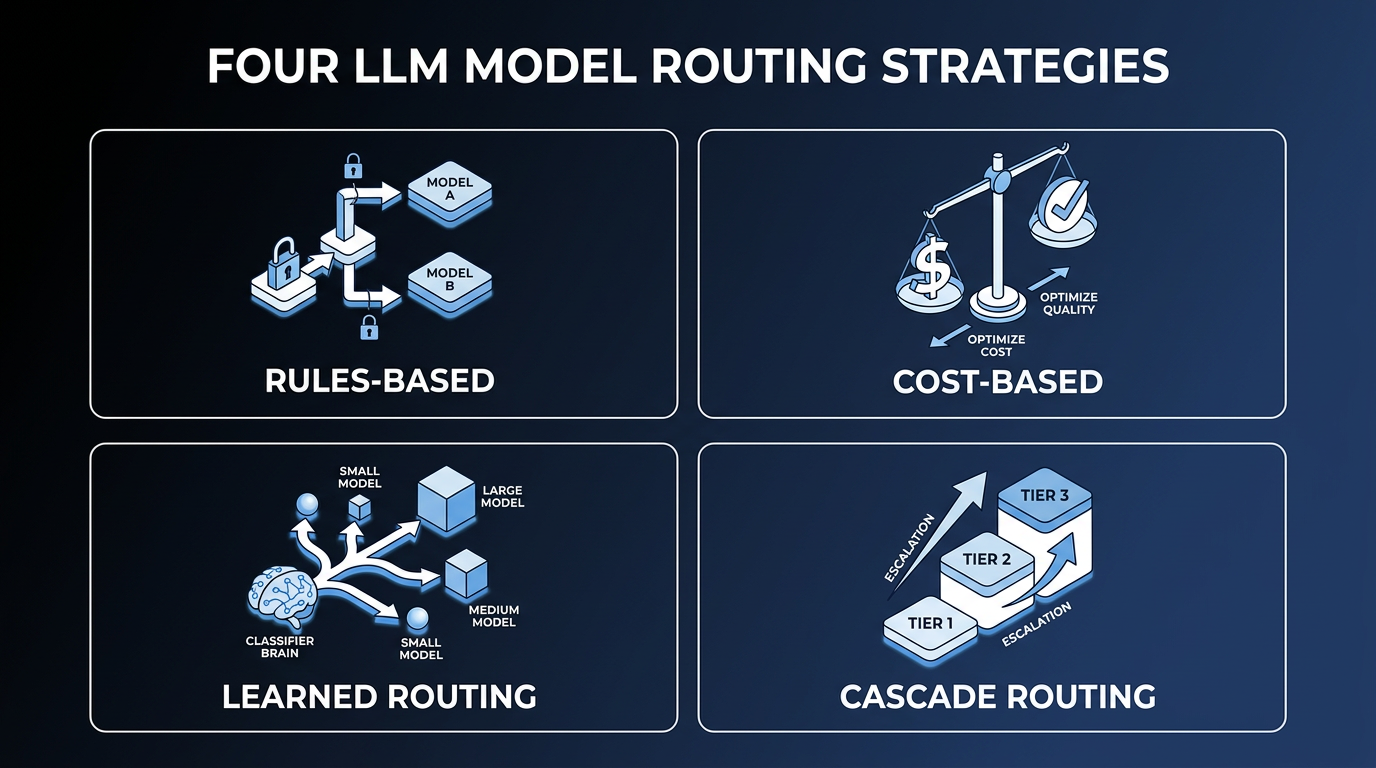
Cascades and learned routers can reduce costs by sending suitable traffic to small models, reserving frontier models, the largest and most capable models, for the inputs that need them. The price is a classifier or a verification step that somebody has to maintain.
Routing costs now have board attention. More than half of CIOs face pressure to deliver AI-driven cost savings, and most don't expect to hit their cost-reduction targets even as total cost of ownership climbs.
Route models at the step level inside a governed process instead of relying only on per-request routing at a gateway. A gateway may see only a prompt, with no context about its process; the application has to pass that context as metadata.
A deterministic engine knows the step is "extract line items from a PDF." It can route that routine work to a smaller model when the model meets the quality threshold. It also knows the next step is "approve spend above threshold." No model call needed.
Elementum’s Workflow Engine calls a model only for steps that need one, and routes each such step to a model appropriate to the task rather than the most expensive one available.
Choose chaining patterns for multi-step business processes
Enterprise chains differ in how calls connect and who holds the state between them. Five patterns are useful for evaluating those differences. Prompt chaining passes results through a defined series of calls, with code checking intermediate outputs. Routing sorts an input before directing it to a specialized follow-up prompt. Parallelization executes independent subtasks together and combines their results.
The remaining two hand more control to the model. In orchestrator-workers, a lead model defines the required subtasks as it works, then assigns them to worker models. In the evaluator-and-revision pattern, one model produces a draft while another reviews it, repeating the cycle until the result meets a defined bar.
Both can fit open-ended work like research or code review. They're a poor fit for payment approvals with known steps, since those processes must preserve authorization rules and produce repeatable audit records. The reason to prefer fixed sequences for known processes is arithmetic: if each step in a chain is right nine times in 10, a five-step chain that depends on every step being right lands correctly about six times in 10.
A fixed sequence with a check after each step catches the miss where it happens. Without that check, the error may surface five steps later, by which point the wrong vendor may already be approved. Business logic belongs in a deterministic process that holds state explicitly; models do the work inside individual steps.
Many enterprise AI strategies skip the deterministic and probabilistic split, even though a finance approval or claims decision may need the same result for the same inputs every run. A prompt sampled at temperature (the setting that controls output randomness) can't make that promise.
Plan human review as a normal workflow stage. Assign it to a responsible owner and define a response target rather than treating it as an exception path. Place human-in-the-loop checkpoints before payments or deletions and before the workflow makes a contract commitment, where mistakes would be difficult to reverse.
Govern logs, oversight, and data handling
Execution audits must trace each run to its approver and identify where the data went. Broader governance covers access and change controls, and those answers have to come from the system that executed the process. Prompt text alone doesn't provide the change controls or decision lineage an auditor needs.
Logging is now a legal floor in Europe. Under the EU AI Act, deployers of high-risk AI systems must retain automatically generated logs for at least six months. Teams may also need to add those logs to records required by industry rules. A SOX-scoped close process (a financial close subject to Sarbanes-Oxley controls) needs the same kind of trail as a HIPAA-covered claims workflow: the auditor reconstructs the actions and changes, including why the model made its recommendation.
A gateway log and a process log answer different questions. The gateway's record identifies model X and prompt Y, then assigns cost Z. A process record, by contrast, might show that request 4471 ran the vendor-onboarding workflow, invoked the extraction agent at step two, failed a policy check at step three, and was routed to a named reviewer who approved it at 14:02.
The process record is generally more useful for reconstructing an end-to-end decision during an audit. Monitoring and control differ the same way: an observability tool records agent behavior and can flag problems, while a deterministic process restricts which steps can run, in what order, and when a person must sign off before output reaches production.
A control plane, a central layer that sets agent permissions, can decide what agents may do. Yet each team may still assemble its own API sequences behind that layer, and those separate sequences can leave execution ungoverned. One governed entry gate in front of dozens of ungoverned pipelines creates AI agent sprawl.
The third audit question is where the data goes. Provider terms only partly answer it. Treat training and retention as contract-specific requirements rather than architectural assumptions, the same applies to zero-retention, meaning the provider stores no prompts or outputs after processing.
One architectural option is to keep source data in place: run the process inside the cloud data platform where the records already live, send a model only the fields a step needs, and retain nothing in the execution layer (the software that runs each process step) once the run completes.
Put LLM orchestration under deterministic process control
Routing models and chaining their calls work best under one governance design. Gartner's cancellation forecast connects directly to the concerns above: teams may buy a router at the gateway, add a framework in the application, then bolt on a monitoring tool afterward. No one ends up owning the business process that auditors and CFOs actually care about. The time to fix that ownership failure is the current budget cycle.
We're Elementum: the Enterprise AI Apps Platform and the AI-native replacement for legacy SaaS. Our deterministic engine sequences the steps and calls AI Agents where reasoning is required, executes automated logic where it isn't, and routes exceptions and approvals to the people who own them. We pre-integrate AI agents with OpenAI, Gemini, Anthropic, and Snowflake Cortex, so one workflow can mix models step by step and teams can swap a model without rebuilding the logic. Configurable decision thresholds set when an agent acts autonomously and when a person must take over.
Our system records each workflow run, including the agent invoked and its result. Our license uses a forecastable flat annual fee per application. It doesn't meter AI: no per-seat license, no per-conversation charge, and no per-action charge for AI.
Everything runs natively inside your own cloud data platform, under your existing access controls. Snowflake is the primary route; Databricks is a live second track, currently an MVP. The Zero Persistence architecture retains nothing at the execution layer between runs. Your data is always yours: we never train on, replicate, or warehouse your data.
We replace legacy SaaS processes in large enterprise deployments. We have the production track record for replacing legacy SaaS at enterprise scale, with named customers including Sanofi, Snowflake, Under Armour, and Elevance Health.
Contact us to map workflow orchestration into your architecture and the rest of your AI roadmap.
Answer common questions about LLM orchestration
These are the questions platform and operations teams raise most often about LLM orchestration in production.
What is LLM orchestration?
LLM orchestration is the control logic that decides which model handles each process step. It controls what data the model receives, what happens when a call fails, and how the system verifies the output before use. In production, it spans two tiers: a gateway that routes and logs calls, and an application tier where chains and agents run. Teams can use that separation to assign infrastructure controls and process controls to clear owners.
What is the difference between LLM orchestration and agent orchestration?
LLM orchestration manages model calls: routing, prompt chaining, context, and model lifecycle (selection, version changes, evaluation, and retirement). Agent orchestration coordinates autonomous agents that decide their own steps and call tools and APIs along the way. Giving agents that freedom also increases the need for approval gates and traceability.
How do you route requests between multiple LLMs?
Four approaches cover most cases: static rules that map task types to models, cost-based selection against a quality threshold, a learned classifier that predicts the best model per input, and a cascade that tries a cheap model first and escalates on failure. Routing at the process step, where the task type is already known, removes the guesswork a per-request router has to do.
How do you avoid vendor lock-in with LLMs?
Lock-in means your models, your data, your data platform, and your interface, those four are the whole claim. Assign models to process steps rather than hard-coding them into prompts and scripts, so a model can be swapped without rebuilding the logic. Keep provider-specific calls behind an interface that can be replaced without changing the process logic.
Keep data in your own systems of record and require the vendor to retain nothing. Separate process logic from platform-specific services so the cloud or data platform can change independently, and write exit terms covering data return and retention into the contract, specifying who holds copies of the data and when those copies must be deleted.
Keep Reading
What Is Agentic AI Orchestration? An Enterprise Guide
How to Use AI for Intake Management and Orchestration
9 Best AI Orchestration Tools in 2026: Enterprise Evaluation Guide
Best Architecture for Managing AI Agent Orchestration in Enterprises
9 Best Workflow Orchestration Tools in 2026
Enterprise AI Orchestration: The Complete Architecture Guide