
Palantir Foundry vs. Open Orchestration: Which Fits Enterprise AI?

Choosing between Palantir Foundry and an Open Orchestration layer determines how much control over your enterprise AI architecture stays with your team and how much shifts to a single vendor. Foundry sells the most tightly pre-integrated stack in enterprise AI, and that integration can make leaving expensive: its proprietary Ontology stores business definitions alongside security policies and the logic behind your workflows.
The field of Palantir Foundry competitors splits into four groups: data cloud platforms, hyperscaler agent platforms tied to major cloud providers, legacy workflow vendors, and Open Orchestration platforms like Elementum. The rest of this article breaks down what separates them, what Foundry actually costs, and where Open Orchestration fits.
Build Operations on Foundry's Ontology
Foundry's core asset is Ontology, an operational layer that sits on top of the platform's datasets, virtual tables, and models and connects them to real-world counterparts: plants, equipment, products, customer orders, financial transactions. On top of it, Palantir's Artificial Intelligence Platform (AIP) provides builder tools like AIP Logic, a no-code environment for building functions powered by large language models (LLMs). It also provides AIP Chatbot Studio for assistants grounded in Ontology data.
A Computer Weekly assessment of the vendor field describes Palantir as pre-integrating data ingestion, semantic modeling, analytics, AI agents, operational applications, and multicloud deployment more tightly than any other vendor on the market. Semantic modeling here means encoding shared business definitions and relationships. The same assessment notes that competitors don't need to replicate that full stack to compete.
Foundry commonly ingests raw data into platform-managed datasets, keeping data and the assets built on it closely integrated. Virtual tables can point to data in external systems instead of copying it, though that path may involve performance and feature trade-offs compared with Foundry-managed datasets.
Calculate the Real Cost of Foundry's Integrated Stack
Foundry evaluations often stall over limited pricing visibility and dependence on embedded engineers, and switching costs compound with every workflow built on top of it.
Model Foundry Costs Beyond the License
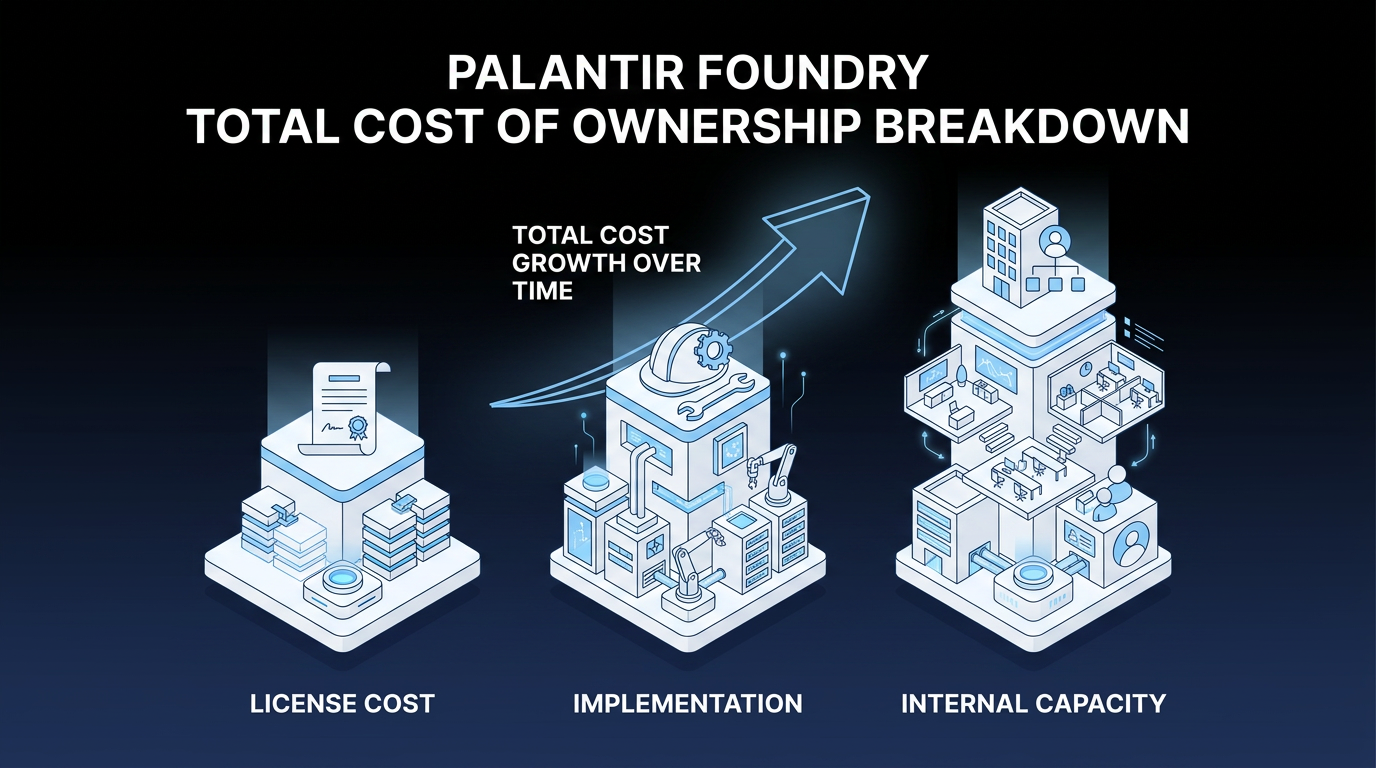
Public pricing is limited, and enterprise agreements vary, so public procurement records provide useful anchors. A UK G-Cloud pricing document lists a single-organization Foundry license inclusive of £3,000,000 of usage a year, a figure that illustrates the scale of public-sector procurement rather than a typical enterprise price. Rollout and internal capacity can also become major parts of the first-year cost.
For the chief financial officer (CFO) conversation, model the license and rollout together, and add internal capacity to the first-year budget.
Plan for Long-Term Forward-Deployed Engineer Dependency
Palantir uses forward-deployed engineers (FDEs) who work directly with customer teams to configure and deploy production use cases. The model can get first workflows into production quickly. It can also build a dependency: the intent is autonomy, but the relationship may remain long term, since Palantir may build, deploy, and operate workflows in production before helping the client create an internal team that owns Foundry standards and support.
Palantir also offers natural-language tooling intended to make Foundry easier to operate, but the institutional knowledge embedded in FDE-built Ontology configurations stays inside the platform.
Treat the Ontology as a Switching-Cost Driver
The same Computer Weekly analysis describes Ontology as Foundry's "most powerful lock-in mechanism." As organizations feed more data sources through Pipeline Builder, Foundry's data-processing tool, they map more objects into Ontology and build more workflows on top, and the cost and complexity of exit increase accordingly.
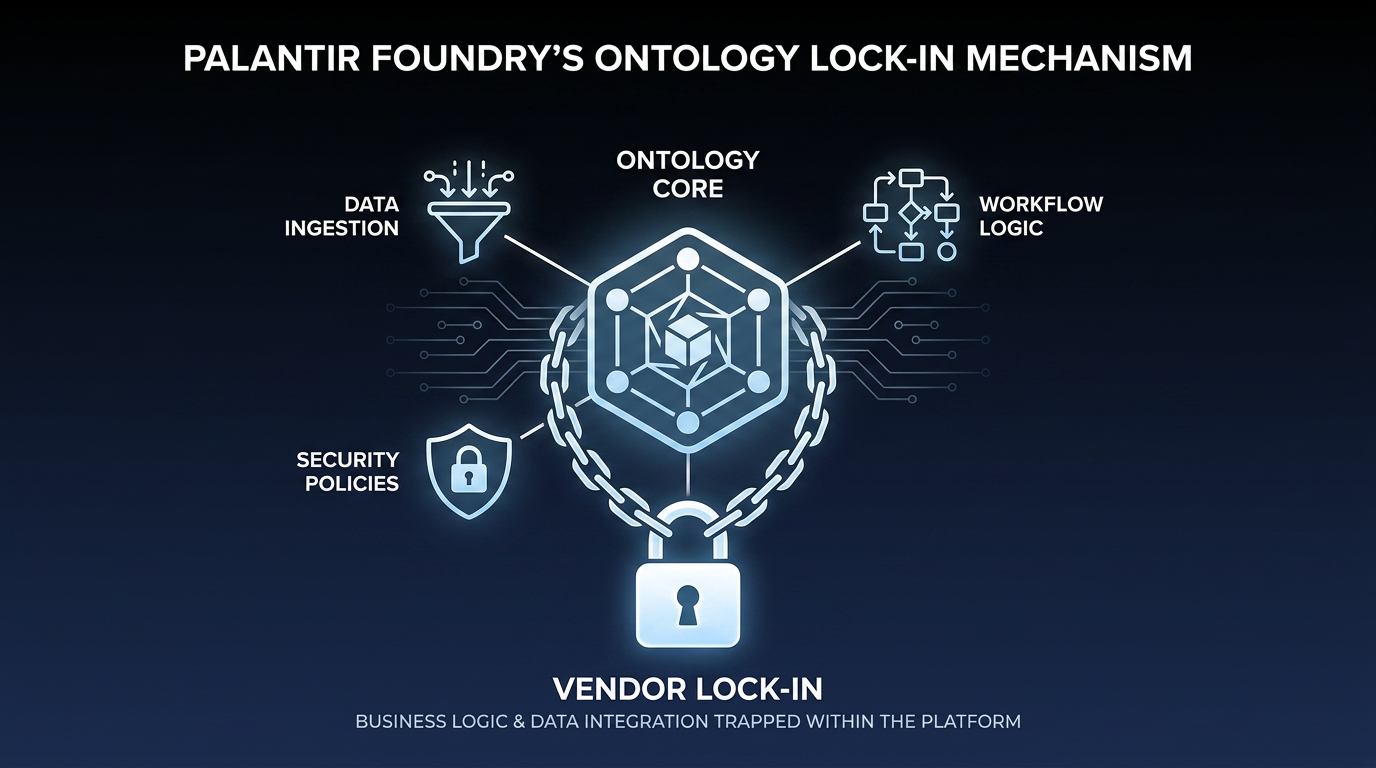
Switching goes beyond data migration: some applications may require rebuilding, since teams can define processing logic inside Foundry through pipeline and processing configuration or code, and business processes may reshape themselves around Foundry's tooling as a result.
At exit, the hard part is moving what the data means. Ontology can become the main repository for Foundry-specific business definitions and relationships, though semantics may also remain in source schemas, documentation, code, and operating procedures. Palantir disputes the lock-in characterization and points to its own published interoperability documentation. Those efforts are worth weighing, but they don't by themselves move Foundry-specific semantics out of Ontology.
How Palantir Foundry Competitors Break Down
Most competitor lists mix vendors that replace different parts of Foundry's stack, which produces incoherent shortlists. Sort candidates by the function you'd actually replace:
- Data cloud platforms: Replace Foundry's pipeline and storage functions, and increasingly complement it, since Palantir also partners with data cloud providers and positions Foundry as an operational layer above them rather than a replacement.
- Hyperscaler agent platforms: Agent-building services tied to major cloud providers that compete for agent-building budgets.
- Legacy workflow vendors: Compete for process automation and case management, rooted in IT service management (ITSM) and business process management (BPM) heritage.
- Open Orchestration platforms: Compete for the coordination layer itself. Elementum is built as a Palantir alternative that treats humans, business rules, and AI agents as equals in any workflow, and it queries data in Snowflake, Databricks, BigQuery, and Redshift in real time without moving it.
An enterprise running a data cloud platform can also be a Palantir customer, since the budget lines differ. The fourth category addresses a different question: how to coordinate agents and rules across the stack you already own, under human oversight, without adding a new proprietary coordination layer.
What Open Orchestration Means in Practice
Open Orchestration architecture keeps the coordination layer independent of any single model vendor or cloud, including the data platform. That layer coordinates AI agents and business rules, with human approvals built into the workflow.
Swapping model providers can be direct, but replacing the system that owns workflow policy, identity, and governance controls can still require substantial re-engineering. Open architecture matters most at that layer, where portability determines how much of the workflow logic has to be rebuilt.
Portability begins in the coordination layer:
- Model-agnostic execution: An abstraction layer sits between workflow logic and model APIs, reducing the workflow changes needed to swap models, though teams may still need to revise prompts, tool schemas, evaluations, and safety controls.
- Query-in-place data access: Workflows query data where it already lives. Creating more copies of regulated data can increase security and compliance exposure.
- Open standards: Model Context Protocol (MCP) connects agents to tools. Agent2Agent (A2A) supports multi-agent coordination by allowing communication between agents. These protocols standardize how systems connect and reduce integrations' dependence on any one vendor.
Agent management platforms centralize oversight of AI agents wherever teams deploy them, providing unified governance, security, and cost controls. Enterprises need that control without accepting another generation of vendor lock-in.
Govern Regulated Workflows Deterministically
A deterministic workflow follows fixed logic: given the same input and relevant system state, it produces the same output. A probabilistic agent may not. That distinction is one key input when assigning roles in a regulated process, alongside decision impact, risk level, data sensitivity, reversibility, model performance, approval policy, and required human review.
Auditability comes first. The deterministic versus probabilistic distinction is a decision many enterprise AI strategies skip, and skipping it gets expensive fast.
Why Agent-Only Architectures Stall
Agentic AI projects can stall when costs escalate, risk controls fall short, or the business value stays unclear. Multi-turn enterprise scenarios also expose reliability problems that can make agent-only architectures unsuitable for processes that require consistent outcomes, and enterprises can discover previously unknown agents already operating in their environments as a result.
What Auditors Require
Regulation raises the bar further: individuals have a right to human intervention when a decision based solely on automated processing produces legal effects on them, and the EU AI Act imposes a human oversight requirement for high-risk AI systems, including authority to override or reverse outputs.
Controls like these favor systems whose behavior is reproducible across audit periods, but reproducibility is only one audit control. Logging, human authority, access controls, and exception handling also matter, and a probabilistic agent whose reasoning varies from run to run may not satisfy those controls on its own.
A hybrid architecture supports both enterprise reliability and auditor scrutiny when deterministic controls govern approvals, logging, overrides, and exception handling, while probabilistic agents handle the specific steps that need interpretation, like reading a supplier contract or classifying an incoming request. Right-sizing each step this way also controls spend, since agent and multi-agent designs can consume more tokens, the units models process, than simple chat interactions.
Choose Open Orchestration Among Palantir Foundry Competitors
Foundry rewards enterprise buyers that want one vendor to own the full stack, and those buyers must accept the switching costs that come with it. If you'd rather keep models swappable and data in place under deterministic governance, choose an open architecture before embedding workflows and business semantics in a proprietary platform. Continued Foundry buildout raises those switching costs further, so the decision is easier to make before buildout than after.
Elementum's Workflow Engine pairs deterministic orchestration with AI Agent Orchestration to govern the agents running inside each workflow. The engine treats humans, business rules, and AI agents as equals, deciding at each step who or what handles it. It stays model-agnostic, reducing the workflow changes needed to swap an LLM, though teams may still need to revise prompts, tool schemas, evaluations, and safety controls.
Orchestrated Intelligence right-sizes spend across that same workflow: deterministic rules handle steps that don't require reasoning, AI agents handle steps that do, and humans review exceptions. That mix keeps costs more predictable than agent-only architectures, where every additional agent call adds token cost regardless of whether the step actually needs one.
Our Zero Persistence architecture keeps that separation structural. Your data is always yours. We never train on, replicate, or warehouse your data.
Who Is Elementum Best For?
Enterprise IT and operations leaders coordinating AI agents, business rules, and human approvals across systems like SAP, Salesforce, and Snowflake, and organizations looking to replace legacy SaaS with workflows built natively on their own data infrastructure.
Many of our customers start with one workflow, prove the savings, and expand into adjacent processes. Among orchestration platforms in this category, we have the production track record for replacing legacy SaaS at enterprise scale, with named customers including Sanofi, Snowflake, Under Armour, and Elevance Health.
Contact us to map workflow orchestration into your architecture and the rest of your AI roadmap.
FAQs About Palantir Foundry Competitors
These are the questions IT and operations leaders most often raise when comparing Palantir Foundry against orchestration alternatives.
Which Palantir Foundry competitors should you compare?
The right competitors to compare depend on which layer of Foundry you're replacing. Data cloud platforms are the most frequently compared alternatives on the data side, hyperscaler platforms compete on what agent tooling can do, and legacy workflow vendors address workflow automation. Open Orchestration platforms like Elementum compete for the coordination layer itself. Pipeline replacement calls for a data-platform comparison, while agent tooling and orchestration each need their own category comparison.
What should you budget for Palantir Foundry?
Budgeting for Palantir Foundry starts from limited public list pricing, since enterprise agreements vary. The clearest public anchor is a UK G-Cloud license listed at £3,000,000 a year for a single organization, though rollout and internal capacity can add significantly more to first-year cost.
How can you assess Foundry lock-in?
Assessing Foundry lock-in means looking at what's encoded in the Ontology, since it stores business definitions, security policies, and workflow logic in a proprietary structure. Exit therefore requires rebuilding meaning in addition to migrating tables. Palantir disputes that reading, and switching costs remain structural whenever applications and processes are built around the platform, especially when processing logic is embedded directly in it.
How should you compare Open Orchestration with Foundry?
Comparing Open Orchestration with Foundry comes down to where the coordination layer lives. Foundry integrates ingestion, semantic modeling, analytics, and AI agents into one proprietary stack, with Ontology as the central abstraction. Open Orchestration platforms coordinate agents, rules, and humans across existing systems instead. Elementum keeps models and clouds swappable and queries supported data platforms in place.
Keep Reading
What Is Agentic AI Orchestration? An Enterprise Guide
Enterprise AI Orchestration: The Complete Architecture Guide
Intelligent Automation: Combining AI, RPA, and Orchestration
Palantir Foundry vs. Open Orchestration: Which Fits Enterprise AI?

Intelligent Automation Solutions for the Enterprise
Enterprise Workflow Software: 5 Top Platforms and How to Choose