
Intelligent Automation Solutions for the Enterprise

AI agents are moving from pilot projects into enterprise operations. More than 60% of organizations expect to deploy them within the next two years, according to Gartner's 2026 CIO and Technology Executive Survey. But governance is lagging deployment at most of those organizations, and that mismatch explains why many AI projects fail before production, and why only 28% of AI use cases in infrastructure and operations meet their return on investment (ROI) expectations, according to a separate Gartner survey.
The bottleneck usually sits in the system around the model, not the model itself. Scalable deployments depend on the right split between deterministic and probabilistic design, backed by agent governance, a board-level ROI case, model flexibility, and data control.
The rest of this blog covers where deterministic orchestration fits, how to contain agent sprawl, and how to build an ROI case the board will fund.
Combine AI agents with deterministic orchestration
Many intelligent automation platforms break at the boundary between AI agents and existing systems. Without a governing layer, no one controls what happens after an agent acts, and every integration point becomes a place the process can break. It breaks fast.
Traditional automation follows explicit rules: if X happens, do Y, every time. An AI agent interprets a goal and decides how to reach it. The same input can produce different outputs depending on context. That flexibility is useful for reading an unstructured contract. It's dangerous for approving a payment.
Business Orchestration and Automation Technologies (BOAT) platforms connect work across systems. They often combine six functions: enterprise connectivity, process orchestration, execution of automation objects like bots and large language model (LLM)-based agents, low-code development, unstructured document extraction, and platform governance. These platforms often overlap with robotic process automation (RPA), low-code automation, workflow orchestration, and IT service management (ITSM) categories.
In scalable deployments, a central orchestration layer usually becomes the control point. It centralizes policy and audit logic for handoffs, coordinates agents from different sources, and enforces policy in one place. It also keeps workflow logic stable when models or agents change. Many deployments hold up or collapse on that last point.
Use deterministic orchestration to bound probabilistic agents
The scaling decision is simple: which parts of a process need to produce the same result every time, and which parts benefit from reasoning? Get this wrong in a regulated function, and you inherit compliance risk that never fully resolves.
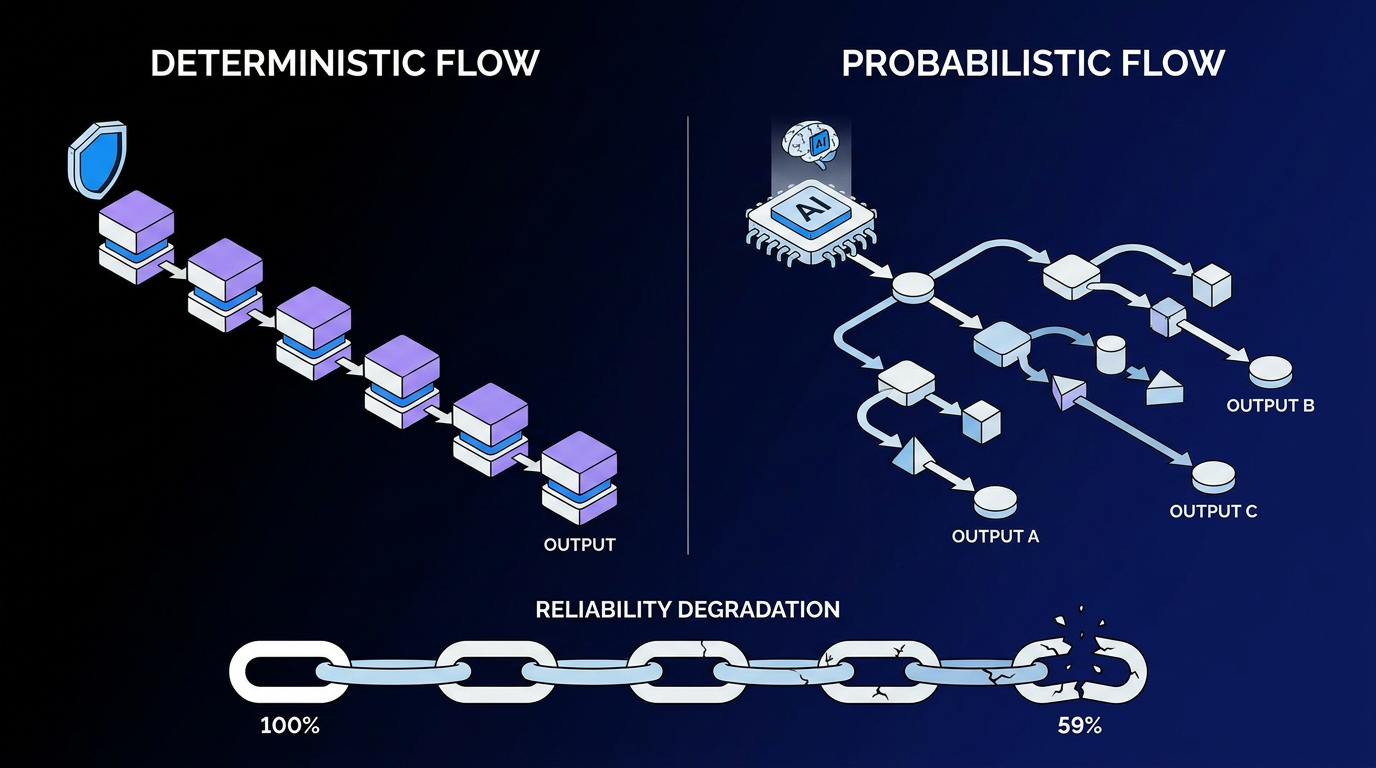
Deterministic workflows produce predictable, repeatable outcomes. Every decision path maps to an approved rule, and audit trails are structural. Probabilistic AI agents are non-deterministic. Outputs can vary even when inputs stay similar, which makes traceability harder and complicates regulatory compliance.
The cost shows up fast. In multi-step agentic workflows, each handoff creates another place for errors to compound, and each additional model call adds cost. Multi-agent designs can require more coordination, monitoring, and cost management than a single interaction. That overhead makes performance less predictable, compounding both errors and cost.
Finance and procurement often require deterministic execution for high-stakes steps. HR often does too. A Know Your Customer (KYC) decision cannot run at an unacceptable error rate, and the same standard applies to loan underwriting checks and employee screening. In a multi-step compliance workflow, even small per-step error rates can compound into a failure rate no regulated process can absorb.
Regulated automated decisions often require clear documentation and accountability through audit trails. Rule-based execution makes that proof easier to produce. Deterministic workflows also throw an explicit error when inputs fall out of bounds. An agent can produce a plausible but wrong output with no error signal at all.
The production-ready pattern is rules plus agents: deterministic orchestration as the control layer, with probabilistic AI as a bounded component inside governed steps. Pure rule-based systems break on ambiguous inputs, while pure AI approaches add cost and variability to steps that don't need either. Across accounts payable, procurement, ITSM, and HR, deterministic logic governs the process end-to-end. Agents handle the specific steps that require language understanding: summarization, classification, extraction, or ranking.
Contain agent sprawl with centralized governance
Agents without governance create risk you cannot see. As agent populations grow across business functions, many enterprises lose visibility into which agents are active, what data each agent can reach, and which decisions each agent can make.
Shadow AI compounds the problem. AI tool adoption is outpacing central approval and security checks. Among organizations that experienced an AI-related breach, 97% lacked proper access controls, according to IBM's 2025 Cost of a Data Breach Report. This policy problem requires instrumentation.
Prompt injection makes the stakes concrete. It holds the top spot in the OWASP Top 10 for LLM applications because models can treat outside content as trusted instructions. Malicious input can redirect model behavior, expose sensitive information, or initiate actions the developer did not authorize. Teams should test prompt injection explicitly before production. Retrieval-augmented generation gives a model approved source material at request time. Fine-tuning can help too. Neither fully mitigates the risk.
Regulated sectors need the same controls. For high-impact sectors, teams should center governance planning on human oversight controls, audit trails that hold up, incident testing, and identity management for automated decision systems. Treat human oversight as a core governance requirement.
Establish configurable decision thresholds for high-stakes actions. Without them, a single misconfigured agent can approve transactions that would never clear a human reviewer, and can do so at high volume before anyone notices. As agents handle more workflow steps, enterprises need the deterministic governance layer more, not less. Higher volume raises the stakes on every ungoverned decision.
Frame AI ROI around board-level cost displacement
CIOs now have to turn AI activity into ROI the board can see in dollars. Deployment milestones no longer count. Boards want dollar figures.
For a board review, the strongest case turns productivity improvement into cost savings in dollars. Quantify full-time equivalent (FTE) capacity and software-as-a-service (SaaS) license reduction in terms of process cycle time. Boards understand two numbers: labor capacity and software spend.
- Digital labor FTEs replaced: Automating a workflow domain like accounts payable can absorb large volumes of manual work each month. Translate reclaimed work into labor capacity the team can redirect.
- Legacy SaaS licensing displaced: Agentic AI can reduce parts of enterprise application software spend when agents handle data entry and routine processing. Organizations that once needed broad seat coverage for a system of record may need fewer licenses as agents take on that work.
Sanofi shows the pattern in practice: the biopharmaceutical company began with software license management before expanding into workflow replacement across procurement and CRM. Its IT organization is now targeting autonomous resolution of a large chunk of employee support requests, a shift projected to save millions of euros a year. Cost cases built on reclaimed capacity and displaced licensing tend to work in board conversations. Boards can tie them to more capacity and lower operating cost.
Protect AI scale with model independence and data sovereignty
Single-vendor architectures create re-engineering risk. Model prices shift, and deployment patterns change.
Model independence and data sovereignty reduce that risk. The architecture should support model and cloud independence, so teams can change the model layer or agent tooling without rewriting workflow logic. Model routing also belongs in the architecture: it sends each task to the best-fit model, so teams can select the right model per step instead of hard-coding one path for every task.
Protect data sovereignty by tracking where data is governed and processed, including system logs. Residency is only one part of the risk. The control question covers storage location and the full path data takes when an agent retrieves, processes, and logs it.
Logging the context window, meaning the prompt and source material the model sees during a request, can quietly move sensitive personal data outside the intended control boundary. Querying data where it already lives, without replication, keeps sensitive records inside their existing access controls and makes residency and privacy requirements easier to meet.
Scale enterprise automation with Elementum
AI agents scale only when deterministic governance scales with them. Deploying an agent is easy. Governing it is hard. Enterprise deployments that reach production put deterministic control around probabilistic intelligence before scale begins. This is the architecture behind Elementum.
We built our Workflow Engine for exactly that. It treats humans, business rules, and AI agents as equals in any process, with a deterministic backbone that produces the same result every time.
Our AI agent management orchestrates any agent, third-party or native, pre-integrated across OpenAI, Gemini, Anthropic, Amazon Bedrock, and Snowflake Cortex, so there's no model lock-in. Configurable decision thresholds route work between AI and humans. Built-in guardrails defend against prompt injection on every model interaction, and every agent action is logged and revocable, with controls aligned to SOX/HIPAA/GDPR requirements.
On data, our Zero Persistence architecture keeps everything inside your environment. Your data is always yours. We never train on, replicate, or warehouse your data. CloudLinks query it in real time where it already lives, without copies or a new warehouse.
Many of our customers start with one workflow, prove the savings, and expand into adjacent processes.
Among orchestration platforms in this category, we have the production track record for replacing legacy SaaS at enterprise scale, with named customers including Sanofi, Snowflake, Under Armour, and Elevance Health.
Contact us to map workflow orchestration into your architecture and the rest of your AI roadmap.
Frequently Asked Questions
These are the questions IT and operations leaders most often raise when evaluating intelligent automation platforms.
What is the difference between simple automation and AI agent orchestration?
The difference comes down to how each handles ambiguity. Simple automation follows fixed rules and runs the same path every time. AI agent orchestration coordinates intelligent agents that hold an objective and access a knowledge base. Those agents can plan and act across multi-step tasks without constant human intervention. The strongest enterprise setups combine both: deterministic rules govern the process while agents handle the steps that need reasoning.
When should you use a deterministic workflow versus an agentic workflow?
The choice comes down to which parts of a process must produce the same result every time, and which benefit from interpretation. Use deterministic logic for workflows tied to regulatory controls or privacy obligations, where audit trails and repeatability matter. Use agents for ambiguous inputs like reading unstructured documents, and keep them inside a governed workflow.
How do you govern AI agents in enterprise operations?
Governing agents start with a single question for each one: what decision is it responsible for, and who is accountable when it's wrong? Enforce identity and least-privilege permissions that give each agent only the access it needs. Add configurable decision thresholds for high-stakes actions and human-in-the-loop checkpoints, all with complete audit logs. In many enterprises, ungoverned agents are why so many agent projects stall before production.
Why should you avoid data replication in enterprise automation?
Data replication multiplies compliance risk. Copying data across systems or borders can increase exposure even if storage stays local. Processing sensitive data outside the intended control boundary can create transfer and audit issues. Querying data where it already lives keeps records inside their existing access controls and shortens audit cycles, and it removes the cost of building and maintaining duplicate data stores.
How long should enterprise automation take to deploy?
Deployment timelines vary by architecture. Traditional enterprise automation and RPA setups often require long rollout cycles, bringing high setup costs, reliability challenges, and an ongoing maintenance burden. In-place data queries can deliver faster initial workflows, because there's no ingestion pipeline to build before value appears. Evaluate timelines against your specific integration and governance requirements.