
Intelligent Automation: Combining AI, RPA, and Orchestration
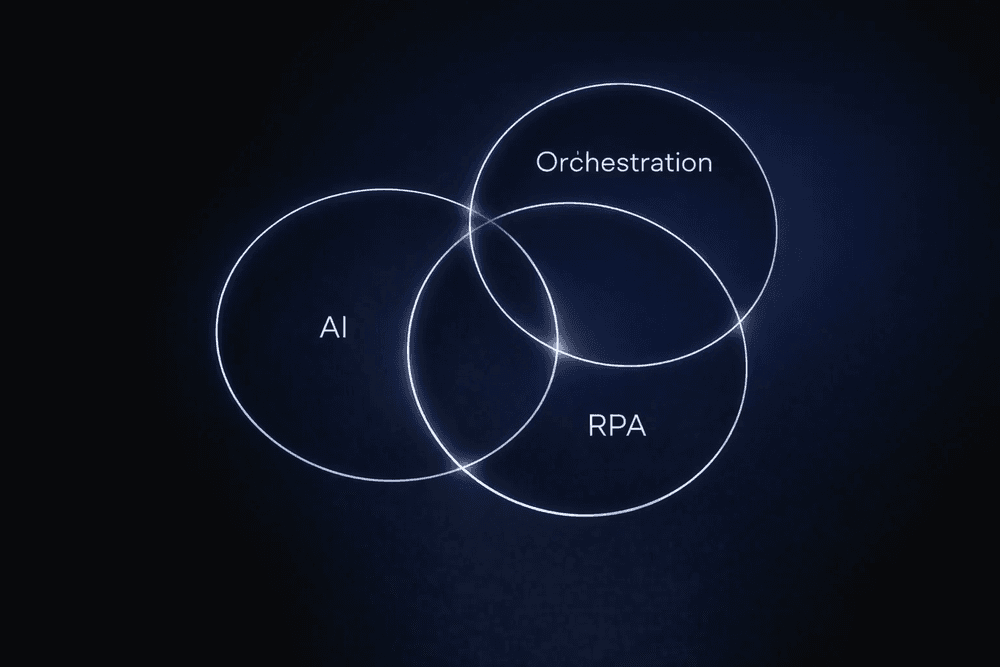
Point automation stops scaling fast. A purchase order can pass through an enterprise resource planning (ERP) system, a document repository, and several spreadsheets before it reaches an approver. Many enterprise processes work this way. Part rules. Part judgment. Lots of unstructured data. That's why intelligent automation, the combination of AI with robotic process automation (RPA) and orchestration, has become a standard way for teams to run work across systems, humans, rules, and agents.
Agent adoption has moved beyond planning, and it's now putting real pressure on operations. Only a small share of organizations have deployed AI agents to date, though most expect to within the next two years.
What Intelligent Automation Combines
Intelligent automation joins workflow orchestration to RPA and AI, and each layer does a different job. AI interprets unstructured inputs. RPA executes scripted tasks. The workflow layer coordinates approval sequence and exception handling.
Treating the three layers as interchangeable is where automation projects break down. Each layer carries different cost and audit risk, and using the wrong one for a given step compounds that risk as workflows spread across systems. Those boundaries decide whether the architecture can stand up to scrutiny.
- RPA (the doing layer): Software robots automate repetitive, rule-based tasks by mimicking human actions across digital systems. RPA follows fixed logic and does not learn or adapt on its own.
- AI and machine learning (the thinking layer): Handles cognitive tasks like document understanding, classification, and unstructured data processing that scripted rules can't cover.
- Orchestration (the conductor layer): Coordinates work allocation, sequencing, monitoring, and exception routing across every resource, human, rule, and agent alike.
A purchase order process illustrates the flow. Intelligent document processing extracts data from an incoming document, the orchestration layer validates it against business rules or routes it for human review, and an RPA bot enters the data into target systems.
Orchestration handles exceptions. Sequence matters. No single layer produces the outcome alone.
Why Orchestration Is the Layer That Determines Reliability
Reliability determines whether enterprise AI gets past the pilot stage. Many pilots work in controlled tests and struggle once they reach production, and most AI pilots stall before ever getting there. Success depends more on orchestration than model selection, because orchestration is what separates repeatable steps from steps that need adaptive intelligence.
Large language models (LLMs) are structurally probabilistic: they generate outputs by sampling from probability distributions, so the same prompt can produce different outputs across runs. Setting temperature, the parameter that controls how much randomness a model uses, to zero can reduce that variance. It does not guarantee identical results across different hardware or batch sizes.
For a finance workflow where identical cases need identical outcomes, that variance can be unacceptable unless the step is constrained by deterministic rules.
Long agent chains create more failure points. Each handoff adds another place for the workflow to break. Agentic approaches can add cost and variability to steps that deterministic workflows could have handled more consistently. That math gets harder to defend in production. The workflow fails when the wrong tool is applied to a step that never needed reasoning.
The audit problem is simple. If a compliance officer needs to point to a specific execution, the workflow has to show what decision it made, when it made it, and why. "The model said so" is not an acceptable audit trail for a financial transaction.
SOC 2 Type II requirements favor predictable, reproducible systems, and HIPAA-controlled workflows and SOX controls set similar expectations. An LLM orchestrating other agents can make the immutable, step-by-step trail those regulators expect hard to produce. Deterministic logging and control need to sit around it.
In a stronger enterprise pattern, deterministic orchestration engines control the overall workflow, and probabilistic AI agents handle the specific steps that require interpretation. The architecture pattern matters more than the label. Business processes and agentic automation both need one governed workflow layer instead of separate, disconnected control planes.
Orchestration models often outlive the individual agents inside them. You may swap LLMs frequently, but your core business processes are long-lived, which makes the orchestration layer the asset worth investing in.
Define Agent Ownership Before Adoption Outpaces Governance
Enterprises may deploy AI agents faster than governance matures. The bill comes due in production when access and ownership rules are unclear. When teams add agents before they define ownership and access limits, approval thresholds tend to appear only after something breaks. By then, teams may already have agents acting across systems without a clear owner.
The failure point appears when teams add agents faster than they add controls. Production issues can lead enterprises to reassess or scale back autonomous AI agents after they spread across systems. Accountability starts to drift.
Agent sprawl makes it worse. As more task-specific agents proliferate, unmanaged sprawl can create the new shadow IT. Teams lose visibility into agent inventory and data access, and retirement decisions get delayed or missed.
Each unmanaged agent compounds security exposure and unauditable decisions, while duplicated logic spreads across teams.
Agent access turns prompt injection, malicious instructions that manipulate an LLM's behavior, from a model risk into a systems-access risk. It ranks #1 on OWASP's LLM risk list, the application-security standards body's ranking of the most critical large language model vulnerabilities. The blast radius scales with agent access: a single agent connected to multiple systems exposes every permission it holds across every connected system.
As AI handles more workflow steps, the deterministic governance layer becomes more critical. Higher volume means higher stakes for every ungoverned decision.
Use controls that match the risk, combined with human-in-the-loop checkpoints. Escalation should route on decision thresholds and action reversibility, with monetary value setting a separate limit. An enterprise might require human approval for high-value refunds while the workflow handles everything below that limit on its own. Operations teams need to configure those thresholds without writing code, because process logic changes faster than any engineering backlog can keep up.
Right-Size AI Cost and Avoid Vendor Lock-In
The economics have to make sense. Intelligent automation is easier to defend in a board review when teams apply AI only where it helps and can move between models when needed. Get either wrong and the ROI evaporates.
Right-sizing starts by matching each step to the least variable tool that can complete it: deterministic rules for steps that need consistency, AI agents for work that truly needs reasoning, and humans for judgment calls. Pure rule-based systems break down on ambiguous inputs. Pure AI approaches inflate cost on steps that never needed reasoning in the first place.
In a procurement process, requisition-to-PO logic, approval chains, and the three-way match, checking that the purchase order, invoice, and receipt agree, all stay deterministic. AI adds value at intake classification and supplier contract extraction. Applying an LLM to every step inflates cost without improving the outcome.
Treat vendor lock-in as a financial risk. Single-vendor AI dependency can turn pricing or availability changes into architecture decisions, and model performance regressions can force rework too. Enterprise CIOs increasingly report running multiple LLMs in production rather than standardizing on one.
The pattern matches models to use cases instead of treating one model contract as the strategic asset. Cost compounds under model dependency. Architecture lasts longer than any model contract.
Control over data affects compliance and architecture, and cost follows from those choices. Sanofi controlled the data by building AI workflows directly on its own data infrastructure with Elementum's Zero Persistence architecture. That design avoids storing customer data in the automation platform, so enterprise data stays where it already lives.
The company started with software license management and achieved $10M+ in software license spend reduction, then expanded into adjacent procurement and CRM workflows. Sanofi's chief digital officer has since set a target to resolve 80% of employee IT requests with AI agents, projecting meaningful additional savings on top of what the license reduction already delivered.
How Elementum Runs Intelligent Automation in Production
The three layers of intelligent automation only pay off when the orchestration layer makes one decision early: which steps stay deterministic and which use adaptive intelligence. Skip that decision and you inherit reliability decay, control drift, and rising cost. Make it well, and you get automation that survives an audit and a board review.
Elementum built our Workflow Engine (Trident) to make that decision operational: it treats humans, business rules, and AI agents as equals, running on a deterministic backbone that produces the same result every time a defined process runs.
Open Orchestration keeps you out of a single vendor's roadmap. We're model-agnostic across OpenAI, Gemini, Anthropic, Amazon Bedrock, and Snowflake Cortex, so you can swap models without rebuilding your workflows.
Orchestrated Intelligence right-sizes the spend across rules, agents, and people. Our AI Agents product orchestrates any agent, third-party or native, inside governed workflows, with configurable decision thresholds, human-in-the-loop checkpoints, full action logs, and revocation controls.
Zero Persistence means your data stays yours. We never train on, replicate, or warehouse your data: Elementum's Zero Persistence architecture queries data in real time where it already lives, so it never leaves enterprise control.
Elementum layers on top of the systems you already run, and it can also replace them over time as workflows migrate, the way Sanofi expanded from software license management into procurement and CRM. Many of our customers start with one workflow, prove the savings, and expand into adjacent processes.
Among orchestration platforms in this category, we have the production track record for replacing legacy SaaS at enterprise scale, with named customers including Sanofi, Snowflake, Under Armour, and Elevance Health.
Contact us to map workflow orchestration into your architecture and the rest of your AI roadmap.
Frequently Asked Questions
Teams scaling intelligent automation need clear boundaries. Rules, AI, humans, and orchestration each need a defined role before production workflows grow.
How Should You Compare RPA and Intelligent Automation?
Comparing RPA to intelligent automation starts with what each one does: RPA is process-driven and follows only the rules a person defines, while intelligent automation adds AI's ability to recognize patterns and handle unstructured inputs. AI handles the thinking layer and RPA handles the doing layer, with orchestration connecting both inside intelligent automation.
How Should Your Team Use AI Agents Versus RPA Bots?
Using AI agents versus RPA bots comes down to how much judgment the task needs: RPA bots follow fixed scripts across systems, while AI agents use reasoning and planning for ambiguous, multi-step tasks. Because agents introduce variability, enterprise deployments govern them inside deterministic workflows to keep actions bounded.
How Should You Think About Orchestration Versus Automation?
Thinking about orchestration versus automation starts with scope: automation performs individual tasks without human intervention, while orchestration coordinates those automated tasks across multiple systems into higher-order workflows. It handles sequencing, monitoring, and exception routing. Without orchestration, you have isolated bots and agents that can't reliably hand work to one another.
When Should You Use RPA, AI, or Intelligent Automation?
Choosing between RPA, AI, or intelligent automation depends on the task: use RPA for structured, repetitive, rule-based tasks and AI for decisions that require interpreting unstructured data. Intelligent automation fits processes that span multiple systems and mix structured and unstructured steps, which describes most real enterprise workflows.
What ROI Should You Expect From Intelligent Automation?
The ROI you should expect from intelligent automation varies by process and maturity. The most reliable returns come from right-sizing: apply AI only where reasoning is needed, and keep deterministic logic for everything that must be consistent and auditable.
Keep Reading

How to Integrate Generative AI into Enterprise Workflows Safely and Effectively
The Enterprise Guide to Integrating AI into Human Workflows at Scale

The Intelligent Front Door: How Enterprises Replace Multiple SaaS Tools with One AI Orchestration Layer
Intelligent Ticket Routing in ITSM: From Manual Triage to Governed Automation
5 Top Solutions for Intelligent Ticket Routing in ITSM: Improve Resolution Speed & Accuracy
Actualizing the ROI of the Cloud with Intelligent Workflows