
The Unquantifiable ROI Problem: Why Enterprises Can't Measure AI Value

Only 22% of organizations have scaled AI across multiple business units, even though 85% of functional leaders plan to spend more on AI in 2026. Finance is losing patience with that shortfall, and the pressure to prove AI return on investment (ROI) falls on the CIO and CFO together.
The AI ROI problem starts before deployment, in how program leaders scope the work. They hand tools to individuals and record no baseline. Costs then grow with adoption while value stays scattered across calendars. Each of those is a program design decision, and a better spreadsheet after go-live can't repair any of them.
This article covers why AI value stalls before the income statement, why cost outruns it, and how to build a case your CFO will sign.
Why AI ROI Stalls Before the P&L
Individual productivity gains rarely reach the income statement. Employees report saving time, yet the share of organizations attributing any earnings before interest and taxes (EBIT) to AI has stayed flat year over year. The profit line hasn't moved.
The profit and loss statement (P&L) records what changes a cost line or a revenue line. Speed changes neither until it turns into lower cost or higher revenue.
Saved Hours Without Booked Savings
Saved hours count as savings only when a cost line shrinks through an avoided hire, a canceled contractor engagement, or a retired license. A survey saying employees save time each week produces none of those.
Reclaimed time often shifts into new tasks, planning, or checking AI output. Total labor cost holds steady while the productivity slide looks excellent.
Assistant-style deployments are hard to defend at budget review for the same reason. The benefit lands in hundreds of individual calendars. The cost lands in one line item procurement can be read.
Claims Without a Baseline
An after number with no before number is a claim. AI programs that start as experiments often skip pre-deployment measurement, and finance teams then receive self-reported time savings and adoption counts as proof.
Seats active, tools rolled out, and tasks completed are consumption metrics. They describe deployment activity, and a board can't book activity.
A defensible baseline records the cost of the process before go-live. It should capture three things:
- Labor Cost: headcount or contractor hours spent on each step.
- License Spend: the cost of the application the process runs on.
- Operating Metrics: cycle time, error rate, and rework rate.
Timing decides whether these numbers are usable. Without them on day one, a defensible ROI claim on day 180 gets much harder to build.
AI Cost Outruns AI Value
The denominator of the AI ROI equation moves too, and it moves the wrong way. Budgeting for token- and inference-based pricing now ranks as the largest barrier IT leaders report when they evaluate AI vendor pricing, in an IDC survey of more than 1,400 of them.
The run cost of AI includes inference, API calls, and other usage-based consumption. Inference is the computing work a model performs to produce an output, and providers usually meter it in tokens, the units of text a model processes.
Costs rise with use. Every adoption win makes the bill harder to forecast.
Per-seat AI add-ons carry the mirror problem. The vendor charges for every eligible user whether or not they open the tool, so cost tracks headcount while value tracks the minority who adopt. Procurement often commits the money before operating results show what it bought.
Agentic deployments compound both effects. An AI agent working through a multi-step task calls a model many times per outcome, and an agent loop that runs longer than intended consumes compute nobody budgeted. Unsanctioned tools add AI agent sprawl: agents multiplying outside finance's view.
AI ROI Starts With Replacing a Process
Organizations that report AI on the P&L tend to redesign whole workflows before they automate individual tasks.
The mechanism is accounting. A business process already carries financial costs, such as application licenses and contractor hours, and operating metrics such as cycle time. Replacing the process draws one boundary around all of them, so teams compare before and after on the same scope. The old cost line either shrinks or it doesn't.
Every step inside a replaced process falls into one of three types, and the mix decides how auditable the result is:
- Deterministic Steps: Fixed logic that must produce the same result every time, such as an approval threshold, a routing rule, or a three-way match that confirms the purchase order, receipt, and invoice agreed before payment.
- Agentic Steps: AI agents interpret unstructured input and decide how to proceed, such as reading a supplier contract or classifying an employee request.
- Human Steps: People review, approve, or decide wherever the stakes call for judgment.
Where teams draw the deterministic vs. probabilistic line, with probabilistic meaning an AI output can vary from run to run, decides how cleanly the process audits. Auditable outcomes give finance evidence it can verify.
Sanofi followed this sequence with Elementum. Sanofi replaced the procurement workflow that ran on Coupa.
Software license management is a practical first process to replace because its savings surface at the next renewal.
Build an AI ROI Case Your CFO Will Sign
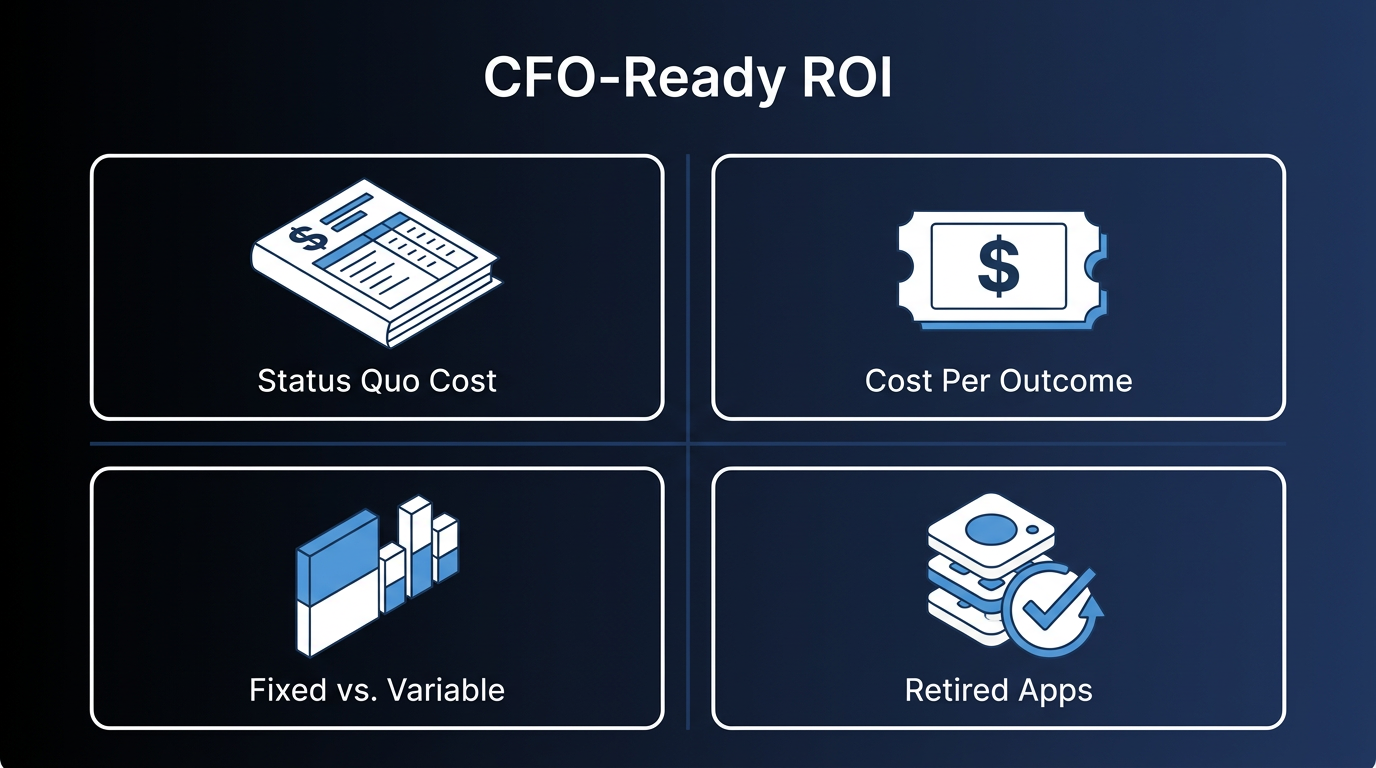
The AI ROI case that survives budget review uses numbers finance already tracks, recorded before the first agent runs. Each measure below maps to a line finance can audit:
- Status Quo Cost: Document the license spend and contractor hours of the process you plan to replace, and record cycle time and rework rate separately. Every later claim is measured against this baseline.
- Cost Per Outcome: Track cost per ticket resolved, per invoice processed, or per contract reviewed. Cost per completed outcome connects spend to what the business paid for.
- Fixed and Variable Cost: Separate the platform fee from metered inference and per-seat add-ons, which rise with adoption. A per-application platform fee keeps the license portion of the denominator predictable as usage grows.
- Retired Applications: Count the applications or modules you retire and the license spend attached to each, starting with the first deployment. Each retirement produces a hard number at renewal.
Together, these measures replace a productivity survey with a ledger.
Take IT support. Before go-live, record the ticketing license cost and the contractor hours spent on each Tier 1 (first-line) ticket. Together, they give a baseline cost per ticket.
The stakes scale fast. Sanofi's Chief Digital Officer has set a goal of AI agents resolving up to 80% of employee IT support requests..
The pattern validates input, puts guardrails on model interactions, and keeps human checkpoints for high-stakes decisions. Resolved tickets stop consuming contractor hours, and teams measure the new cost per ticket against the recorded baseline. No survey required.
Anchor AI ROI in Retired Legacy SaaS
AI budgets keep rising, and cloud AI costs already overrun plans. A productivity-slide version of the AI ROI case gets harder to defend because it shows no changed cost or revenue line. A case built on license spend eliminated and process cost measured before deployment gives finance evidence it can audit.
We built Elementum as the Enterprise AI Apps Platform. It replaces the application, retires the licensed system, and shrinks the estate. Our Workflow Engine treats people, business rules, and AI agents as equals in one process, and the engine sequences every step deterministically. Every run logs which agent it invoked, which workflow it ran, and what it returned. Pair those records with cost, error, and rework data to see the full financial result.
Our license is a flat annual fee per application, with no per-seat license, no per-conversation charge, and no per-action charge for AI. Model consumption and other usage-based costs remain variable lines, and cost-per-outcome tracking keeps them visible.
We run natively inside your own cloud data platform, starting with Snowflake, and query your data in place under your existing access controls. Under our Zero Persistence architecture, we never train on, replicate, or warehouse your data. Nothing is retained at the execution layer after the run completes.
Many of our customers start with one workflow, prove the savings, and expand into adjacent processes. Global enterprises including Sanofi, Under Armour, and Elevance Health run on Elementum.
Contact us to map AI-native applications into your cost-reduction architecture and the rest of your AI roadmap.
FAQs About AI ROI
These are the questions finance and IT leaders most often raise when an AI program reaches budget review.
What Is a Realistic ROI From Enterprise AI Projects?
A realistic ROI from enterprise AI projects varies widely by use case and by whether the organization recorded a baseline. Only 25% of AI initiatives delivered their expected ROI over the prior few years, according to CEOs surveyed by IBM in 2025. Figures like this blend unmeasured projects with negative ones, so treat any single benchmark as a planning range.
Why Is AI ROI So Hard to Measure?
AI ROI is hard to measure because productivity gains arrive as reclaimed minutes, and finance can book those minutes only when they become an avoided hire, reduced contractor spend, or a retired license. Without a pre-deployment baseline, the only evidence left is self-reported time savings and adoption counts. Meanwhile, metered inference and per-seat pricing move the cost side every month.
How Long Does It Take to See ROI From AI?
The time to see ROI from AI depends on which benefit you count. Cycle-time reductions tend to show up soon after go-live. License displacement appears when a retired application's renewal comes due. Revenue effects usually take longer and stay harder to attribute.
Which KPIs Measure AI ROI?
The key performance indicators (KPIs) that measure AI ROI map to a cost or revenue line: cost per outcome, cycle time against the pre-deployment baseline, error and rework rate, and license spend displaced by retired applications. Seats active and tasks completed measure consumption, so keep them as secondary indicators.
Keep Reading
AgentForce Alternatives for Enterprise AI Agent Platforms

How Companies Use Agentic AI Across the Enterprise
AI Agent Management: How Enterprises Govern Agents at Scale
AI Agent Observability and Monitoring: The Enterprise Stack

Agent Sprawl: How Enterprise CIOs Are Governing Hundreds of Disconnected AI Agents

AI Governance Best Practices: A Framework for Enterprise CIOs