
AgentForce Alternatives for Enterprise AI Agent Platforms
Salesforce's Agentforce is a natural starting point for any company already running Salesforce and considering agentic AI. That's exactly why it deserves scrutiny: the platform decision determines agent governance, how AI spend scales, and where enterprise data has to live for years. Getting it wrong is expensive to unwind.
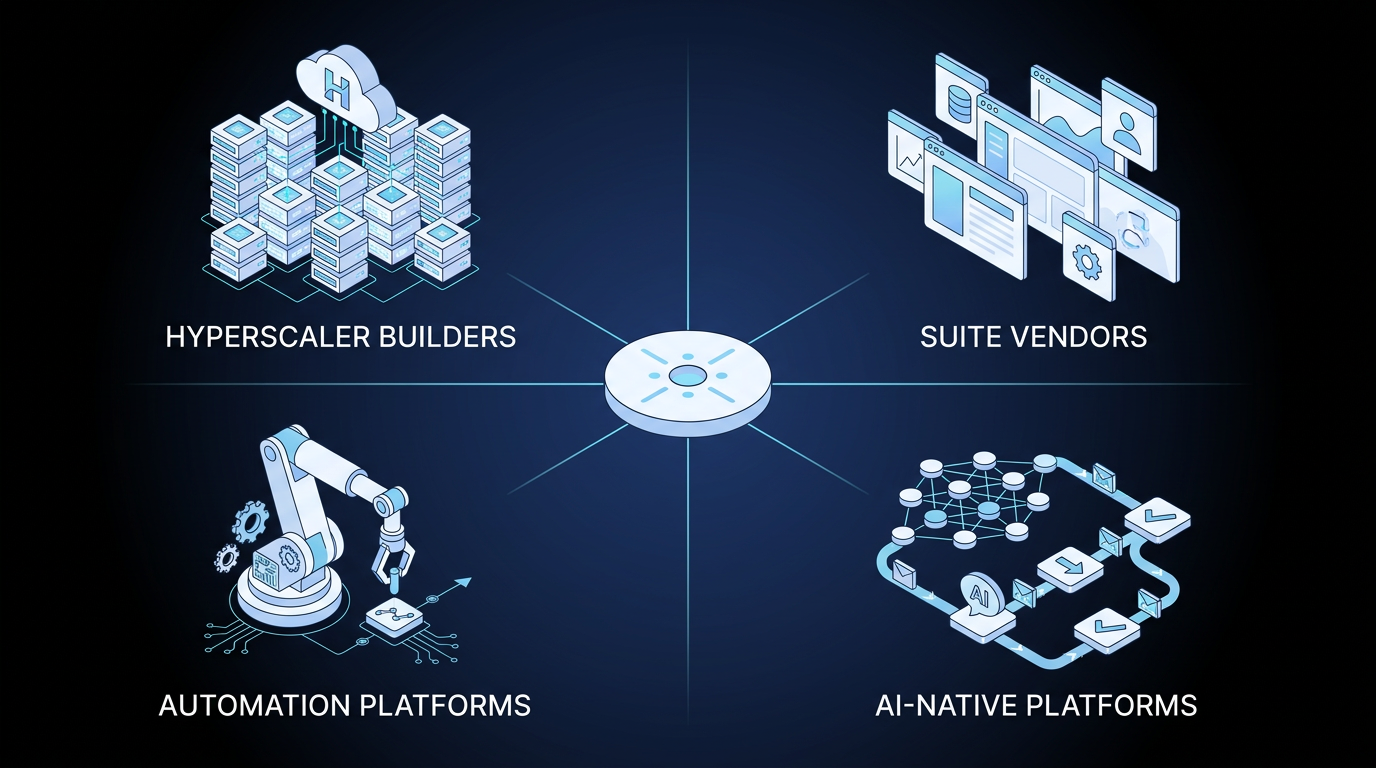
The alternatives fall into four categories: hyperscaler agent builders, enterprise application vendors shipping agents inside their own suites, automation vendors extending robotic process automation (RPA) into agentic work, and AI-native enterprise application platforms that replace applications instead of adding agents to them. This article compares each category against Agentforce on pricing, governance, and data architecture.
Why Enterprise Buyers Evaluate Agentforce Alternatives
Enterprise buyers evaluating Agentforce alternatives run into three risks that only surface after the contract is signed: pricing that resists forecasting, agent behavior that varies across identical scenarios, and a dependency on Salesforce's unified data layer. Each one shifts cost or risk onto the buyer rather than the vendor.
Pricing That Resists Multi-Year Forecasting
Agentforce bills agent activity through Flex Credits, a system that charges per action rather than through a simple per-request count. Because a single user request can trigger several backend actions, actual cost depends on the execution path rather than request volume alone, which makes usage difficult to translate into a stable budget.
Salesforce has offered three pricing models for Agentforce over time: a flat per-conversation rate, action-based Flex Credits, and per-user licensing. For a procurement team building a three-year budget, a pricing structure that keeps changing is itself a risk line.
Non-Deterministic Behavior in Regulated Processes
Agentforce's behavior varies across sessions: the same customer scenario can follow a different execution path from one run to the next, because the model interprets intent differently each time.
When agents drifted, engineering teams had little recourse beyond continuously rewriting prompts, a pattern Salesforce engineers reportedly called doom-prompting. Salesforce's answer, the Agent Script feature, imposes deterministic structure on agents, but it also shifts that engineering work onto customer teams. Avasant research director Chandrika Dutt described the recalibration as "a burden on CIOs and their teams, both from a cost and skills perspective," according to CIO reporting.
For finance and healthcare, a confidently wrong answer can create legal exposure. That variance can disqualify an agent-only architecture for decisions that require repeatable rules and documented approvals.
The Data 360 Dependency
Agentforce depends on trusted, unified enterprise data to generate reliable outcomes. In July 2026, a research note questioned Agentforce's product maturity and cited weak customer traction, according to CIO coverage. The note identified Data 360 readiness, modernized and unified data with governance Agentforce can access reliably, as one of the biggest factors separating successful deployments from stalled ones.
Enterprise teams whose core systems sit outside Salesforce, or live in a separate cloud data warehouse, face integration work connecting those systems before the first agent produces value.
Demand These Controls from an Agentforce Alternative
Pricing uncertainty and agent variance shift cost and control risk onto the buyer, and data readiness adds a separate deployment burden before those risks even surface. Over 40% of agentic AI projects will be canceled by the end of 2027, according to Gartner, driven by escalating costs, unclear value, and inadequate risk controls.
Enterprise teams should enforce policies through deterministic controls rather than rely on an agent to follow them probabilistically, especially where ungoverned deployment risks turning into agent sprawl across business units.
- Deterministic execution with bounded AI: The split between deterministic and probabilistic systems should be an architectural line, not a prompt-engineering exercise. Steps with fixed logic run identically every time, and the workflow calls a model only where interpretation is genuinely required.
- Audit trails that name the deciding layer: An auditor needs a record showing whether a rule, a model, or a person made each decision. A transcript of agent reasoning is not a control record.
- Pricing you can put in a three-year budget: Flat or committed fees keep the AI line forecastable. Meters that scale with adoption punish success.
- Data sovereignty by architecture: The platform should process data inside the customer's own cloud data platform.
- Zero lock-in across all four axes: Keep the model, the data, the data platform, and the interface swappable. Changing any one of them shouldn't require rebuilding process logic.
Any Agentforce alternative that can't clear all five checks defers the same governance problem to next year's renewal.
Compare Agentforce Alternatives by Governance Model
Vendor strengths differ by criterion: process location and regulatory requirements shape which category fits, and buyers must also decide whether to build an agent stack or buy a governed one.
Hyperscaler Builders Can Combine Several Usage Meters
Hyperscaler agent-building platforms are tools for teams building and coordinating agents inside cloud environments, and their pricing and governance approaches differ. Buyers should evaluate how credits, model usage, queries, and compute consumption may affect total cost.
Buyers building custom agents inside one cloud should evaluate each platform's connections to that provider's identity, security, data, and observability services, and how much the team must build and manage for deployment. This includes workflow logic, governance policy, integration architecture, and cost control. Teams should model how usage-sensitive components could make total cost depend on agent complexity and adoption volume.
Suite Vendors Govern Agents Inside Their Own Applications
Enterprise suite vendors are another option for enterprise agents. Suite vendors govern agents using the data, permissions, workflows, and business objects already managed inside their own products.
Buyers should assess how each governs agents within that boundary. Standardize on several and you recreate the Agentforce constraint once per vendor: each application vendor governs a separate agent fleet, and cross-suite processes fall between them. The complete process needs a governance owner when work crosses several suites.
Automation Platforms Offer Deployment Control
RPA-adjacent automation platforms offer another route into agentic automation and let buyers evaluate agentic work alongside established automations. Buyers should assess how that approach connects agentic work to existing processes and applications, and whether the applications themselves remain in the estate.
AI-Native Enterprise Application Platforms Replace Legacy SaaS
AI-native enterprise application platforms replace legacy SaaS rather than adding agents on top of it. Elementum's AI Agents operate inside a deterministic Workflow Engine that sequences every step of a business process, calls an agent where reasoning is required, runs automated logic for the remaining steps, and routes exceptions and approvals to the people who own them.
Where Elementum Fits Among Agentforce Alternatives
Platform selection that drives up costs, leads to inadequate risk controls, or obscures business value is expensive to unwind afterward: a consumption meter compounds with adoption, and an ungoverned agent compounds with volume. A shortlist of Agentforce alternatives that doesn't resolve both problems just defers them to next year's budget cycle.
Elementum’s Workflow Engine right-sizes spend by calling AI agents only where reasoning is genuinely needed and running deterministic logic everywhere else. Our AI Agents use configurable decision thresholds that determine when an agent acts autonomously and when human-in-the-loop review is required, and every request produces a log recording which agent and workflow ran and what result it produced. Because the model, data platform, and interface are all swappable, none of that logic has to be rebuilt when priorities change.
Snowflake is the primary route for production deployments, with Elementum running inside the customer's tenant and querying source systems in place under existing access controls. Databricks is a live minimum viable product (MVP) track rather than an equivalent production option.
Elementum charges a flat annual fee per application, with no per-seat license and no per-conversation or per-action charge for AI, so the platform fee doesn't move with usage volume. Many of our customers start with one workflow, prove the savings, and expand into adjacent processes.
We have the production track record for replacing legacy SaaS at enterprise scale. Global enterprises including Sanofi, Under Armour, and Elevance Health run on Elementum.
Contact us to map the replacement path into your architecture and the rest of your AI roadmap.
FAQs About Agentforce Alternatives
These are the questions IT and operations leaders most often raise when evaluating Agentforce alternatives.
What should you budget for Agentforce, and why is forecasting difficult?
Budgeting for Agentforce is difficult because the billable unit is an action, not a user request, and a single request can trigger multiple actions. Agentforce offers action-based Flex Credits alongside per-user and conversation-based options, and that mismatch between expected demand and actual execution adds to the pricing uncertainty enterprise buyers report.
Do you need Salesforce Data Cloud for Agentforce?
Agentforce can run without Salesforce Data Cloud, but reliable outcomes often depend on Data 360 readiness. Building that data foundation adds cost and integration effort for companies whose data lives outside Salesforce.
Which Agentforce alternative fits if your company hasn't standardized on Salesforce?
Which Agentforce alternative fits depends on where your processes live. Hyperscaler builders suit teams assembling custom agents inside one cloud, suite vendors govern agents inside their own applications, and Elementum fits cross-system business processes that need deterministic governance and data kept inside the customer's own cloud data platform. Elementum charges a flat annual fee per application rather than a per-action AI charge.
Why should you use deterministic governance for regulated workflows?
Deterministic governance matters for regulated workflows because rule-based decisions need to produce the same result for the same inputs, in finance, HR, and procurement alike. An auditor also needs a record showing whether a person, a rule, or a model made each decision. Deterministic workflows provide that repeatable execution; probabilistic agents alone can't guarantee it, and their auditability depends entirely on the logging and governance built around them.
Keep Reading

How Companies Use Agentic AI Across the Enterprise
The Enterprise Guide to Agentic AI for ITSM
Agentic AI for ITSM: A Practical Architecture for Enterprise IT
What Is Agentic AI Orchestration? An Enterprise Guide

Agentic AI vs. Generative AI: Why Enterprise Workflows Need Both
Beginner's Guide to Agentic Automation: What Is Agentic Automation?