
AI Governance Best Practices: A Framework for Enterprise CIOs

You are being asked to prove AI return on investment (ROI) while production agents create data-exposure risks your existing controls may not fully cover. The margin for getting AI governance wrong is narrow. In many AI programs, agents reach production before governance catches up: task-specific tools move fast, and enterprise control owners move slower. Budget risk and project risk converge at the same point: governance that hasn't caught up with deployment.
Your AI governance needs controls that still work as AI volume grows. Standards need to show up in daily operating decisions, not only in policy documents. The rest of this article covers the core components of an enterprise AI governance program, how to align it to recognized standards, the risks it has to contain, and how to keep deterministic controls in charge of probabilistic agents.
Why AI Governance Is a Budget and Audit Problem Now
AI governance now sits inside your budget conversation. You face pressure to move from AI pilots toward results the board can measure.
More than 80% of AI projects fail, roughly twice the rate of non-AI IT projects, according to RAND Corporation research. 73% never move beyond the pilot stage, according to McKinsey's State of AI report. Weak integration across business workflows, data systems, and governance rules is a recurring reason AI initiatives stall before they scale, and that pattern can expose thin audit trails or unmeasured ROI.
Top-level accountability gives AI programs a clearer path from experiments to results the board can measure.
Build the Core Components of Enterprise AI Governance
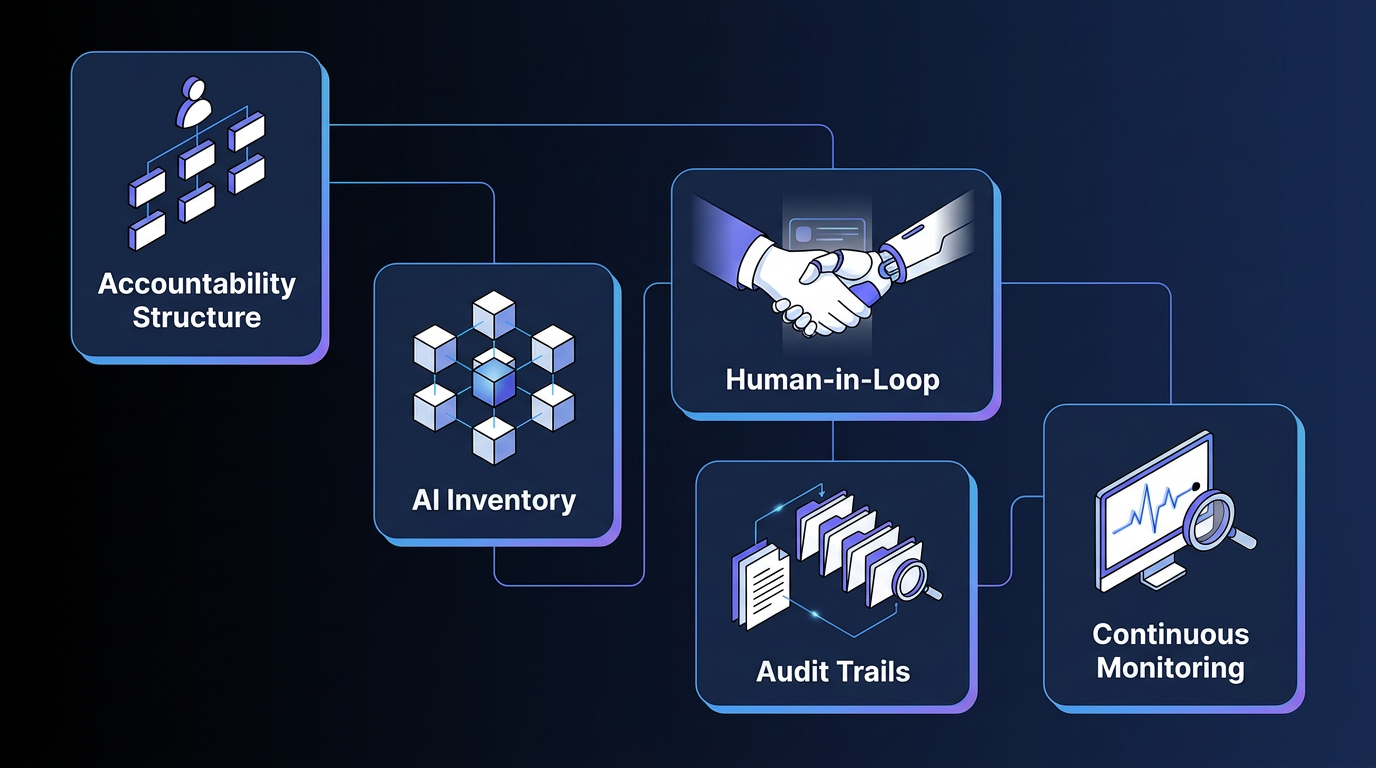
AI governance needs five controls. Skip one and you create a blind spot that shows up during an audit, a board review, or an incident.
Formal Accountability Structure
Create a cross-functional governance body with defined roles across IT, legal, compliance, and business units. AI governance responsibility should span organizational management, senior leadership, and the board level. The board retains ultimate accountability. Clear ownership gives teams a path for approvals, escalations, and post-incident decisions.
AI System Inventory and Risk Classification
You cannot govern what you cannot see. Governance teams should fund AI system inventories by risk priority. Classify use cases into low, medium, and high risk, then apply the right level of control. Uniform controls waste effort on low-risk cases and under-protect high-risk ones.
Human-in-the-Loop Controls
Define exactly which decisions AI can influence and where a human must always review. Use human review gates for any output affecting financials, customers, employees, or regulatory obligations, and add rapid rollback mechanisms. Without clear gates, reviewers find out after the action has already created risk.
Audit Trails and Documentation
Capture the full execution record: prompts, retrieved documents, tool calls, intermediate outputs, final recommendations, approvals, and system actions. The record should show what the system received, what it did, what it returned, and who approved the result. That still applies when private model reasoning is unavailable. Without a complete record, you cannot answer why a system produced an outcome, and auditors and regulators ask exactly that.
Continuous Monitoring
Apply ongoing monitoring to model drift, where performance changes as data and conditions change. Track emerging bias and performance decay, and review the risk management process itself on a set cadence. Without continuous monitoring, a model that passed launch review can drift into biased or inaccurate outputs before the next audit cycle.
Use volume as the formalization trigger. When active use cases exceed what informal coordination can handle, governance needs a formal owner and structure before launch.
Align AI Governance to the Right Standards
Use recognized standards as the baseline. For most enterprise chief information officers (CIOs), that starts with the National Institute of Standards and Technology's AI Risk Management Framework (NIST AI RMF) or ISO/IEC 42001. Add mapping to the European Union's AI Act (EU AI Act) where legal exposure requires it. A recognized baseline gives your team a reference point for governance decisions.
- NIST AI RMF: Voluntary, use-case-agnostic guidance structured around four functions: Govern, Map, Measure, and Manage. It gives CIOs a common language for risk management even though it carries no direct penalties.
- ISO/IEC 42001: The first AI management system standard from ISO. Unlike NIST, it specifies requirements to establish, implement, maintain, and continually improve governance. Customers or partners may require auditable proof.
- EU AI Act: Binding law for EU-facing AI systems, organized around risk categories that include prohibited, high-risk, limited-risk, and minimal-risk AI. Treat it as a regulatory mapping requirement whenever AI systems may affect EU users or operations, and pay close attention to use cases that could fall into high-risk categories.
Enterprises can combine voluntary risk frameworks with certifiable management systems, then map both to legal obligations. This still needs careful legal and operational review: ISO/IEC 42001 does not replace laws or regulations, and voluntary frameworks do not remove use-case-specific obligations.
Classification is harder than it looks: a meaningful share of enterprise AI systems land in ambiguous territory under the Act's risk tiers. The safer approach treats potentially high-risk systems as high-risk until a formal determination is made.
Contain AI Risks That Create Fines, Failed Audits, and Bad Spending
Prompt injection, shadow AI, agent sprawl, and audit trail failures recur across incident reports and regulatory findings. They are specific. They are measurable. Governance frameworks exist to control them.
- Prompt injection: Prompt injection is an attack where malicious instructions trick an AI system into ignoring its intended rules. It has held the number one position on the Open Worldwide Application Security Project (OWASP) Top 10 for large language model (LLM) Applications for the second consecutive edition. Successful attacks can expose sensitive data, and in connected systems they can also trigger command execution or manipulate decision-making.
- Shadow AI: Employees create shadow AI when they use AI tools outside approved enterprise controls. 69% of organizations suspect or have evidence of employees using prohibited public GenAI, according to Gartner. When official tools create friction, employees route around them and take corporate data with them.
- Agent sprawl: Agent sprawl describes the unmanaged spread of task-specific agents across applications and teams. Gartner predicts that by the end of 2026, 40% of enterprise applications will feature task-specific AI agents, up from under five percent in 2025. At that scale, agents become a control problem inside the application layer.
- Audit trail failures: Without complete action logs, organizations lose the ability to reconstruct who authorized an AI action, what data it used, and why it produced a given outcome.
Identity makes each of these risks worse. Non-human identities, the credentials assigned to software, agents, services, and machines, already outnumber human identities several times over in most enterprise environments, and most organizations cannot say who owns them. Governing agents in production means governing the credentials they carry.
Separate Deterministic Controls From Probabilistic Agent Decisions
Keep deterministic controls separate from probabilistic agent decisions. Agents can reason. They should not govern the workflow. The difference between deterministic and probabilistic AI often determines whether governance holds as AI use grows. Some AI strategies blur that line, letting agents make the governance calls meant for fixed rules.
A deterministic system produces the same output for the same input every time, using fixed rules and validated execution paths. A probabilistic AI agent interprets a goal and decides how to reach it, and the same input can produce different outputs on different runs. That variability helps when reading an unstructured contract, but it becomes a liability when approving a payment.
In poorly governed agent chains, a downstream agent may treat the prior output as ground truth, and errors compound across sequential handoffs even when each step looks reliable in isolation.
Governance built for deterministic systems can break when applied to probabilistic ones. Financial controls, service-level agreement (SLA) enforcement, regulatory reporting, and Sarbanes-Oxley (SOX) audit trails all need the same thing: replayable paths that only deterministic workflow control can guarantee.
A practical enterprise pattern uses deterministic orchestration with bounded probabilistic components. Fixed rules govern the process. Agents handle specific steps that need language understanding. Human-in-the-loop controls govern the boundary between them.
Governance has to match the autonomy level of each step. As AI handles more workflow steps, the deterministic governance layer becomes more critical, not less. Higher volume means higher stakes for every ungoverned decision.
Sanofi's rollout followed exactly this pattern. The pharmaceutical company began by governing software-license workflows, then extended the same controls into procurement and CRM as it replaced legacy SaaS with agentic workflows built natively on its own data infrastructure.
Govern AI Agents Across Production Workflows
Agents need controls of their own. This is the part many AI strategies understate. Autonomous agents execute actions at machine speed. A single misconfigured agent can repeat a high-impact action many times before anyone notices, and the audit log may not tell you under whose authority it acted.
Effective agent governance depends on a few concrete practices. Unmonitored, over-privileged agents expand the enterprise attack surface.
- Purpose-bound, temporary credentials: Grant agents access scoped to a task and revoke it automatically on completion. Avoid static API keys for agent authentication because they leave persistent access pathways open.
- Chains of delegation: Link every agent's authority to a human owner so accountability is never ambiguous when something goes wrong.
- Circuit breakers and rollback: Circuit breakers are automated stop controls that halt agent operation on threshold violations. Use them with rapid rollback mechanisms, because agent actions outpace human oversight.
- Complete action logging: The orchestration layer must log every agent action and allow rollback so you can prove why, how, and under whose authority it acted.
Human oversight only works if reviewers have clear escalation criteria. A named reviewer who rubber-stamps outputs fails as a control.
Prove AI Governance ROI to Your Board With Elementum
Weak governance can turn enterprise AI deployment into fines, failed audits, and bad spending. Enterprises are deploying agents while they build the accountability, audit, and control infrastructure to govern them. The bill can include fines, failed audits, and frozen budgets after projects get canceled.
Elementum exists for exactly this problem. We built our AI Workflow Orchestration Platform on the principle that governance has to live inside the workflow, not alongside it. Our Workflow Engine treats humans, business rules, and AI agents as equals within a deterministic backbone, so the same process follows the same governed path, controls, and audit trail every time.
Open Orchestration means our AI Agent Orchestration controls work with any agent, third-party or native, inside that same governed workflow. Configurable decision thresholds set the point where an AI output advances automatically and where it routes to a person for review. Built-in guardrails defend against prompt injection, and every agent action is logged and revocable.
Orchestrated Intelligence right-sizes spend across deterministic rules, AI agents, and human judgment, so you pay for reasoning only where reasoning adds value.
Zero Persistence means your data stays where it lives: we never train on, replicate, or warehouse your data.
Many of our customers start with one workflow, prove the savings, and expand into adjacent processes.
Among orchestration platforms in this category, we have the production track record for replacing legacy SaaS at enterprise scale, with named customers including Sanofi, Snowflake, Under Armour, and Elevance Health.
Contact us to map governed AI orchestration into your enterprise architecture and the rest of your AI roadmap.
Frequently Asked Questions
These are the questions enterprise CIOs and governance teams raise most often when standing up or auditing an AI governance program.
What Is AI Governance?
AI governance is the set of policies, standards, and controls that manage AI risk across the AI lifecycle. It covers risk identification, accountability, transparency, human oversight, and continuous monitoring. Operationally, it's what lets an organization answer why an AI system produced a given outcome and who is accountable for it.
Who Should Own AI Governance in an Organization?
AI governance spans organizational management, senior leadership, and the board level, with the board holding ultimate accountability. Senior leadership owns the rollout and typically delegates technical governance to the chief technology officer (CTO) or a Chief AI Officer, risk assessment to the chief risk officer (CRO), while legal owns regulatory compliance. Formalize ownership once informal coordination no longer scales.
Which AI Governance Frameworks Should You Use?
The baseline often combines the NIST AI RMF for voluntary risk-based guidance and ISO/IEC 42001 for a certifiable AI management system, with EU AI Act mapping for EU-facing AI use. Mature programs often use voluntary frameworks and management-system standards to support regulatory mapping.
Why Does Determinism Matter for AI Governance?
Deterministic systems produce the same output for the same input every time. Financial controls, regulatory reporting, and audit trails need that because they must be replayable. Probabilistic AI agents introduce variability that compounds across multi-step workflows, so reliability degrades as steps chain together. Governing AI across multi-step workflows means keeping a deterministic backbone and applying probabilistic agents only where language understanding adds value.
How Do You Prove AI Governance ROI to the Board?
Translate governance outcomes into dollar terms where possible. Start with reduced manual hours and avoided incidents or compliance penalties, and include revenue impact only when it can be directly attributed. Frame the investment as time saved and legacy licenses removed, with headcount assumptions separated from the ROI case. Board credibility comes from hard, quantified figures, not adoption metrics like logins or active users.