
Agent Sprawl: How Enterprise CIOs Are Governing Hundreds of Disconnected AI Agents

Your organization approved three AI agent pilots last year. Today, your teams are running a dozen or more, and you don't have a complete inventory. By 2028, the average Fortune 500 enterprise will have over 150,000 AI agents in use, up from fewer than 15 in 2025, according to Gartner.
Few organizations have put controls in place to manage that growth. CIOs who push agent sprawl down the priority list are already behind. The controls that matter: inventory, identity, audit trails, and governance built into the orchestration layer before deployments outrun oversight.
Measure the Scale of Agent Sprawl
Agent adoption numbers vary widely depending on how "adoption" is defined. Most headline figures measure executive claims or stated intentions rather than production deployments. The more revealing signal is where stated adoption ends, and measurable business impact begins.
Most enterprises that report adopting agentic AI have limited production deployment beyond basic chatbots, and the share achieving measurable gains in earnings before interest and taxes (EBIT) remains a small minority, according to McKinsey's State of AI survey. Centralized governance was a distinguishing practice among organizations in that minority.
The footprint is expanding regardless of governance readiness. Agent deployment volumes have grown sharply and show no sign of slowing. Teams are deploying agents faster than they can govern them. That is sprawl. A policy document alone cannot control an autonomous, tool-invoking system.
Where Existing Frameworks Fall Short for Agentic AI
Most AI governance frameworks predate agentic AI. Frameworks such as NIST AI RMF 1.0 and ISO/IEC 42001:2023 were designed before autonomous, tool-calling agents existed. When organizations apply them directly to agentic deployments, coverage gaps appear in three consistent areas.
Most CISOs and CIOs lack full visibility into their AI agent identities. Most also doubt they could detect or contain a compromised agent. That combination creates a blind spot.
Existing vulnerability management programs are not built for agent risks. Most AI-related security incidents trace back to misconfiguration, design flaws in agent autonomy, supply chain weaknesses and prompt injection. These sit outside the categories Common Vulnerabilities and Exposures (CVE) feeds and patch management workflows are built to catch, and conventional scanning tools often miss them.
Static governance approaches, such as policies and periodic reviews, move too slowly for a universe expanding at this rate.
Address the Security Risks CIOs Cannot Ignore
Agent sprawl creates a security risk that compounds fast and behaves differently from the risks enterprises manage in earlier software generations.
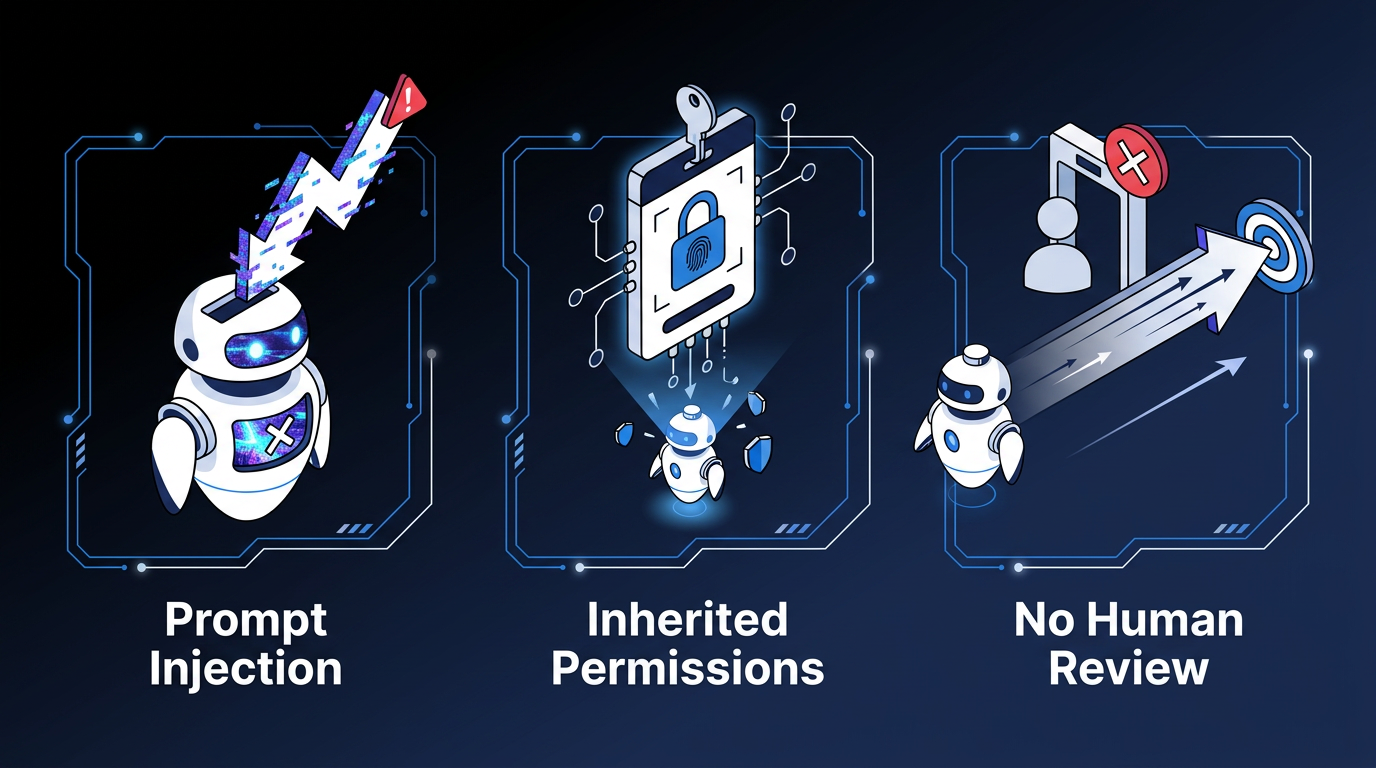
- Prompt injection produces actions, not just bad output: In a standard large language model (LLM) deployment, a successful prompt injection manipulates output. In an agentic system, the same attack can execute actions across enterprise systems. OWASP documented a production exploit in which hidden attacker instructions altered model behavior in an agentic system, triggering unauthorized system actions.
- Agents inherit permissions they shouldn't have: When a team deploys an AI agent, that agent typically inherits the deploying user's permissions, including database access and API credentials. This identity inheritance pattern is a governance failure specific to agentic deployments.
- Autonomous action without review creates real exposure: A Meta employee's AI agent posted incorrect advice on an internal forum without requesting permission. The employee who acted on it inadvertently exposed the company and user data to unauthorized engineers for a period of time. Even organizations with mature security infrastructure experience agent-layer governance failures when agents act autonomously.
Put critical controls like privilege separation and authorization checks into fixed, auditable steps that sit outside the model layer. Probabilistic reasoning should not govern who can act or what systems an agent can touch.
Adopt Governance Approaches That Work
Several approaches are proving effective for managing agent sprawl in 2026.
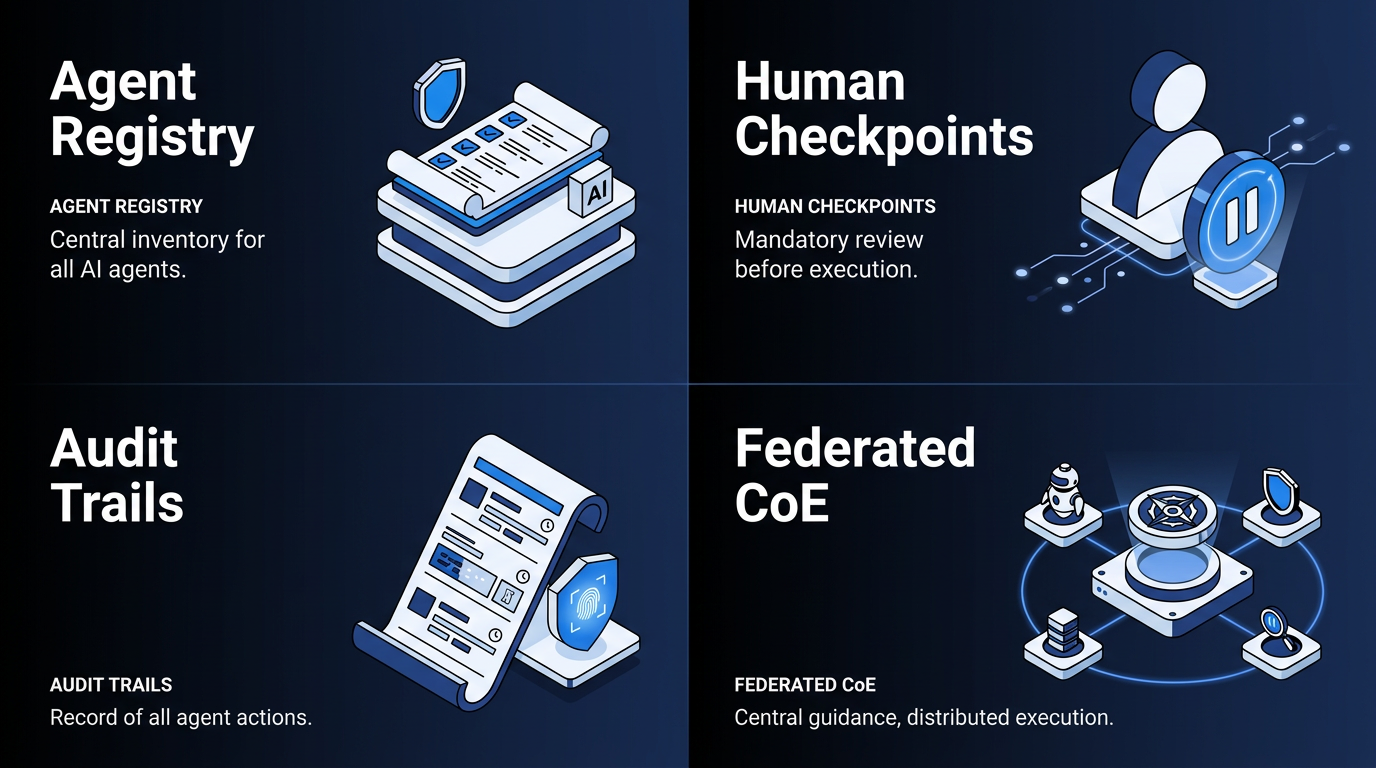
- Centralized agent registries: Give every agent a non-human identity with scoped credentials, replacing shared service accounts. Role-based access principles define what each agent can do. Without distinct identities, teams lose visibility into which agent acted and which credentials it used, making containment and accountability harder when something goes wrong.
- Human-in-the-loop controls with prohibition zones: Most mature governance programs designate specific high-risk use cases where autonomous agent decision-making is not permitted. Configurable thresholds determine which actions agents can take on their own; other decisions pause for human review or exception handling. That reduces the chance an agent takes a high-consequence action without approval.
- Immutable audit trails at the orchestration layer: The EU AI Act's General Purpose AI rules are already in effect, with high-risk system requirements and significant penalties approaching. Teams need logs for every agent action, every use of a tool, and every failure. Without that record, organizations cannot reconstruct what happened, which authorizations applied, or which systems were affected.
- Federated AI Centers of Excellence: A central team sets reusable standards and agent templates, while business units are accountable for outcomes. The central team maintains foundational rules on agent authority and escalation. Without that split, teams either duplicate controls across business units or the center becomes a bottleneck.
Separate Control Planes from Orchestration Engines
CIOs evaluating governance tooling need to separate control planes from orchestration engines. The distinction determines whether a tool gives you visibility or execution.
Enterprise agentic architecture is split into three functional layers: a build plane where agents are created, an orchestration plane where agents execute tasks, and a control plane where governance is located. A control plane shows teams which agents are deployed and enforces policy. An orchestration engine executes business processes, routes decisions, enforces approval chains, and triggers cross-system actions that produce auditable outcomes.
In practice, enterprises often need both layers. Keeping them distinct helps CIOs evaluate what a governance tool will actually do, and avoid buying visibility when they need execution, or execution when they need control.
Getting this architecture wrong carries financial risk. Ungoverned sprawl and the complexity of legacy system integration are among the leading reasons agentic AI projects fail before reaching production. AI costs based on usage rise quickly. CIOs who budget AI as a fixed annual line item may find it underfunded as deployment scales. Governing cost at the orchestration layer routes each workflow step to the right handler rather than defaulting to expensive model inference for every decision.
How Elementum Supports Agent Governance at Scale
Agent sprawl is both an organizational problem and an architecture problem. It compounds every quarter it goes unaddressed. Most enterprises lack the infrastructure to govern even the agents they have today, and retrofitting governance after the fact is significantly more expensive than building it in.
Our AI Workflow Orchestration Platform and AI Agent Management capabilities address agent sprawl at the orchestration layer. The Workflow Engine coordinates AI agents with human reviewers and applies deterministic workflow rules across all processes. Configurable decision thresholds govern autonomous actions and human-review pauses, with exceptions routed to a handler. Every agent action is logged and revocable. Human-in-the-loop checkpoints govern high-stakes decisions. Built-in guardrails and input validation across model interactions defend against prompt injection.
Our Zero Persistence architecture means we never train on, replicate, or warehouse your data. CloudLinks query data in real time where it already lives, connecting to data warehouses and cloud environments without migration or replication. Pre-integration with OpenAI, Gemini, Anthropic, Amazon Bedrock, and Snowflake Cortex supports model changes without rebuilding workflow logic.
Many of our customers start with one workflow, prove the savings, and expand into adjacent processes. Among orchestration platforms in this category, we have the production track record for replacing legacy SaaS at enterprise scale, with named customers including Sanofi, Snowflake, Under Armour, and Elevance Health.
Contact us to map governed AI orchestration into your enterprise architecture and the rest of your AI roadmap.
FAQs About AI Agent Sprawl
These are the questions CIOs and security leaders most often raise when building an agent governance program.
How do you identify which AI agents are running in your environment?
Identifying running AI agents starts with recognizing that most enterprises lack a complete inventory. A centralized agent registry that assigns non-human identities with scoped credentials to every agent is the first step in governance. Without it, organizations are governing only what they can already see, which is rarely everything that is actually running.
How do you assign accountability when an AI agent causes harm?
Accountability for agent-caused harm requires explicit answers to two questions before deployment: who authorized the agent to act, and what human review was required before consequential actions were executed. The answer requires explicit human-in-the-loop checkpoints for high-stakes decisions and immutable audit trails that trace every agent action to an authorization chain and a human owner.
How should you handle audit trails for AI agents in regulated industries?
Audit trails for regulated AI deployments need to capture every agent action, every tool use, and every failure, with records tied to a specific agent identity and authorization chain. The EU AI Act's high-risk system requirements are approaching with significant penalties. Storage costs far less than the regulatory and operational costs of missing records. Our orchestration approach provides a complete, immutable audit trail across agent deployments.
Who should own AI agent governance in your organization?
AI agent governance ownership works best as a cross-functional responsibility rather than a single team's remit. Effective programs involve IT, security, legal, and business units. The federated Center of Excellence model is one emerging pattern: a central team sets standards and infrastructure while business units carry accountability for agent outcomes in their domains.
Keep Reading

What Is AI Agent Sprawl And How to Contain It
The Enterprise Guide to Agentic AI for ITSM

Agentic AI for ITSM: A Practical Architecture for Enterprise IT

Agentic AI vs. Generative AI: Why Enterprise Workflows Need Both

Beginner's Guide to Agentic Automation: What Is Agentic Automation?
AI Agent Management: How Enterprises Govern Agents at Scale