
A Phased Legacy System Replacement Strategy for Retiring Enterprise SaaS
Your IT service management (ITSM) renewal lands in 14 months. The procurement suite renews six months later. Meanwhile, the board wants to know what AI will retire.
By default, a replacement program selects a platform, migrates the data, retrains the workforce, and cuts over on a long weekend. That program takes every risk you own and schedules it for one date. You can't reverse it.
A phased legacy system replacement strategy spreads that risk across modules. You open a new front door for employee requests and move one workflow behind it, while the new application reads data where it already lives. You switch off each legacy module only after its replacement has run in production.
Each cutover can be reversed, and the savings from the first module pay for the second.
Why a Single Cutover Puts Every Risk in One Event
A fixed go-live date ties together four types of work that fail in different ways. Data migration, process redesign, workforce retraining, and integration changes must all succeed together.
Birmingham City Council began in 2018 with an estimate of £19M plus a £1M contingency for an Oracle Fusion system to replace SAP. It went live in April 2022, and the council was effectively bankrupt in 2023, in part because of the software. The forecast now stands at £144.4M through 2027/28, the council has written off £69M of anticipated savings, and in 2024 investigators put total money lost at £216.5M.
Failures can follow a successful data migration. TSB's data migration succeeded in April 2018, and the platform failed on arrival. The Financial Conduct Authority (FCA) and Prudential Regulation Authority (PRA) fined the bank £48.65M, and TSB paid £32.7M in redress.
Testing tends to get compressed when teams fix the date before they understand the scope. Rolling back means reversing everything at once. In practice, there is no rollback.
Phased replacement takes longer to finish and delivers a working application early. It keeps a rollback path open and lets earlier modules pay for later ones.
Replace Legacy SaaS in Four Phases
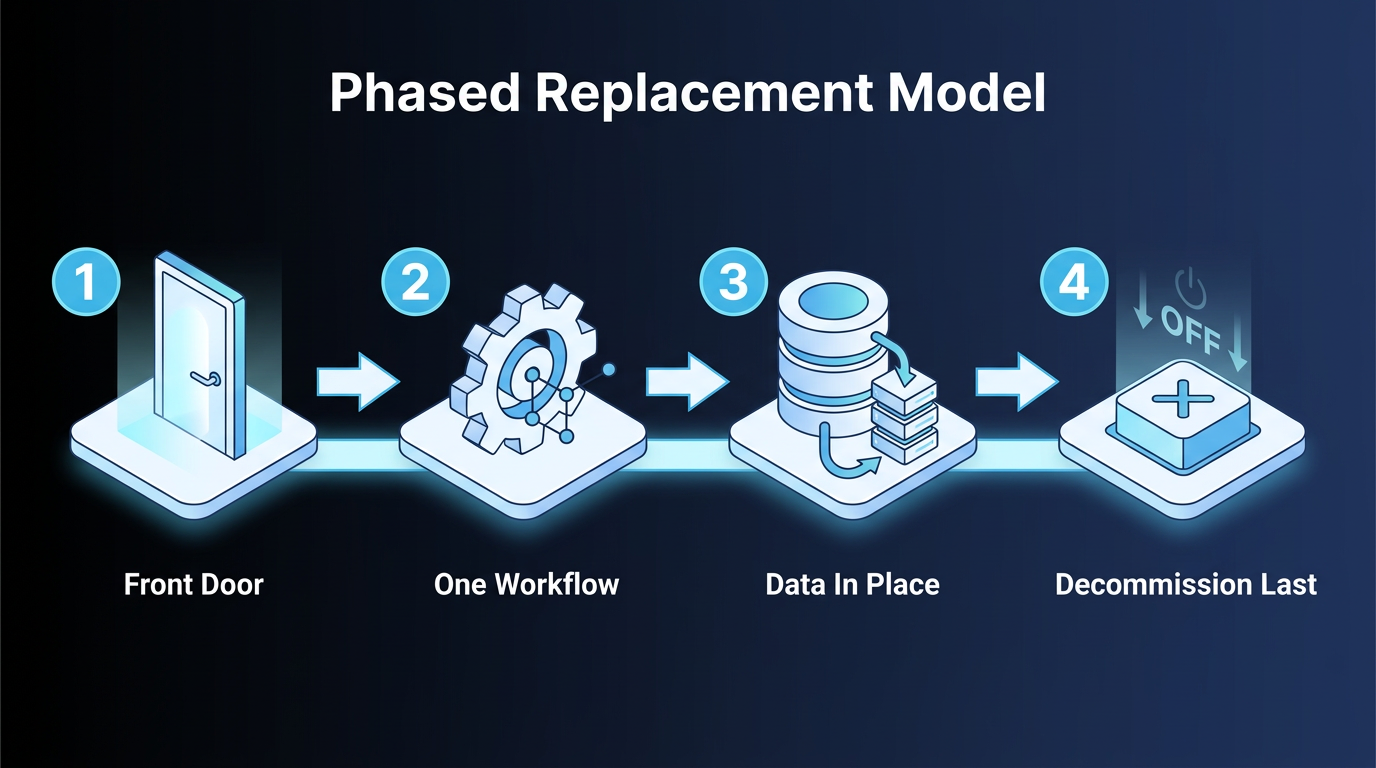
The phased model has four moves, and each new application is built around one use case and replaces one legacy module or manual process. The order of the moves is deliberate: front door first, data in place, one workflow at a time, and decommissioning last.
Change the order and employees may not route work through the new interface, or you may leave two architectures running indefinitely.
Start at the Front Door Employees Already Use
When employees already type requests into Microsoft Copilot, Claude, or a company-approved GPT, put the intake there.
A request for laptop access, a purchase, or a benefits answer routes to the governed process behind it, where input validation and AI guardrails control model interactions. Elementum provides Concierge as its front door, and Copilot, Claude, or a company-approved GPT can fill the same role.
As the front door takes requests, the legacy portals should see less traffic. That decline gives teams a practical route to switching modules off without a single cutover.
The front door is the façade in the Strangler Fig pattern, which Martin Fowler described in a 2004 essay. The façade is a routing layer that sends requests to the old system and shifts traffic to new components until the old system handles nothing. "The most important reason to consider a strangler fig application over a cut-over rewrite is reduced risk," he writes. Whether it's Elementum's Concierge or Copilot, the front door takes each request, and each new application takes over request handling for one more module.
Elementum powers Sanofi's own assistant, also called Concierge. It launched in 2024, and tens of thousands of employees across Sanofi use it, with data drawn from ServiceNow, Workday, and Sanofi's internal policies and org charts. Employees get answers in one place while those systems stay where they are.
Connect to Data Where It Lives
Leave data where it lives, which removes migration from the launch schedule. A data migration usually requires teams to rewire and retest downstream integrations before go-live, and that work often determines the launch date and becomes part of the critical path.
Elementum runs inside your customer-governed data cloud. Snowflake is the primary option, and Databricks is available as a minimum viable product (MVP) track. CloudLinks connect to Snowflake or Databricks and query data in place, and your existing Role-Based Access Control (RBAC) and row-level security policies continue to apply.
SAP, Salesforce, and Oracle remain systems of record. The Workflow Engine uses that data under the existing controls.
Take On One Workflow at a Time
Define each application around one use case. Each application replaces one module or manual process.
Sanofi's path covered software license management, followed by procurement and then CRM. For many estates, ITSM is a sensible first module because much of its traffic already starts as request intake.
Give each application one owner and one number to prove. Evaluating ServiceNow alternatives at the module level is a smaller lift than replacing the entire platform and its configuration management database (CMDB). Start with the ticket front door and Tier-1 resolution.
Bounded scope controls the risk. A bounded pilot should "allow aggressive learning without significantly impacting operational stability," according to Gartner's agentic pilot guidance. The pilot can be a module behind a front door, and if the application underperforms, traffic returns to the legacy portal.
Inside each application, steps that need reasoning go to AI agents, steps that must run the same way every time go to automated logic, and the people who own the approvals keep them. A deterministic engine then sequences those steps, which keeps deterministic and probabilistic work separate.
Decommission Each Module Last
Switching off a module is a project with its own budget and exit criteria. It comes after the replacement enters production.
A migration disposition is the keep, change, replace, or retire decision for an application. Assigning one to every module stops a platform-wide default from deciding the entire migration.
The seven Rs cover retire, retain, rehost, relocate, repurchase, replatform, and refactor. The framework began as a tool for cloud infrastructure decisions.
For a back-office SaaS estate, that framework maps to three practical choices. Which modules stay, and which move?
- Retain: The systems of record, such as SAP, Workday, Salesforce, and the CMDB, stay where they are.
- Replace: The ticket front door, Tier-1 resolution, purchase requests, and HR requests move to an application.
- Retire: The license goes once the module's traffic is gone and the archive is ready, with the seats coming off at renewal.
In this model, core enterprise resource planning (ERP) stays in the retain column as the system of record.
Ring-fence the legacy module with four controls that stop new dependencies from extending its life:
- Allow no new features or integrations.
- Make the module read-only once its replacement carries the traffic.
- Create an archive that satisfies retention obligations.
- Set a sunset date someone has signed.
Until the sunset date, the legacy system remains the source of record for its data domain, and the new application reads from it.
Two pitfalls from the Strangler Fig pattern apply here: the façade becomes a bottleneck or single point of failure if nobody engineers it as production infrastructure, and programs stall in half-completed replacements when nobody owns decommissioning. The first project Fowler described, led by his colleague Chris Stevenson, had already returned its investment before the old system was replaced.
Plan a 90-Day Path to the First Application
Plan for the first application to reach production in about 90 days, and fix three things at the start: your own baseline, one owner, and the next renewal date on the calendar. Your Tier-1 volume supplies the baseline that counts, and the second application can then use the first one's measured savings in its funding case.
Elementum targets about 90 days to put the first application in production, because data migration stays off the critical path. For an ITSM entry point, its published figure is 60% of Tier-1 tickets resolved with no human touch.
Savings from reclaimed seats, reduced manual handling, and avoided integration work let the first application pay for the next.
Schedule Each Module Retirement Around Contract Renewals
Schedule each retirement backward from the module's renewal date, so its replacement carries production traffic before the notice period opens. List every module with its renewal date, notice period, and owner, then sequence the replacements in that order.
The sunset date is also your renewal lever. Negotiating power depends on a viable alternative. A replacement module already carrying production traffic gives the vendor visible proof that one exists.
Start that conversation a year before renewal, because a CIO negotiating within 30 days has little room left. That timing turns the phased model into a cost line the CFO can plan against.
The renewal calendar also sets the length of the full program. A suite whose modules renew across several years retires over the same span, one module per renewal, and each retired license helps fund the next replacement.
Pick the First Module for Your Legacy System Replacement Strategy
Pick the module your renewal calendar reaches first, and put its replacement into production before negotiations begin. You then enter renewal talks with a working alternative. The path back to the legacy portal stays open until you choose to retire the module.
Elementum is The Enterprise AI Apps Platform. It replaces specific legacy SaaS back-office modules rather than automating steps inside them, and systems of record remain in place. Licensing is one annual fee per application, with no separate fee per seat, conversation, or AI action, so the first application is a fixed line in the budget. The zero persistence architecture retains nothing at the execution layer once a run completes.
We have the production track record for replacing legacy SaaS at enterprise scale, with Sanofi, Under Armour, and Elevance Health among the enterprises that run on Elementum. Contact us to replace legacy licenses with enterprise AI apps across your enterprise application estate and the rest of your AI roadmap.
Frequently Asked Questions About Legacy System Replacement Strategy
Most questions about a legacy system replacement strategy come down to risk and time.
How Does a Phased Legacy System Replacement Strategy Work for Your Team?
A legacy system replacement strategy is the plan for which applications your enterprise keeps, modernizes, replaces, or retires, and in what order. A phased version assigns a disposition to each module and keeps systems of record in place. It replaces one workflow at a time behind a front door employees already use.
Which Legacy System Replacement Strategy Fits Your SaaS Estate?
For a back-office SaaS estate, retain the systems of record, replace the modules where the work happens, such as the ticket front door and purchase requests, and retire each license once its traffic is gone. The seven Rs still apply to infrastructure, and these three choices decide the application layer.
How Does the Strangler Fig Pattern Reduce Your Modernization Risk?
A façade, or routing layer, sends requests to the legacy system. It gradually shifts them to new components until the old module handles no traffic and meets its retirement criteria.
In a SaaS estate, the agentic front door is that façade. It may be Concierge, Copilot, or a company-approved GPT. Each new application takes over request handling for one module. The façade still needs production-grade engineering, and someone has to own each module's exit.
How Long Should You Plan for a Phased Legacy System Replacement?
Plan about 90 days for the first application, which is Elementum's target in the phased model, and let renewal dates, module complexity, and the order of retirement set the full program timeline. For comparison, cloud ERP migrations can take 18 to 36 months.
Keep Reading
Replacing ServiceNow: A Practical Guide for Enterprise IT Leaders

How to Delegate and Coordinate AI Agent Tasks
How a Global Pharma Leader Replaced Legacy Workflows with Orchestrated Intelligence
The Enterprise Guide to Agentic AI for ITSM
Agentic AI for ITSM: A Practical Architecture for Enterprise IT
AI Agent Observability and Monitoring: The Enterprise Stack