
The Intelligent Front Door: How Enterprises Replace Multiple SaaS Tools with One AI Orchestration Layer

The next SaaS sprawl problem is already here.
Your enterprise already runs a sprawling SaaS stack. Much of it was purchased outside IT's line of sight. Some paid seats sit unused. Now each of those applications is embedding its own AI agent.
That creates a second sprawl problem on top of the first.
The intelligent front door is the answer: one AI-powered orchestration layer between your employees and your systems. It routes every request to the right agent, workflow, or system. It creates a single entry point with built-in governance and no new data silos.
Owning the interface may prove more valuable than owning the back end. Vendors know that. Most will define the concept for you before you have a chance to ask the right questions. This article covers what to ask.
Address SaaS Sprawl and Agent Sprawl Together
SaaS sprawl has been a known quantity for years. Most of it grows outside IT's line of sight. Paid seats go unused. Contracts renew on autopilot.
The spread of AI agents adds the next problem. According to Gartner's 2026 Hype Cycle for Agentic AI, only 17% of organizations expect to deploy within the next two years; more than 60% expect to deploy within the next two years. Each application gets its own AI interface. Each one creates another data connection. Fragmentation compounds.
Many companies still manage this in pieces. Shadow AI is already running unchecked. When employees lack governed AI tools, they find alternatives on their own. Every unsanctioned tool is a data exposure risk your security team can't see.
The intelligent front door addresses both pressures with the same architecture. One governed entry point can replace many disconnected agent interfaces. Employees get one usable AI experience. That lowers the temptation to reach for shadow alternatives.
Build the Three Layers an Intelligent Front Door Requires
An intelligent front door routes intent to the right agent, workflow, or system. Then it orchestrates the process behind the scenes: approvals, escalations, compliance checks and audit logging.
A chatbot answers questions. An intelligent front door governs execution.
A working front door requires three layers:
- Interface layer: A conversational, context-aware entry point that accepts natural-language requests from employees across any department. HR benefits questions, purchase requests, IT access tickets, and sales forecast updates all enter through the same channel.
- Orchestration layer: The intelligence that routes each request to the right handler. That may mean automated handling or human review, with business rules applied where policy requires them. This layer keeps track of the request and its context. It enforces policy and governs every step.
- Integration layer: Connections to existing enterprise systems, including ERP, CRM, and ITSM platforms, as well as your own data cloud (e.g., Snowflake or Databricks), via APIs, without requiring data consolidation or system replacement.
These three layers create a governed entry point, not another disconnected interface. The orchestration layer determines whether the front door actually reduces fragmentation.
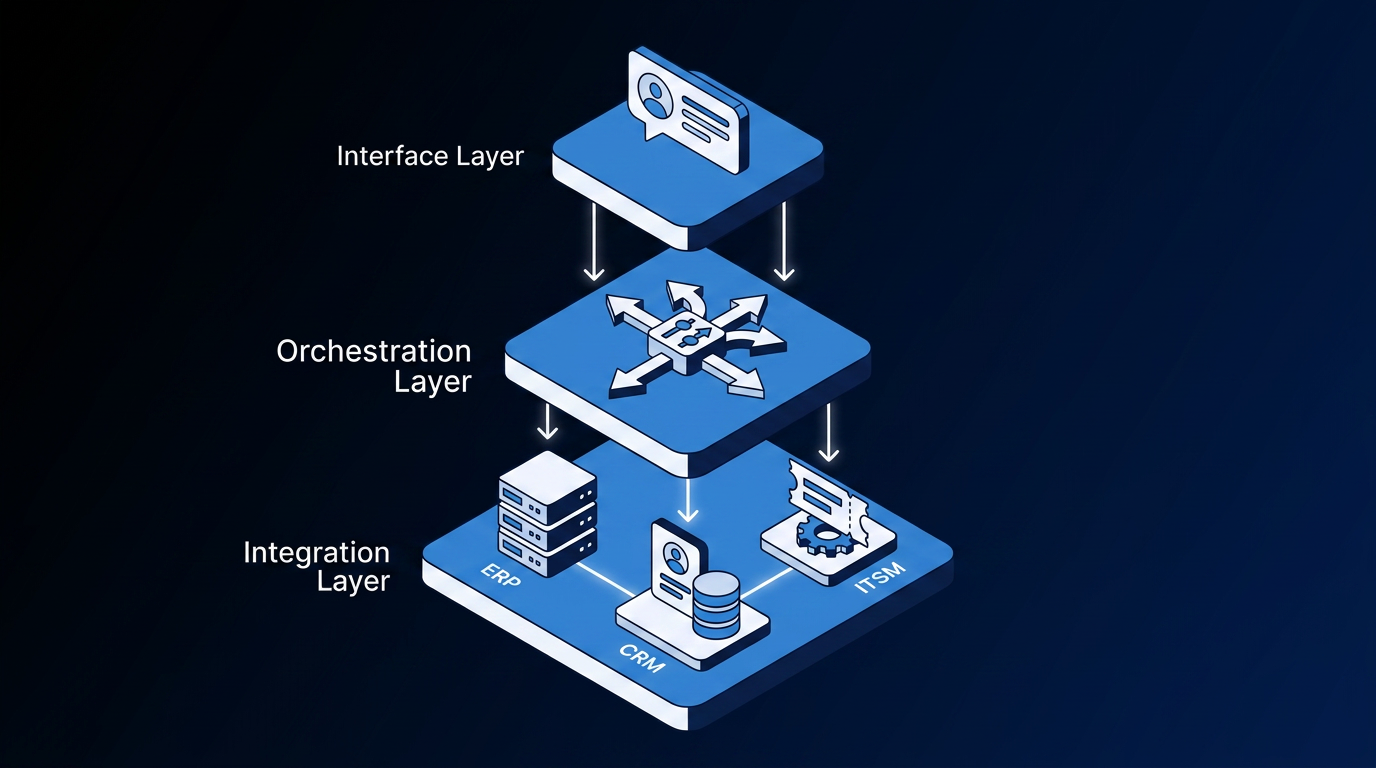
The orchestration layer is what handles routing, enforces policy, and creates the audit record. Without it, a front door becomes another chat interface sitting atop the same fragmented stack. A few integrations with common enterprise tools can add another layer to an already fragmented AI stack rather than fix it.
Recognize Where Existing Platforms Hit a Structural Ceiling
Existing workflow platforms were built for deterministic, rule-bound processes. Every step is pre-specified by a human designer. That architecture served enterprises well for two decades.
AI agents work differently. They interpret goals and decide how to achieve them. The same input can produce different outputs depending on context.
Enterprises need to govern both models in the same workflow. A procurement process, for example, needs deterministic rules. Those rules handle approval routing and SLA enforcement. The same process can also benefit from AI agents that read unstructured supplier contracts and flag discrepancies. Force that hybrid requirement into a platform designed only for deterministic execution. Friction shows up at every step.
Enterprise workflows increasingly combine deterministic controls with agentic work. AI is no longer a simple add-on. The architecture pushes it into the workflow itself.
Existing platforms are responding by repositioning around these requirements. But AI-native platforms deploy improvements continuously. Enterprise change cycles still create lag between major product updates and the governance work needed to adopt them.
Agents reason. Engines govern.
Address the Data Sovereignty Constraint Most Front Door Strategies Ignore
Most front-door strategies solve the interface problem but miss the data problem entirely.
SaaS AI tools can copy enterprise data into vendor-controlled environments. Once that happens, your controls stop at the edge of your own systems.
That is shadow AI by another name. Your enterprise can't enforce access controls, audit data flows, or apply deletion policies to data sitting outside systems you control.
That creates risk.
Data and AI sovereignty are explicit architectural concerns. Where data lives is becoming a political question, not just a technical one. The May 2026 Digital Omnibus agreement split the EU AI Act's enforcement timeline rather than delaying it outright. Article 50 transparency obligations still start in August 2026, while Annex III high-risk systems now have until December 2027, and Annex I embedded systems get until August 2028. Each date is its own architectural deadline.
Any intelligent front door that requires data to be replicated into a vendor's environment raises this concern. The orchestration layer needs to query data where it already lives. No copying. No syncing. No storing.
Your data stays where it already lives.
Build a Consolidation ROI Case That Survives a Board Presentation
CIOs face growing pressure to prove AI's value on near-term timelines, or risk tighter scrutiny of budgets. The intelligent front door offers two cost options.
- SaaS licenses you can retire: SaaS renewal costs are rising 10% to 20% or more at each contract cycle, according to Gartner. AI tools that started free now average $20 to $30 per employee per month, with premium tiers reaching $200 per month, according to CIO. Rising AI spend forces leaders to examine overlapping application categories and ask whether consolidation is warranted. An orchestration layer that handles cross-department intake and workflow routing can replace dedicated point tools in those categories.
- Hours your team gets back: Many IT teams still handle routine requests manually, including password resets and access requests. That limits the time available for strategic work. An intelligent front door with AI agents can handle triage, routing, and resolution on routine requests, freeing capacity without a headcount discussion. Sanofi, for example, is targeting an autonomous AI resolution rate of 80% for IT requests, projecting annual savings of 10 million euros by running agentic workflows directly on its own data infrastructure, according to Fortune.
Most organizations chasing AI ROI are still running pilots. Only about 5% have captured substantial financial gains from AI workforce change, according to BCG, and architecture is what separates them from the rest.
How Elementum's AI Orchestration Platform Delivers the Intelligent Front Door
Elementum's single front door is one version of this architecture. One chat-based interface routes employee requests to the right AI agent and workflow. Orchestration, governance, and audit trails operate behind the scenes. HR benefits questions route to an HR agent and HR inquiry workflow. Purchase requests are routed to a purchasing agent and the procurement workflow.
Our Workflow Engine treats AI agents and human reviewers as equals in any process. Business rules enforce policy where needed. AI agents interpret requests and reason through options. Deterministic business rules enforce SLAs and routing for approvals. Humans review judgment calls and high-stakes decisions. Configurable decision thresholds determine when an AI agent can act on its own and when a decision routes to human approval. Every agent action is logged and revocable.
We are pre-integrated with OpenAI, Gemini, Anthropic, and Snowflake Cortex. You are not tied to one model. You can swap models without rebuilding workflow logic. You can also use the most cost-effective model for each step instead of defaulting to premium models across the board.
On data sovereignty, our Zero Persistence architecture addresses the replication problem directly. CloudLinks query your data in real time where it already lives, across Snowflake, Databricks, BigQuery, Redshift, AWS, and Azure. We never train on, replicate, or warehouse your data. We never become your system of record.
First production workflows deploy in 30 to 60 days. We help build the first workflow. Then your team takes over and builds independently. You do not need vendor engineers forever. No multi-year implementation roadmaps.
The intelligent front door addresses SaaS sprawl and agent sprawl with a single architecture. Pricing pressure and data sovereignty pose governance risks that single-purpose tools cannot resolve, and the orchestration layer turns that risk into a governed employee experience rather than another fragmented interface.
Many of our customers start with one workflow, prove the savings, and expand into adjacent processes. Among orchestration platforms in this category, we have the production track record for replacing legacy SaaS at enterprise scale, with named customers including Sanofi, Snowflake, Under Armour, and Elevance Health.
Contact us to map workflow orchestration into your architecture and the rest of your AI roadmap.
FAQs About the Intelligent Front Door
These are the questions IT and operations leaders most often raise when evaluating whether a governed AI orchestration layer is the right consolidation move.
What Separates an Intelligent Front Door from a Chatbot?
An intelligent front door does more than answer questions: it routes intent to the appropriate agent, workflow, or system, then orchestrates the full process, including approvals, escalations, compliance checks, and audit logging. The orchestration behind the interface carries the intelligence. A chatbot sits at the surface; a front door governs what happens underneath.
How Does an Intelligent Front Door Reduce SaaS Spending?
A front door reduces SaaS spending by replacing single-purpose tools. It consolidates intake, routing, and workflow execution across departments into a single orchestration layer. You stop treating each function as a separate buying decision. One platform handles workflow orchestration across service desk, procurement intake, HR case management, and IT ticketing while connecting to your existing systems of record or your own data cloud.
What Architecture Prevents New Vendor Lock-In When Consolidating on a Single AI Orchestration Layer?
Avoiding new vendor lock-in requires careful examination of the architecture. A platform locked to a single AI model provider or cloud environment creates the same dependency problem it claims to solve. Look for orchestration that works across models and deployment that works across clouds. Require zero data persistence so the vendor has no hold on your data when you want to leave.
How Long Does It Take to Deploy an Intelligent Front Door?
Deployment timelines vary based on scope. AI-native orchestration platforms can deploy first production workflows in 30 to 60 days. The typical entry point is a single workflow in IT service management or procurement. Expansion to adjacent departments follows once the pattern is proven.
What Governance Controls Should an Intelligent Front Door Include?
Governance requirements for an intelligent front door start with configurable decision thresholds that determine when the AI can act on its own and when a decision routes to human approval. Require full audit trails for every agent action, built-in guardrails against prompt injection, and compliance controls that cover SOX, HIPAA, and GDPR. Forty percent of enterprises will demote or decommission AI agent programs by 2027 due to governance approaches that do not account for agent differences, according to Gartner. Governance can't be an afterthought.
Keep Reading

What Is AI Agent Sprawl And How to Contain It
How to Use AI for Intake Management and Orchestration
What Is Agentic AI Orchestration? An Enterprise Guide
5 Top Solutions for Intelligent Ticket Routing in ITSM: Improve Resolution Speed & Accuracy
AI Guardrails: How to Govern What AI Agents Can Access, Decide, and Do

How to Use AI in Procurement