
How to Integrate Generative AI into Enterprise Workflows Safely and Effectively

Board-level AI mandates now have two tests: CISOs need controls over exposed data, and CFOs need ROI by next quarter. The margin for getting your generative AI strategy wrong is exactly zero. Seventy-three percent of AI projects remain stuck in pilot purgatory, never graduating to production, according to CIO.
Most enterprise AI strategies break down between the demo and production. The production workflow has to survive an audit and cut real costs across business units. What separates the two is workflow redesign, governed orchestration, security controls, and cost discipline, applied before scale rather than after.
Most Generative AI Integrations Fail Before They Scale
Across industries, the overwhelming majority of generative AI implementations have no measurable impact on profit. The reason traces to integration: AI bolted onto existing workflows rather than being built into them.
Only about 5% of organizations have managed to capture substantial financial gains from AI, according to BCG. That group shows three-year total shareholder returns roughly 4x higher than AI laggards.
Most failures trace to process and architecture gaps.
- Bolting AI onto broken processes: Organizations reporting real financial returns from AI consistently redesigned end-to-end workflows before selecting modeling techniques. Workflow redesign comes first. AI selection comes after.
- Orchestration and data readiness gaps: Enterprises often select point products that solve one part of the AI stack, leaving no central workflow layer to route work, apply controls, and track what agents do. Most organizations still describe their data as not AI-ready, and most expect to need a tech stack upgrade before deploying AI agents at all.
Architecture, governance, and process design block production deployment more often than the model itself does.
The Fix: Redesign Workflows Before Choosing Models
Teams often choose an LLM first and then look for processes to apply it to. The organizations capturing value do the opposite: they identify end-to-end workflows, including procurement-to-payment and hire-to-retire, then decide where AI agents should be inserted for discrete tasks within those workflows.
Treat model selection as a workflow-design decision. Use deterministic business rules for steps that must produce the same result every time. Reserve AI agents for steps that require interpretation or reasoning. Keep human judgment for irreversible or high-stakes decisions.
Consider a procurement workflow as an example. Three-way matching checks that the invoice agrees with the purchase order and goods receipt, so it follows fixed logic that deterministic rules handle. Reading an unstructured supplier contract takes language understanding: an AI agent extracts payment terms and flags non-standard or compliance-sensitive clauses. Approving a high-value vendor commitment requires a human reviewer who can weigh context that no model can fully capture.
This mixed execution model produces better outcomes than either full automation or agent-only approaches. It also makes it easier to decide where control must remain deterministic and where judgment can remain human.
Govern Generative AI Before You Scale It
Good governance helps organizations move faster. It prevents rework later in the scaling process, which is why it matters early rather than as a retrofit.
Few organizations consider their governance processes genuinely ready for AI. That shortfall shows up in two specific ways: shadow AI proliferation and agent sprawl.
Shadow AI Creates Real Financial Risk
A growing share of employees use free AI tools at work regardless of policy, and the volume of sensitive corporate data fed into those tools continues to climb year over year. Shadow AI security incidents cost an average of $670,000 more than other breaches, according to IBM. Blocking alone tends to fail when approved tools don't meet employee needs.
The effective response starts with approved tools that meet employee needs, plus monitoring the data boundary with data loss prevention and filtering requests based on data classification. A single governed entry point for AI-assisted requests reduces shadow AI adoption by routing each request through the right agent and workflow with a full audit trail. That's the control point. Without that entry point, unsanctioned tool use continues to grow outside governance.
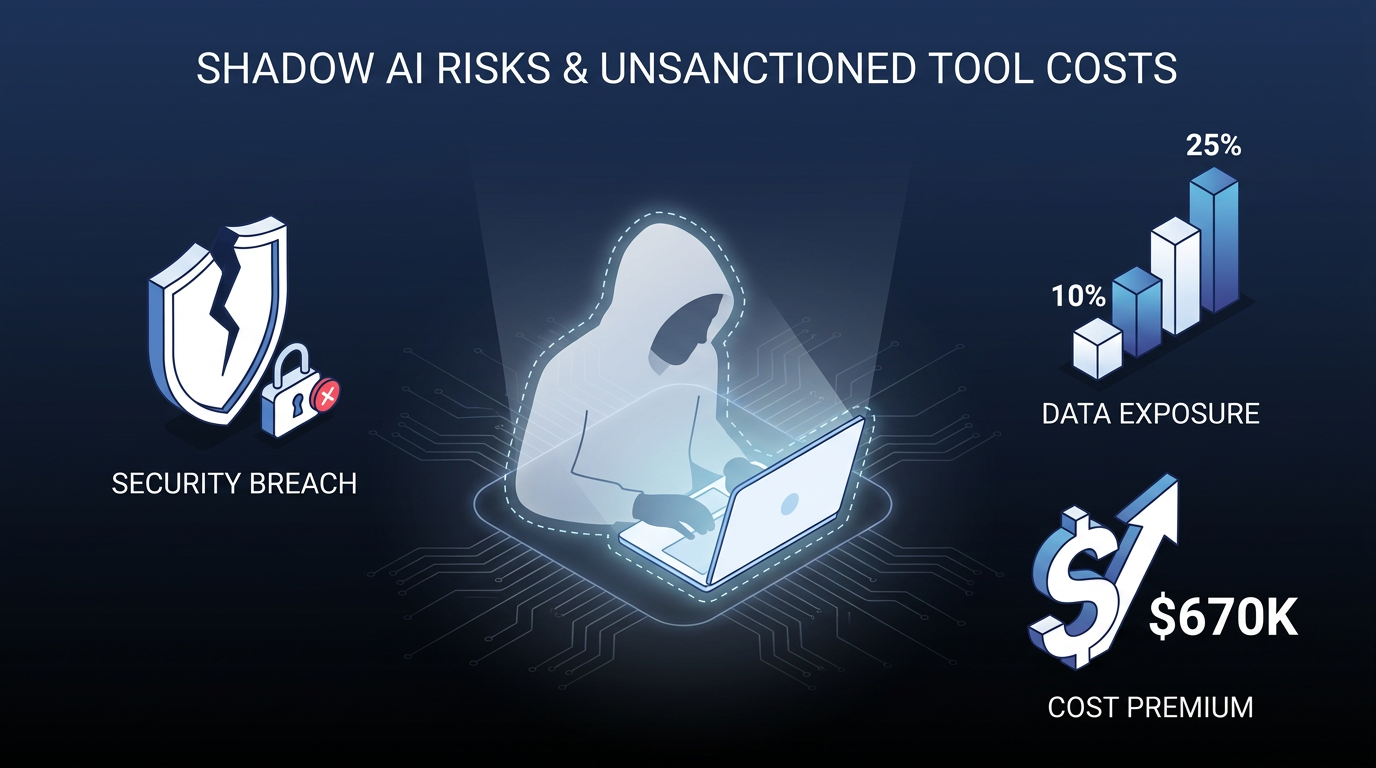
Agent Sprawl Compounds Governance Risk
Task-specific AI agents are moving from a minority of enterprise applications toward a majority within the next year. Without centralized orchestration, that growth can quickly become a large fleet of specialized agents across the enterprise, each one bringing its own authentication flow, data access pattern, and unreviewed permission set.
Your workflow should log every agent action, make each action auditable, and allow your team to revoke actions when needed, with human-in-the-loop checkpoints for high-impact decisions. As the number of agents grows, the number of missing controls increases rather than remaining fixed.
Address Security Risks Specific to Generative AI
Generative AI brings new security risks to enterprise software. OWASP's ranking of LLM risks identifies prompt injection, where hidden or adversarial instructions cause a model or agent to act outside its intended boundaries, as the top-ranked vulnerability. EchoLeak, a zero-click prompt injection disclosed in June 2025, caused Microsoft 365 Copilot to leak internal data without requiring user interaction and remains the clearest illustration of what an unscoped AI integration can expose.
Production enterprise AI needs two security patterns in particular.
- Layered prompt injection defense: Apply input validation and context isolation at every model interaction point, then filter outputs. Indirect injection attacks can arrive via data the agent processes, so defenses need more than a single guardrail layer. Without a layered defense, a hidden prompt in the data stream can still trigger unsafe output or data leakage.
- Least-privilege agent scoping and zero-persistence data architecture: Every AI agent needs tightly scoped, role-based permissions that limit it to the tools and data required by the task, thereby limiting the blast radius if one agent fails. In multi-agent environments, access rules quickly become more complex, and if permissions are too broad, a single compromised or misconfigured agent can expose more systems and data than the task requires. Data sovereignty keeps your data where it already lives: real-time querying avoids replication, and row-level and column-level security limit which records or fields a workflow can access.
Together, these controls determine whether generative AI remains governable once it moves from pilot to production.
Avoid Agent-Only Architectures
The push toward agentic AI is real, but agent-only approaches carry structural risks that become visible only at enterprise volume.
Even modest per-step error rates can compound sharply across long agent chains. In practice, multi-step agent workflows become less reliable as errors accumulate across steps, and end-to-end reliability can break down quickly.
Cost compounds the reliability problem. Research comparing deterministic and direct inference costs at one million transactions per month found a 40x cost ratio. For high-volume, well-defined tasks, agent-first designs can be less economical than a deterministic path when one exists.
A deterministic workflow backbone holds up better in enterprise environments with high transaction volume, while AI agents still operate within bounded scopes for tasks that genuinely require interpretation. That combination holds up better as volume, cost pressure, and audit requirements all increase together.
Use Elementum to Integrate Generative AI Safely Into Enterprise Workflows
The roughly 5% of enterprises that capture real AI value rely on structured orchestration, deterministic governance, data sovereignty, and the freedom to use multiple models. Waiting to address these architectural requirements after deployment compounds the cost and risk of every additional workflow.
Our AI workflow orchestration platform is built around these exact requirements and includes our Open Orchestration and AI Agent Management capabilities. Our Workflow Engine treats AI agents, deterministic business rules, and human decisions as equals in every workflow.
Agents from any provider operate within governed workflows, including OpenAI, Anthropic, Google Gemini, Amazon Bedrock, and Snowflake Cortex. There is no LLM vendor lock-in. You can swap models, mix multiple models within a single workflow, or adopt new models as they're released without rebuilding workflow logic.
CloudLinks query your data in real time where it already lives, applying row-level and column-level security across Snowflake, Databricks, BigQuery, Redshift, and 200+ data sources. That means workflows can be limited to the records and fields they're allowed to access.
Every agent action is logged and revocable, and configurable decision thresholds govern when autonomous execution hands off to human review. Built-in guardrails and input validation defend against prompt injection across every model interaction.
The platform is SOC 2 Type II certified and supports GDPR, CCPA, SOX, and HIPAA requirements with audit trails and governance controls.
Production deployment typically takes weeks rather than the extended timelines associated with legacy vendors, without rebuilding workflow logic for every new model release.
We never train on, replicate, or warehouse your data. Many of our customers start with one workflow, prove the savings, and expand into adjacent processes. Among orchestration platforms in this category, we have the production track record for replacing legacy SaaS at enterprise scale, with named customers including Sanofi, Snowflake, Under Armour, and Elevance Health.
Contact us to map governed AI orchestration into your enterprise architecture and the rest of your AI roadmap.
FAQs About Integrating Generative AI Into Enterprise Workflows
These are the questions CIOs and AI program leads most often raise when moving generative AI from pilot to production.
What data infrastructure should you put in place before scaling AI?
Your data needs governance and in-place query access before scale becomes a realistic goal. Most organizations still describe their data as not AI-ready, and data accessibility and integration block scale more often than volume does. Organizations that treat data as a product and invest in master data management and governance frameworks deploy generative AI into production at a markedly higher rate than those that don't.
Should you standardize on a single LLM or use multiple models?
Multi-model strategies reduce lock-in risk and let you match cost to each workflow step, since different tasks need different levels of accuracy and cost. At enterprise transaction volumes, routing every step through a single premium provider can cost up to 40x more than using the most cost-effective model for each step.
How should you measure whether AI is delivering business value?
Tracking EBIT contribution and cost per transaction provides a clearer picture than activity metrics. Fewer than one-third of decision-makers can tie AI value to organizational financial growth, according to Forrester. The organizations seeing measurable returns connect AI directly to redesigned workflows with clear financial metrics. JPMorgan Chase CEO Jamie Dimon has said the bank's roughly $2 billion in annual AI spending is now matched by an equivalent amount in cost savings.
What security risks are unique to AI agents versus traditional software for you?
AI agents introduce two specific risks beyond those posed by traditional software. The first is prompt injection, in which adversarial inputs cause agents to act outside their defined boundaries. The second is behavioral conflicts from contradictions between a model's training, fine-tuning, and runtime prompts, which can cause agents to evade guardrails or behave deceptively. Model behavior can also change over time, which creates an additional governance challenge compared with traditional software.
How can you govern shadow AI without blocking innovation?
Governing shadow AI without blocking innovation starts by addressing the need that drives employees to use unsanctioned tools in the first place. Most organizations still lack a robust policy to manage or detect shadow AI, and pure blocking fails, as employees often adopt unsanctioned tools that outperform approved alternatives. Effective governance combines an approved toolset that genuinely meets employee needs, data boundary monitoring, and a single governed entry point that routes all AI-assisted requests through appropriate workflows with full audit trails.
Keep Reading
AI Agent vs AI Workflow: Orchestration vs Automation

How to Automate Procurement Workflows with AI Agents and Business Rules
7 Best AI Workflow Automation Tools in 2026
9 Best Workflow Orchestration Tools in 2026
Replacing Legacy CRM Workflows: An AI Orchestration Approach for Enterprise Sales Operations

Agentic AI vs. Generative AI: Why Enterprise Workflows Need Both