
Enterprise AI Governance Strategies for Large Organizations

Gartner reports a sharp jump in what's becoming known as agent sprawl: the average Fortune 500 enterprise is projected to run more than 150,000 AI agents by 2028, up from fewer than 15 in 2025, while only 13% of organizations say their agent governance is adequate.
Your board expects return on investment (ROI) from AI this fiscal year. Your security team wants to know what data those agents can access and whether they can change or approve records. Enterprise AI governance is how you answer both, run every day rather than reviewed once a year.
Govern Shadow AI Before It Gets Expensive
Shadow AI has moved from a policy issue to a real cost. When employees use AI tools outside approved channels, security teams lose sight of prompt data and tool connections to work systems, and it gets harder to trace decisions. Auditors may now ask teams to show how they find, control, and log ungoverned AI. That matters most when AI systems touch regulated data or approval workflows.
Employee use of unsanctioned AI is widespread, with a majority of workers connecting AI tools to work systems without IT approval, often through free tools and with sensitive data in play.
Gartner also reports: organizations abandoned at least 50% of generative AI projects after proof of concept by the end of 2025, and organizations that master governance fundamentals are far more likely to move pilots into production than those that don't. Teams most often cite cost overruns and risk involving data privacy and security. Governance affects each problem.
Anchor the Program to Established Frameworks
You don't need to invent a governance model from scratch. That burns audit cycles you don't have before the EU AI Act's August 2, 2026 main application date. Start with existing frameworks.
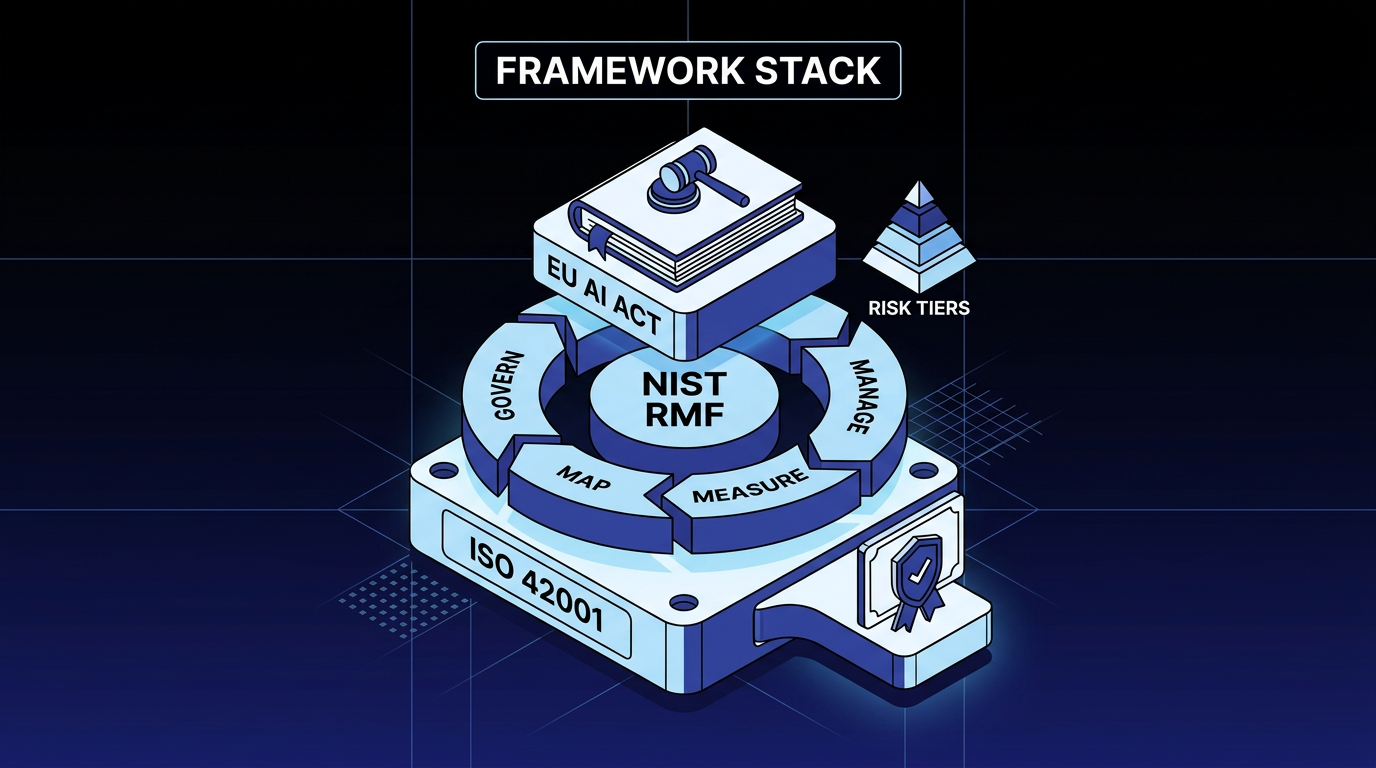
The National Institute of Standards and Technology (NIST) publishes the AI Risk Management Framework (AI RMF), a voluntary framework not tied to one sector or one use case. Its four core functions are Govern, Map, Measure, and Manage. Govern cuts across the other three: it sets the ownership model and risk culture that connect AI risk to business priorities.
ISO/IEC 42001 is the standard auditors can certify. It defines an AI management system with a Plan-Do-Check-Act cycle, and its control set covers ethics, accountability, transparency, and data privacy. If customers or regulators ask for proof, ISO 42001 is the standard an auditor can certify you against.
The EU AI Act is mandatory regulation for in-scope AI systems in the EU market. It classifies systems into four risk tiers. High-risk systems must meet several obligations before market placement: risk assessment and mitigation, activity logging, technical documentation, human oversight, accuracy controls, and cybersecurity controls.
Most of the Act's remaining provisions apply from August 2, 2026. EU lawmakers reached a political agreement in May 2026 to postpone the high-risk compliance deadline to December 2, 2027, but the Official Journal does not yet include that amendment. The original deadline remains the law until the amendment is included. Plan against the earlier date.
Use ISO 42001 as the spine auditors can certify. Run the NIST four-function loop inside it for technical depth, then add the EU AI Act's obligations for in-scope systems. The requirements overlap enough that a single risk assessment can anchor all three: high-risk EU AI Act systems still need evidence for documentation, logging, human oversight, accuracy, and cybersecurity.
Give AI Governance One Named Owner
In many enterprises, accountability for AI risk scatters across legal, compliance, IT, and business teams. When every function owns the risk, no one owns the risk.
Give one executive the pen, usually the chief information officer (CIO) or a chief AI officer (CAIO). Back that owner with a cross-functional governance board: the chief information security officer (CISO), the chief data officer (CDO), general counsel, and business unit leaders. Start centralized for consistency, then let business units take decision rights once teams embed guardrails in platforms and processes. Parking governance solely inside legal stalls it. Most day-to-day governance decisions are architectural: which model and data, and at what approval threshold.
The board's first job is an AI inventory and policy baseline. You can't govern agents you can't enumerate. Track every model and agent in production, along with the author, the accountable owner, and the data and systems it touches. Spreadsheets and email threads are a poor fit for consistent audit trails in large AI programs. Route intake and approval through structured workflows. Log every decision.
Four policies form the minimum policy set:
- Acceptable use: which tools employees may use and how data limits apply in each context. Without it, shadow AI stays invisible until audit or incident response.
- Model risk: how production models are validated and monitored for drift, including when they need re-approval. This keeps model behavior from changing silently after launch.
- Third-party AI: contract terms governing what vendors may do with your data. This keeps vendor terms from becoming your weakest governance control.
- Incident response: who acts, and how fast, when an AI system misbehaves or leaks data. Clear ownership reduces delay when harm is still containable.
Of the four, the third-party policy deserves the hardest scrutiny. Ninety-two percent of AI contracts claim data usage rights beyond what is necessary for service delivery, and many allow vendors to use customer data for retraining models, according to TermScout data cited by Stanford Law School's CodeX center. If your vendor can train on your data, their terms of service become part of your governance boundary. Vendor terms set that edge.
Govern AI Agents Inside Deterministic Workflows
Policies and inventories describe what should happen. Governance executes, or breaks, in the workflow layer, and a common audit failure appears here: teams assign probabilistic systems deterministic jobs, then can't explain why the same workflow produced different outcomes on different days.
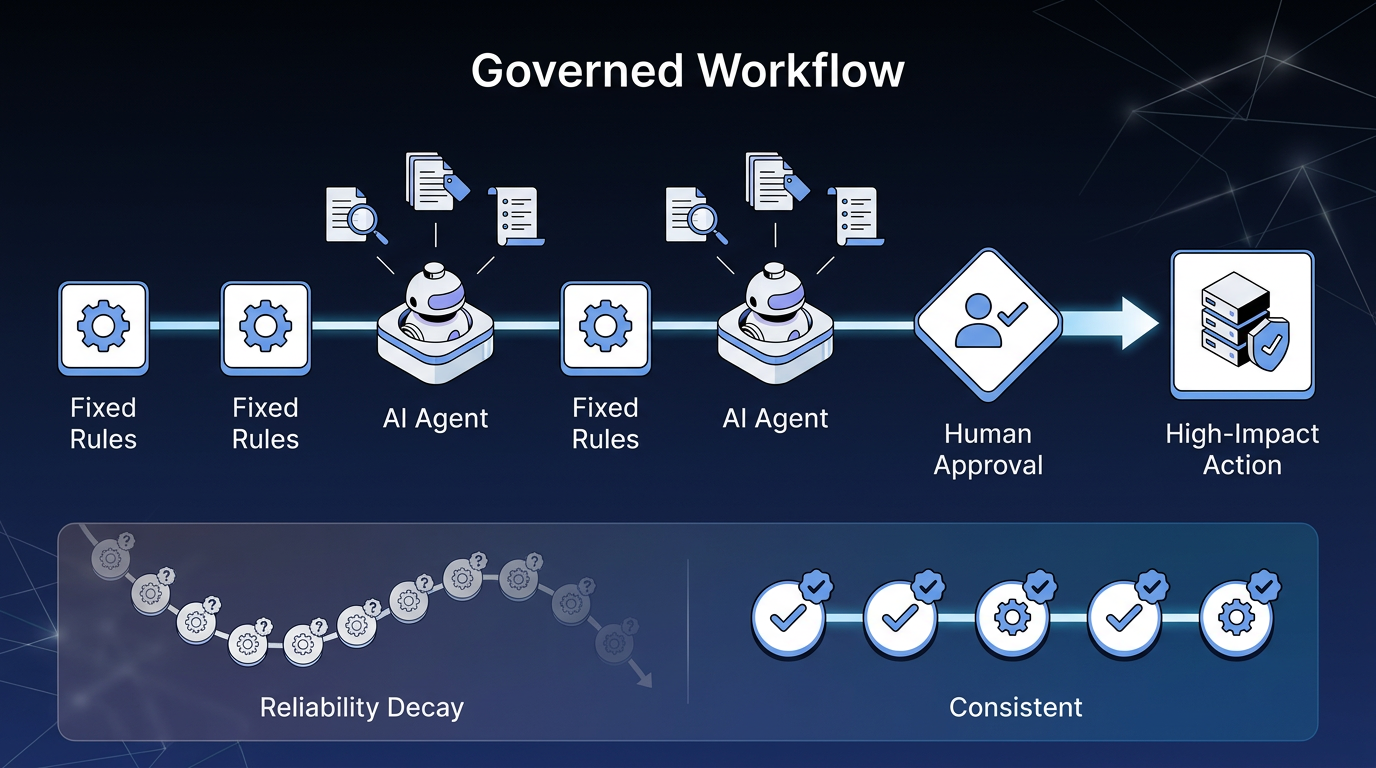
Traditional automation follows explicit rules: if X happens, do Y, every time. An AI agent interprets a goal and decides how to achieve it, which means the same input can produce different outputs. That flexibility fits reading an unstructured contract. It fails when the task is approving a payment. Enterprise AI strategies can miss this deterministic-versus-probabilistic decision, and it has to be made step by step across each workflow.
The math gets worse as workflows get longer. A workflow's end-to-end reliability is each step's success rate multiplied across every step and handoff, and that number decays fast in long agent chains. A regulated process can't run on that curve. In IT service management (ITSM) workflow automation, the stakes are concrete: an agent that routes identical priority-one (P1) incidents differently on Tuesday and Thursday creates an audit failure.
The architecture built for audit embeds agents inside deterministic workflows. Fixed rules govern the process. The same process produces the same result every time. Agents handle bounded interpretive work such as extraction, classification, and summarization, following the same control pattern.
Use deterministic rules where consistency is all you need, and AI only where interpretation earns its cost. Human approval checkpoints can hold decision authority at high-impact actions. Configurable decision thresholds set when an agent may act and when a person must approve, which protects authority and supports the effective human oversight the EU AI Act requires for high-risk systems. As agents handle more workflow steps, the deterministic governance layer carries more weight, and higher volume raises the stakes on every ungoverned decision.
Sanofi illustrates the production pattern. The company started with software license management, expanded into procurement by replacing Coupa, and is now extending into CRM workflows using AI agents built on its own data infrastructure rather than a new layer of vendor tools. Sanofi's Chief Digital Officer has set a target of resolving 80% of employee IT requests autonomously through the same architecture, according to BusinessWire's coverage of the partnership.
Put Enterprise AI Governance Into Production With Elementum
The EU AI Act deadline is near, and agent counts are compounding rapidly. Governance is what gets pilots into production; without it, gaps turn into abandoned projects and security exposure. Elementum’s AI Workflow Orchestration Platform is built to run this architecture in production.
Open Orchestration gives you the flexibility to swap AI models, clouds, or tools without rebuilding your workflow logic. Our AI Agents are pre-integrated with models from OpenAI, Gemini, Anthropic, and Snowflake Cortex, so no single AI vendor becomes a second lock-in problem on top of the first.
Orchestrated Intelligence right-sizes spend across deterministic rules, AI agents, and human decisions. Our Workflow Engine (Trident) treats humans, business rules, and AI agents as equals, with configurable decision thresholds and prompt-injection guardrails on every model interaction, plus full audit trails and logged, revocable agent actions that support control requirements under frameworks such as SOX, HIPAA, and GDPR.
Zero Persistence means we query your data where it already lives, through CloudLinks, our connections to your data platforms. Your data is always yours: we never train on, replicate, or warehouse your data.
We have the production track record for replacing legacy SaaS at enterprise scale, with named customers including Sanofi, Snowflake, Under Armour, and Elevance Health. Many of our customers start with one workflow, prove the savings, and expand into adjacent processes.
Contact us to map governed AI orchestration into your enterprise architecture and the rest of your AI roadmap.
FAQs About Enterprise AI Governance
Most AI governance questions become operational questions once agents touch enterprise data and systems, including approval paths.
How should you define enterprise AI governance?
Enterprise AI governance is the policy-and-control system, backed by accountable processes, that an organization uses to manage AI risk from design through deployment and production. For autonomous agents, it extends to runtime: that means traceability and clear human ownership, including decision thresholds for runtime actions.
Who should own AI governance in your organization?
AI governance ownership should sit with one executive sponsor, usually the chief information officer (CIO) or a chief AI officer (CAIO), who holds end-to-end accountability. A cross-functional board should own defined slices across security, data, legal, and the business. Governance parked solely in compliance tends to stall, since most governance decisions are architectural rather than contractual.
How should you govern AI agents differently from AI models?
Governing AI agents differs from governing AI models because autonomy changes the risk model. Agents make sequential decisions and act on enterprise systems through connected tools, often without direct human input, so governance has to cover the whole system at runtime, enforced through end-to-end tracing and human approval checkpoints.
Which governance framework should you adopt first?
The framework to adopt first depends on exposure. If you place AI systems on the EU market, the EU AI Act is mandatory and its obligations set the floor. From there, ISO/IEC 42001 works as the certifiable management-system spine, with the NIST AI RMF's four functions running inside it. The three overlap enough that one well-built risk assessment can satisfy all of them.
Keep Reading

The 6 Biggest Risks of Using AI in Enterprise & How to Mitigate Them

Enterprise AI Orchestration: The Complete Architecture Guide
Agentic AI for ITSM: A Practical Architecture for Enterprise IT
AI Incident Management: Automating IT Response with Deterministic Workflows
How AI Workflow Automation Runs Business Processes

When to Use AI Agents: The Enterprise Decision Guide