AI Incident Management: Automating IT Response with Deterministic Workflows
A high-severity ticket lands at two a.m. Your on-call engineer starts pulling context from a monitoring console, the ticket queue, a chat thread, and last quarter's post-mortem. Until that work is done, nobody touches a fix. The clock runs anyway.
An AI agent can cut that triage time sharply. It can also restart the wrong service, or "fix" a problem that doesn't exist, with the same apparent certainty. AI incident management works when a deterministic workflow decides which of those two outcomes is possible.
The design that holds up puts AI agents on the reasoning steps of incident response and keeps every action inside a workflow that runs the same way each time. Any action with a large blast radius, where one mistake could spread across services, goes to a named human. The same workflow handles service-desk incidents and employee IT requests for access, passwords, or hardware.
This article covers where AIOps stops, why ungoverned agents fail mid-incident, and how to build the controls, audit trail, and cost model before agents go live.
What AI Incident Management Is and Where AIOps Stops
AIOps tools find the incident. AI incident management governs what happens next, and that's where an agent's actions can change production systems.
An incident is an unplanned interruption to a service or a drop in its quality. Incident management is the practice of restoring normal operation as fast as possible, as defined in ITIL 4, the IT service management (ITSM) framework many service desks follow. What has changed is who does the work between detection and closure: AI agents now handle steps that used to belong to the on-call engineer.
AIOps (artificial intelligence for IT operations) tools ingest events across domains, correlate them, and flag that an incident exists. They mainly help teams assess the incident and pick a fix. Some also support or trigger automated remediation.
AI incident management covers that remediation step and adds controls across the whole process. It classifies the ticket, pulls context from the knowledge base and recent incidents, proposes or executes a fix, requests approval, escalates, and closes the record with an audit trail. Correlation can show an incident's pattern or scope. The workflow decides what the agent may do about it.
Two kinds of logic run inside that workflow. Deterministic logic produces the same output from the same input every time: if the service is down and a named owner approves a rollback, the workflow rolls back to the previous version. Probabilistic logic interprets a goal and produces an output that can vary with context. That's what a large language model (LLM) does.
Reading a stack trace and proposing a likely root cause is probabilistic work, and deciding whether that fix may run belongs to deterministic logic. That boundary makes the deterministic vs. probabilistic split a core design decision in incident management.
Why Ungoverned AI Agents Fail During Incidents
Outages already carry six- and seven-figure costs, so an agent that extends one adds to a real bill. One in five survey respondents said their most recent impactful outage cost more than $1 million, and 57% put their most recent major outage above $100,000, according to Uptime Institute's annual outage analysis. At those numbers, every minute an agent adds to an outage has a price.
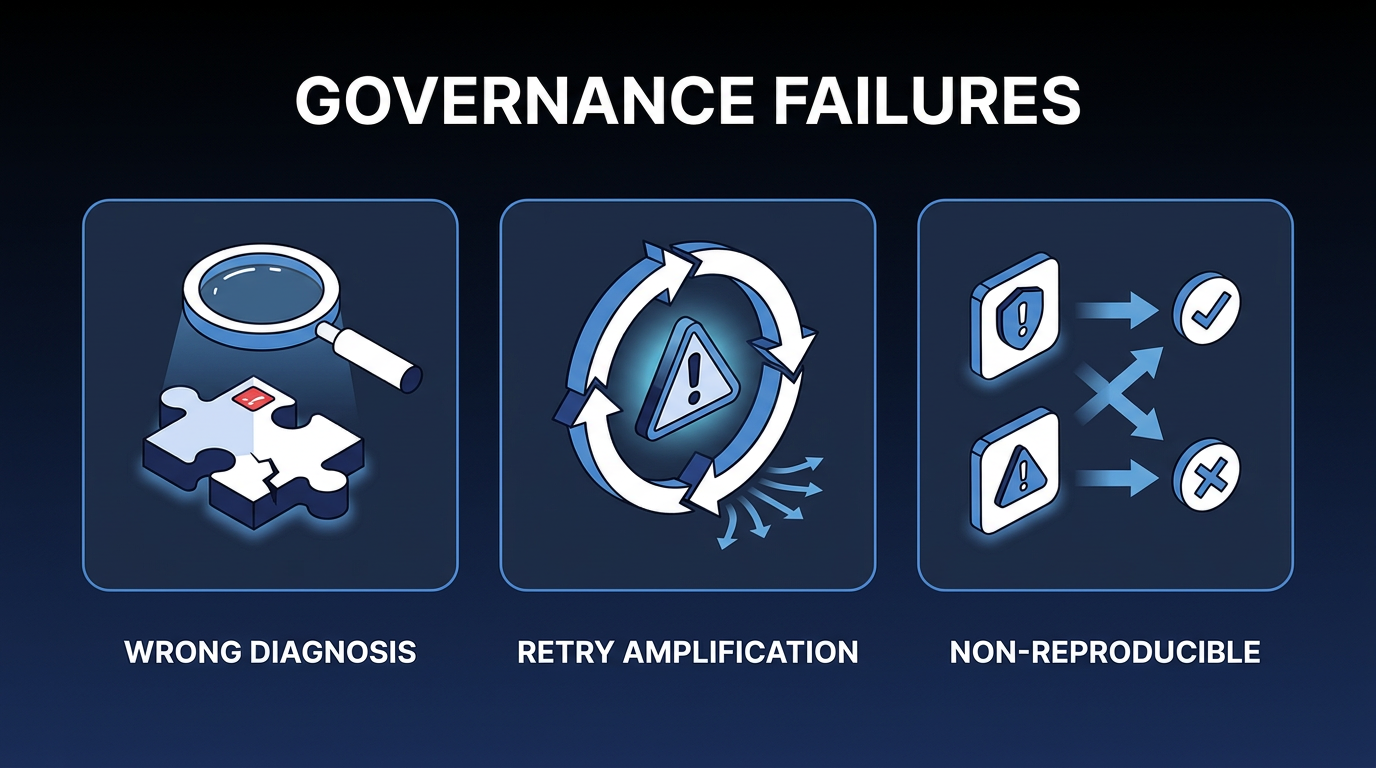
The risk sits in how the system is designed. During an active incident, an agent without enforced limits can fail in three distinct ways, and each one gets worse under pressure.
- Confident Wrong Diagnoses: An LLM may match a novel incident to the nearest historical one and propose a remediation for a problem you don't have. The diagnosis reads as plausible, and the action can make things worse.
- Retry Amplification: Without retry limits, an agent may loop through the same task or fire simultaneous API calls, which adds load to systems that are already degraded.
- Non-Reproducibility: Chaining probabilistic steps lets the same alert produce a different sequence of actions on Tuesday than it did on Monday. A change board or an auditor needs the opposite.
All three are architecture problems. When the workflow doesn't enforce limits, the agent's prompt becomes the only control. Only the workflow can block an unauthorized action before it runs.
How Deterministic Workflows Split Incident Work
A deterministic workflow fixes the order of steps and the permission attached to each one. It calls an AI agent only where a step needs interpretation, so the agent never sets its own permissions. AI agents, automated logic, and people work as equals in the same flow, and the workflow assigns who acts at each step.
Consider an access-failure ticket. The workflow receives the request, and an AI agent classifies it against your incident taxonomy. The agent then checks the knowledge base and recent incidents for a match. What comes back sets the route.
A known issue with a validated fix and a small blast radius runs as automated logic. If the metric it targets, such as error rate or latency, gets worse, the workflow rolls the change back. A match with competing explanations goes to an approval gate. Anything novel, cross-service, or irreversible goes straight to a named engineer, who starts with the agent's context already gathered.
Configurable decision thresholds set those boundaries. Each threshold defines the conditions an agent's result must meet, including the maximum impact an action may carry, before the action runs automatically. Reversible actions that clear the threshold execute, and anything below it or with high impact goes to human-in-the-loop review. The service owners set those thresholds.
That split stays safe only if the agent's role doesn't grow with volume. When an exception pattern repeats often enough to be understood, you codify it as automated logic with a fixed rollback, which removes reasoning from that step entirely. The agent's discretion never expands.
Higher volume raises the cost of every ungoverned decision. As the agent handles more tickets, the deterministic layer carries more weight. More tickets, more governance.
The Audit Trail Regulators Expect
EU rules for high-risk AI systems and for financial-sector incidents both expect a record that exists before anyone asks for it. Teams that plan to rebuild it afterward start behind.
AI used as a safety component in managing critical digital infrastructure can qualify as high-risk under the EU AI Act. The Digital Omnibus amendment moved those obligations from August 2, 2026, to December 2, 2027. That leaves time to build the controls before they apply.
Providers of high-risk systems must build in automatic event logging across the system's lifetime (Article 12), and deployers must keep those logs for at least six months (Article 26(6)). Providers must also design the system for human oversight (Article 14). Deployers must assign that oversight to people with the competence, training, and authority to carry it out (Article 26(2)).
A fully autonomous responder with no designated human overseer would not meet those requirements. Financial entities carry separate reporting duties under the Digital Operational Resilience Act (DORA). A major information and communication technology (ICT) incident triggers a staged set of reports, ending in a final report that includes root-cause analysis.
A deterministic workflow logs each agent action as it runs. The record builds itself. Each entry carries a timestamp, the inputs, the result, and any approval, which gives a DORA root-cause timeline its raw material. Reconstructing an agent's reasoning from chat transcripts after the fact is slower, and harder to defend to a supervisor while reporting deadlines run.
How Consumption-Based AI Pricing Affects Incident Costs
Metered AI pricing makes incident costs hard to forecast, and the spikes arrive during your worst weeks.
Model providers meter usage in tokens, the units of text a model reads and writes. Agents that retry and loop during a bad incident burn more tokens exactly when things go wrong, and every retry creates another metered call. Longer workflows, extra model calls, and usage-based overages all push the bill up.
A bad week for reliability becomes a bad week for the AI bill. It lands when your team has the least time to review usage.
A flat annual fee per application keeps the platform share of incident costs predictable. Limiting model calls to the steps that need interpretation shrinks exposure to usage spikes. Model usage still varies with incident volume, so a flat fee narrows the forecast range without fixing every line item.
How Elementum Runs AI Incident Management on Deterministic Workflows
Building deterministic controls before agents go live keeps blast radius a design choice. After the first bad incident, it becomes a post-mortem finding.
Elementum is the Enterprise AI Apps Platform that allows you to deploy AI, deterministic workflows, and human-in-the-loop actions at scale, without moving your data off of your data cloud. In IT, we replace ServiceNow incident and service request modules, while the CMDB and the rest of the stack keeps running. Teams can start with one process while the rest of the existing stack keeps running.
Our Workflow Engine runs your existing AI agents inside the process where a step needs reasoning, executes automated logic where it doesn't, and routes exceptions and approvals to the people who own them.
Configurable decision thresholds determine when an agent acts and when a named owner approves. We log every agent action, so the audit trail builds while the workflow runs.
Our Zero Persistence architecture retains nothing after the run: we never train on, replicate, or warehouse your data. We run natively inside your own cloud data platform, with Snowflake as our primary production deployment, and query source systems in real time under your existing access controls. We charge a flat annual fee per application, with no per-seat license, no per-conversation charge, and no per-action charge for AI.
Global enterprises including Sanofi, Under Armour, and Elevance Health run on Elementum. Many of our customers start with one workflow, prove the savings, and expand into adjacent processes.
Contact us to map deterministic incident workflows into your ITSM architecture and the rest of your AI roadmap.
FAQs About AI Incident Management
These are the questions IT and service-desk leaders most often raise when they evaluate AI agents for incident response.
What Is AI Incident Management?
AI incident management uses AI agents inside the IT incident process to classify tickets, gather context from knowledge bases and past incidents, propose or execute remediations, and escalate to people. In a governed design, a deterministic workflow fixes the sequence and permissions. Agents handle only the steps that need interpretation.
Can AI Resolve IT Incidents Without Humans?
AI can resolve some bounded incident types without a human, such as known issues with a validated, reversible fix. Novel, cross-service, or irreversible incidents should go to a named engineer. If the system counts as high-risk under the EU AI Act, Article 14 requires providers to design it for human oversight, however capable the model is.
How Is AI Incident Management Different From AIOps?
AI incident management differs from AIOps in where it works. AIOps platforms mainly ingest and correlate events to flag that an incident exists, and some also support or trigger automated remediation. AI incident management governs what happens after detection: triage, approval, remediation, escalation, and the audit record. The two run well together, with AIOps as the signal and a deterministic workflow as the process that acts on it.
Can You Audit AI-Driven Incident Response?
AI-driven incident response is auditable when the workflow logs every step as it runs. The record shows which workflow ran, which agent it called, what result the agent produced, and who approved it. Deployers of high-risk AI systems under the EU AI Act must keep those logs for at least six months, so the workflow has to create them at runtime instead of rebuilding them from conversation history.