
The 6 Biggest Risks of Using AI in Enterprise & How to Mitigate Them
Enterprise AI fails when governance, cost control, and security lag adoption. A board may expect return on investment (ROI) by Q2. A chief information security officer (CISO) may worry about data exposure. Employees routing work through public chatbots make the margin for error even smaller. The upside is real. So is the downside.
Gartner predicts that organizations will cancel more than 40% of agentic AI projects by the end of 2027, due to escalating costs, unclear business value, or inadequate risk controls. Agentic AI systems use agents that can plan steps and call tools as they act toward a goal.
Enterprise AI risks show up as breached data, canceled projects, runaway token bills, and audit findings. Six architectural choices reduce these enterprise AI risks.
Risk 1: Constrain Prompt Injection Before Agents Reach Internal Systems
OWASP ranks prompt injection first among LLM risks since the list debuted. It remains difficult to eliminate in large language models (LLMs), the systems behind many generative AI tools. Ignore it and you expose every system your AI can reach.
User prompts, retrieved documents, and tool outputs can alter model behavior in unintended ways. External content can behave like instructions in LLM workflows.
The blast radius grows with autonomy. In June 2025, researchers disclosed EchoLeak, a zero-click vulnerability in a major enterprise AI assistant. An attacker's email could coerce the assistant into accessing internal files. It could then transmit their contents to an attacker-controlled server, with no user interaction. An agent with access to multiple systems can expose every permission its owners assigned to it.
Mitigation starts with treating agents as one governed step within a governed AI workflow:
- Input Validation and AI Guardrails: Apply on every model interaction.
- Least Privilege: Scope tool access to the minimum a task requires.
- Human Approval: Require it on destructive actions.
A guardrail LLM alone remains susceptible to the same jailbreaks, or prompts that bypass model safety controls, as the model it protects.
Risk 2: Replace Shadow AI With Governed Access
In a survey of cybersecurity leaders, 69% of organizations suspect or have evidence that employees are using prohibited public generative AI, according to Gartner. Shadow AI, the unsanctioned use of AI tools without IT approval, is becoming common across enterprise workforces. The cost of ignoring it is breached data and lost intellectual property.
Hidden AI use creates new paths for customer data and confidential work products to leave governed systems. Intellectual property can leave the same way. IT leaders are already reporting privacy and security concerns around shadow AI, including negative AI-related data incidents.
Banning it rarely fixes the incentive problem. Employees choose unsanctioned tools when approved options are absent, slower, or disconnected from how work actually gets done. The better answer is to provide governed tools that meet real productivity needs. One governed entry point gives IT visibility into sanctioned model calls while giving employees a tool that fits real work.
Risk 3: Govern Agent Sprawl Before Production Incidents
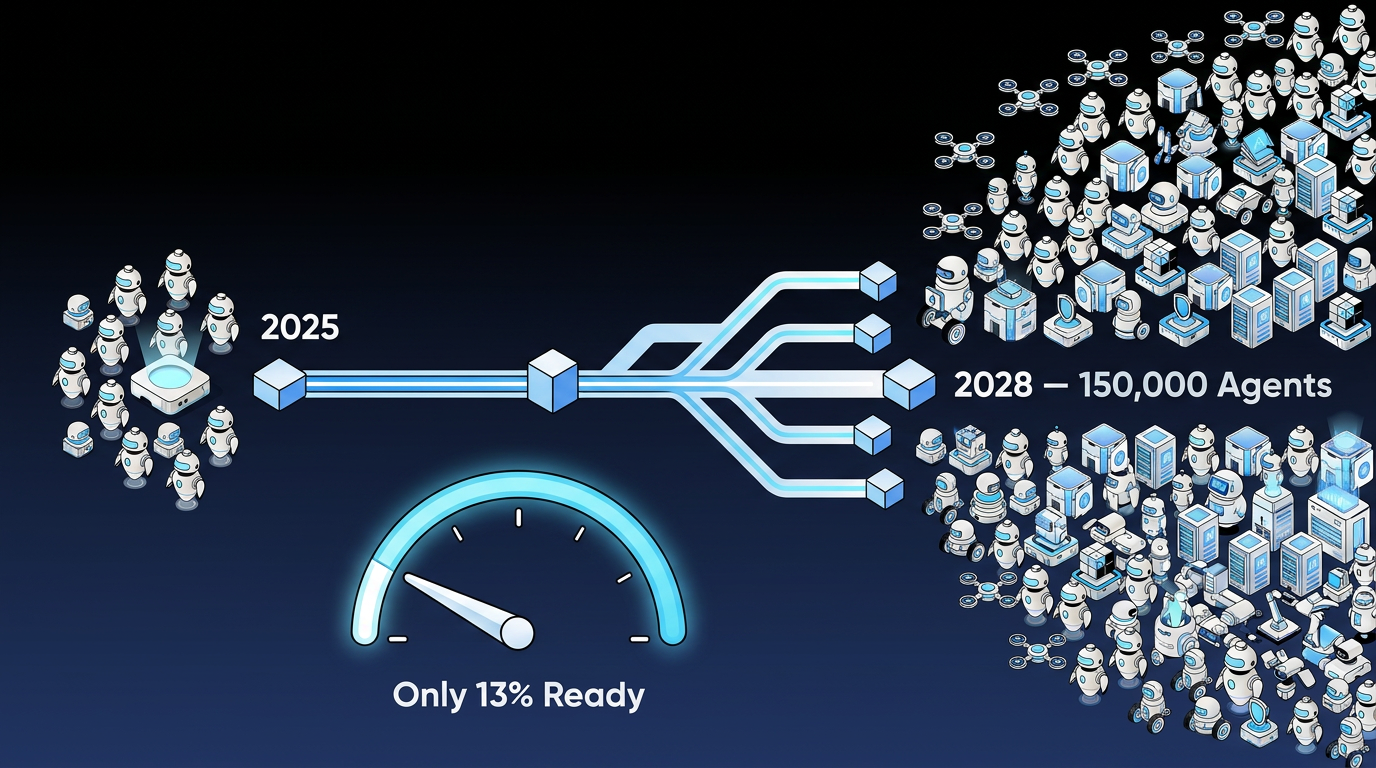
Agent volume is about to jump. By 2028, the average Fortune 500 enterprise will run over 150,000 agents, up from fewer than 15 in 2025, yet only 13% of organizations believe they have the right agent governance in place. Agent sprawl, the uncontrolled growth of agents across teams and systems, is becoming a major governance problem in the enterprise.
Ungoverned agents get exposed after production incidents: enterprises that skip this step often end up demoting or decommissioning agents once something breaks in production. Uniform governance creates its own risk. Over-restrict simple agents and teams build around the rules. Under-restrict autonomous agents and security exposure rises.
Compliance makes this sharper. Regulated workflows often need accountable logs that connect access made through AI systems to responsible users. Service accounts are shared technical identities used by systems, not individual people. AI record-keeping expectations reinforce the same operating principle for high-risk AI systems. Teams must create logs before auditors ask for them.
Governance becomes more critical as AI handles more workflow steps. Higher volume means higher stakes for every ungoverned decision. Effective mitigation logs every agent action and keeps it revocable. It also places human-in-the-loop checkpoints at the points where judgment is required.
Risk 4: Tie AI ROI to Capacity Reclaimed
AI budgets face board-level pressure because enterprise technology investments are not turning into results consistently. Only 48% of digital initiatives meet or exceed their business outcome targets, according to Gartner, while CIOs face pressure to improve productivity and reduce costs.
Cancellation risk reflects escalating costs, unclear business value, and inadequate risk controls. Production failure often involves weak data foundations. It also involves immature operating models and workflows that break when demos meet production constraints.
Hours of work removed survive board scrutiny better than a deployment milestone. They tie the investment to a dollar figure. Sanofi started with software license management and achieved $10M+ software license spend reduction. That is the kind of number that can hold up in a board presentation: digital labor full-time equivalents (FTEs) replaced and legacy SaaS licensing displaced.
Risk 5: Keep Orchestration Model-Agnostic to Avoid Lock-in
Betting your architecture on a single model provider concentrates operational and commercial risk. A deprecation or outage can cascade through a tightly coupled AI stack. A price change can also hit every workflow in the deployment at once.
Provider pricing changes can materially increase operating costs for teams that cannot quickly migrate critical workflows. AI providers are changing pricing rates or models rapidly as competition, computing costs, and market pressure collide. When rates and models keep moving, a default model choice can become expensive faster than teams expect.
Place governance and workflow logic above the model. That lets you swap the model layer without rebuilding workflows or tool integrations. Keep the orchestration layer model-agnostic, and a model shutdown becomes a controlled migration instead of a workflow rebuild.
Risk 6: Use Deterministic Workflows to Control Agent Costs
Agentic architectures burn tokens in ways that make budgets unpredictable. Pricing deflation doesn't save you. Consumption-based AI costs, where usage rises with each model call or token, can still outrun budgets. By 2028, AI coding costs will overtake the average developer's salary, according to Gartner, due to rising LLM token consumption and consumption-based licensing.
Agent frameworks can generate many LLM calls before producing a result or failing. Long context windows, the amount of text a model can process at once, can swell each request. Repeated tool calls and retry loops, where systems try again after failed or uncertain responses, add more variable consumption. A per-step estimate can understate the real cost.
Right-size the workflow. Deterministic workflows follow fixed rules instead of asking a model to reason through every step. Deterministic rules handle logic that doesn't need reasoning; AI agents run only where interpretation or language understanding is genuinely needed. Routing simple logic through code instead of a model call removes an AI cost entirely for that step.
Pure rule-based systems can't handle ambiguity. Pure agent approaches add cost and variability where none is needed. A workflow that mixes deterministic rules with agents reduces avoidable model calls. It also keeps fixed-rule steps consistent and limits AI use to the steps that need interpretation.
Turn Major Risks of Using AI in Enterprises Into a Governed Architecture
AI is moving into production faster than governance, cost controls, auditability, and provider flexibility can keep up. These six risks share that pattern. Security and agent sprawl need tighter permissions and better logs. ROI depends on hours of work removed, not a deployment milestone. Lock-in calls for model flexibility.
Cost control depends on fewer avoidable model calls. Deterministic orchestration helps connect those controls without pretending it is the root cause of every risk. Fixing that layer before production reduces the chance of expensive decommissioning work, audit remediation, or breach response.
Elementum built our AI Workflow Orchestration Platform for this. The Workflow Engine treats AI agents as equals with humans and business rules, with a deterministic backbone that keeps every rule-based step consistent. Model choice stays separate from workflow logic. We orchestrate agents from OpenAI, Gemini, Anthropic, Amazon Bedrock, and Snowflake Cortex. Teams swap models without rebuilding workflows.
We build guardrails into every model interaction to defend against prompt injection. Configurable decision thresholds keep humans in the loop on the calls that need judgment. We log every agent action for SOX, HIPAA, and GDPR audits, and teams can revoke access at any point.
Your data stays yours through Zero Persistence architecture: we never train on, replicate, or warehouse your data. Many of our customers start with one workflow, prove the savings, and expand into adjacent processes.
We apply governed AI orchestration across enterprise workflows such as software license management and healthcare provider onboarding. The same governed pattern extends to retail IT support.
Among orchestration platforms in this category, we have the production track record for replacing legacy SaaS at enterprise scale, with named customers including Sanofi, Snowflake, Under Armour, and Elevance Health.
Contact us to map governed AI orchestration into your enterprise architecture and the rest of your AI roadmap.
FAQs about major risks of using AI in enterprises
These are the questions IT and security leaders most often raise when facing enterprise AI risk. Enterprise AI risk spans security, shadow AI, agent oversight failures, unproven ROI, vendor lock-in, and runaway cost.
What risks should you watch for when using AI in enterprises?
The risks to watch for when using AI in enterprises fall into six categories: security and data breach risk, shadow AI, agent oversight failures, unproven ROI, vendor lock-in, and runaway cost. These risks interact: shadow AI raises breach exposure, and ungoverned agents raise both compliance and cost exposure.
How should you mitigate enterprise AI risks?
Mitigating enterprise AI risks spans three areas:
- Technical: Apply least-privilege tool scopes, input validation, and audit logging with individual attribution; require human approval on destructive actions.
- Governance: Use the National Institute of Standards and Technology AI Risk Management Framework (NIST AI RMF), with an AI inventory and documented human-in-the-loop oversight.
- Organizational: Provide sanctioned AI tools that give employees a governed way to use AI without pushing work into shadow tools.
Each area closes a different part of the exposure: technical controls limit blast radius, governance frameworks create accountability, and sanctioned tools remove the incentive for shadow AI.
What compliance rules could apply to your enterprise AI systems?
Enterprise AI systems that access regulated data touch privacy, security, financial-reporting, and sector-specific controls, including HIPAA, GDPR, and SOX. They also include FedRAMP (Federal Risk and Authorization Management Program), a U.S. federal cloud security authorization program, and SOC 2, a service organization control framework for security and privacy.
The EU AI Act adds human oversight and record-keeping requirements, including automatically generated logs and serious-incident reporting. GDPR's automated decision-making rules require organizations to provide ways to request human intervention. Audit attribution is a common operating shortfall: teams need to trace access made through AI systems to the responsible individual, not just a service account.
Why might your enterprise AI pilot fail to reach production?
Your enterprise AI pilot fails when early demonstrations meet production constraints. Root causes include lack of maturity, weak governance, data that isn't AI-ready, and compounding errors in multi-step agent chains. Error rates compound across long agent chains. Pilots work, but production breaks.