
AI Employee Onboarding: How Smart Systems Improve the New Hire Experience

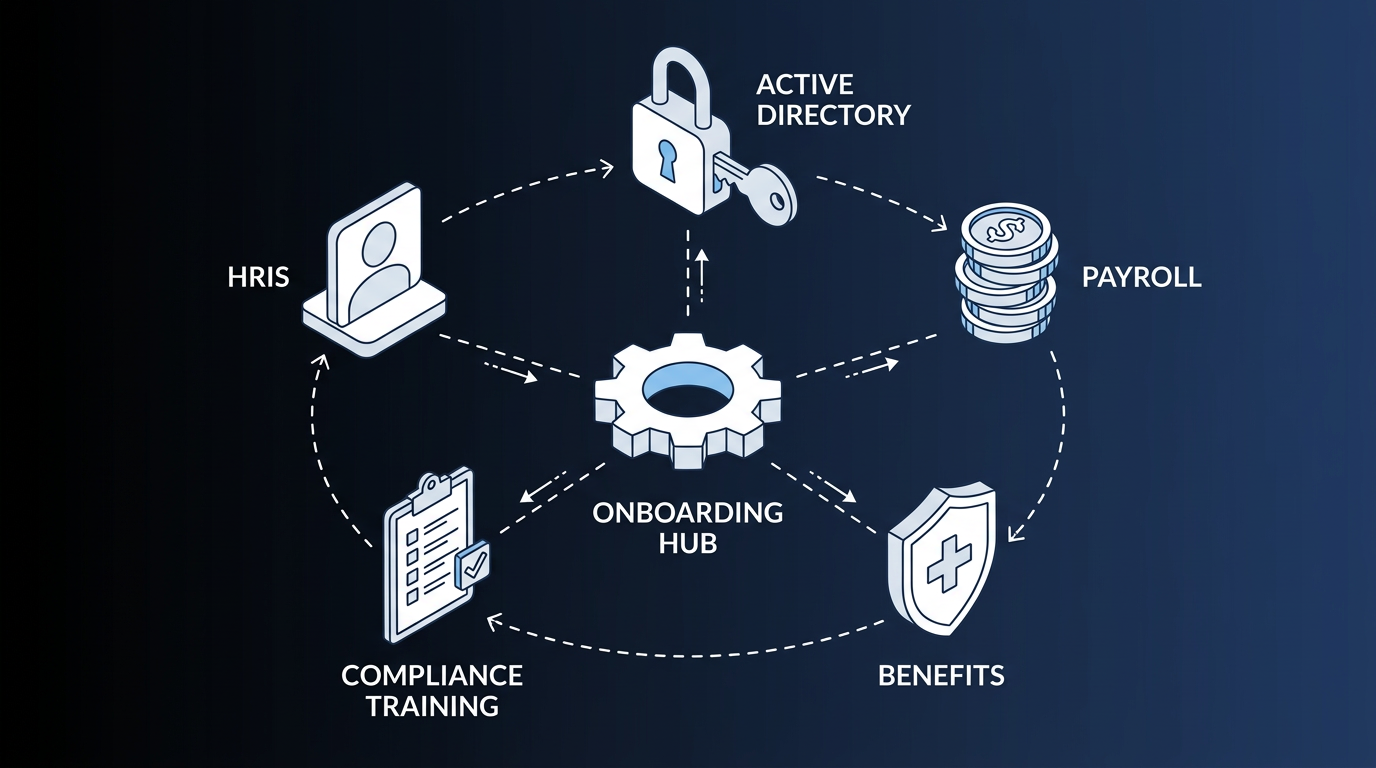
A single onboarding workflow can touch HR process automation, HRIS, Active Directory, payroll, benefits enrollment, and compliance training. Each handoff between those systems can cause delays or missing credentials, with compliance risk building in the background. Meanwhile, HR teams are stretched thin, often working beyond capacity on processes that could run without them.
The cost of getting onboarding wrong shows up in early attrition: most new hires decide whether to stay or leave within their first six months, and organizations that deliver a fragmented first week pay for it in turnover.
Paperwork Automation and Digital-First Onboarding
Before workflow automation, onboarding meant printed forms, physical signatures, email-based IT tickets, and HR coordinators re-entering the same data across disconnected systems. Admin work consumed most of the HR workday. That model was built for an era when paperwork was the process.
AI use in HR is rising, especially in high-volume support tasks. Employee assistance tools have seen the steepest adoption growth, roughly doubling in two years across large HR teams. When onboarding spans multiple systems and departments, automating handoffs reduces time and eliminates the back-and-forth that slows down every new hire's first week.
AI Chatbots for First-Week Questions
New hires in their first week have dozens of immediate questions about benefits, IT access, paid time off (PTO), and expenses. Each question used to require finding the right person, waiting for a reply, or digging through scattered internal pages. Slow answers create friction fast.
AI-powered assistants connected to HRIS and knowledge systems can answer common questions quickly and tailor responses based on role and employment type, with location-specific guidance where needed. IBM's AskHR system achieved a 94% containment rate for common HR questions, with 99% manager adoption. These tools give employees an always-available channel for everyday questions, handle paperwork, provision access, and help teams meet compliance requirements without manual follow-up.
Role-Based Learning Paths That Adapt in Real Time
At enterprise scale, onboarding programs need to vary by role and region, with prior experience changing the pace. What a new sales rep needs to learn in week one differs from what a new finance analyst needs, and the order matters, too. AI-driven learning systems incorporate role requirements and prior experience, then adjust training paths as signals emerge.
Machine learning can sequence learning activities, assess understanding, and adjust the path based on the learner's performance. New hires spend more time on actual gaps and skip material they already know. Enboarder's 2025 HR Leader Survey found that 29% of HR leaders rank high attrition in the first 90 days as their top onboarding challenge, and 60.8% say it is getting worse, making the quality of the early learning experience a direct retention lever, not just an HR nicety.
Compliance and Document Automation
Compliance checks and document signing take up a large share of onboarding time, and errors create direct financial exposure. I-9 audit enforcement has intensified, with fines for paperwork errors running into the thousands of dollars per violation. Most employers have not yet fully automated this process, leaving a compliance gap that audits expose.
Background check integration has picked up across the industry. Automating these steps reduces time, risk, and coordination overhead for HR, legal, and IT. Teams that have gone furthest report near-complete compliance task completion before Day 1, which removes the last-minute scramble that delays a new hire's first productive day.
Connecting New Hires Before Day One
The window between offer acceptance and start date is a real attrition risk. Silence during this period gives competitors room to poach candidates who have not yet started. Drop-off before Day 1 is preventable, and it starts with contact.
AI-driven pre-boarding can send timed messages, distribute digital paperwork, trigger IT setup, and share team and culture content before the start date. Candidates who hear from their new employer before Day 1 arrive more prepared and more committed.
IT Access Before the First Day
Setting up IT access across a large organization is a coordination problem that spans multiple teams. Delays start with fragmentation: HR completes a hire, IT waits for a ticket to be submitted, and the new employee shows up on Day 1 without access to anything. A Forrester Total Economic Impact (TEI) study documented a financial services firm in which new employees previously took 3 weeks to become productive due to delays in multi-system setup.
Many large organizations now connect the hiring event directly to account creation and access setup, so everything is ready before Day 1. Some have cut provisioning time from thirty minutes to seconds. Others have eliminated the Day 1 IT contact entirely by shipping fully configured laptops. The most automated teams trigger IT workflows the moment a hire is confirmed, removing the manual request entirely.
Slow IT setup also poses a security risk because when researchers or technical staff cannot obtain the equipment they need within a reasonable time, they resort to workarounds. Unauthorized cloud services fill the gap, and that data ends up outside the organization's control. Automated provisioning removes the wait that drives that behavior.
Spotting Disengagement Early
Retention models can analyze multiple data points simultaneously to surface warning signs that individual managers are unlikely to catch in real time. These models pull from onboarding activity, manager interactions, compensation, training progress, and team data. A new hire who is quietly disengaging often shows it in the data before anyone notices in a meeting.
Machine learning can flag turnover risk using data that HR systems already collect. When one person leaves, their teammates are more likely to follow within the next few months. One departure can quietly trigger more. That multiplies the cost of each lost hire, and the pattern often starts during onboarding when new hires are still deciding whether they made the right choice.
Getting HR Time Back
Human-in-the-loop AI automates routine tasks while HR focuses on the work that truly requires a person: building relationships, reading the room, and coaching new hires through the parts of a new job that no checklist covers. AI handles scheduling, routing, and paperwork. People handle people.
HR teams that have automated admin-heavy onboarding tasks get back hours each week that used to be spent on data entry, ticket routing, and status checks. Some organizations have cut HR's hands-on time per new hire from around ten hours to two.
Some organizations are using that recaptured time to change what HR does. McKinsey's HR Monitor 2025 documents high-performing organizations using automation and gen AI to reduce HR staff ratios from one per 70 employees to one per 200. McKinsey frames this as a shift from a cost-focused HR model to one built around speed, automation, and strategic work.
Sanofi's deployment shows what this looks like at scale. Sanofi's internal AI assistant, Concierge, is now used by about 60,000 employees worldwide, and company leadership says AI agents could eventually resolve up to 80% of IT support requests, potentially saving about 10 million euros a year. The same setup handles contract management, procurement, and HR workflows, all running directly on Sanofi's own data with no data movement required.
Future-Proof Your AI Employee Onboarding With Workflow Orchestration
Onboarding works when the handoffs between systems, teams, and decisions are governed from start to finish. When those handoffs break down, new hires wait, access goes missing, and compliance tasks pile up. The fix is to connect onboarding steps into a single governed process that automates routine work and routes judgment calls to the right person.
Every enterprise onboarding workflow follows the same basic pattern: multiple systems, multiple teams, steps that must occur in a set order, with a record of every action. Point tools can handle individual steps. Workflow orchestration connects all of them into one governed, repeatable process.
Elementum's AI workflow orchestration and AI Agent Management tools are built for exactly this kind of cross-system, cross-team work. Our Workflow Engine treats AI agents as equals alongside people and business rules, with a clear decision behind every step. Our Single Front Door routes every employee request, whether it is HR, IT, or Finance, through one chat interface into the right workflow.
For teams handling sensitive employee data during onboarding, our Zero Persistence architecture addresses the first question in every conversation with an AI vendor. We never train on, replicate, or warehouse your data. It stays in your environment. Every action is fully auditable, with SOC 2 Type II, GDPR, and CCPA compliance built in.
HR and IT teams build onboarding workflows agentically, describing the process in natural language and letting the platform construct the workflow logic. The visual builder is available for maintenance and updates once workflows are live, without requiring an IT ticket every time something needs to change. Teams set configurable decision thresholds that determine whether an AI agent completes a step or sends it to a person for review.
We have the production track record for replacing legacy SaaS at enterprise scale, with named customers including Sanofi, Snowflake, Under Armour, and Elevance Health. Many of our customers start with one workflow, prove the savings, and expand from there.
Contact us to map workflow orchestration into your HR and IT setup, as well as the rest of your AI roadmap.
FAQs About AI Employee Onboarding
These are the questions HR and IT leaders most often raise when evaluating AI-driven onboarding.
How Do You Measure ROI From AI Employee Onboarding?
ROI for AI employee onboarding typically tracks five areas: time to full productivity, first-year retention, HR hours saved on admin, new-hire satisfaction, and compliance task completion rates. Teams that measure well can clearly demonstrate the business case. Teams that do not measure often find their AI projects treated as experiments rather than infrastructure.
Can AI Onboarding Work With Your Existing HRIS and Identity Systems?
The most common approach is a workflow layer that sits across your existing systems, connecting the hiring event to account creation and access setup. Data moves across your stack without creating new copies or new silos. Every step leaves a clear record of what ran, when, and who approved it.
What Are the Data Privacy Risks in AI Onboarding?
Onboarding data includes personally identifiable information (PII), login credentials, and compliance documents, so data handling is a hard requirement from day one. Look for architectures that avoid copying data unnecessarily. Before signing with any AI vendor, verify what data they store, where it goes, and which compliance frameworks they cover.
How Do You Preserve Human Connection in AI-Driven Onboarding?
AI works best on the logistics: paperwork, routing, scheduling, and routine questions. The welcome conversation, team introduction, and early coaching still need a leader. Most HR teams find that keeping at least three human touchpoints in the first week makes onboarding feel personal, even when most of the admin runs automatically.
How Do You Scale AI Onboarding Across Geographies and Business Units?
The key is to configure workflows by region and employee type while keeping everything under a single governance model. A single approach breaks down fast across different countries, employment types, and business units. Identify the specific pain points first, build workflows to match, and assign clear ownership at the team level so each region can manage its own process within a shared framework.
Keep Reading
How to Automate Employee Provisioning with IT Software: A Step-by-Step Guide
7 HR Process Automation Tools: Best Platforms for Enterprise HR Workflows

Human-in-the-Loop Agentic AI: How Enterprise Teams Deploy Agents Without Losing Control
The Enterprise Guide to Integrating AI into Human Workflows at Scale
What Is Agentic AI for the Enterprise?
How to Deploy Agentic AI: A Guide for Enterprises