
How to Deploy Agentic AI: A Guide for Enterprises
Between board-level AI mandates, your Chief Information Security Officer's (CISO) data sovereignty concerns, and a Chief Financial Officer (CFO) who expects return on investment (ROI) by next quarter, the margin for getting your agentic AI deployment wrong is exactly zero. Most enterprises are still early in deploying AI agents, and broader adoption is likely to occur over the next few years, according to Gartner's Hype Cycle for Agentic AI. Adoption is on a steeper curve than that of other emerging technologies in the same survey.
Understanding how to deploy agentic AI requires a clear-eyed view of what separates the small share of organizations actively running agentic systems in production from the rest, which are still working through pilots.
Why Most Enterprise Agentic AI Deployments Stall
Consider an invoice-coding agent that handled 50 test invoices in a sandbox without issue. The moment it has to read live data from your enterprise resource planning (ERP) system, follow a four-step approval chain in your procurement system, and write every decision to an audit log that Finance and Internal Audit will review, volume climbs, edge cases multiply, and the governance and integration work that nobody scoped in the pilot becomes the actual project.
The invoice-coding example is a small slice of a wider pattern. Three recurring issues show up across enterprise agentic AI programs that stall before production:
- Data architecture isn't agent-ready: Most enterprises didn't build their data for agents to query, and the searchability and reusability problems show up the moment an agent tries to pull context across systems. Agents need business context to make decisions, and most enterprises haven't structured their data with that requirement in mind.
- Governance lags adoption: Only a small share of companies has a mature governance model for autonomous AI agents. Many organizations also lack a formal agentic AI strategy, which makes coherent phase-gating and ROI measurement structurally difficult.
- Agent sprawl creates a new category of shadow IT: Many enterprises report AI agents spinning up faster than they can govern them, with users provisioning agents independently across different frameworks and vendors. This produces fragmentation, inconsistent governance, and hidden security exposure.
Each of these issues compounds at the production scale, which is why a phase-gated rollout sequence matters more than the choice of model or vendor.
The Four Phases of Deploying Agentic AI
A phase-gated approach helps enterprise agentic AI deployments by ensuring that each stage carries explicit criteria that teams must meet before advancing. Moving too quickly raises the risk of joining the cancellation cohort.
Phase 1: Assess Readiness and Select the Right Process
Start by identifying processes with two characteristics: high volume and recoverable errors. Agentic implementations achieved a 71% median productivity gain in Stanford's Enterprise AI Playbook, whereas more constrained approval-based models yielded lower gains.
Before selecting a process, document your data searchability limitations, assign a cross-functional governance team spanning IT, Human Resources (HR), Finance, and Operations, and outline your agentic AI strategy. Managing AI solely within IT is increasingly giving way to enterprise-level management rather than individual or siloed efforts.
Phase 2: Run a Governed Pilot
The pilot tests also expose whether your governance infrastructure can hold up under production-like conditions.
Start with the tightest constraints, then expand the agent's autonomy as it proves itself. You must track every centrally deployed AI agent and assign a designated human owner to each.
Phase 3: Redesign Processes Before Scaling
Scaling requires process redesign, and companies deploying AI agents at scale need to redesign their end-to-end processes to achieve the productivity step-changes the technology promises. Layering agents onto broken workflows accelerates the dysfunction.
Cross-functional governance has to be active at this stage. Each category of agent action needs documented decision rules, escalation paths, and evaluation checkpoints.
Phase 4: Production Deployment with Continuous Operations
Production introduces operational challenges absent from pilots. Vendors release models faster than ever, which forces versioning strategies and continuous monitoring that didn't exist in traditional software. The production governance setup provides freedom within a clear framework: clear risk taxonomies, rigorous testing, and measurement of outcomes and risks across systems.
Build Governance and Security Into Every Deployment Phase
In practice, governance works best when teams build it into every phase rather than bolt it on after deployment. Research documents the financial consequences of getting this wrong.
Ninety-nine percent of organizations reported financial losses tied to AI-related risks, with average losses conservatively estimated at $4.4 million, according to a recent Ernst & Young (EY) Responsible AI Pulse survey of 975 executives at firms with more than $1 billion in annual revenue.
Three governance priorities come before any agent goes live:
- Agent identity management: Non-human identities now outnumber human identities by orders of magnitude inside enterprise environments. Each agent needs its own identity, strict Role-Based Access Control (RBAC), and a defined decommissioning process. Agents that teams spin up for proofs of concept and leave active after projects end become "zombie agents" that retain access, consume resources, and expand the attack surface with no owner or oversight.
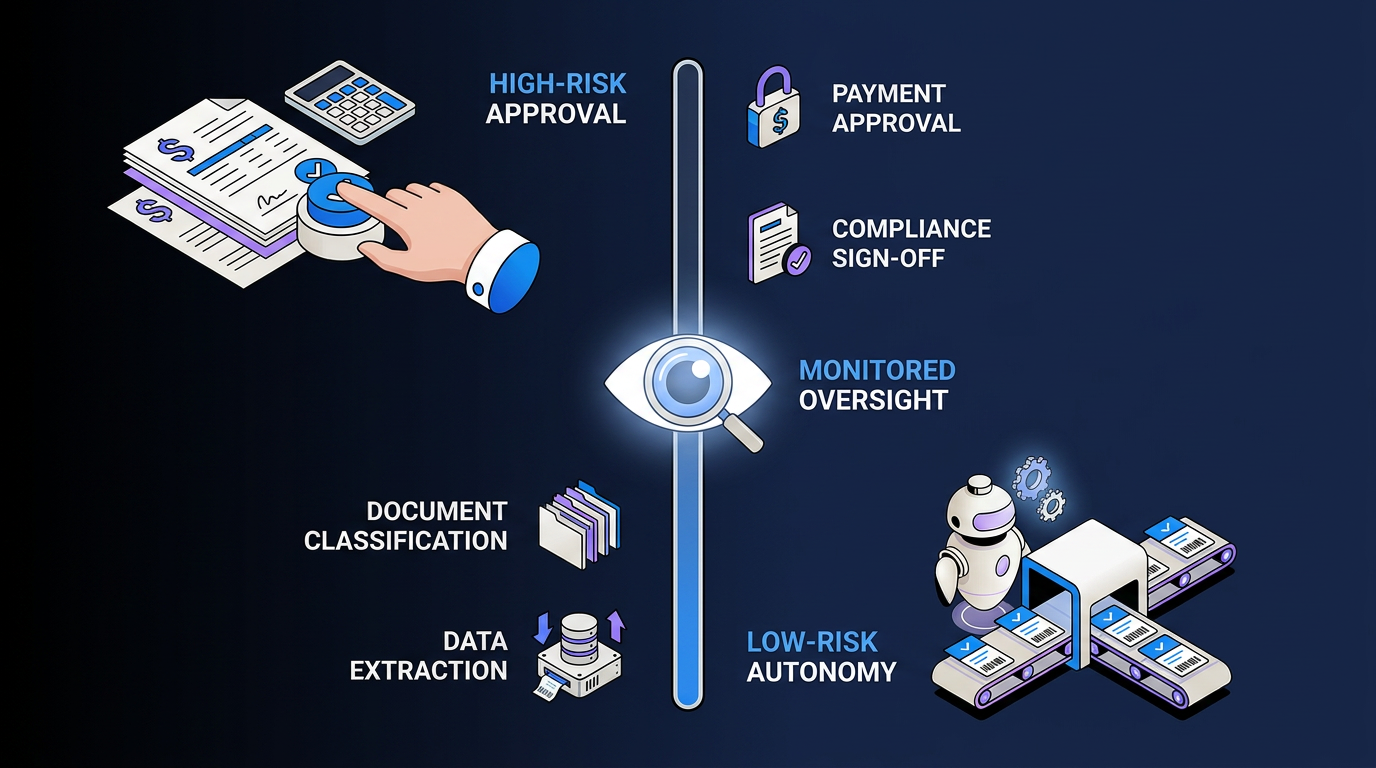
- Human-in-the-loop policies: Only a small minority of IT application leaders are considering fully autonomous agents. Enterprises' weight deployment toward human oversight, and the OWASP AI Agent Security Cheat Sheet recommends explicit tool authorization for sensitive operations and human-in-the-loop for high-risk actions. Configurable thresholds that determine when human review must occur are a practical safeguard. They are the mechanism that keeps a misconfigured agent from approving thousands of transactions before anyone notices.
- Audit trails: Compliance-ready logging must capture what every agent did, what data it accessed, what authorization decisions it made, and why. Auditors are paying close attention to how organizations manage compliance, security, and privacy risks across these systems.
Why Deterministic Workflows Anchor Agentic AI Deployment
To answer the architecture question, you need to understand a distinction many enterprise AI strategies skip.
Workflows orchestrate large language models (LLMs) and tools via fixed code paths, whereas agents allow LLMs to dynamically direct their own processes and tool use. That flexibility is valuable for tasks like reading unstructured documents or classifying ambiguous requests. It carries risk for tasks like approving payments or generating service-level agreement (SLA) commitments.
A common failure mode in agentic development is applying agentic approaches too broadly. The practical decision rule: deterministic logic usually handles functionalities without alternative interpretations better than agents do. Ticket ID generation should follow fixed logic. Ticket type should determine SLA values, not an LLM's interpretation.
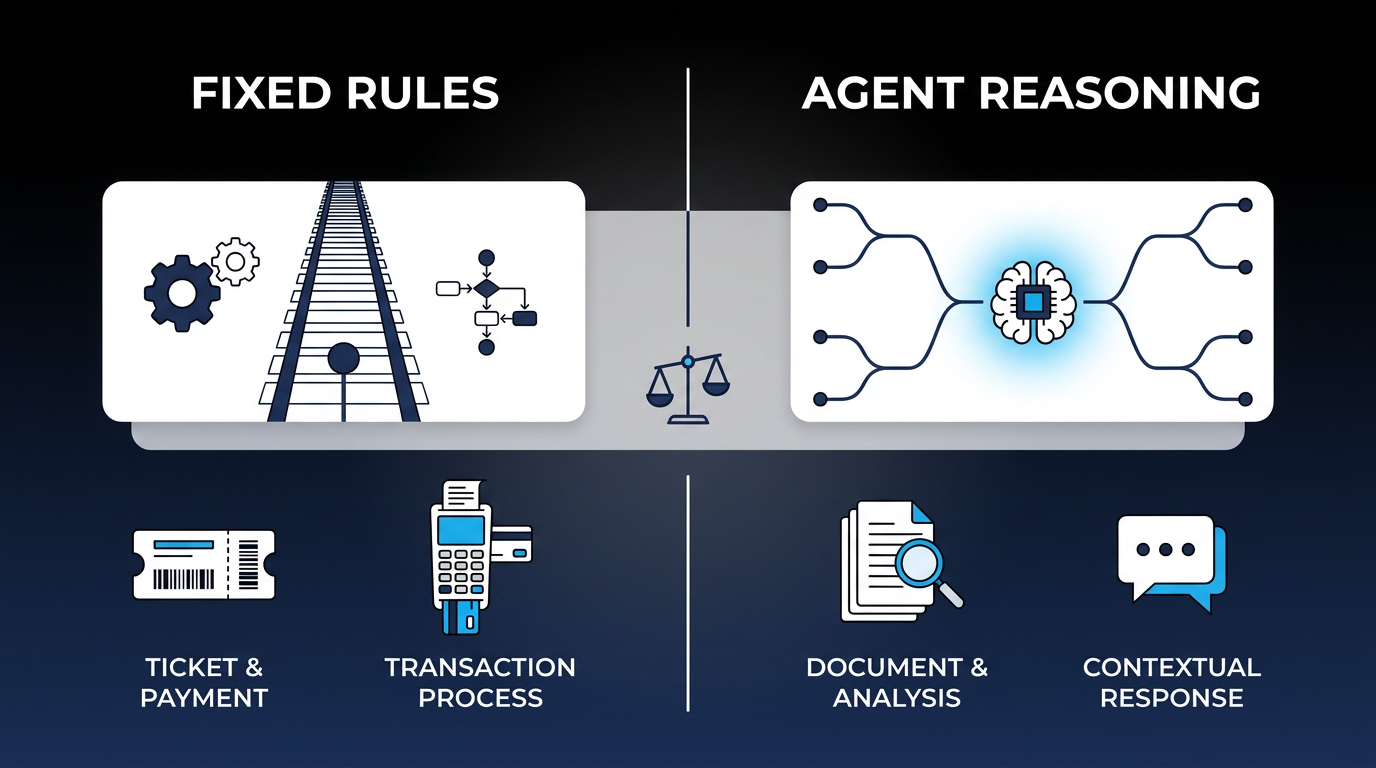
A useful deployment pattern uses deterministic orchestration for governance and places agent execution inside constrained workflow steps. We call this deterministic orchestration: a setup where every step is auditable and every decision is accountable. In practice, the simplest workable design is often the strongest, and not every workflow needs to be agentic. Deterministic platforms continue to run core process flows while AI provides reasoning or interpretation at specific steps.
Rules-based execution avoids inference cost and does not produce plausible-but-wrong answers. If unit tests can enumerate every valid output for every valid input, the problem likely does not require an LLM.
How to Deploy Agentic AI with Elementum at Enterprise Scale
The deployment challenge is less about whether enterprises will adopt agentic AI and more about whether the architecture can govern agents at scale and deliver ROI before the budget window closes. Every phase of deployment above depends on the same foundational capability: a deterministic workflow layer that coordinates humans, business rules, and AI agents as first-class participants in every process. We call this the Trident Model.
We built our AI Agent Orchestration platform for this architecture. Our Workflow Engine provides the deterministic backbone, and we apply AI agents only at steps that require reasoning, interpretation, or language understanding. Our AI agent management capabilities include configurable human-in-the-loop thresholds, confidence scoring, and full audit trails.
We map these to SOC 2 Type II, General Data Protection Regulation (GDPR), California Consumer Privacy Act (CCPA), Sarbanes-Oxley (SOX), and Health Insurance Portability and Accountability Act (HIPAA) compliance frameworks. We pre-integrate with OpenAI, Gemini, Anthropic, Amazon Bedrock, and Snowflake Cortex, so you can swap models without rebuilding workflow logic.
Data sovereignty runs through our patented Zero Persistence architecture: no training on customer data, no replication, and no warehousing. Our CloudLinks query your data in real time, where it already lives, in Snowflake, Databricks, BigQuery, or Redshift, without copying a single row outside your environment.
Production deployment depends on data readiness, governance maturity, and integration complexity. Implementation cycles often stretch when those foundations are weak.
Contact us to see how Elementum fits your AI strategy.
FAQs About How to Deploy Agentic AI
These are the questions IT and operations leaders most often raise when planning their first enterprise agentic AI deployment.
What's the biggest reason enterprise agentic AI deployments fail?
The biggest reason enterprise agentic AI deployments fail is that data architecture isn't ready. Most organizations acknowledge data quality problems, and only a small minority of enterprise AI initiatives appear to deliver demonstrable returns. Agents need searchable, reusable data to make autonomous decisions, and most enterprises haven't structured their data for that purpose.
How long should you expect agentic AI production deployment to take?
Production deployment timelines vary based on data readiness, governance maturity, and integration complexity. Cycles can stretch significantly when data integration and governance work are extensive.
How do you prevent agent sprawl in enterprise environments?
Preventing agent sprawl requires centralized orchestration, unique agent identities, and defined ownership for every agent. Gartner identifies six specific steps, including limiting agent access to only what's necessary, assigning accountability, and establishing lifecycle processes to retire redundant or outdated agents.
Should you build agentic AI in-house or buy a platform?
The build-versus-buy decision typically comes down to available AI engineering talent, governance requirements, and tolerance for vendor lock-in. In-house builds offer control but require scarce specialization. Vendor platforms can accelerate deployment, with trade-offs around flexibility and lock-in. Model-agnostic orchestration architectures help preserve flexibility regardless of which path you choose.
When should AI agents act autonomously versus require human approval?
The autonomy threshold depends on the consequence and recoverability of errors. High-volume, recoverable tasks are stronger candidates for autonomy than high-stakes, irreversible decisions. The OWASP AI Agent Security Cheat Sheet recommends human-in-the-loop controls for high-risk actions.
Keep Reading
The Enterprise Guide to Agentic AI for ITSM

Deterministic vs. Probabilistic AI: The Enterprise Guide to Building Workflows That Scale

What Is AI Agent Sprawl And How to Contain It

AI Guardrails: How to Govern What AI Agents Can Access, Decide, and Do

Human-in-the-Loop Agentic AI: How Enterprise Teams Deploy Agents Without Losing Control
How to Implement IT Process Automation for Enterprise Teams in 2026