
AI Governance Explained: Frameworks and Compliance Tips

Between the EU AI Act's August 2026 enforcement deadline and a growing wave of U.S. state AI laws, the cost of a weak AI governance strategy is rising quickly. Sixty-three percent of breached organizations either have no AI governance policy or are still building one, and 97% of AI breaches involved organizations that lacked proper AI access controls, according to IBM.
Production AI requires governance: it shapes how organizations control risk, document decisions, and keep systems within policy as they scale. This article breaks down the major frameworks, the compliance deadlines that carry real penalties, and the architectural decisions that separate governance programs that work from ones that exist only on paper.
What AI Governance Covers and Why It Differs From Data Governance
AI governance encompasses the policies, controls, risk management frameworks, monitoring capabilities, and accountability structures that govern how an organization deploys and operates AI systems. For Heads of AI and Chief Information Officers (CIOs), it spans five structural domains: which AI tools are sanctioned, how risks are identified and mitigated, how compliance is maintained across jurisdictions, how production AI systems are monitored, and who owns AI risk at every level.
There's a temptation to treat AI governance as an extension of existing data or IT governance programs, and that's a structural mistake. AI governance differs because new use cases can move into production quickly, AI agents can take autonomous action, and each deployment creates a separate regulatory and operational exposure.
Sixty-nine percent of organizations suspect or have evidence of employees using prohibited public GenAI tools, according to Gartner.
Weak governance structures can prevent enterprise AI teams from deploying models to production or demonstrating return on investment (ROI). Boards and executive teams rely on governance to protect AI investment and demonstrate value at scale.
The Three AI Governance Frameworks Enterprise Leaders Need
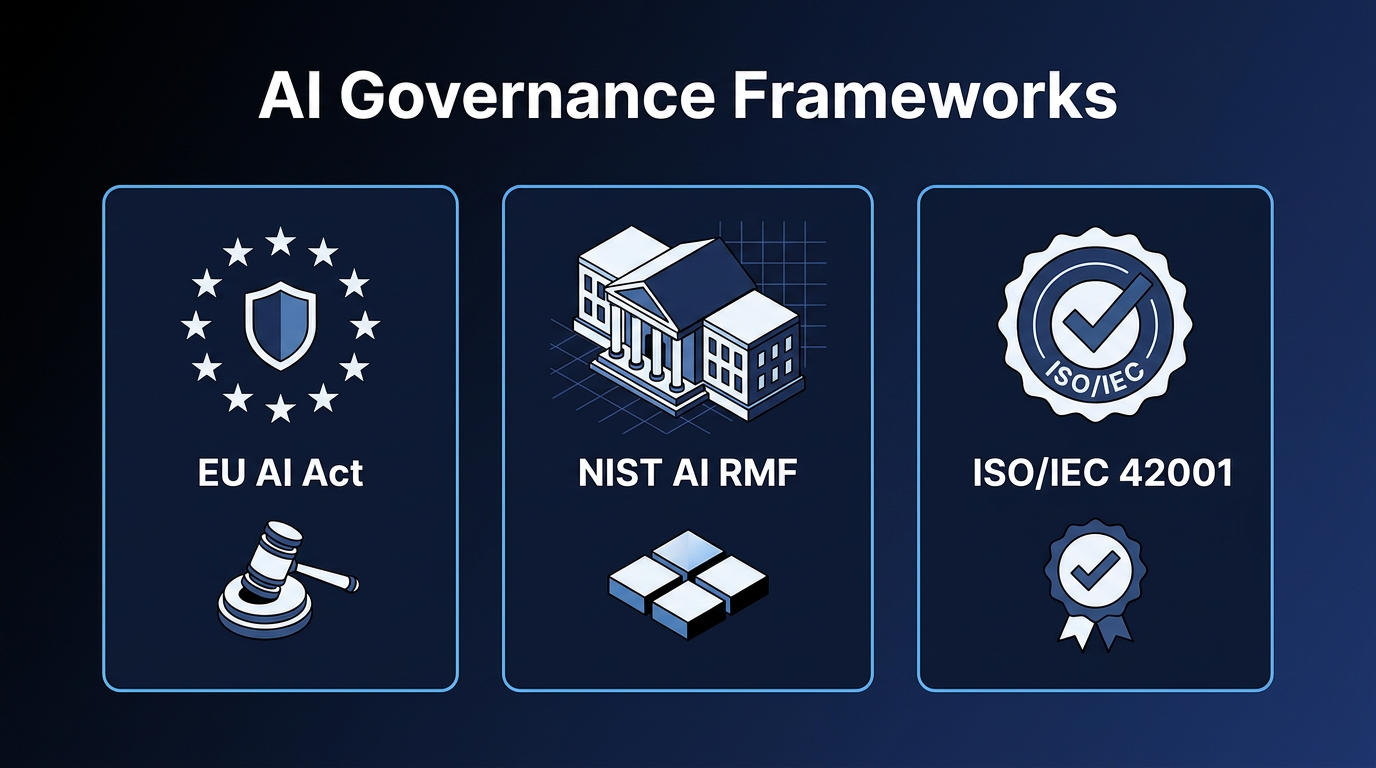
The EU AI Act, NIST AI RMF, and ISO 42001 are the three frameworks enterprise AI leaders most commonly encounter. Each serves a different purpose, and most organizations will need to align with more than one.
1. EU AI Act: Binding Regulation With Real Penalties
The EU AI Act timeline began on August 1, 2024, and applies progressively through 2027 across all 27 EU member states. It classifies AI systems into risk tiers: unacceptable, high-risk, limited-risk, and minimal-risk, with obligations scaled accordingly. Prohibited practices have been banned since February 2, 2025. GPAI model rules took effect in August 2025.
August 2, 2026, activates the remaining provisions, including Article 50 transparency rules and national enforcement. Operators of high-risk AI systems face obligations around risk management, technical documentation, human oversight, transparency, post-market monitoring, and recordkeeping.
Violations of prohibited AI practices carry fines up to €35 million or 7% of global annual revenue. High-risk AI violations can carry fines of up to €15 million or 3% of annual turnover, according to the EU AI Act. GDPR enforcement history shows EU regulators don't treat compliance as optional. Non-EU organizations whose AI systems are placed on the EU market, or whose outputs are used within the EU, may also need to comply.
2. NIST AI Risk Management Framework: The U.S. Enterprise Baseline
The NIST AI Risk Management Framework (AI RMF) is a voluntary framework organized around four core functions: Govern (policies and accountability), Map (risk identification), Measure (risk assessment), and Manage (risk response). U.S. federal agencies use it as a procurement reference, and it serves as an international enterprise governance baseline.
The Generative AI Profile identifies risks unique to GenAI: hallucination, data poisoning, and prompt injection. It proposes management actions for each. NIST IR 8596, released as a draft in December 2025, bridges the NIST Cybersecurity Framework 2.0 with the AI RMF. Security teams get a single reference point spanning both. The AI RMF Playbook is free and walks practitioners through suggested actions for each framework function.
3. ISO/IEC 42001: The Certifiable AI Management System
ISO/IEC 42001 is the first international AI management system standard, published in 2023. It specifies requirements for establishing and maintaining an Artificial Intelligence Management System (AIMS) using the Plan-Do-Check-Act methodology familiar from ISO 9001 and ISO 27001. ISO/IEC 42006, published in 2025, formalizes the third-party certification pathway.
Most enterprise AI teams start with the EU AI Act as their primary compliance benchmark, then layer in NIST for risk methodology and ISO 42001 for certification readiness.
Practical Compliance Tips for Enterprise AI Teams
Here are some practical tips to help you turn AI governance frameworks into an operational program.
Appoint a Single Governance Owner With Real Authority
The most common structural failure is diffuse accountability: committees with no single owner, or advisory roles with no authority to block a deployment.
- Assign one person to own the AI inventory, governance committee agenda, and exception process for unsanctioned tools
- Give this role authority to block deployments, not just advise on them
- Tie performance goals to organizational objectives, not advisory KPIs
Build a Centralized AI Inventory, Including Vendor-Embedded AI
You can't govern what you can't see.
- Catalog every SaaS application with AI features
- Tag each system by risk drivers: personal data, consequential decisions, and autonomous behavior
- Include AI embedded in third-party tools
- Treat this as an ongoing operational practice, not a one-time audit
Apply Risk Tiering So Governance Effort Matches Actual Risk
Not every AI tool requires the same scrutiny.
- High-risk systems need rigorous pre-deployment review, human-in-the-loop validation, and continuous monitoring
- Limited-risk tools need standard review with defined data handling controls
- Minimal-risk tools need light-touch monitoring only
The EU AI Act defines high risk through specific use cases rather than general tiers, but the proportionate governance principle holds across frameworks.
Define Human-in-the-Loop Policies With Explicit Trigger Criteria
Governance frameworks must specify when human review is required, how interventions occur, and how decisions are documented.
- For high-risk actions: AI suggests, humans decide
- For low-risk tasks: AI acts autonomously within defined escalation thresholds
- Regular checkpoints govern everything in between
Without configurable approval thresholds, a single misconfigured agent can approve transactions that would never clear a human reviewer, and do it thousands of times before anyone notices.
Deploy Continuous Monitoring, Not Point-in-Time Audits
Point-in-time reviews don't enforce policy while workflows execute.
- Continuous compliance checks, anomaly detection, and misuse prevention need to run as workflows execute, not after the fact
- Automated enforcement during execution closes the window between when a violation occurs and when anyone finds out
Treat AI Agents as Privileged Identities
Every AI agent needs a defined identity, a documented scope of access, and an assigned set of credentials.
- Apply the same provisioning and de-provisioning controls used for human privileged accounts in your IAM system
- Separating agent capabilities limits access and reduces the risk of agent sprawl, where one agent acts far beyond its intended scope

Govern Vendor AI Through Procurement
Auto-updates can change model behavior without notice, turning a sanctioned tool into an unreviewed one overnight.
- Add AI governance questionnaires to standard procurement
- Require contractual notification when vendors update AI models
- Classify vendor AI tools using the same risk tiers applied to internally built AI
Why Workflow Orchestration Is Becoming the Governance Enforcement Point
AI governance and workflow orchestration are converging because policy documentation at design time doesn't enforce behavior at runtime. If identity, permissions, data rules, and human approvals aren't controlled at the execution layer, there's no way to reconstruct how the system stayed within policy while work was running.
Audit trails, explainability, Role-Based Access Control (RBAC), and decision logging can't be easily retrofitted into an orchestration layer that wasn't designed for them, especially in regulated industries. Auditors and regulators need the same two things: evidence of why a decision was made and proof it stayed within policy.
Deterministic workflow components produce predictable, reconstructible outputs. Probabilistic AI components produce variable outputs; without governance controls, none of those outputs are auditable. When governance is built into architecture, teams route approvals, log actions, and enforce policy without retrofitting compliance after the fact. This is why AI governance belongs in architectural selection, not just post-deployment review.
How Elementum Strengthens AI Governance in Every Workflow
AI governance programs fail when governance exists as a separate layer from execution. Compliance violations, shadow AI, and audit failures share a common cause: policy that documents requirements without enforcing them at runtime. Most governance programs sit above execution as a separate layer, which means controls that look solid on paper don't fire when a workflow runs. Governance needs to be built into the orchestration layer itself.
Our Workflow Engine and AI Agent Orchestration capabilities treat humans, deterministic business rules, and AI agents as equals across all processes. We log every agent action, with configurable human-in-the-loop checkpoints for higher-risk or lower-confidence decisions. Confidence thresholds govern when agents act autonomously and when humans step in, and those thresholds can be adjusted at any time without rebuilding the workflow.
Our patented Zero Persistence architecture addresses data sovereignty requirements directly: we never train on your data, never replicate it, and never warehouse it. CloudLinks query data in real time where it already lives: Snowflake, Databricks, BigQuery, and Redshift. Row-level and column-level security policies control exactly what each agent can access.
Every automated decision produces a full audit trail, with built-in compliance support for GDPR, the California Consumer Privacy Act (CCPA), Sarbanes-Oxley (SOX), and the Health Insurance Portability and Accountability Act (HIPAA).
Pre-integration with OpenAI, Gemini, Anthropic, Amazon Bedrock, and Snowflake Cortex means no large language model (LLM) vendor lock-in. Our Workflow Engine enforces policy at every step, where work actually runs, not just at design time.
Contact us to see how Elementum fits your AI governance strategy.
FAQs on AI Governance
These are the questions IT and operations leaders most often raise when evaluating AI governance frameworks and compliance programs.
How Should You Distinguish AI Governance From AI Ethics?
Ethics defines principles. Governance defines the policies, controls, workflows, and accountability structures used to apply those principles in production. In practice, governance documents decisions, assigns ownership, and enforces controls.
Who Should Own AI Governance in Your Organization?
Cross-functional governance structures are the norm in enterprise organizations. Without a named owner, governance loses accountability. Enterprises build AI governance committees across IT, business, legal, and compliance, with a single accountable owner at the center.
Does AI Governance Apply If Your Team Uses AI Tools Rather Than Builds Them?
Yes, the EU AI Act covers deployers as well as providers. Large enterprise customers increasingly expect AI governance commitments in commercial agreements. Enterprise buyers evaluate governance commitments during diligence, whether you build or buy AI.
Does Investing in Dedicated AI Governance Tooling Make a Measurable Difference?
Organizations deploying AI governance tools are 3.4 times more likely to achieve high governance effectiveness, according to Gartner. Governance tooling now sits alongside security and observability as part of the infrastructure for enterprise AI programs.
How Do You Handle the Patchwork of U.S. State AI Laws?
U.S. state AI laws remain active in 2026 despite federal preemption efforts. Build a governance architecture that tracks jurisdictional changes rather than targeting compliance with any single regulation.\
Keep Reading

AI Guardrails: How to Govern What AI Agents Can Access, Decide, and Do

Human-in-the-Loop vs. Human-on-the-Loop: When to Use Each for Enterprise Workflows

How to Control and Monitor the Output of AI Agents

What Is AI Agent Sprawl And How to Contain It

Deterministic vs. Probabilistic AI: The Enterprise Guide to Building Workflows That Scale

The Enterprise Guide to Agentic AI for ITSM
\