
How Does CRM Automation Look in 2026?
Many customer relationship management (CRM) systems still rely on manual work: reps update records by hand, managers track pipeline numbers in spreadsheets, and operations teams stitch together approval chains across four systems. CRM automation is moving from static, rule-based workflows toward orchestration driven by artificial intelligence (AI) agents, but vendor ambition is outpacing production reality.
This article breaks down what CRM automation looks like in 2026, where the structural risks sit, and which architectural decisions separate organizations scaling AI in CRM from those still running pilots.
AI Agents Are Entering CRM Systems Faster Than Governance Can Keep Up
By the end of 2026, 40% of enterprise applications will include task-specific AI agents, up from less than 5% in 2025, according to Gartner. That is an eightfold increase in a single year. Major CRM vendors are embedding more autonomous capabilities into their platforms.
While 88% of firms use AI in some form, only 23% are scaling agentic AI, and roughly 39% are still experimenting, according to CIO. A significant share of agentic AI projects are at risk of cancellation due to escalating costs, unclear business value, and inadequate risk controls.
Most CRM AI projects can launch a pilot; few reach reliable production at scale, where the savings and capacity gains add up to real ROI. For operations leaders making CRM automation decisions, the question is whether your governance architecture, data quality, and orchestration layer are mature enough to move from pilot to production rather than stalling in between.
Trends Reshaping CRM Automation in 2026
Each trend below shifts the buying conversation. Taken as a group, they push CRM automation decisions upstream, from feature comparisons to architectural commitments that are hard to undo once agents go live.
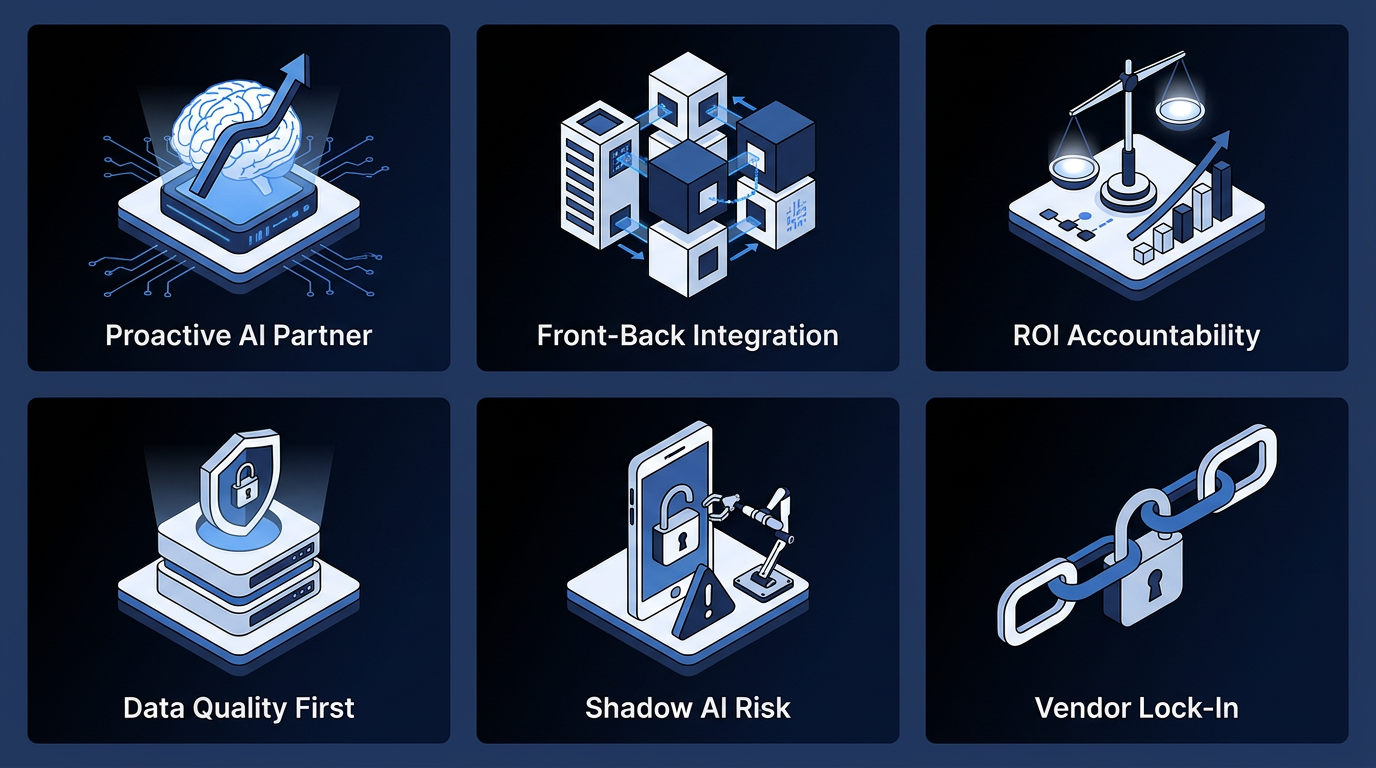
- From Record System to Proactive Partner: CRM systems are moving beyond passive data repositories. Agentic AI is reframing them as proactive partners. Predictive pipeline management, AI-generated deal risk signals, and continuous pipeline health checks are replacing subjective rep reporting with data-driven forecasting.
- Front-to-Back-Office Workflow Integration: Vendors are deepening integrations across CRM, enterprise resource planning (ERP), and workflow tools. Agents can now coordinate across front-, mid-, and back-office processes, where a sales close triggers automated order management, inventory checks, and revenue recognition without manual handoffs. Organizations that separate CRM and ERP automation often create broken handoffs that limit the value of cross-functional processes.
- The ROI Reckoning: The AI hype cycle is winding down in 2026, and pressure is building to deliver concrete results, according to Forrester. Enterprises will defer 25% of planned AI spend into 2027, and fewer than one-third of decision-makers can tie the value of AI to their organization's financial growth. CRM automation budgets are not exempt from this scrutiny.
- Data Quality as the Gating Factor: AI-powered CRM automation does not fix bad data; it scales it instead. Many organizations still lack AI-ready CRM data, and poor data quality remains a direct blocker to production deployment. Data readiness predicts AI deployment success, and organizations with successful AI initiatives invest more heavily in data and analytics foundations than those without.
- Shadow AI in Sales Teams: Shadow AI in CRM environments is risky because it touches live deal records, customer contacts, and pipeline forecasts. Forty-nine percent of employees use AI tools their employer hasn't sanctioned, and 58% of those users rely on free versions with minimal security, according to BlackFog research reported by ZDNet. When a sales rep feeds customer data into an ungoverned AI tool to draft a proposal, that creates a compliance exposure your security team cannot see.
- Vendor Lock-In Becomes Architectural: When AI agents are trained, configured, and governed inside a single vendor's environment, the cost of switching shifts from contractual to architectural. Migration becomes a rebuild problem. CRM vendor lock-in can become a technical, financial, and operational constraint on the evolution of AI.
Where CRM Automation Projects Actually Break Down
Common failure modes in CRM automation come from structural issues. Where projects break down is often the more useful question.
- Agent sprawl without visibility: Some companies end up with tens of thousands of agents and no way to track what exists or prevent duplication. Every major CRM system provides governance features within its own boundaries, but governance across platforms simultaneously remains unresolved. We have written more on agent sprawl and how it compounds at scale.
- Multi-turn context failure: Large language models (LLMs) often struggle with complex processes such as multi-step case resolution or sales negotiations because their outputs vary and errors compound across steps. Recent benchmark research shows that LLMs can perform substantially worse in multi-turn settings than in single-turn settings, with one study finding an average 39% drop in performance.
- Return on investment (ROI) measurement: Only 28% of AI use cases in infrastructure and operations achieve ROI expectations. Organizations with strong alignment among IT, business users, and leadership on which problems AI will solve are more than 3x as likely to report significant value from their AI tools. Measurement problems often follow earlier alignment problems.
In CRM, these failures damage pipeline accuracy, forecast credibility, and customer relationships before anyone traces the problem back to architecture.
The Architectural Decision: Deterministic Orchestration vs. Agent-First CRM Automation
Many CRM automation strategies underweight this decision, even though it often determines whether a project scales or stalls.
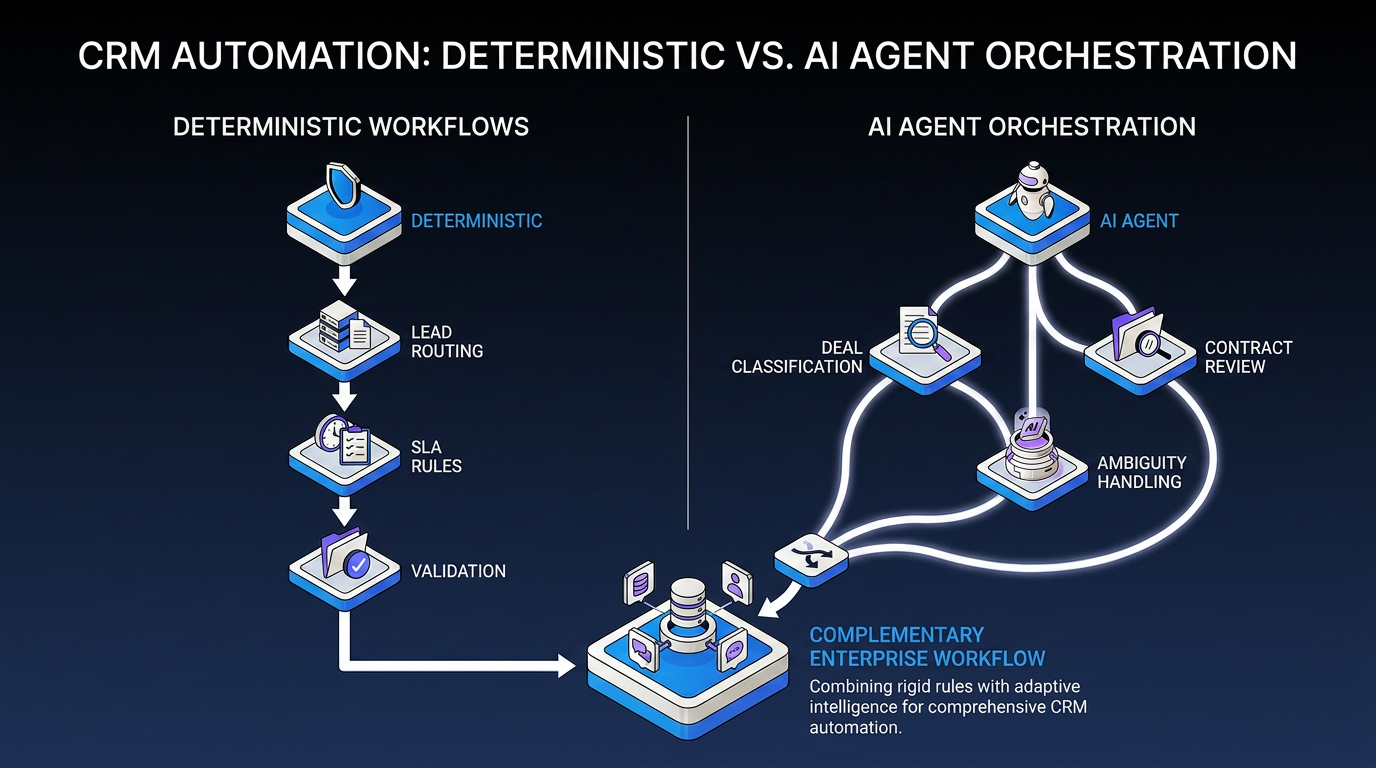
Any CRM automation at enterprise scale runs on deterministic orchestration: if X happens, do Y. The same input produces the same output every time. Every step is auditable, and every decision is accountable. AI agents take a different approach: they interpret a goal and decide how to achieve it, so the same input can produce different outputs depending on context. This is probabilistic behavior, where outcomes vary based on context and prior interactions. Both approaches come with clear strengths and trade-offs.
Deterministic workflows are auditable, predictable, and cost-effective for structured CRM tasks like lead routing, service-level agreement (SLA) enforcement, and data validation. They break down when applied to variable processes that require judgment, such as interpreting unstructured customer communications or qualifying complex deals.
Agent-first approaches handle ambiguity well but introduce reliability risks at scale. Agents are useful for reasoning and interpretation, but business processes still need consistency, auditability, and control. Governance overhead, integration work in existing systems, and evaluation requirements typically grow as teams move from proof of concept to production.
A common enterprise pattern uses a deterministic backbone to maintain process consistency and enforce policies, with AI agents handling specific steps requiring reasoning, classification, or interpretation. Start simple, then expand into more complex sub-flows only where real failure points justify it.
Deterministic automation remains central to reliability and compliance, while agentic AI adds reasoning where it is useful.
The split is clear in CRM: a contract approval process must follow the same routing rules and compliance checks every time. Within that process, an AI agent that reads the contract to flag non-standard terms or classify risk levels adds genuine value. The orchestration layer sets which steps stay deterministic and which are handled by an agent.
How Elementum Future-Proofs CRM Automation with AI Workflow Orchestration
The main takeaway from CRM automation in 2026 is that architecture matters more than feature breadth. Putting governance and orchestration first, then applying AI agents where they add real value, keeps routing, approvals, and audit trails consistent while using AI for interpretation where it is useful.
Our AI Agent Orchestration platform and AI Agents are built for that model. We treat humans, business rules, and AI agents as first-class participants in every workflow. Our Workflow Engine, Trident, is the deterministic backbone. AI agents handle steps that need reasoning or interpretation, such as document classification, contract analysis, or data extraction.
We integrate with leading CRM systems via native application programming interfaces (APIs) and connect to data platforms such as Snowflake and Databricks via CloudLinks. We come pre-integrated with OpenAI, Gemini, Anthropic, Amazon Bedrock, and Snowflake Cortex, so teams can swap or combine models without redesigning the workflow logic. Our patented Zero Persistence architecture addresses data sovereignty directly: we never train on your data, never replicate it, and never warehouse it. We're SOC 2 Type II, GDPR, and CCPA compliant, with full audit trails on every query and data access.
Our no-code Workflow Engine enables internal teams to extend and maintain workflows independently after initial setup, with human-in-the-loop checkpoints where judgment matters. Many enterprises start with a single workflow, see measurable results, and expand into adjacent processes once savings are documented.
Contact us to map workflow orchestration into your architecture and the rest of your AI roadmap.
FAQs About CRM Automation
These are the questions IT and operations leaders most often raise when evaluating CRM automation in 2026.
How Long Should Your CRM Automation Take If You Include AI Agent Configuration?
CRM automation that includes AI agent setup, testing, and governance configuration typically takes longer than traditional CRM deployments. Implementation timelines vary widely based on integration complexity, data readiness, and the number of systems involved. Most implementation guidance notes that AI features extend timelines, especially when governance frameworks and audit trails are established before agents go live.
What Is a Realistic ROI Timeline for Your CRM Automation?
ROI timelines vary widely by implementation quality. Vendor studies sometimes report short payback periods for targeted deployments, but most AI use cases in infrastructure and operations stall short of meeting ROI expectations. Defining concrete success criteria and aligning IT, business, and leadership teams before deployment are strong predictors of positive outcomes.
Who on Your Team Is Accountable If Your CRM AI Agent Makes a Decision That Harms a Customer Relationship?
Accountability is an open question in governance, and the industry hasn't settled on a playbook. Governance structures need to account for AI-generated actions and their downstream effects. Organizations need clear ownership models, configurable human-in-the-loop checkpoints, and audit trails before deploying autonomous agents in customer-facing CRM processes.
What CRM Data Quality Standards Should You Meet Before You Deploy AI-Powered Automation?
CRM data quality should be assessed and remediated before AI agent deployment begins. Many organizations are still working with incomplete, inaccurate, or AI-unready CRM data. When AI agents operate on poor CRM data, they can produce fast, wrong outputs that move through automated decision chains before anyone can review them.
How Can You Maintain Data Sovereignty When Your CRM AI Agents Process Data Across Multiple Regions?
Data sovereignty in multi-region CRM deployments depends on architectures that query data where it already lives, with no copies made across environments. Evaluate vendors on whether they store or replicate your CRM data during workflow execution, and confirm that real-time querying happens within your existing compliance boundary.
Keep Reading
How to Automate Procurement Workflows with AI Agents and Business Rules
7 Best AI Workflow Automation Tools in 2026

What is Business Process Automation? Enterprise Use Cases and Best Practices for 2026
Business Process Automation vs. AI-Driven Automation: Breaking Down the Differences
9 IT Process Automation Tools: Top Platforms for Automating IT Workflows
9 Leading AI Platforms for Automating Help Desks in 2026: Comparison & Buying Guide