
AI Governance Tools: How Enterprises Monitor and Control AI at Scale
Enterprise AI is moving from pilot to production, fast enough that formal governance can't keep pace. When approval chains, audit trails, and risk controls arrive after agents are already touching live systems, compliance exposure and budget overruns follow close behind.
Enterprises need every model call, agent action, approval, and audit trail inside a process they can control. The article covers what governance tools do, the risks driving adoption, why agents need governance separate from models, and how the workflow layer underneath determines whether governance holds up in production.
What AI Governance Tools Do
AI governance tools give enterprise teams oversight and compliance controls. They cover the full AI lifecycle, from use case intake through production and retirement. AI systems need clear owners, complete records, and defined ways to approve, stop, and review actions. They need a traceable answer when a regulator or customer asks how the system produced a specific outcome.
These tools do five main jobs:
- AI model and agent inventory: A single registry of every AI system, its use case, risk tier, owner, and applied controls. Teams cannot govern agents they do not know exist.
- Continuous monitoring and observability: Real-time tracking of every model call, including prompt, response, latency, token count, and errors. These controls help teams catch drift and abnormal behavior, including bias.
- Audit trails and compliance documentation: Logged records of every AI action, mapped to frameworks like the EU AI Act, NIST AI Risk Management Framework (AI RMF), ISO/IEC 42001, and the General Data Protection Regulation (GDPR).
- Access controls and identity management: Role-Based Access Control (RBAC), limits on who or what can access data, and data residency enforcement across every AI system.
- Runtime guardrails: Policy enforcement that limits what an AI system can access and decide, and that still applies when an agent behaves unpredictably.
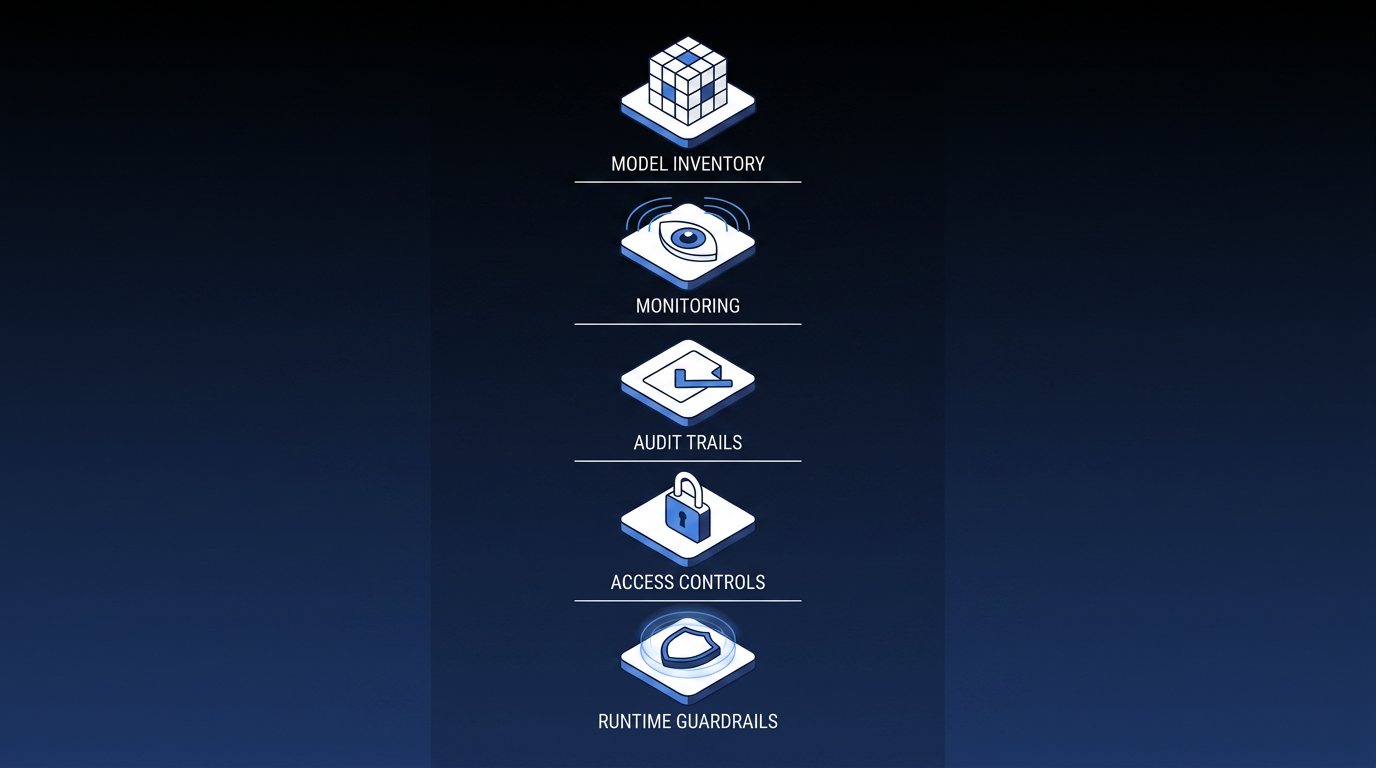
These controls only function as a working system when the tool connects to real AI systems and data flows, not just dashboards built after the fact. Global spending on AI governance platforms is set to reach $492 million in 2026 and surpass $1 billion by 2030, according to Gartner, as fragmented AI regulation expands to cover most of the world's economies.
The Risks Driving Governance Adoption
Enterprise AI governance responds to specific ways these systems break. Shadow AI and agent sprawl already move faster than many control frameworks. Prompt injection creates a further failure point that governance frameworks haven't caught up to.
Shadow AI is already operating inside your enterprise, whether IT knows it or not. Most employees now use AI tools at work, and a significant share use tools their employer hasn't approved, which puts that activity outside any governed logging path. Employees most often expose sensitive data in employee records, customer records, and internal documents. That exposure is harder to investigate when the AI use sits outside approved ownership paths, leaving a data-exposure event with no governed decision path and no audit trail.
Agent sprawl makes the identity problem worse. Gartner projects that 40% of enterprise applications will include integrated task-specific AI agents by 2026, up from less than 5% in 2025. Agent growth is outpacing many organizations' governance readiness. Each agent is a software identity with its own credentials and permissions for system access, so growth in agent count is really growth in an identity and audit problem tied to access.
Prompt injection ranks LLM01, the top risk in the Open Worldwide Application Security Project's (OWASP) Top 10 for large language model (LLM) applications. It uses natural language phrasing to manipulate AI behavior, and proper logging helps teams detect attempts to access sensitive data through it. When an agent has real permissions to act, a successful injection turns content manipulation into an authorization problem. That failure surfaces fast, often before anyone notices.
Left ungoverned, these risks become one of the reasons agentic AI projects lose funding. Gartner projects that more than 40% of agentic AI projects will be canceled by the end of 2027, citing escalating costs, inadequate risk controls, and unclear business value. Governance gives AI projects a better path to scale, because teams can prove ownership, permissions, approvals, and audit history before an incident forces a shutdown.
Why Agents Need Their Own Governance
Agents can act while models usually cannot. Traditional model governance often assumes a system scores, classifies, or recommends. Agentic AI can call tools and use credentials to trigger workflow steps in live production systems, so the governance model has to change with it. Treating an autonomous agent like a passive model leaves the highest-risk part of the AI estate ungoverned.
Teams can govern an AI assistant as an extension of the individual user. An AI agent needs governance as part of a team: visibility into the work it performs and the systems it touches. An AI operator that runs a business function needs controls across data access, workflow execution, approvals, and audit trails.
Governing agents at enterprise scale requires control across five areas: data access, workflow orchestration, identity and permissions, audit trails, and architectural flexibility. Teams need to control what agents can see, what steps they can run, what permissions they carry, what records they leave, and how those controls adapt as systems change. Each area maps to a real way things break. Weak identity controls can leave stale or overbroad permissions in place, which exposes connected enterprise systems.
Human reviewers catch policy misses that automated controls do not. In simulation testing, AI agents fail multi-step tasks nearly 70% of the time, often due to a lack of structured human oversight. For high-risk systems, the EU AI Act requires appropriate human oversight and logging. That oversight needs an action path that lets a human step in before an irreversible action happens. A framework that logs agent behavior but cannot stop an irreversible action only describes the process; it does not govern it.
As AI handles more workflow steps, the deterministic governance layer becomes more critical. Higher volume raises the stakes for every ungoverned decision: a misconfigured agent can approve transactions or trigger escalations repeatedly before anyone notices.
Governance Depends on the Architecture Underneath
A governance tool that watches AI is only as reliable as the process it watches. Probabilistic agents and deterministic workflows behave differently by design, and that difference decides whether governance holds up in finance and in regulated functions such as procurement or HR.
A deterministic workflow follows a fixed path: the same input follows the same governed path to the same result. An AI agent interprets a goal and decides how to reach it, so the same input can produce different outputs depending on context. That flexibility is valuable for reading a supplier contract. It is dangerous for a three-way match, where finance checks the purchase order and receipt against the invoice before payment.
Reliability issues compounds across chained steps: a workflow built on a series of probabilistic agent decisions has more ways to fail than one built on one built on deterministic orchestration with bounded probabilistic components. Multi-agent systems also fail when agents misunderstand each other during handoffs, and inter-agent interaction is a recurring source of breakdowns. Unpredictable failure is the wrong foundation for a payroll run or a regulatory report.
LLM outputs can vary in production even when prompts look identical, for reasons as mundane as rounding, parallel processing, or minor format changes. Downstream systems may treat those small changes as different inputs. Production teams can use deterministic workflows as the primary orchestrator, with AI agents handling specific reasoning steps inside governed boundaries. Payroll calculation and benefits rules stay deterministic, while agents coordinate onboarding tasks and answer policy questions. Requisitions become purchase orders, move through approval chains, and clear a three-way match before payment. The core process logic stays intact.
Agent control planes manage how agents are built and embedded into workflows under governance, separating build and workflow-embedding responsibilities from governance responsibilities. As agents spread across the build and orchestration layers, governance needs to sit outside both. That separation gives teams independent visibility and consistent policy enforcement, even when runtime environments behave unpredictably.
Sanofi, one of the world's leading biopharmaceutical companies, applies this governed approach to IT support. Its goal is autonomous resolution for up to 80% of employee IT requests, with agents operating inside deterministic escalation paths rather than running unchecked, according to Fortune reporting.
Map Governed AI Orchestration to Your Enterprise Architecture
Monitoring AI only after deployment catches problems late. Across many production AI systems, governance works best when it's built into how the process runs, not bolted on afterward. Enterprise IT leaders have to make that architecture choice before deployment, before more agents enter production and the window to get it right closes.
At Elementum, we treat humans and business rules alongside AI agents in a single deterministic Workflow Engine. Our AI Agents orchestrate any agent, third-party or native, with configurable decision thresholds for AI versus human judgment and built-in guardrails against prompt injection. We log every agent action and let teams revoke actions behind human-in-the-loop checkpoints.
This deterministic layer keeps processes stable: the same input, under the same governed conditions, produces the same result every time. Audit trails and governance controls support regulated Sarbanes-Oxley (SOX), Health Insurance Portability and Accountability Act (HIPAA), and GDPR environments. On data, our Zero Persistence architecture keeps data gravity with you. Your data stays where you control it: it's always yours, and we never train on, replicate, or warehouse your data.
We apply governed orchestration to software license management, procurement, provider onboarding, and IT support use cases across pharmaceutical and healthcare environments and in retail. Among orchestration platforms in this category, we have the production track record for replacing legacy SaaS at enterprise scale, with named customers including Sanofi, Snowflake, Under Armour, and Elevance Health.
Contact us to map governed AI orchestration into your enterprise architecture and the rest of your AI roadmap.
Frequently Asked Questions
Enterprise AI governance questions usually come down to control scope and agent accountability.
How should you compare AI governance and AI observability?
AI governance and AI observability differ in what they control: governance defines authorization and accountability for AI action under the applicable policy, while observability answers whether the system can be inspected after the fact. Governance controls permissions before action; observability records what happened afterward.
How should you compare AI governance tools with data governance and MLOps tools?
AI governance tools address risks specific to AI systems: model inventories, risk tiers, agent run logs, bias detection, and human oversight checkpoints. Data governance tools focus on data quality and access, and MLOps platforms focus on model deployment infrastructure. AI governance supplies the accountability and compliance layer outside both.
Should your team build or buy AI governance tooling?
Whether to build or buy AI governance tooling depends on portfolio size and risk profile. Enterprises with a small number of production models can often govern through extensions to existing GRC platforms. Those with larger portfolios or high-risk regulated systems generally need dedicated tooling, since integration and governance work can consume a meaningful share of a project's budget either way.
What regulations should you plan for?
Regulatory planning starts with the EU AI Act, a mandatory law that sets the legal floor for high-risk AI systems. For voluntary planning, the NIST AI RMF gives teams an operational framework, and ISO/IEC 42001 adds a certifiable management standard. Many enterprises use the legal requirements together with the risk-management and management-system pieces.
Why should you govern AI agents differently from AI models?
AI agents need separate governance from AI models because models typically score, classify, or recommend, while agents can take consequential actions in live systems. Agents carry non-human identities with real credentials and permissions, chain multi-step tasks where errors compound, and hand off work to other agents where context can get lost. That combination requires identity management and runtime revocability with human-in-the-loop checkpoints.
Keep Reading
AI Governance Framework: A Guide for Organizations
AI Governance Explained: Frameworks and Compliance Tips
Shadow AI Governance: How CIOs Find and Control Unsanctioned AI in the Enterprise
8 Best AI Tools for IT Support Ticket Triage
9 Best AI Orchestration Tools in 2026: Enterprise Evaluation Guide
7 Best AI Workflow Automation Tools in 2026