
AI Agent Orchestration Framework: How to Design & Scale Multi‑Agent Systems
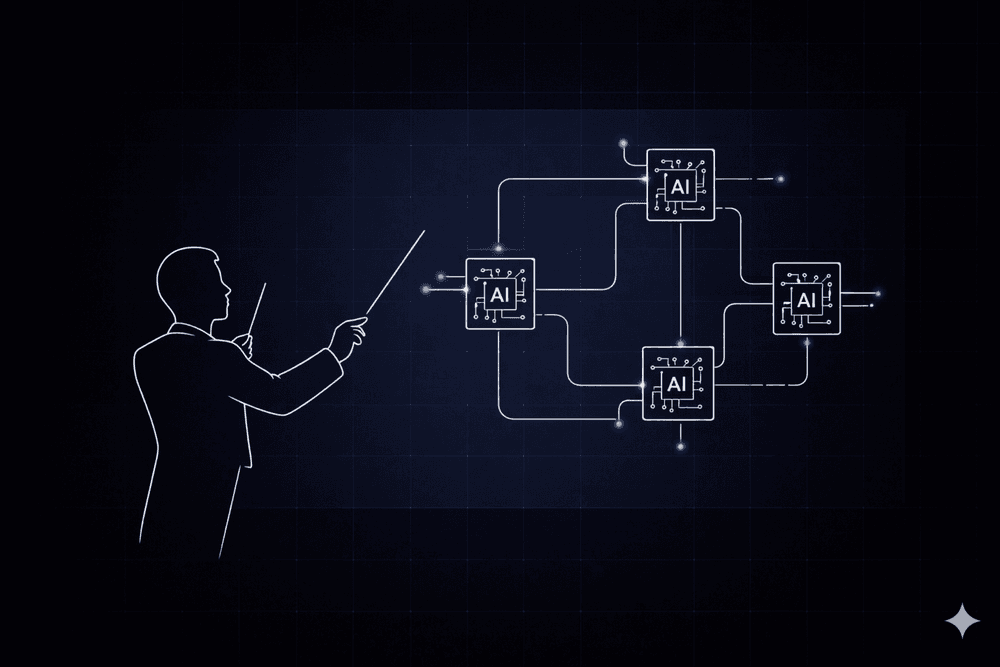
An agent demo can answer test requests. The same agent behaves differently when it runs a complex process repeatedly at enterprise volume under audit. Only 17% of organizations have deployed AI agents, while more than 60% expect to do so within the next two years. But according to Gartner, more than 40% of agentic AI projects will be canceled by the end of 2027.
The figures point to strong adoption intent and a high risk of project failure. An AI agent orchestration framework separates a working pilot from a production deployment by governing how agents, business rules, and humans work together. The architecture must withstand compounding errors and audit requirements at enterprise volume. It must also account for token costs, the usage charges for text a model processes and generates.
This article breaks down the orchestration patterns available, the practices that keep them reliable in production, and how Elementum applies deterministic guardrails to agents at scale.
What is an AI agent orchestration framework?
An AI agent orchestration framework coordinates multiple specialized AI agents. Together, they can complete multi-step work that no single agent handles reliably on its own. The framework manages execution flow, including state and inter-agent communication. It also decides which steps use fixed logic and which steps a model handles.
Traditional automation and AI agents use different decision models. Traditional automation follows explicit rules: if X happens, do Y.
An AI agent interprets a goal and decides how to achieve it. The same input can produce different outputs depending on context. That flexibility is valuable for reading a supplier contract or classifying an ambiguous request. It's dangerous for approving payments or filing regulatory reports.
The framework's job is to put each kind of logic where it belongs and keep a record of every decision along the way.
Choose the right orchestration layer
Vendor materials may use the word "orchestration" for three distinct layers, and buyers should verify which one a product actually provides. Each layer solves a different problem, and none of them substitutes for the other two:
- Agent frameworks: Developer toolkits that define how an individual agent reasons, remembers, and calls tools.
- Orchestration engines: Systems that run business processes from start to finish, coordinating agents with humans and the systems involved. Durable state survives interruptions, approval gates pause work for authorization, and transactional integrity keeps related operations complete and consistent. A purchase order or incident escalation follows the same governed path every run.
- Agent control planes: Layers that sit above execution and track agents, identities, costs, and system health rather than run business processes.
Buy a framework when you need an engine, and you will rebuild the process layer later. You will also rebuild every workflow already running on it. A production fleet may require both the engine and the control plane: one system executes durable processes while the other tracks identity, cost, and fleet health.
That split is the core of Elementum's recommended orchestration architecture. A framework alone gives you capable agents with nowhere governed to run.
Compare six orchestration patterns and their trade-offs
Six orchestration patterns cover the main design choices. The selection principle is simple: start with the simplest pattern that fits the problem, and add complexity only once the workload proves it's needed. A common failure is adding hierarchy or parallel execution before the workload requires it.
- Orchestrator-worker: A supervisor agent decomposes requests and delegates to specialists. This works well when designers can define task decomposition in advance, but the manager's plan can drift from the original intent across iterations. Backtracking, where the system revisits earlier steps, also burns unpredictable compute.
- Sequential pipeline: Agents run in a fixed linear order, each consuming the previous output. The execution order is deterministic and easy to trace, but agent outputs remain probabilistic. The pattern is weaker when a later step must revisit information processed earlier.
- Hierarchical: Layered orchestrators oversee domain agents, which handles multi-domain complexity. Hierarchy adds coordination overhead, though, because the routing model may need progressively more agent metadata as the roster expands.
- Concurrent fan-out: Independent subtasks run in parallel to cut latency. The trade-offs are higher token spend and synthesis logic that must reconcile conflicting outputs.
- Event-driven: Agents publish decisions as events on a streaming backbone, an infrastructure layer that moves events continuously between systems. Event boundaries can limit the spread of some failures when consumers isolate errors and support retries, and the event log preserves a replayable history of agent interactions.
- Deterministic workflow engine with embedded agents: The engine enforces structure and retries and maintains audit logs while agents handle interpretation inside it. Regulated processes generally favor this pattern because the process path stays reproducible even when individual steps involve a model.
Sometimes a single agent is the right design. It keeps tool execution together with its logic and context. This simplifies deployment and governance until tool count or task diversity forces a split.
Why multi-agent systems degrade as workloads grow
Multi-agent systems have recurring failure modes. System design and inter-agent misalignment can combine with task verification gaps. A working pilot can become a system that fails quietly in production.
Model quality alone does not eliminate these failures. A single-agent setup can be more reliable when the task does not require distributed specialization. Adding more agents does not automatically improve performance.
End-to-end success is the product of every step and every agent-to-agent handoff. Overall reliability can decline even when each individual step performs well on its own. The math compounds. Short pilots often hide this decline, while longer production workflows expose it.
Cost compounds too. Multi-agent coordination adds token overhead that teams should weigh against task value. Parallel execution can trade lower latency for greater token use. That adds up.
High-value tasks may justify the added complexity, but teams should check whether the cost makes sense for their workload.
Ungoverned agent sprawl steepens both the error and cost curves.
Embed AI agents in deterministic workflows
We recommend embedding probabilistic agents as bounded steps inside deterministic orchestration rather than building purely agentic systems. Deterministic steps handle predictable logic. Agents take over where reasoning or interpretation adds value. Keep it bound.
The surrounding workflow should expose each model decision for review and preserve it in the audit record. It should also allow execution to pause before consequential actions.
The economics support this architecture. A deterministic workflow executing a decision tree carries a low marginal cost per transaction; it never calls a model for a routine decision. An agent making repeated model calls adds inference, retry, context, and coordination costs on every run. At enterprise volume, that gap compounds: Elementum's internal analysis puts the cost differential between agent-only and orchestrated approaches as high as 20x for the same transaction.
Elementum treats human-in-the-loop controls as a continuous feedback loop built into the workflow. This design gives reviewers a defined point to correct uncertain decisions before consequential actions continue. Escalation can follow a configurable decision threshold. Workflows involving regulated or sensitive data can also go to a human. So can requests that don't match a known intent pattern. When a decision misses the threshold, the workflow routes that step to a human.
For example, an enterprise might set a hypothetical $500 approval threshold. An agent approves purchases under that amount autonomously. Purchases above it pass through an approval gate.
Apply practices that survive the move to production
Pattern choice sets the ceiling; operational discipline determines whether you reach it. Prioritize these five operational practices:
- Checkpoint every step: Write durable state per step so a crashed run resumes from its last checkpoint instead of restarting. Use idempotency keys, unique request identifiers that prevent a retry from creating duplicate writes. Retries stay safe.
- Keep guardrails deterministic: Enforce permissions with fixed, auditable policy checks rather than another large language model (LLM). Another model can introduce the same variability and prompt-injection risk as the model it supervises. In a prompt injection, malicious instructions manipulate model behavior.
- Instrument everything: Trace prompts and tool calls. Record each decision. Protect audit logs from the agents they monitor. Track output correctness in addition to infrastructure errors. A technically successful run can still produce an incorrect result.
- Require compatible protocols: Model Context Protocol (MCP) and Agent2Agent (A2A) now sit under Linux Foundation stewardship. When an architecture uses both tool connections and agent-to-agent communication, evaluate MCP and A2A support as a vendor selection criterion. Without the relevant protocol support, each new agent or tool risks becoming a custom integration that teams must maintain themselves.
- Gate releases with evaluation: Run regression suites against a golden set, a fixed collection of human-reviewed real queries and expected results. This catches model or prompt changes that degrade correct outputs even when the workflow still runs without infrastructure errors.
Omitting these controls creates specific risks: unsafe retries, undetected output errors, policy gaps, or custom integrations that teams must maintain.
How Elementum's orchestration framework runs in production
Choose your AI agent orchestration framework before agents proliferate. Ungoverned workflows often require rework when teams later add durable state and audit controls around approval gates. Retrofit costs compound the same way error rates do. Auditability comes first.
Elementum's AI Workflow Orchestration Platform runs on the deterministic-backbone pattern this article describes. We designed the Workflow Engine (Trident) to give humans and AI agents as equals with business rules inside deterministic workflows. The engine preserves the same governed process path and applies the same business rules every run. It does so even when an embedded model produces variable output.
Elementum's AI Agent Orchestration connects to any agent, third-party or native, and governs it within that same Workflow Engine. Pre-built integrations across multiple model providers reduce model-provider lock-in. Teams can switch among supported providers without a workflow rebuild. Configurable decision thresholds route uncertain decisions to humans.
Elementum logs every agent action and lets authorized operators revoke it. Human-in-the-loop checkpoints and full audit trails add governance. Elementum also has compliance controls for SOX, HIPAA, and GDPR.
Data handling runs on our Zero Persistence architecture. Your data is always yours. We never train on, replicate, or warehouse your data. We query data where it already lives, so your compliance boundary never moves. The boundary holds.
Sanofi is applying this same model to its own IT organization, targeting autonomous resolution of up to 80% of employee IT support requests and projecting roughly €10 million in annual savings from the automation alone.
Among orchestration platforms in this category, we have the production track record for replacing legacy SaaS at enterprise scale, with named customers including Sanofi, Snowflake, Under Armour, and Elevance Health. Many of our customers start with one workflow, prove the savings, and expand into adjacent processes.
Contact us to map workflow orchestration into your architecture and the rest of your AI roadmap.
FAQs about AI agent orchestration frameworks
These are the questions IT and platform leaders most often raise when evaluating an AI agent orchestration framework.
Why do you need an AI agent orchestration framework?
An AI agent orchestration framework coordinates multiple specialized AI agents, plus the humans and business rules around them, so multi-step processes complete reliably. Execution-flow management covers state and inter-agent communication. The framework also determines which steps use fixed logic and which steps a model handles.
Do you need an orchestration layer for AI agents?
Not always. A small agent using a limited toolset for a short task can run directly against a model application programming interface (API). At enterprise scale, though, organizations typically need orchestration for durable state, governed handoffs, and audit records for compliance. Without it, teams must build those handoffs and audit trails themselves for regimes like GDPR or HIPAA.
How should you distinguish an agent framework from a control plane?
An agent framework is a developer toolkit for building an individual agent's logic and tool use. A control plane governs the whole fleet instead: inventory, identity, cost, and observability. The orchestration engine sits between them, executing the actual business process that both layers support.
Which orchestration pattern should you start with?
Start with the simplest one that fits the problem. For regulated or audit-sensitive processes, start with a deterministic workflow engine and embed agents only at steps that genuinely require interpretation. Add fan-out or hierarchy once the workload proves it needs them.