
Orchestration vs. Automation: Why Enterprises Move Beyond Workflow Automation
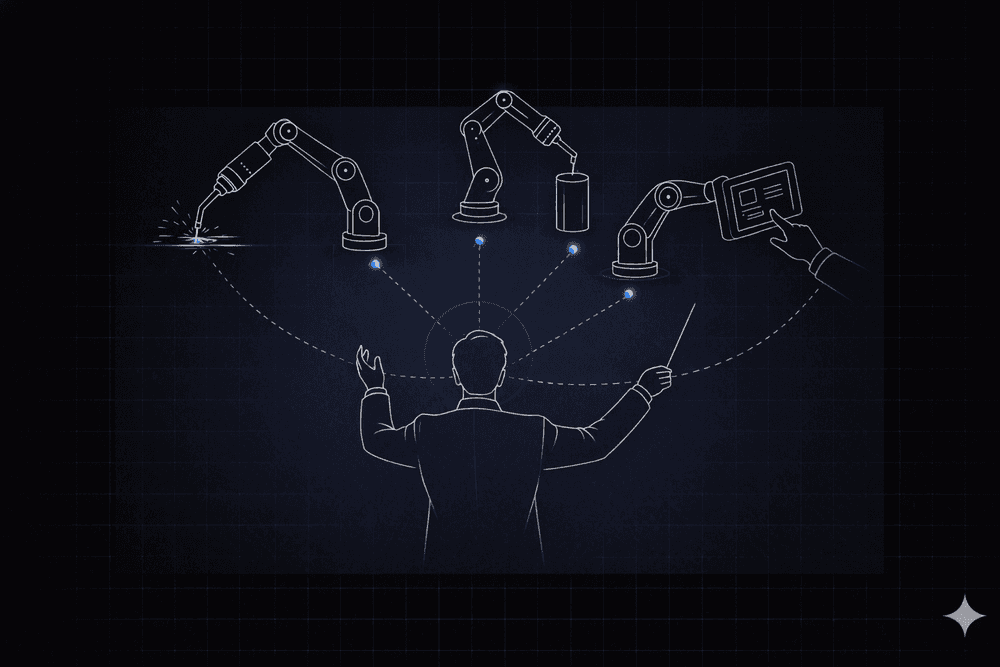
Your team has automated task after task. Invoice extraction runs cleanly, ticket routing works, and reports generate on schedule. The end-to-end process still crawls. Nothing coordinates the handoffs between those tasks. Nothing tracks their dependencies or shows where work stalls. The break sits between task automation and coordinated handoffs. That break separates automation from orchestration in real enterprises where many teams share the work.
That difference decides whether your automation program keeps paying off or turns into maintenance debt. The cost compounds. It also decides whether the AI agents you're deploying now repeat the scaling failures of the robotic process automation (RPA) era. This time, the components are probabilistic. They fail in ways bots never did.
Where Automation Ends and Orchestration Begins
Automation makes one task repeatable without human effort: if X happens, do Y. Every time. Orchestration coordinates automated tasks and the human decisions around them across systems into a complete end-to-end process. The orchestration layer sequences work. It tracks dependencies, handles exceptions, and monitors every system the process touches.
Payroll shows the boundary cleanly. Teams can automate a payroll calculation as an isolated formula. An orchestrated payroll process moves hours, eligibility, tax handling, payment, exception review, and reporting through one governed sequence.
RPA uses software scripts that emulate human interaction with application interfaces. That makes it useful for single points of friction, such as form-filling and copying values between screens. But it is rule-based and reactive. It carries no context of the larger process. In an insurance claim, a bot might copy claim data from an intake document. Orchestration owns the path from intake and review through exception handling, approval, and final payment.
RPA and integration platform as a service (iPaaS) fit inside an orchestration platform as component tools.
Why Workflow Automation Hits a Scaling Wall
Task-level automation programs stall for structural reasons: integration challenges, skills gaps, and shifting business processes all slow the work in different ways.
Brittleness creates the technical scaling problem. RPA can become brittle when automations depend on changing user interfaces. As automation programs grow, teams spend more effort tracing which automations touch which systems and identifying where changes may create breakage. In a small program, that's an inconvenience. In a large program, maintenance becomes hard to govern and expensive to maintain.
Tool sprawl keeps the process manual at its edges. Teams automate the sub-processes that are easy to reach. The process as a whole still depends on paper intake and inbox approvals. Exceptions still need phone calls. Without a strong governance plan, companies can accumulate redundant bots while the end-to-end automation that produces real savings remains out of reach.
AI Agents Are Repeating the RPA Pattern
Enterprises are adopting AI agents fast. Teams often deploy agents before shared logging is in place. Owners often haven't defined approval thresholds yet. Governance then lags adoption. Gartner also predicts widespread cancellations: over 40% of agentic AI projects will be canceled by the end of 2027, mostly early-stage experiments driven by hype, according to a Gartner prediction.
RPA and AI agents fail through different mechanics, but both hit the same scaling wall and carry more risk as use grows. A large language model (LLM) is probabilistic: the same input can produce different outputs. Each probabilistic step may depend on the previous one. Without validation, reliability can decay across the chain. Across long chains, even high per-step accuracy can produce low end-to-end completion rates. The math compounds.
Token consumption, the usage unit that drives much of LLM cost, can climb the same way. Agentic workflows can consume far more tokens than simple chat interactions. That risk rises when agents loop or call models repeatedly. An agent that loops on an underspecified goal can generate hundreds or thousands of LLM calls. A single misconfigured workflow can burn a budget for hours before anyone notices.
Ungoverned agents can multiply across teams the way unmanaged bots once did. When no shared system logs decisions and assigns ownership for thresholds, that pattern of AI agent sprawl turns every unlogged agent decision into an audit question you can't answer.
How Orchestration Right-Sizes Every Workflow Step
A deterministic control layer keeps error and cost from compounding unchecked. It decides, step by step, who does the work at each step. The same input follows the same path. Deterministic systems produce the same output from the same input, every run. That property makes a process auditable. Pure agent chains give that up.
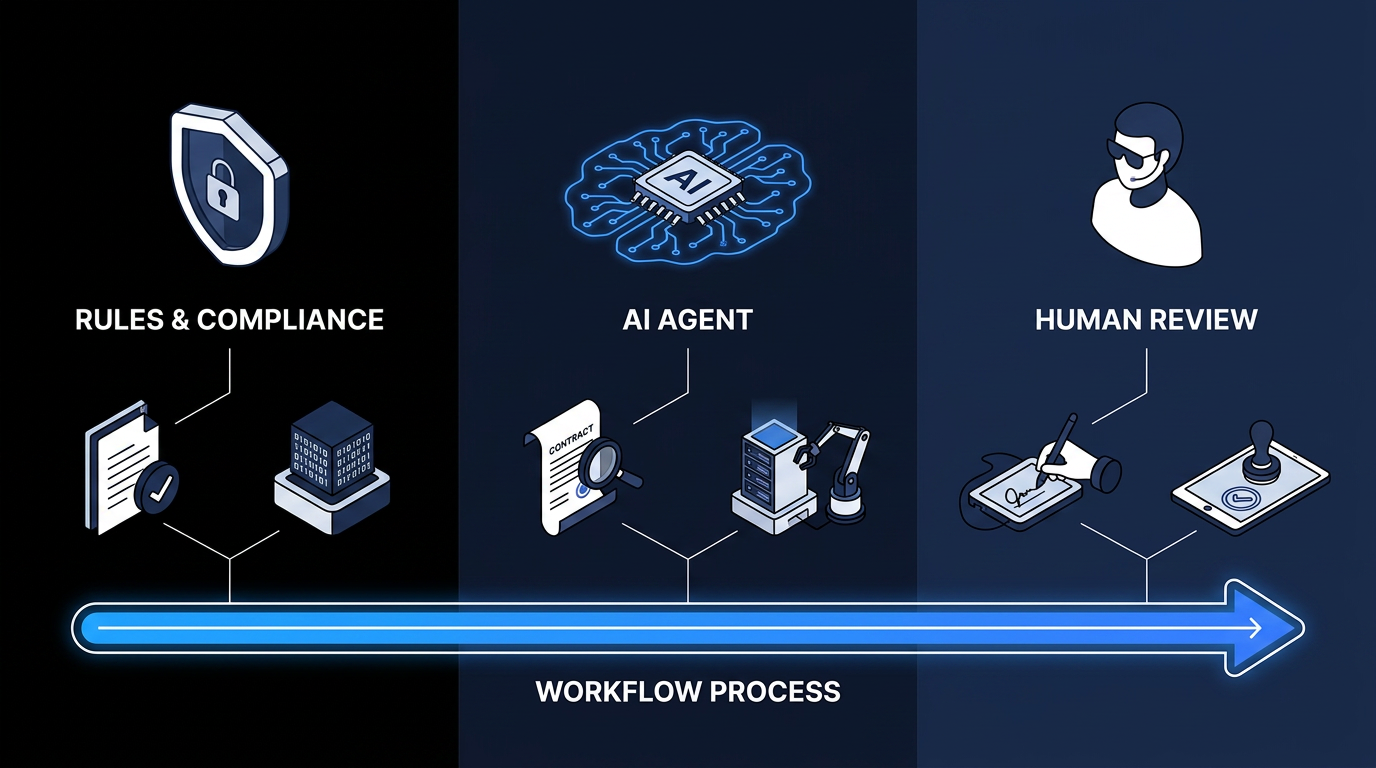
The deterministic vs. probabilistic decision assigns each workflow step according to the control it needs. Regulatory checks need predictability. Interpretation-heavy work needs judgment. Here's how that plays out in practice:
- Deterministic Rules: Regulatory and compliance checks, plus approval thresholds, wherever predictability is worth more than flexibility.
- AI Agents: Interpretation-heavy steps where rigid logic breaks down, such as reading a supplier contract or classifying unstructured documents.
- Humans: Judgment calls and high-stakes approvals, where accountability has to sit with a named person.
That is how teams scale without losing control. Early workflows often expose recurring exception patterns that looked ambiguous during design. Once production data makes those patterns clear, the right move is to encode them as deterministic rules. Agents stay focused on the remaining interpretation-heavy work. Maturity means getting more precise about where autonomy belongs.
Elementum builds on this architecture: our Workflow Engine treats AI Agents, humans, and business rules as equals in the same process. The deterministic backbone keeps workflow paths, rules, thresholds, routing, and audit trails consistent. Configurable decision thresholds route agent outputs to a human reviewer whenever an output doesn't meet the workflow's defined threshold.
Right-sizing each step means paying for reasoning only where reasoning is needed. Teams avoid spending agent-level compute on deterministic logic. Governance comes first.
What Enterprise Orchestration Looks Like at Sanofi
Sanofi needed orchestration across a global enterprise. Its Chief Digital Officer, Emmanuel Frenehard, was blunt about the disconnected vendor agents: Sanofi wanted one way to coordinate all of it. Sanofi chose agentic AI orchestration and built directly on its Snowflake data lake with Elementum.
The first production build, Concierge, is an internal AI assistant that Sanofi now uses broadly across its workforce. Elementum workflows and the Claude model family power it. Sanofi's target is for AI agents to autonomously resolve up to 80% of employee IT support requests, projected to save an estimated €10 million ($11.6 million) annually, according to Fortune's reporting.
Apply the Orchestration vs. Automation Distinction to Your AI Roadmap
For AI roadmaps, the orchestration vs. automation question is now a governance question. Every agent deployed without a deterministic control layer adds to the same maintenance and governance debt your organization already paid down once in the RPA era. The components this time are probabilistic, and errors compound across steps. Fix the architecture before the agent count grows. Before scale.
We built our AI Workflow Orchestration Platform to be that control layer. It's model-agnostic and pre-integrated with OpenAI, Gemini, Anthropic, Amazon Bedrock, and Snowflake Cortex, so teams can mix models within a single workflow instead of locking into one vendor.
We log every agent action for auditability. We apply SOX, HIPAA, and GDPR compliance controls to every workflow. Your data is always yours. We never train on, replicate, or warehouse your data.
Many of our customers start with one workflow, prove the savings, and expand into adjacent processes.
Among orchestration platforms in this category, we have the production track record for replacing legacy SaaS at enterprise scale, with named customers including Sanofi, Snowflake, Under Armour, and Elevance Health.
Contact us to map workflow orchestration into your architecture and the rest of your AI roadmap.
FAQs About Orchestration vs. Automation
These are the questions IT and operations leaders most often raise when they weigh orchestration against point automation.
How should you explain the difference between orchestration and automation?
Automation executes a single task without manual intervention. Orchestration coordinates automated tasks and the human decisions around them across systems into a complete end-to-end process. It adds dependency management and monitoring across every step. Automation is the building block; orchestration is the management layer above it.
Can your team use automation and orchestration together?
Yes, and most enterprise deployments run both. Automated tasks are the components an orchestration layer sequences, monitors, and governs. The orchestration layer adds what individual automations lack: exception handling and cross-system visibility, with a single audit trail for the full process.
When should you use automation vs. orchestration?
Use automation for repetitive work that can run in isolation. Move to orchestration when a process crosses systems and needs governed approvals or end-to-end audit visibility. Once handoffs and exceptions appear, task-level automation alone leaves the process ungoverned.
Should you treat hyperautomation as the same thing as orchestration?
Hyperautomation and orchestration are different. Hyperautomation is a strategy of using RPA, AI, low-code tools, and other technologies to automate as many processes as possible. Orchestration is the coordination layer that makes those technologies operate as one governed process.
Do AI agents replace your workflow orchestration layer?
AI agents increase the need for workflow orchestration. Agents are probabilistic components. Chaining them without a deterministic control layer means error rates compound across steps. Orchestration governs where agents operate, routes outputs that don't meet the defined threshold to a human reviewer, and keeps every agent action auditable.