
How to Create Audit Trails for AI Conversational Agents
Conversational-agent deployments become difficult to govern when teams cannot enforce runtime controls. They touch regulated data in free-form dialogue while they answer benefits questions or reset system access.
When an auditor asks why an agent took a specific action, application logs may prove that an API call happened. They may omit the policy decision behind it. That reason is missing.
Application logging and AI audit trails answer different questions: logs record technical events, while an audit trail records what the agent did, what inputs triggered it, what data it touched, and who authorized the action. Building one requires an architecture that records the evidence with defined fields and retention periods.
This blog walks through what a complete record needs, which regulations set the retention clock, and the architecture that produces a trustworthy trail as a byproduct of how the workflow runs.
Capture the Required AI Audit Trail Fields
The National Institute of Standards and Technology's Generative AI Profile (NIST AI 600-1) and the International Organization for Standardization's ISO/IEC 42001 require many of the same fields, and both go well beyond request-and-response logging. If no system records a field at decision time, reliable reconstruction later becomes unlikely.
NIST AI 600-1 directs teams to record where the data originated, how it was transformed, and the reasoning behind each decision. ISO/IEC 42001 Annex A.6.2.8 specifies core fields: the exact input, date and time, requesting user account, request origin, exact output, and model version used.
Tool-level records should show which tool the agent invoked, when, by which agent, and with what parameters and purpose. The OWASP AI Agent Security Cheat Sheet from the Open Worldwide Application Security Project calls for logging the authorization outcome and policy version for high-risk actions, where a policy version identifies the set of rules in force at that time.
A complete audit record for a conversational agent captures:
- Verbatim Input & Output: Record the exact prompt and exact completion (the model's generated response); summaries are insufficient
- Model Identity: Record the model's name and version, along with its parameters for every inference call (each request sent to a model)
- Tool & Function Calls: Record the name and result of each invocation, along with its parameters
- Data Access: The sources the agent retrieved or queried
- Identity Records: Record the person or service account that initiated the request separately from the agent identity
- Guardrail Results: Content filter verdicts and the policy checks that fired or didn't
- Human Oversight: Record approvals and any rejections or overrides, with the reviewer's identity
- Session Linkage: A conversation ID tying every step back to the originating request
OpenTelemetry is an open standard for collecting traces and logs. Its GenAI semantic conventions are the emerging standard for tracing agent behavior, defining standard field names and formats for telemetry data. By default they capture only metadata, so teams must explicitly opt in to prompt content and tool arguments. In v1.41.0, every GenAI convention document still carries Development status.
Map the Regulations Driving AI Audit Trail Obligations
Retention periods for conversational-agent records vary by regulation and record category. Designing for the wrong minimum may force teams to migrate logs they did not capture correctly.
Article 12 of the EU AI Act requires high-risk AI systems to enable automatic recording of events across the system's lifetime, by design rather than through manual reconstruction after the fact.
The Digital Omnibus amendment (Regulation (EU) 2026/1744), in force since July 27, 2026, deferred the main high-risk compliance obligations, including the logging articles, to December 2, 2027. Article 50 got no such deferral: since August 2, 2026, AI transparency obligations require systems interacting directly with people to disclose their AI nature. The AI Act also sets penalties of up to €15 million or 3% of global annual turnover for non-compliance.
Article 19 requires providers to retain automatically generated logs for a minimum period. Under Article 26(6), deployers must retain logs under their control for at least six months. Article 18 requires providers to keep technical documentation for ten years after market placement. United States sector rules add their own minimum retention periods:
- HIPAA §164.316(b)(2)(i): Organizations must retain Security Rule documentation for six years from creation or its last effective date
- The Sarbanes-Oxley Act (SOX) / SEC Rule 2-06: Firms must retain records relevant to an issuer audit, including electronic records, for seven years after the audit concludes
- SEC Rule 17a-4 / FINRA (Financial Industry Regulatory Authority): Firms must retain business communications for three to six years by category, with a complete time-stamped audit trail in non-rewriteable, non-erasable storage
Financial firms should assess generative AI chatbot communications under existing books-and-records rules, including prompts and outputs. Where logs contain personal data, GDPR processing-record requirements apply alongside sector-specific minimums, and retention policies must account for both.
Build an AI Audit Trail Step by Step
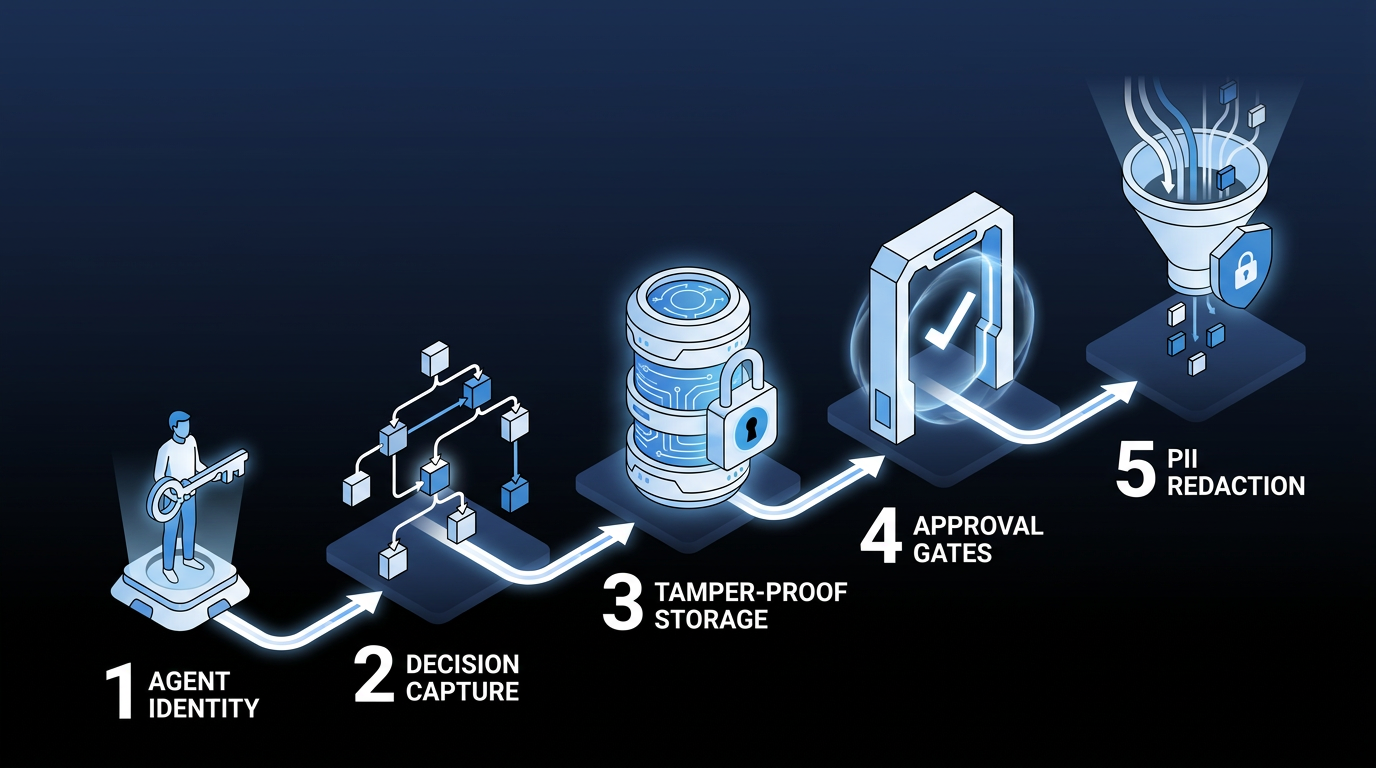
Deferring identity controls leaves records that teams cannot attribute to a person or agent, and no reconstruction can fix that after the fact. Start with identity, because every later record depends on knowing who or what took the action. Skipping this step now creates holes that later governance measures cannot repair as agentic AI matures.
- Assign Every Agent a Distinct Identity With a Named Human Owner
When agents act through shared service accounts, the audit record can't separate a person's actions from an agent's autonomous actions, and forensics then has no clear owner or next step. Give each agent its own credential with scoped permissions and time-bound access, paired with a human owner who can revoke its authority. As agent counts grow, this control also contains AI agent sprawl.
- Capture the Decision Record at Every Step
Record every field from the list above, and tie those fields together with a conversation ID so teams can trace one request across handoffs: one request, one trail. Keep the identity of the person who started the request through every multi-agent workflow handoff; otherwise, downstream actions may no longer be attributable to that person.
- Store the Trail in Tamper-Evident, Append-Only Storage
Regulators and auditors need evidence they can verify without trusting the operator. Properly configured write once, read many (WORM) storage in compliance mode blocks deletion during the required retention period, including deletion by root accounts. Hash-chaining log entries makes modifications detectable, because an altered record breaks the chain.
- Put Approval Gates in Front of Irreversible Actions, and Log Every Override
The orchestrator should enforce human-approval requirements; the model whose actions need control should not select them. Trigger human-in-the-loop review for irreversible deletions, external spend, customer-facing messages, and access to regulated data. Without an enforced approval gate, one misrouted or manipulated request can trigger an irreversible action before a reviewer sees it. Record the approval identifier alongside the agent's proposed action; that record proves who accepted the risk.
- Set Retention by Regulation, and Redact Once
A conversational deployment may log the same personally identifiable information (PII) across voice platforms, large language model (LLM) provider logs, application logs, and storage access logs. Redact or tokenize it at the earliest capture point rather than configuring redaction separately in every downstream system. Log which entity types the system detected and which actions it took, so teams can audit the redaction itself.
These controls produce attributable, tamper-evident records. Reconstruction still depends on the architecture underneath.
Why Deterministic Orchestration Is the Audit Foundation
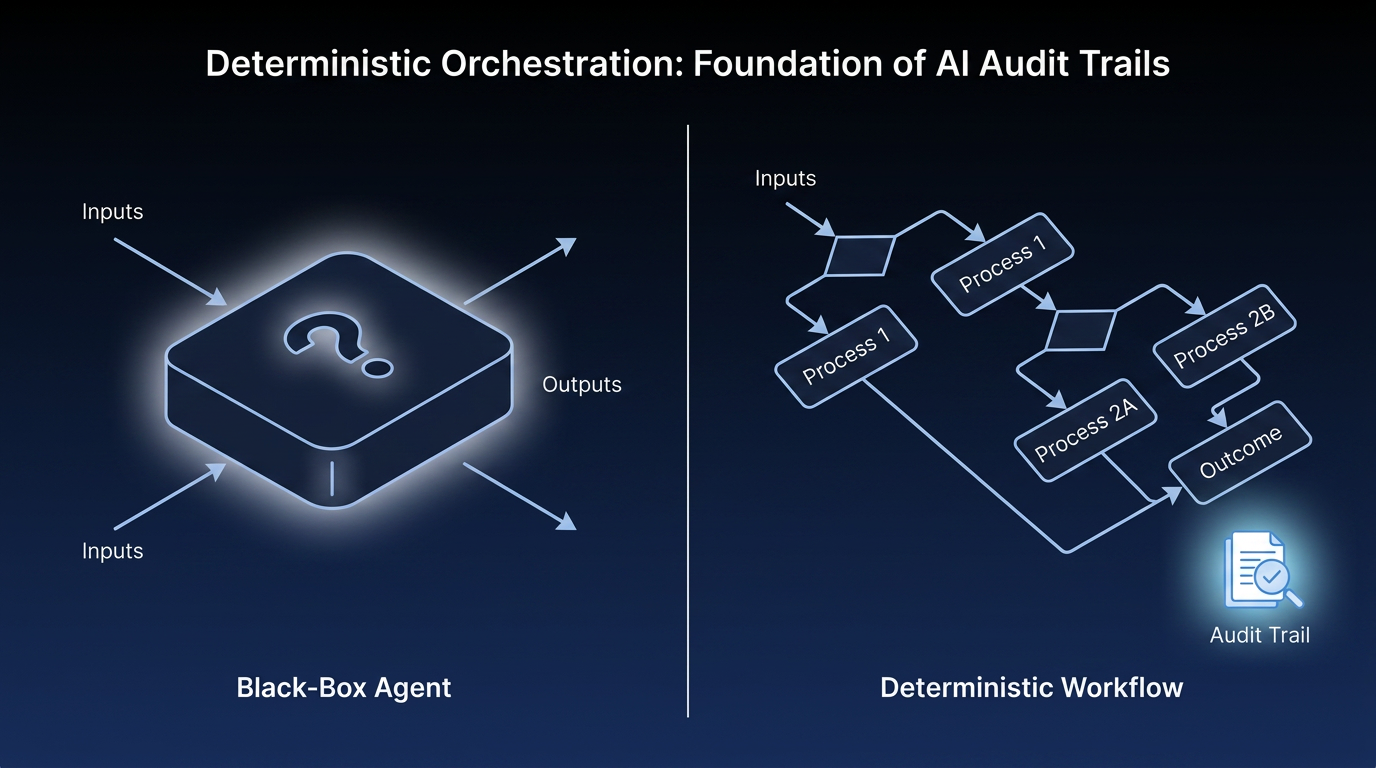
Large language models (LLMs) can exhibit behavioral non-determinism in agents: the same prompt may produce a different action path on different runs, which weakens the traceability and accountability an audit must establish.
Even complete input-and-output logs from a black-box agent (an agent whose internal decisions are not exposed) may omit the intermediate logic that produced an action. Usable evidence comes from architecture that emits it at the moment of decision.
Deterministic orchestration leaves model variability intact while making the surrounding workflow decisions explicit and recordable. When teams instrument deterministic workflows, the trail can record each fixed branch and the associated approval or access decision. Probabilistic outputs still require separate records of model inputs, outputs, versions, and guardrail results.
The pattern separates the deterministic and probabilistic parts of a conversational process, which is central to AI governance. A deterministic workflow governs sequence, approvals, and data access, while agents handle interpretation and language inside bounded steps. When a regulator asks why the system took an action, the trail can identify the rule that controlled a specific step, and it can show the recorded context for any model output without claiming to expose the LLM's complete internal reasoning.
Elementum’s AI Agents operate within deterministic workflows. For example, a deterministic step can check the caller's entitlement to a record and write that check to the trail before an agent phrases the answer. The record can name the rule that gated the step, the identity that cleared it, and the agent that produced the language.
How Elementum Builds AI Audit Trails by Design
Auditors can verify the structured evidence the workflow emits at each step. Logging added outside a black-box agent may capture the API call while missing internal policy and tool decisions.
The deferred high-risk deadline gives teams time to build. Retrofitting a trail under enforcement pressure may require teams to rework production workflows.
Elementum’s AI Workflow Orchestration Platform builds auditability into enterprise agent management. Our Workflow Engine orchestrates third-party and native AI agents inside deterministic workflows. We log every agent action and let authorized operators revoke it. We also provide full audit trails and human-in-the-loop checkpoints for high-stakes decisions.
A decision threshold is a configured rule that determines whether AI acts autonomously or routes an action to a person. Agent actions stay revocable at human-in-the-loop checkpoints.
CloudLinks query data in real time where it already lives inside Snowflake, BigQuery, Databricks, and Redshift, under our Zero Persistence architecture. Your data is always yours: we never train on, replicate, or warehouse your data.
Choosing how to prove what a conversational agent did comes down to whether the architecture records the decision, not just the API call. Our AI Agents combine logged, revocable actions with human-in-the-loop review at critical decision thresholds, inside a workflow that produces the audit trail as a byproduct of running the process rather than as a layer bolted on afterward.
Many of our customers start with one workflow, prove the audit trail holds up under review, and expand into adjacent processes. Among orchestration platforms in this category, we have the production track record for replacing legacy SaaS at enterprise scale, with named customers including Sanofi, Snowflake, Under Armour, and Elevance Health.
Contact us to map governed AI orchestration into your enterprise architecture and the rest of your AI roadmap.
FAQs About AI Audit Trails
These are the questions compliance and platform teams most often raise when they start building an AI audit trail.
What is an AI audit trail?
An AI audit trail is a chronological, tamper-evident record that connects governance decisions with the actions and outputs an AI system produces. It shows what happened, what inputs triggered it, why it happened, and who authorized it. System logs answer what the software executed; an audit trail answers who authorized an action and under which policy version, at the agent, tool-call, and inference level.
How long should organizations retain AI conversation logs?
Retention periods for AI conversation logs depend on the governing regulation and record category. Operational logs, technical documentation, healthcare records, and audit-related records each carry different minimums, so map each category to its applicable minimum, maximum, deletion, and legal-hold requirement.
Can AI chat logs be discovered in litigation?
AI chat logs can be discovered in litigation. Organizations should treat them as electronically stored information that may become relevant in litigation or regulatory inquiries, extend litigation holds (legal instructions to preserve relevant records) explicitly to AI prompts and outputs when counsel determines they're in scope, and coordinate retention policy across IT, legal, and compliance.
What distinguishes AI observability from an AI audit trail?
AI observability and an AI audit trail serve different purposes. Observability monitors model behavior in real time, including latency, drift, token usage, and cost, helping engineering teams fix problems before users notice. An audit trail produces durable, tamper-evident evidence of past behavior that regulators, customers, and auditors can verify without trusting the operator, and observability tooling alone rarely produces that auditor-grade evidence with human-approval records and integrity verification.
Keep Reading
How to Create Audit Trails for AI Conversational Agents
What Are the Types of AI Agents and When Does Each One Belong in Your Workflow?

When to Use AI Agents: The Enterprise Decision Guide

How to Control and Monitor the Output of AI Agents
AI Agents vs Chatbots: What Are the Key Differences?
How to Deploy Agentic AI: A Guide for Enterprises